
Joy Foroughi
Executive Assistant


Two Month Launch Advantage for Founders With Senior Mobile Developers
Senior mobile developers give founders decisive technical ownership: they make architecture calls that hold up under growth, ship on predictable timelines, and prevent the kind of costly rework that drains a startup's runway. The payoff shows up in fewer support incidents, faster time-to-market, and code that survives contact with real users. For founders weighing team composition, that ownership is the difference between a product that scales and one that needs to be rebuilt at year two.

Senior mobile developers give founders decisive technical ownership: they make architecture calls that hold up under growth, ship on predictable timelines, and prevent the kind of costly rework that drains a startup's runway. The payoff shows up in fewer support incidents, faster time-to-market, and code that survives contact with real users. For founders weighing team composition, that ownership is the difference between a product that scales and one that needs to be rebuilt at year two.
TL;DR:
Senior developers make architecture choices that support long-term scalability and align with business goals, reducing costly future rework.
They implement rigorous code review, automated testing, and strategic decision-making to minimize technical debt and reduce post-launch bugs.
Hiring a senior developer often costs more initially but can decrease total project hours needed by reducing rework and improving decision quality.
Ideal candidates demonstrate deep platform experience, process discipline, and provide clear examples of handling failure, not just buzzword familiarity.
Bringing senior developers on before the initial architecture is set can reduce expensive rework and technical pitfalls, supporting long-term app stability and growth.
1. Concrete benefits founders can expect from senior developers
Every founder asking whether senior talent is worth the premium is really asking one question: will this person make fewer expensive mistakes than someone earlier in their career? The potential benefits depend on the developer’s experience, the team’s processes, and the complexity of the product, and can show up in specific, measurable ways.
Technical ownership: Senior developers choose architecture patterns based on where your product is going, not just what compiles today, so decisions align with business goals instead of short-term convenience.
Decision velocity: Fewer escalations and less back-and-forth mean features move from spec to shipped faster, with fewer full rewrites along the way.
Release quality: Stronger testing habits and security awareness translate into fewer critical bugs reaching production.
Product judgment: Engineers who understand user behavior push back on features that look good in a deck but create friction in the app, which protects conversion rates.
Mentorship: A senior developer raises the skill level of everyone around them, turning a junior-heavy team into a self-sufficient one over time.
Maintainable code: Patterns built to scale reduce the size and cost of every future refactor.
The Occupational Outlook Handbook from the U.S. Bureau of Labor Statistics describes the developer role as spanning design, testing, maintenance, and security, work that demands judgment across the full product lifecycle rather than narrow task execution. That breadth helps explain why lifecycle experience matters when hiring; the BLS description does not compare outcomes for senior and junior developers.
Pro Tip: Ask any senior candidate to walk you through one decision they'd reverse if they could. Their answer tells you more about judgment than any resume line.
Mentorship deserves particular attention because founders often underweight it. A senior developer who documents decisions, reviews code with intent, and explains the "why" behind a pattern is quietly building your team's future capacity. That knowledge transfer means you are not permanently dependent on one person's memory to keep the app running, which matters the moment that person moves on or takes vacation.
2. Risk, technical debt, and long-term maintenance explained for founders
Rushed code does not disappear, it accumulates. A shortcut taken to hit a launch date becomes a support ticket six months later, then a full afternoon of debugging, then a rewrite nobody budgeted for. This is technical debt, and it compounds the same way financial debt does: the longer it sits, the more it costs to unwind.
Senior developers limit this in predictable ways:
Code review standards that catch fragile patterns before they ship, not after a user reports a crash.
Architecture decisions made early, so the app's data flow and module boundaries do not require a rebuild every time a new feature is added.
Automated testing that catches regressions before they reach production instead of after a user complains.
CI/CD pipelines that make releases routine instead of stressful, reducing the odds of a bad deploy.
Not every shortcut is a mistake. Founders should apply a simple test: if fixing it now costs less than the support and reputation cost of leaving it, fix it. If the shortcut is isolated and unlikely to be touched again soon, it can usually wait. This kind of triage is a core senior skill, and it is covered in more depth in our piece on when to refactor, rewrite, or leave technical debt alone.
Post-launch, the difference shows up in your support queue. Apps built on rushed foundations can generate a steady stream of edge-case bugs; experienced oversight, testing, and monitoring can help apps stabilize after launch, freeing budget for growth work instead of firefighting.
3. Cost versus ROI: when seniors save you money
A senior developer costs more per hour than a junior one. Over the life of a project, reduced rework can offset that higher hourly rate.
Junior-dominant teams can cost less upfront, but without experienced oversight they may require more rework and QA cycles, which can reduce the initial savings or delay launch.
Mixed teams can work well when a senior leads architecture and review while others execute, but only if that senior has real authority over decisions.
Senior-led teams may cost more per hour but can need fewer hours overall when experienced decision-making prevents avoidable mistakes.
The real ROI drivers are reduced rework, fewer post-launch support incidents, and hitting a market window before a competitor does. A two-month head start on launch can matter more to a startup's survival than a lower hourly rate ever will.
As a rule of thumb: hire seniors full-time when the product is your core business and will run for years. Use staff augmentation when you need a specific skill gap filled fast. Choose a senior-led agency when you need the full team, the architecture, and the accountability bundled together, particularly for an MVP launch or a platform rework where mistakes are expensive to unwind.
4. What to look for when you hire senior mobile developers
Seniority is not a title, it is a pattern of behavior you can test for directly.
Architecture depth: Can they explain how they'd structure the app for a 10x increase in users, not just today's load?
Platform fluency: Real experience across iOS, Android, or cross-platform frameworks like Flutter or React Native, not just familiarity.
Process discipline: Comfort with CI/CD, observability tooling, and security basics as a normal part of the job, not an afterthought.
Shipped proof: Products they've launched, ownership of specific decisions, and people who can vouch for their work.
Pro Tip: In interviews, ask about a project that failed and what they changed afterward. Founders learn more from how a candidate handles failure than from a clean success story.
Watch for red flags: heavy reliance on buzzwords without concrete examples, an inability to explain why they chose one trade-off over another, or no mentoring stories at all. A senior developer who has never helped someone else grow has likely never had to defend their own decisions out loud, which is a skill you want on your team.
5. How a senior-led approach works in practice
Direct access to senior developers changes the shape of a project. When a founder can talk to the person actually writing the code, instead of routing every question through an account manager, feedback loops shrink and accountability sharpens. Nobody can quietly reassign the hard problem to someone junior.
This direct-access model, with senior developers and designers engaged from kickoff through launch, is a key approach for some mobile app development teams.
Shorter feedback loops: Questions get answered by the person who understands the code, not relayed through a middle layer.
Post-launch support: Apps keep evolving instead of stalling the moment the initial contract ends.
Accountability: One team owns the decision and the outcome, from architecture through App Store submission.
6. How senior developers interact with AI tools
AI coding assistants have changed how mobile apps get built, but not in the way some founders assume. According to Stack Overflow's 2025 Developer Survey, developers using AI agents reported productivity benefits, while adoption of agents remained far from universal. The same survey highlights declining trust in AI output and finds that most respondents do not use "vibe coding" as part of their professional work.
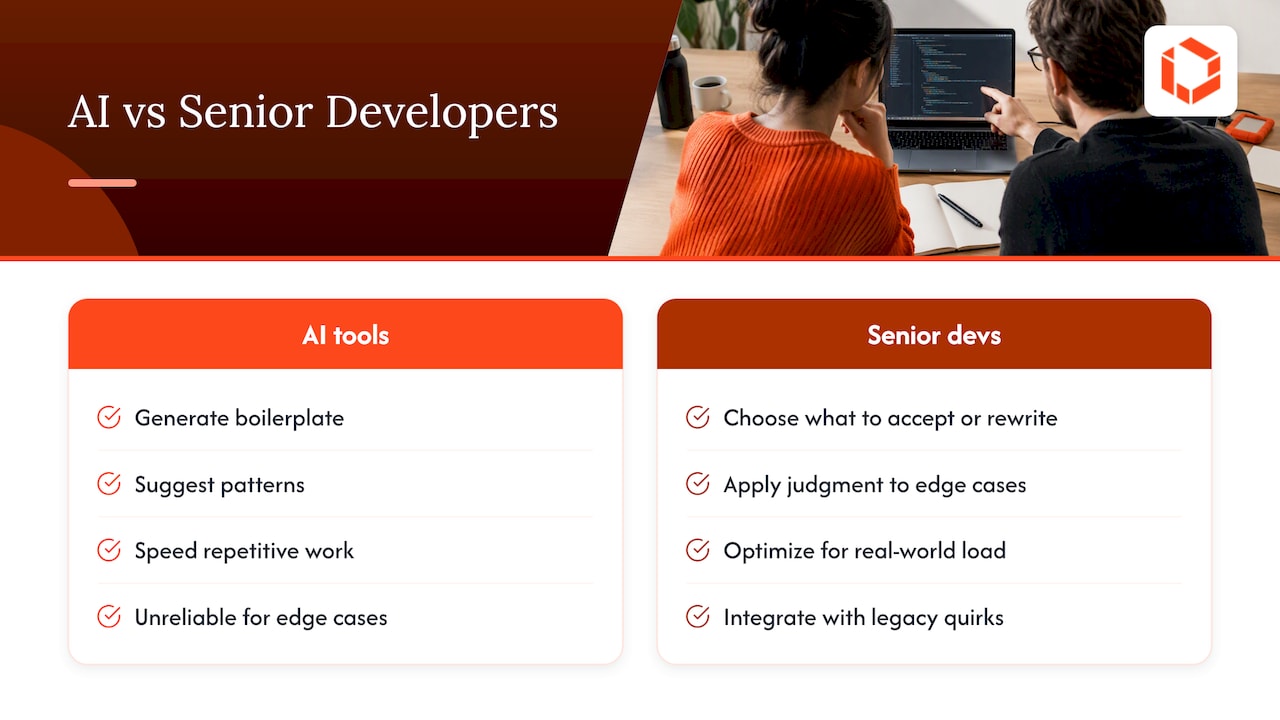
That caution is where seniority matters most. AI tools are strong at generating boilerplate, suggesting patterns, and speeding up repetitive work. They are far less reliable at handling edge cases, optimizing performance under real-world load, or integrating cleanly with a legacy system that has its own quirks. A senior developer knows which AI-generated suggestion to accept, which to rewrite, and which to discard entirely, a judgment call that benefits from experience with the product and its constraints.
For a founder, the practical approach is to pair AI tools with relevant project knowledge, testing, and human validation. AI can help speed up some development tasks, while architecture, security, and release decisions still require accountable human review.
7. Leadership in cross-functional communication and stakeholder management
A senior developer's value extends past the codebase into how well they translate technical reality into terms a founder, a designer, and an investor can all act on. When a timeline slips or a feature needs to be cut, someone has to explain why in language that does not require a computer science degree to parse.
This is where decision latency becomes a real cost. Every hour a founder waits for a clear technical answer is an hour that scope creep has room to grow. Senior developers shorten that loop by giving direct, specific answers instead of hedged ones, and by flagging risk early rather than after a deadline has already been missed.
Strong communication also shows up in how scope gets managed. A senior developer who has seen a project drift before will push back on a feature request that threatens the timeline, and will do it with a concrete alternative rather than a flat no. That kind of stakeholder management, balancing what the business wants against what the engineering can actually deliver on schedule, is a leadership skill as much as a technical one. Guidance on project quality and communication management reinforces how tightly these two disciplines are linked: clear communication practices are what keep quality standards from quietly slipping during a busy sprint.
8. Handling complex problem-solving in live environments
Bugs that show up in development are manageable. Bugs that show up in production, with real users mid-session, are a different category of problem entirely, and this is where experience separates itself fastest from theory.
A senior developer troubleshooting a live incident works from pattern recognition built over years: they know which logs to check first, which recent deploy is the likely culprit, and how to isolate the issue without taking the whole app down while they investigate. That speed matters because every minute of a live outage is a minute of lost trust, lost sessions, and potentially lost revenue.
This skill also shows up before a crisis happens, in the form of observability. Senior developers tend to build monitoring and alerting into the app from the start, so problems get caught by a dashboard instead of a wave of one-star reviews. Practical guidance on testing and release readiness echoes this: the habits that prevent incidents are largely the same habits that make them easier to resolve when they do occur.
For founders, the practical takeaway is that a calm, methodical troubleshooting process under pressure is not a soft skill, it can help reduce the impact of incidents and improve how quickly your team recovers from them.
9. Adaptability to evolving mobile technologies and platform updates
Mobile development does not hold still. Apple and Google push platform updates that can break existing features overnight, new frameworks emerge, and user expectations for performance keep climbing. A senior developer's value here is less about knowing every new tool and more about knowing how to evaluate whether a new tool is worth adopting at all.
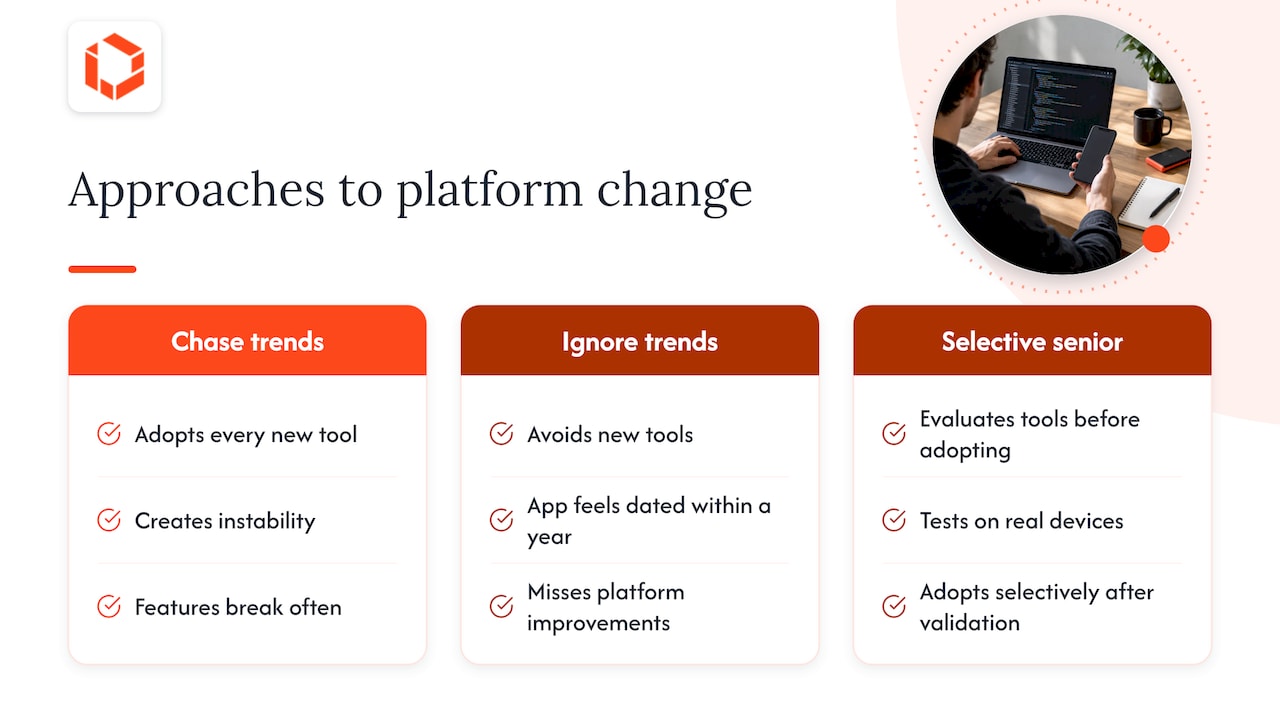
This shows up in practical ways: deciding whether to migrate a Flutter or React Native app when a major version update lands, anticipating how an iOS or Android policy change will affect app approval, or recognizing when a widely hyped library is not mature enough for a production app yet. Chasing every new trend creates instability; ignoring all of them creates an app that feels dated within a year. Senior developers sit in the middle, adopting selectively and testing thoroughly before committing.
Real-device testing remains part of that discipline even as tooling gets more automated. As one perspective on AI-assisted development and device testing points out, generating content or code quickly does not remove the need to verify how it behaves on actual hardware, across actual operating system versions. That verification step is exactly the kind of unglamorous work that separates apps that hold up through platform updates from ones that break with the next release.
10. Why timing your senior hire matters most
The founders who get the most from senior developers are the ones who bring them in before the architecture is set, not after the first version has already calcified around bad decisions. Waiting until things break is a costly mistake we see repeated across early-stage apps.
If you take one action this week, audit your current technical decisions and ask whether anyone on your team has the experience to defend them under pressure. If the answer is unclear, that gap is worth closing before your next release, and a senior-led team like the ones TouchZen builds is one direct way to close it.
How TouchZen puts senior-led development to work for founders
At TouchZen, we help founders with mobile app development and UX/UI design, from an initial MVP to ongoing product improvements. Our approach connects technical decisions with product goals, with attention to architecture, testing, and maintainability throughout development.

If you're weighing whether your next release needs senior ownership behind it, start with our mobile app development page or explore MVP development for startups to explore how we can support your next release.
Sources

FAQ
How much money do mobile app developers make?
Pay varies widely by experience, platform, and location, with senior developers commanding higher rates than junior or mid-level engineers. The U.S. Bureau of Labor Statistics provides occupational data on the broader software developer role, though exact figures depend on your market and engagement type.
Will AI replace mobile app developers?
AI is changing development work, but a developer survey cannot establish whether it will replace mobile developers in the future. Stack Overflow’s 2025 survey reports productivity benefits among developers using AI agents alongside concerns about output accuracy. Human judgment, testing, and review remain important for professional app development.
Is mobile app development still in demand?
Yes, the Bureau of Labor Statistics projects continued demand for software developers, driven partly by growth in AI, IoT, and automation. That demand applies to both new app builds and the ongoing maintenance existing apps require.
How much do founders of apps make?
Earnings for app founders depend entirely on the business model, market, and execution, so there is no single representative figure. Outcomes tend to correlate with product quality and time-to-market, which is part of why founders weigh senior development experience so heavily before building.
What do senior mobile developers do differently from junior developers?
Senior developers make architecture decisions with long-term scalability in mind, catch risks earlier through code review and testing discipline, and mentor other engineers as part of daily work. This combination tends to reduce post-launch bugs and rework compared to teams without senior oversight.