
Joy Foroughi
Executive Assistant


Flutter Developer Rates in 2026: What Businesses Should Expect
Discover Flutter Developer Rates in 2026. What Businesses Should Expect for budgeting and hiring skilled talent across regions.

TL;DR:
Flutter developer rates in 2026 vary from $25 per hour in Asia to over $250 in the United States, depending on experience and region. Costs increase with AI feature integration, cross-platform demand, and market inflation, affecting project budgets significantly. Businesses should consider total engagement costs, project scope, and regional factors to budget effectively for Flutter development.
Flutter developer rates in 2026 are defined by experience level, geographic location, and the growing complexity of cross-platform app requirements, making accurate rate knowledge non-negotiable for business budgeting. Flutter, Google's open-source UI toolkit built on the Dart programming language, has moved from niche framework to mainstream choice for startups and enterprises building for iOS, Android, and web simultaneously. The rate spread is wide. A junior developer in South Asia bills at a fraction of what a senior engineer in San Francisco commands. Understanding where your project falls on that spectrum is the first step toward a budget that holds.
What are the current Flutter developer rates and salary benchmarks in 2026?
Flutter developer compensation in 2026 follows a clear three-tier structure across experience levels, with significant regional variation layered on top. The US market sets the ceiling. Junior Flutter engineers earn base salaries between $70,000 and $95,000, mid-level developers earn $105,000 to $140,000, and senior engineers reach $150,000 to $205,000. Those figures reflect full-time employment in the United States.
Hourly contractor rates tell a different story by region. The table below shows the standard market ranges businesses encounter when sourcing Flutter talent globally.
Region | Experience Level | Hourly Rate Range |
|---|---|---|
US / Western Europe | Senior | $150–$250+ |
US / Western Europe | Mid-level | $100–$150 |
Eastern Europe | Mid to Senior | $40–$80 |
Asia (South/Southeast) | Entry to Mid | $25–$50 |
Regional hourly rates range from $18 per hour for entry-level South Asian developers on platforms like Upwork to $120 per hour for senior US-based engineers. That is a sevenfold spread. The practical implication: your budget ceiling and floor are set almost entirely by where you hire.
One distinction businesses frequently miss is the difference between a salaried developer's effective hourly cost and a contractor's bill rate. A $140,000 mid-level salary translates to roughly $67 per hour before benefits and overhead. A contractor billing $120 per hour may actually cost less when you factor in no benefits, no payroll taxes, and no long-term commitment. The math depends on project duration and scope.
Pro Tip: When comparing candidates across regions, calculate total engagement cost over the project timeline, not just the hourly figure. A $60/hr Eastern European developer on a six-month project often delivers better total value than a $100/hr US contractor on a rushed eight-week sprint.
Which factors are driving Flutter developer rate changes in 2026?
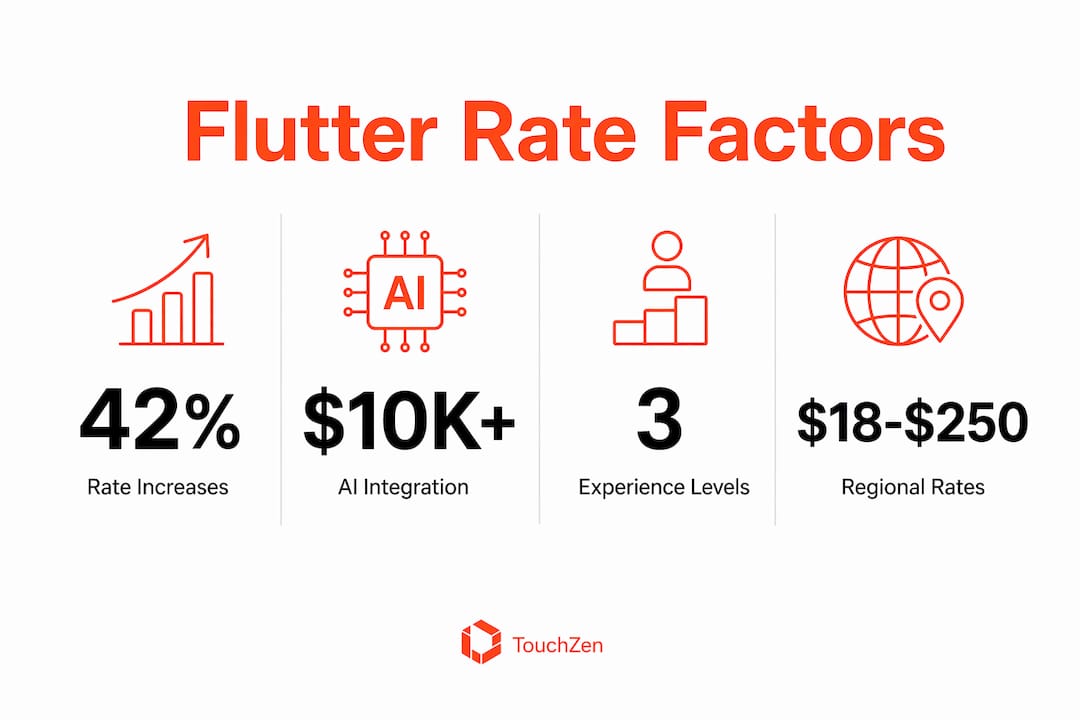
Three forces are pushing Flutter developer compensation upward in 2026: AI and machine learning feature integration, rising cross-platform demand, and broad market rate inflation across software development.

The AI integration factor is the most significant new cost driver. Adding AI or ML features to a Flutter app adds $10,000 to $50,000 or more to development costs depending on complexity. That cost increase reflects the specialized skill set required. Developers who can build Flutter UIs and integrate TensorFlow Lite or Firebase ML are commanding a premium that did not exist at this scale two years ago.
Market-wide, 41.7% of software development providers increased their rates slightly in 2026, while only 4.72% decreased them. The direction is clear: rates are rising, not falling. Businesses that budgeted based on 2024 figures need to revise upward.
Flutter developers also command a 10–20% compensation premium over generic mobile developers. That premium reflects the productivity multiplier Flutter provides. One developer shipping to iOS, Android, and web simultaneously delivers more output per dollar than two separate native developers. The market has priced that efficiency into the rate.
Key drivers shaping 2026 Flutter developer compensation:
AI/ML integration skills push senior rates toward the top of their bands
Cross-platform demand keeps Flutter talent in short supply relative to React Native or native iOS/Android
Market-wide rate inflation affects all software roles, Flutter included
Project urgency adds a premium when timelines are compressed
For businesses tracking app development trends, the consistent message is that specialized cross-platform skills are becoming more expensive, not less.
How do contractor pay rates compare to billable rates for Flutter projects?
The gap between what a Flutter developer earns and what a business pays is one of the most misunderstood aspects of budgeting for contract work. Bill rates typically exceed contractor pay rates by 20–50%. That gap covers payroll burden, agency margin, benefits administration, and risk premium.
Cost Component | Who Pays | Typical Impact on Bill Rate |
|---|---|---|
Developer pay rate | Agency / Contractor | Base |
Payroll burden (taxes, insurance) | Agency | +15–25% |
Agency margin | Agency | +10–20% |
Urgency / clearance premium | Business | +10–30% |
Location premium (onsite, US-only) | Business | +10–20% |
A developer earning $80 per hour as a contractor may appear on your invoice at $110 to $130 per hour once agency fees and payroll costs are included. That is not a markup for profit alone. It reflects real operational costs that agencies absorb on your behalf.
The confusion compounds when businesses compare quotes from different sources. A freelancer on Upwork quoting $90 per hour and an agency quoting $130 per hour for the same seniority level are not necessarily far apart in total project cost. The agency rate includes project management, quality assurance, and replacement guarantees. The freelancer rate does not.
For a detailed breakdown of how these structures affect total project spend, the freelancer vs. agency cost comparison is worth reviewing before you commit to either model.
Pro Tip: Always ask vendors to itemize their bill rate components. A transparent agency will show you the developer pay rate, the burden, and the margin separately. If a vendor refuses to break it down, that opacity usually costs you more in the long run.
What budgeting strategies should businesses use when hiring Flutter developers in 2026?
Effective budgeting for Flutter development in 2026 starts with total cost of engagement, not headline hourly rate. The hourly figure is one variable. Project scope, AI feature requirements, team structure, and location all multiply or divide that number significantly.
Follow this framework when building your Flutter development budget:
Define scope before sourcing talent. A vague brief produces vague quotes. Document your feature list, platform targets (iOS, Android, web), and AI integration requirements before approaching any developer or agency. Scope creep is the primary cause of budget overruns, not rate increases.
Segment your talent needs by task. Senior Flutter developers should not be writing boilerplate UI code. Use senior engineers for architecture, complex state management, and AI/ML integration. Use mid-level developers for feature development. Use junior developers for testing and maintenance. Mixing levels correctly can reduce your blended rate by 20–30%.
Choose your engagement model deliberately. Dedicated development teams carry higher upfront costs but deliver more consistent quality than freelancers for projects lasting more than three months. For short, well-defined projects, a freelancer or boutique agency is often more cost-efficient.
Account for regional timezone and communication costs. Eastern European developers offer strong value at $40–$80 per hour, but timezone gaps with US-based product teams add coordination overhead. Senior Flutter developers in Turkey, for example, deliver quality comparable to Western European peers at lower rates, with timezone overlap that reduces decision latency for European clients.
Build a contingency for AI feature complexity. If your roadmap includes any AI or ML functionality, add a 15–25% budget buffer above your base estimate. AI integration costs are highly variable and frequently underestimated at the scoping stage.
For a full breakdown of how these variables affect total spend, the mobile app cost breakdown for 2026 provides founder-level detail on each cost driver.
Pro Tip: Request a fixed-price milestone structure rather than a pure time-and-materials contract when working with agencies. Milestones force scope clarity upfront and give you cost predictability without eliminating flexibility for later-stage changes.
Key takeaways
Flutter developer rates in 2026 vary from $25 per hour in Asia to $250 or more in the US, and businesses that budget without accounting for region, experience level, and AI complexity will consistently underfund their projects.
Point | Details |
|---|---|
US salary bands are wide | Junior Flutter engineers start at $70K; seniors reach $205K depending on specialization. |
Regional rates span a sevenfold range | Hourly rates run from $25/hr in Asia to $250+/hr for senior US contractors. |
Bill rates exceed pay rates by 20–50% | Agency margins, payroll burden, and urgency premiums all add to the headline hourly figure. |
AI integration raises costs significantly | Adding AI or ML features adds $10,000 to $50,000 or more to total project cost. |
Flutter commands a 10–20% premium | Cross-platform productivity justifies higher rates compared to single-platform mobile developers. |
My honest read on Flutter developer hiring in 2026
The number I see businesses get wrong most often is not the hourly rate. It is the assumption that a lower rate equals a lower total cost. I have watched startups hire a $35/hr developer, spend three months in revision cycles, and end up paying more than they would have for a $90/hr engineer who shipped clean code in six weeks.
Flutter is a genuinely productive framework. One skilled developer building for iOS, Android, and web simultaneously is worth more than the rate suggests. The Flutter vs. React Native comparison makes this clear: the productivity argument for Flutter is real, and it justifies the compensation premium.
The market shift I am watching most closely is AI integration. Developers who can build Flutter UIs and wire in machine learning models are a small subset of the Flutter talent pool. Their rates are moving fast. If your 2026 roadmap includes any AI-powered features, budget for that skill set now, not after you have already scoped the project at a lower rate.
The businesses that get the best outcomes are the ones that treat developer rate conversations as a budgeting exercise, not a negotiation. Know your scope. Know your region. Know the difference between pay rate and bill rate. Those three pieces of knowledge will protect your budget better than any rate negotiation tactic.
— Cyrus
How TouchZen approaches Flutter development budgeting
Budgeting for a Flutter project is easier when you are working with a team that has done it more than 75 times across real products. TouchZen works directly with senior Flutter developers on every project, which means you get accurate scoping from engineers who have built apps at scale, not estimates from a sales team.
TouchZen's Flutter app development services cover the full engagement from scoping and architecture through launch and post-launch support. The team has delivered results like 100,000 downloads in the first year and 10x subscription growth for clients who needed both speed and quality. If you are planning a Flutter project for 2026 and want a budget grounded in real market rates, TouchZen is worth a conversation. You can also review TouchZen's standing as a top-ranked app development agency before reaching out.
FAQ
What is the average Flutter developer hourly rate in 2026?
Flutter developer hourly rates in 2026 range from $25 per hour in Asia to $250 or more for senior US-based contractors. Eastern European developers typically bill between $40 and $80 per hour.
Why do Flutter developers earn more than generic mobile developers?
Flutter developers command a 10–20% premium because a single Flutter developer ships to iOS, Android, and web simultaneously, delivering more output than a single-platform native developer.
What is the difference between a contractor pay rate and a bill rate?
The bill rate a business pays exceeds the developer's actual pay rate by 20–50% because it includes payroll taxes, agency margin, and any urgency or location premiums added to the contract.
How much does AI integration add to Flutter development costs?
Integrating AI or ML features into a Flutter app adds between $10,000 and $50,000 or more to total project cost, depending on the complexity of the models and the developer's specialization.
Should businesses hire freelance Flutter developers or a dedicated agency in 2026?
For projects longer than three months, a dedicated team typically delivers more consistent quality than a freelancer. For short, well-scoped projects, a freelancer or boutique agency is often the more cost-efficient choice.