Joy Foroughi
Executive Assistant


How to Hire a Dedicated App Development Team
Discover how to effectively hire a dedicated app development team to accelerate your startup's MVP launch and ensure consistent delivery.
Hire a dedicated app development team when you need speed, continuity, and senior-led delivery to ship an MVP without the overhead of building in-house. Your immediate next step: write a one-page MVP brief covering platform (iOS, Android, or cross-platform), three to six core user stories, your primary success metric, and your target user. Use that brief to screen every candidate from day one. TouchZen has launched 75+ apps across industries, supporting startups from product strategy and UX/UI design through development, launch, and post-launch support.
Key Takeaways
Hiring a dedicated app development team requires a clear MVP brief, interviews with the proposed team, well-defined IP and staffing terms, and a structured 30/60/90-day onboarding plan.
Point | Details |
|---|---|
Write your MVP brief first | Define platform, three to six user stories, KPIs, and acceptance criteria before contacting any vendor. |
Meet the proposed team | Ask to meet the engineers expected to work on your product and clarify how any staffing changes will be handled. |
Clarify IP and replacement terms | Define IP ownership, confidentiality, replacement timelines, and handover responsibilities before signing. |
Use the 30/60/90 framework | Confirm environment access by day one, a production-ready feature by day 60, and full sprint cadence by day 90. |
TouchZen as recommended partner | TouchZen has launched 75+ apps with senior-led, named-developer access and post-launch support retainers. |
When should you hire a dedicated team vs. freelancers or in-house?
A dedicated development team is a stable external group of engineers who work on your product across multiple sprints, preserving context and integrating with your delivery process. Unlike short-term freelance support or fixed-scope outsourcing, this model is designed for ongoing product development and an evolving roadmap.
Primary advantages:
Speed to hire: a vetted team can be assembled and onboarded faster than recruiting full-time employees
Senior-led continuity: the same engineers carry context from sprint one through launch and beyond
Integrated cadence: standups, retrospectives, and demos run on your schedule, not the vendor's
Roadmap ownership: the team participates in prioritization, not just ticket execution
Trade-offs to weigh:
Ongoing commitment: This model works best when your roadmap spans multiple sprints; short, clearly defined tasks may be better suited to a freelancer or fixed-scope engagement.
Management overhead: you still need a product owner or founder-level decision-maker available weekly
Cost premium vs. a single freelancer, though the gap narrows quickly once you factor in coordination time
Decision checklist — hire a dedicated team if you answer yes to three or more:
Your time-to-market window is under six months
The product roadmap extends beyond the initial launch
You need cross-functional coverage (design, engineering, QA) rather than one skill
The required tech stack (Flutter, React Native, Swift, Kotlin) is scarce in your local market
For a direct comparison of in-house vs. agency development, the trade-offs shift further once you price in recruiting costs, benefits, and ramp time. Freelance platforms like Upwork give you access to millions of developers quickly, but single contributors are best for scoped tasks rather than ongoing, cross-functional delivery, and they increase management overhead for product founders.
According to GENTY recruitment’s guide for US startups, clearly defining the role and using consistent, structured evaluation criteria can make the hiring process more reliable.
How do you define scope, budget, and timeline before hiring?
Your one-page MVP brief
Before you contact a single vendor, write down: platform(s), three to six core user stories ranked by priority, must-have vs. nice-to-have features, target KPIs (activation rate, Day-7 retention, first-revenue milestone), required integrations (payment, auth, analytics), and your acceptance criteria for launch. This brief becomes your filter. Any vendor who cannot respond to it specifically is not ready to own your roadmap.
Sample milestone timeline
Milestone | Typical Duration |
|---|---|
Discovery and scoping | 1–2 weeks |
UX/UI design and prototype | 2–4 weeks |
Development sprints (MVP) | 6–12 weeks |
QA and bug resolution | 1–2 weeks |
Launch and go-live | 1 week |
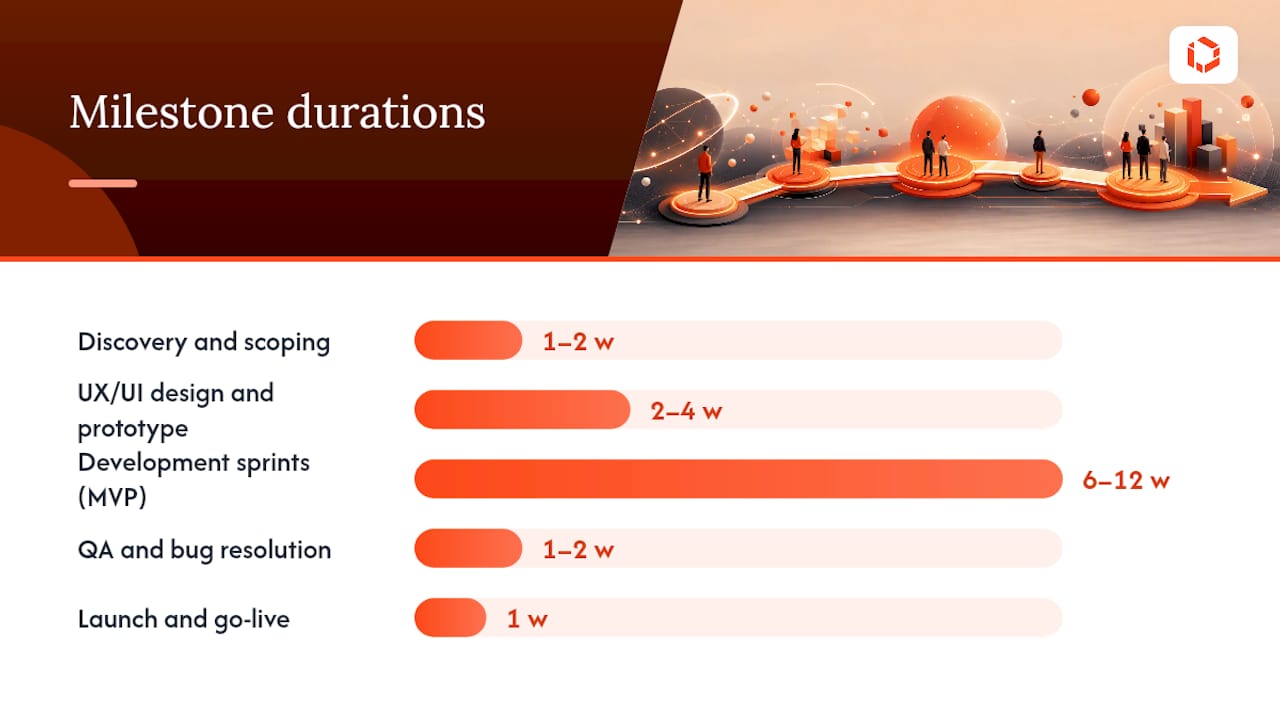
Total MVP range varies depending on complexity, typically spanning several weeks.
Cost benchmarks
Cost signal: Dedicated-team pricing varies significantly based on location, seniority, team size, technical complexity, and what the vendor includes. Compare itemized proposals rather than relying on a single regional benchmark.
When a vendor is vague about per-developer rates or bundles everything into a single project fee, ask them to break out the monthly cost per engineer and what is included (equipment, payroll, HR, replacement). Transparency here is a trust signal, not a negotiation tactic.
What roles does a startup app development team need?
Core roles for an MVP-stage dedicated team:
Product manager / product owner: owns the backlog, sprint goals, and stakeholder communication
Tech lead / senior engineer: makes architecture decisions, sets code standards, unblocks the team
iOS and/or Android developer (or a Flutter/React Native engineer for cross-platform): owns the client-side build
UI/UX designer: drives wireframes, prototypes, and design system; hands off specs to engineering
QA engineer: writes and runs test cases, owns the bug lifecycle, and signs off on each sprint
DevOps / infrastructure: manages CI/CD pipelines, cloud environments, and deployment automation
Skills to prioritize for speed and maintainability: Swift or Kotlin for native builds; Flutter or React Native for cross-platform; REST and GraphQL API design; automated testing (XCTest, Espresso, Detox); analytics instrumentation (Amplitude, Mixpanel, Firebase); and security basics (OWASP Mobile Top 10).
Scale the team at concrete milestones. Add a backend specialist when your API complexity outgrows what the tech lead can own solo, typically around the second or third sprint cycle. Bring in a mobile performance engineer when DAU crosses a threshold where load time and crash rate directly affect retention. A data engineer becomes necessary once you are running A/B tests and need reliable event pipelines.
How do you vet and interview a dedicated development team?
Review portfolio relevance. Ask for two or three case studies in your industry or with similar technical complexity. Generic portfolios with no measurable outcomes are a signal to probe further.
Meet the proposed team. Before signing, ask to speak with the engineers expected to work on your product. Clarify their roles, availability, and how the vendor handles staffing changes after the engagement begins.
Check references from similar projects. Ask for one or two client references from projects with comparable scope or technical complexity. Focus your questions on communication, delivery reliability, problem-solving, and how the team handled changes during development.
Ask for a sample deliverable. Request a brief technical proposal or architecture sketch for your MVP brief. The quality of that document tells you more than any sales call.
Confirm IP ownership and replacement SLA in writing before the discovery call ends.
Sample technical questions for a senior mobile engineer:
Walk me through an architecture decision you made that you would change today. What would you do differently?
How do you handle offline state in a mobile app with a real-time data requirement?
Describe your approach to CI/CD for a mobile product with two-week release cycles.
Red flags that predict delivery failure:
Refusal to allow named-developer interviews
Vague or missing replacement timelines
IP ownership language that is absent or ambiguous in the draft contract
No client references from engagements longer than three months
Pro Tip: Ask to meet the engineers proposed for your project before signing. Use the conversation to confirm their technical experience, communication style, availability, and expected responsibilities. Also clarify how the vendor will handle any staffing changes during the engagement.
For a deeper set of role-specific questions, the iOS developer interview guide covers the technical depth you should expect from a senior mobile hire.
Which engagement model fits your startup's stage?
Model | How it works | Best for |
|---|---|---|
Time and materials | Billed by hours or days; scope can flex | Pre-seed, early MVP, uncertain requirements |
Fixed-price | Agreed scope, fixed fee, change orders for additions | Well-defined, short-duration deliverables |
Dedicated team retainer | Monthly team cost; ongoing roadmap ownership | Seed through Series A+, continuous product development |
Practical recommendation by stage:
Pre-seed / early MVP: Start with time and materials and a short trial period (two to four weeks). This lets you validate the team's working style before committing to a longer engagement.
Seed: Move to a dedicated team retainer once your roadmap extends three or more months. Negotiate a trial sprint before the full contract starts.
Series A+: Retain and scale the dedicated team. Renegotiate scope and pricing quarterly as the product grows.
Ask every vendor what the management fee covers. A well-structured retainer includes equipment, payroll administration, HR support, and a replacement SLA. If those items are not in the contract, they will surface as surprise costs later.
What contract terms should a US startup review?
Before work begins, review the agreement carefully with qualified legal counsel. Key terms to discuss include:
100% IP assignment / work-for-hire clause: all code, designs, and documentation created during the engagement belong to your company from the moment of creation
Engineer-level NDAs: signed by each individual contributor, not just the vendor entity
Replacement process: explains how staffing changes will be handled, including notification, a reasonable replacement timeline, knowledge transfer, and approval of the new team member.
Payment milestones tied to acceptance tests: never pay a milestone without a defined, objective deliverable that proves completion
Data protection and confidentiality: scoped to the delivery location's applicable law and your users' data residency requirements
Termination notice and transition support: minimum 30-day notice with a documented handover obligation, including code repositories, credentials, and documentation
For app security compliance requirements, confirm that the contract addresses OWASP Mobile Top 10 obligations and any data handling rules relevant to your users.
Negotiate the replacement SLA and IP clause before you need them. Ask for the vendor's average engagement length as a stability signal. Short average engagements (under six months) suggest high churn on their side.
What should you expect in the first 30–90 days?
Offshore developer onboarding best practices consistently point to three failure modes: missing environment access on day one, unclear acceptance criteria for the first sprint, and no named technical owner during ramp. Address all three before kickoff.
30-day milestones:
Kickoff call completed; all environment access (repos, staging, APIs, design files) granted within 48 hours
First sprint planned with written acceptance criteria for every story
Named account manager and tech lead confirmed on both sides
60-day milestones:
First production-ready feature demoed and accepted
Sprint cadence (two-week sprints) running without founder intervention
Bug triage and QA sign-off process documented
90-day milestones:
MVP feature set complete or on a confirmed timeline
Operational handover documentation started (architecture decisions, deployment runbook)
Retrospective held; team velocity and delivery predictability assessed
Per offshore workflow best practices, clear handoffs, agreed cadences, shared tools (Jira, Slack, Figma, GitHub), and named points of contact are the structural levers that prevent miscommunication and scope drift on remote teams.
How do you support and scale the team after launch?
Post-launch is where many startups under-invest. A maintenance retainer should specify SLA response hours (critical bugs within four hours, non-critical within 24), patch windows, security update cadence, monitoring coverage (Crashlytics, Datadog, or equivalent), and incident response ownership.
KPIs to track from day one post-launch:
Crash-free session rate (target above 99.5%)
Day-1 and Day-7 retention
DAU/MAU ratio as a stickiness signal
Conversion funnel drop-off points
Early LTV:CAC signal once paid acquisition begins
Scale the team when the data tells you to, not on a calendar schedule. Add mobile performance capacity when crash rate or load time degrades under real traffic. Bring in backend capacity when API latency becomes a retention driver. Add a data engineer when you need reliable event pipelines for A/B testing. When renegotiating scope and pricing at scale, use your sprint velocity data as the anchor: teams that have delivered consistently earn rate stability; teams that have missed milestones do not.
What actually separates successful founder-agency partnerships?
Most founders treat vendor selection as a procurement decision. The ones who ship faster and build better products treat it as a product decision, applying the same rigor they would to hiring a founding engineer.

The single behavior that correlates most strongly with a successful engagement is insisting on named-developer interviews before signing. Not portfolio reviews, not sales calls, not reference checks alone. The moment you sit across from the actual engineer who will own your codebase and ask them about a real architecture trade-off, you learn more in 20 minutes than in any RFP process.
Clear staffing-change terms matter for the same reason. A reliable vendor should explain how replacements, knowledge transfer, and continuity will be handled if a team member becomes unavailable. Discuss these expectations before signing and document the agreed process in the contract.
Senior-led onboarding is the third lever. The first sprint sets the team's working patterns for the entire engagement. If a junior engineer is running your kickoff while the senior developer "joins later," your technical debt starts accumulating before a single line of production code is written.
Treat vendor selection as a product decision. The right development partner is not the cheapest or the fastest to respond. It is the one whose senior engineers can own your roadmap with the same accountability you would expect from a co-founder.
TouchZen builds dedicated teams that ship your MVP
TouchZen's mobile app development service covers every stage a startup needs: MVP definition, UX/UI design, native iOS and Android engineering, cross-platform builds in Flutter and React Native, go-to-market strategy, launch, and post-launch support. Every engagement is senior-led, with direct access to the engineers building your product from day one.
TouchZen has shipped 75+ apps generating more than 20 million downloads, with 12+ features from Apple and Google. The team supports startups across product strategy, UX/UI design, native and cross-platform development, launch, and post-launch support.
Schedule a discovery call to discuss your MVP brief, technical requirements, and next steps with the TouchZen team.
Sources
Recruitment Process for US Startups: 2026 Guide | GENTY Recruitment
Offshore Developer Onboarding Best Practices for 2026 | Remotee
FAQ
How long does it take to hire a dedicated app development team?
From first vendor contact to a contributing engineer on your product typically takes two to four weeks when you have a written MVP brief ready and the vendor sources individually rather than from a bench.
What is the difference between a dedicated team and a fixed-price project?
A dedicated team owns your roadmap continuously across sprints; a fixed-price engagement delivers a scoped set of features for a set fee, with change orders required for any additions. Dedicated teams suit startups with evolving requirements.
How much does a dedicated app development team cost for a US startup?
Costs vary based on team size, seniority, location, technical complexity, and engagement length. Request an itemized proposal showing each role, monthly rate, included services, and any additional management or infrastructure costs.
What contract clause matters most when hiring app developers?
No single clause covers every risk. IP ownership, confidentiality, payment and acceptance terms, data security, termination, staffing changes, and handover responsibilities should be reviewed together with qualified legal counsel.
Can TouchZen handle both MVP development and post-launch support?
Yes. TouchZen provides end-to-end services from MVP definition through native and cross-platform engineering, launch, and ongoing maintenance retainers, with senior-led teams and direct developer access throughout.