
Joy Foroughi
Executive Assistant


How to Accelerate Your App Development Process in 2026
Discover effective strategies to accelerate app development process in 2026. Boost speed and quality with modular architecture and AI testing.

TL;DR:
Speeding app development depends on modular architecture, automation, and performance profiling from day one. These strategies enable parallel work, automate testing, and improve responsiveness, helping startups reach market faster without sacrificing quality. Continuous telemetry and scalability planning ensure sustained growth and prevent costly rewrites later.
Accelerating the app development process is defined as reducing time-to-market by combining architectural discipline, agile execution, and automation without sacrificing code quality or user experience. For startup founders and product managers, speed is not optional. Every week of delay costs you market position, investor confidence, and early adopters. The strategies that work in 2026 are not shortcuts. They are modular architecture, CI/CD pipelines, AI-powered testing, and performance profiling applied systematically from day one.
How does modular architecture and agile methodology speed up app development?
Modular architecture is the single most effective structural decision you can make to speed up app creation. It means breaking your app into independent, self-contained components that can be built, tested, and deployed separately. Modular design decouples components, easing testing and feature updates without requiring full system rebuilds. That separation is what allows two or three engineers to work in parallel without stepping on each other's code.
Agile sprint execution compounds the benefit. When your team works in two-week sprints with defined deliverables, you get continuous feedback from stakeholders before the wrong feature is fully built. That early course correction is the real time saver. Scope creep, the silent killer of startup timelines, gets contained because each sprint has a fixed boundary.
Here is what modular architecture and agile execution look like in practice for a startup:
Separate feature modules: Authentication, payments, notifications, and analytics each live in their own module. A bug in payments does not block the notifications team.
Shared component libraries: Buttons, form fields, and navigation patterns are built once and reused across screens, cutting UI development time significantly.
Sprint-based feature releases: Each sprint ships one working feature to a staging environment, giving product managers real data to prioritize the next sprint.
Parallel workstreams: Backend API development and frontend UI development run simultaneously because the contract between them is defined upfront.
Pro Tip: Keep modules decoupled by defining strict API contracts between them before any code is written. Teams that skip this step spend the last two weeks of every sprint resolving integration conflicts.
What role does automation, including CI/CD and AI-powered testing, play in accelerating app development?
Automation is the force multiplier that separates teams shipping weekly from teams shipping quarterly. Without it, every release requires manual builds, manual test runs, and manual deployments. That overhead compounds fast.

CI/CD pipelines automate builds, tests, and deployments, enabling rapid and reliable release cycles. The practical result is that a developer merges code and the pipeline handles the rest. Broken builds surface in minutes, not days. That speed of feedback is what keeps your team moving.
AI-powered automated testing takes this further. Automated generation and execution of tests saves half-day manual tasks and improves code quality across the board. Developers who automate the entire testing loop with AI, including writing tests, running dry runs, and refining coverage, reduce production bugs and ship with more confidence. AI also reduces the iteration cycle from weeks to days by automating code generation and prototyping. Developers describe what they need in plain language and get functional code generated immediately.
Here is the automation setup that works for most startup teams:
Set up a CI/CD pipeline on day one. Use it to run unit tests, integration tests, and linting on every pull request. Never merge untested code.
Add AI-powered test generation. Feed your core user flows into an AI testing tool and let it generate test cases you would not have written manually.
Automate deployment to staging. Every successful build on the main branch should deploy automatically to a staging environment for QA review.
Monitor build times. If your pipeline takes more than 15 minutes, it slows the team. Identify and parallelize the slow steps.
Run automated regression tests before every release. This catches regressions without requiring a dedicated QA engineer to retest every screen manually.
Pro Tip: Integrate automation from day one, not after your first production bug. Teams that bolt on CI/CD after launch spend weeks retrofitting tests and fixing the gaps that automation would have caught early.
Which performance optimizations improve app responsiveness from day one?
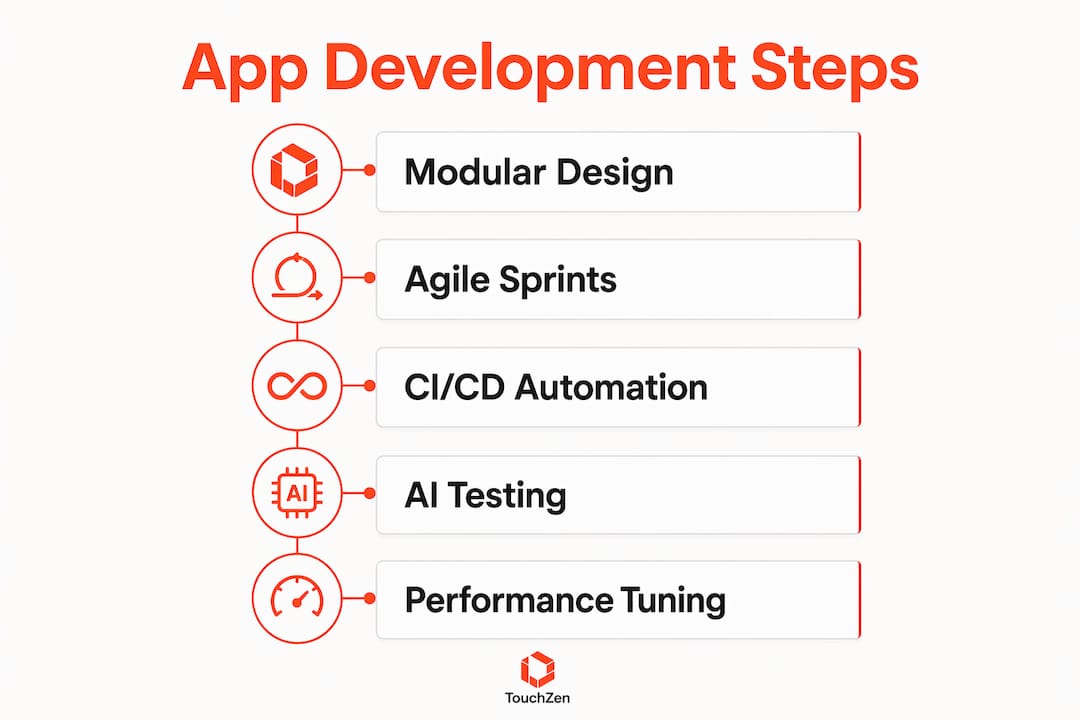
Performance is not a post-launch concern. Performance optimization requires foundational architectural decisions at prototyping, not patch fixes applied later. Startups that treat performance as a launch-week task routinely face rewrites that cost more time than the original build.
Baseline Profiles can improve code execution speed and app responsiveness by 30% from the first launch. They work by pre-compiling the critical paths your app takes during startup and key UI interactions. The result is a noticeably faster experience for every user who opens your app for the first time. That first impression directly affects Day 1 retention.
Startup profiles and lazy loading of libraries also matter. Deferring heavy library initialization until after the first screen renders reduces cold start time without requiring architectural changes. For React Native apps specifically, replacing FlatList with FlashList reduces UI thread blocking and improves scrolling responsiveness from first launch.
Prioritizing critical user journeys like onboarding speed improves Day 1 through Day 30 retention significantly. Optimization applied only post-launch is not sufficient. You need to profile your app before release and fix the bottlenecks that matter most to new users.
Optimization technique | Impact | Effort level |
|---|---|---|
Baseline Profiles | 30% faster startup and UI response | Medium |
Lazy loading of libraries | Reduced cold start time | Low |
FlashList over FlatList | Smoother scrolling, less thread blocking | Low |
Onboarding flow profiling | Higher Day 1 and Day 30 retention | Medium |
Architectural anti-pattern removal | Prevents systemic slowdowns | High |
Pro Tip: Profile your app on a mid-range device, not a flagship. Most of your early users will not have the latest hardware. Optimizing for a mid-range baseline catches the performance gaps that flagship testing misses.
How can startups plan for scalability and avoid bottlenecks that slow growth?
Scalability planning belongs in the discovery phase, not the growth phase. Founders who defer this conversation until they have 10,000 users typically face a painful partial rewrite at exactly the moment they can least afford the distraction.
Monolithic database schemas and synchronous multi-service calls are the two most common architectural bottlenecks that surface-level tweaks cannot fix. A monolithic schema means every new feature requires changes to a shared database structure, creating conflicts and slowing every team that touches it. Synchronous calls between services mean one slow dependency stalls the entire request chain.
Here is how to build for mobile app scalability from the start:
Design your database schema around bounded contexts. Each feature domain owns its data. Payments does not share tables with user profiles.
Use asynchronous communication between services. Message queues decouple services so a slow email notification does not delay a checkout response.
Set performance budgets early. Define acceptable response times for your core API endpoints before you write the first line of backend code.
Monitor with real telemetry from day one. Behavioral analytics tools provide insights that drive informed decisions without guesswork. You cannot fix what you cannot measure.
Plan for AI system integration early. AI features added to a monolithic architecture later create significant refactoring costs.
The scenario that plays out repeatedly for startups that skip this work: they hit a growth milestone, their app slows to a crawl under load, and they spend three months on infrastructure instead of new features. That three-month gap is often fatal at the seed stage.
What are the practical steps to implement these acceleration techniques?
A systematic approach beats a piecemeal one every time. The following five steps give your team a clear sequence to follow, regardless of your current stage.
Define requirements and critical journeys first. Map the three to five user flows that matter most for activation and retention. Every architectural and optimization decision should serve those flows.
Adopt modular architecture and agile sprint planning. Structure your codebase into feature modules before writing production code. Set up two-week sprints with a defined definition of done for each module.
Set up CI/CD and integrate AI-powered testing. Your pipeline should be running before your first feature is complete. Add AI test generation for your critical user flows in the first sprint.
Profile app performance and implement targeted optimizations. Run performance profiling on a mid-range device before your pre-launch beta. Apply Baseline Profiles, lazy loading, and FlashList where relevant.
Plan scalability and monitor continuously. Define your database schema boundaries and API contracts in the architecture phase. Set up telemetry and A/B testing from launch so you have real data driving every post-launch decision.
Startups should optimize critical journeys pre-launch and incorporate real telemetry post-launch. The teams that ship fastest treat optimization as a continuous cycle, not a one-time task.
The most common mistakes to avoid during this process are: skipping the architecture phase to save time, adding automation after the first production incident, and treating scalability as someone else's problem until it becomes a crisis.
Key Takeaways
Accelerating app development requires combining modular architecture, agile execution, CI/CD automation, and performance profiling applied from the first day of the project.
Point | Details |
|---|---|
Modular architecture enables speed | Decoupled modules allow parallel workstreams and reduce integration delays across teams. |
CI/CD and AI testing cut cycle time | Automating builds, tests, and deployments removes manual overhead and catches bugs before production. |
Performance profiling belongs pre-launch | Baseline Profiles and lazy loading deliver measurable gains before users ever open the app. |
Scalability planning starts at discovery | Monolithic schemas and synchronous calls create bottlenecks that surface-level fixes cannot resolve. |
Optimization is a continuous cycle | Post-launch telemetry and A/B testing drive the informed decisions that sustain growth. |
Speed without shortcuts: what I've learned building apps for startups
The most persistent myth I encounter is that speed and quality trade off against each other. They do not. The teams that ship fastest are almost always the ones with the most disciplined processes. They have clear module boundaries, automated pipelines, and defined performance budgets. The teams that ship slowly are the ones improvising architecture sprint by sprint.
Cross-functional collaboration is the variable most founders underestimate. When product, design, and engineering align on critical user journeys before a single line of code is written, the entire build moves faster. Decision latency, the time between identifying a problem and acting on it, is the real bottleneck in most startup development cycles. Tight communication eliminates it.
Embrace AI and automation not as a trend but as a practical response to resource constraints. A small engineering team can often move significantly faster with AI-assisted testing, prototyping, and code-generation workflows. That is not an exaggeration. It is the new baseline for competitive startups in 2026.
The teams I have seen succeed treat telemetry as a first-class product feature. They instrument their apps from day one, watch the data after launch, and make changes based on what users actually do. That culture of continuous learning is what separates apps that grow from apps that stall.
— Cyrus
How TouchZen helps startups ship faster without compromising quality
TouchZen works directly with startup founders and product managers to build iOS and Android apps that reach market faster. Every project is handled by senior developers and designers from kickoff to launch, with no delegation to junior staff.
TouchZen integrates AI-powered development and performance optimization into every engagement, applying the same modular architecture, CI/CD automation, and profiling techniques covered in this article. The team has launched over 75 apps across industries, with results including 100,000 downloads in the first year and a 10x increase in user subscriptions for clients. If you are ready to move from idea to launch with a team that has done it before, talk to a TouchZen expert about your project today.
FAQ
What is the fastest way to accelerate app development?
Combining modular architecture with CI/CD automation and AI-powered testing delivers the greatest reduction in development cycle time. These three methods work together to enable parallel workstreams, eliminate manual overhead, and catch bugs before they reach production.
How does CI/CD improve app development efficiency?
CI/CD pipelines automate builds, tests, and deployments so every code merge triggers an immediate quality check. This removes the manual release overhead that typically adds days to each development cycle.
What are Baseline Profiles and why do they matter?
Baseline Profiles pre-compile the critical code paths your app uses during startup and key UI interactions. They can improve app responsiveness by 30% from the first launch, directly affecting Day 1 user retention.
When should startups plan for scalability?
Scalability planning belongs in the discovery and architecture phase, before any production code is written. Monolithic database schemas and synchronous service calls are architectural problems that require partial rewrites to fix, not surface-level patches.
How does AI change the app development process?
AI reduces the iteration cycle from weeks to days by automating code generation, test writing, and prototyping. Developers describe requirements in plain language and receive functional code, cutting the manual effort required at every stage of the build.