
Joy Foroughi
Executive Assistant


One-Platform MVP: 7 Signs You Shouldn't Build Both Yet
Discover the 7 signs it's time to build a one-platform MVP instead of launching on both. Save money and focus on success!

For most early-stage apps, the answer is yes: build a one-platform MVP first. Trying to launch on iOS and Android simultaneously before you've validated demand is usually the most expensive mistake a founder can make with limited runway. Here are the seven signs that tell you a dual-platform build is premature:
Your user base is concentrated on one device type or geography
Your app has no must-have native features (camera, GPS, biometrics) that force a mobile-first build
You need to learn fast, not launch wide
Your budget can't absorb two QA surfaces, two store listings, and two marketing funnels
Your team can't yet support two release cadences and two analytics pipelines
You haven't validated device split or platform demand with real users
You have no funded plan for simultaneous user acquisition on both stores
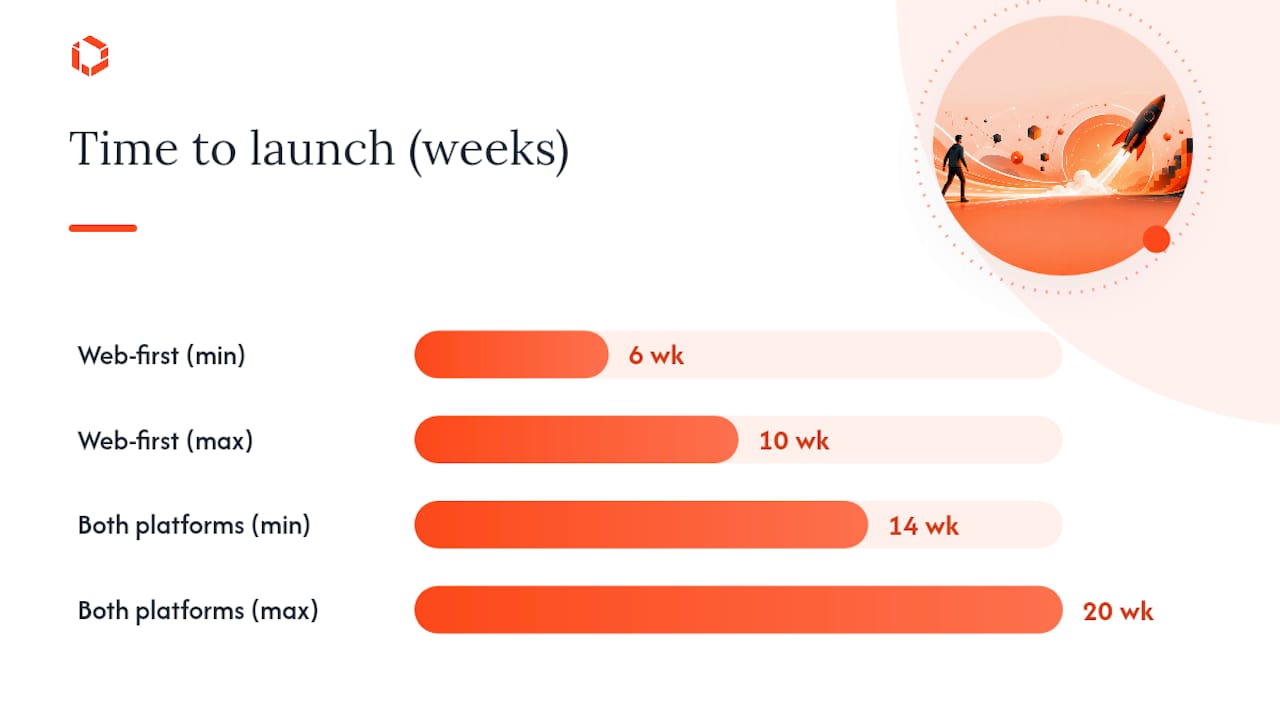
If four or more of these apply to you, build single-platform. Teams that skip this step often discover, too late, that a responsive web MVP takes 6 to 10 weeks while a dual-platform native build stretches to 14 to 20 weeks, twice the time to your first real user signal. Your immediate next step: run a two-week survey of your waitlist or beta list asking what device and OS they use, then commit to the platform that wins.
Key Takeaways
A one-platform MVP validates demand faster and cheaper than a dual-platform launch, and most early-stage apps should sequence platforms rather than build both at once.
Point | Details |
|---|---|
Check your sign count | If four or more of the seven diagnostic signs apply, build single-platform first. |
Web-first saves weeks | A responsive web MVP takes about 6 to 10 weeks versus 14 to 20 weeks for both platforms. |
Follow the UA economics | Pick the platform where your user acquisition dollars and monetization model align, not the theoretical bigger audience. |
Set gate metrics first | Hit stable retention, revenue, and crash-rate targets before starting a second-platform build. |
Get expert scoping | TouchZen's senior team can assess your platform data and scope a fast, single-platform MVP through its MVP development service. |
Why a One-Platform MVP or Web-First Approach Usually Wins
Speed to learning is the entire point of an MVP, and platform count is the biggest lever you control. A single native platform typically takes 10 to 14 weeks to reach MVP, while building both iOS and Android from day one commonly runs 14 to 20 weeks. That gap isn't just development time. It's a month or more of delayed user feedback, delayed revenue signal, and delayed pivot decisions.
The hidden cost isn't just code. Every platform you add multiplies your operational surface: a second app store relationship, a second creative pipeline for screenshots and store copy, a second analytics setup, and doubled QA and bug triage. Mobile development is also structurally slower to iterate on than web because app store review cycles and version approval add friction that a web app simply doesn't have. You can ship a fix to a web app in minutes; a mobile update can sit in review for days.
Cross-platform frameworks like Flutter and React Native split the difference. They let you ship one codebase to both stores, which helps when you're feature-complete but cash-constrained. The trade-off: these frameworks can lag on deep native integrations and occasionally introduce framework-specific bugs that eat the time you thought you saved.
Pro Tip: If you're unsure whether your idea needs a native app at all, build a clickable web prototype first. You'll learn what users actually do with your product before you spend a dollar on app store optimization.
The 7 Signs You Should Not Build for Both Platforms Yet
Each sign below comes with two diagnostic questions and one recommended action. Score yourself honestly. Founders tend to overestimate how "obviously multi-platform" their idea is.
1. You don't know your users' device split yet.
Ask: Have you surveyed your waitlist, beta users, or existing customer base about their phone OS? Do you have any analytics from a landing page or existing web product showing device mix?
Action: If you can't answer with real numbers, don't guess. Build a lightweight web-first landing experience, capture device data for two to four weeks, then decide.
2. Your app has no must-have native feature.
Ask: Does your core value proposition require camera capture, GPS tracking, push notifications for time-sensitive events, offline mode, or biometric login? Or could a responsive web app deliver 90% of the experience?
Action: If the answer is "web could do this," these native-only features aren't your justification. Ship web-first and reserve native for after you've proven demand.
3. You need to learn fast, not launch wide.
Ask: Is your biggest risk right now "will anyone use this" or "can we scale to millions"? Do you have fewer than three months of validated learning behind your current concept?
Action: Choose the platform with the fastest iteration loop for your team, often web or a single native OS, not the platform with the biggest theoretical audience.

4. Your budget can't absorb two engineering tracks.
Ask: Does your current runway support maintaining two codebases, two QA passes, and two sets of store fees? Would a dual build push your break-even validation point back by more than a month?
Action: Pick the platform that matches your buyer profile and commit your full budget there. A detailed app development cost breakdown helps you see exactly where dual-platform spend compounds.
5. Your team can't yet support two release cadences.
Ask: Do you have dedicated QA or a release manager for each platform? Can you triage crash reports and store reviews on both stores without dropping response time?
Action: If your team is under five people, run one platform, one release train, and one feedback loop until you hit stable retention.
6. You have no funded user-acquisition plan for both stores.
Ask: Is your UA budget split evenly, or does one platform dominate your target geography? Android CPIs can run 60 to 80% lower in markets like India, Southeast Asia, and LATAM, while iOS often delivers cleaner early conversion data thanks to higher ARPU.
Action: Launch where your UA dollars stretch furthest and your monetization model actually fits, not where you assume "everyone" is.
7. Your device and geography mix skews heavily to one OS.
Ask: Does your target market or existing customer base show a clear majority on one platform? Is your monetization model (subscriptions, ads, one-time purchase) better suited to one store's economics?
Action: Follow the data. If it's ambiguous, default to Android for volume-driven or price-sensitive markets, or iOS for early paid-conversion clarity.
When Building for Both Platforms Actually Makes Sense
Some situations genuinely call for dual-platform or cross-platform from day one. If your product depends on network effects, where the app is worthless unless both sides of a marketplace can join immediately, waiting to add a second platform kills the model before it starts. Well-funded launches with a committed marketing budget across both stores, or products with an already-proven multi-platform audience, also justify the extra scope.
On the technical side, the real decision often isn't Kotlin versus Swift. It's whether you need two stores now or can validate on one first. When you do need both, Flutter or React Native usually gets you there faster than two native codebases, though native Swift and Kotlin remain the better call for AR, Bluetooth, or low-latency tracking features that frameworks can't fully replicate.
Before you commit to two stores, confirm you can actually support them:
Marketing creative and store listing assets ready for both platforms
Analytics and crash reporting configured separately for iOS and Android
Support staffing that can handle two review streams without delay
A QA process that covers both platforms without slowing releases
Your Roadmap From Single-Platform Launch to Second-Platform Expansion
Weeks 1 to 4: Finalize scope, pick your primary platform based on the diagnostic signs above, and start senior-led design and engineering.
Weeks 5 to 10: Ship your MVP, instrument analytics from day one, and start collecting retention and engagement data.
Weeks 11 to 20: Iterate weekly on the metrics that matter, and hold off on the second platform until you hit your gate metrics.
Before starting the second platform, teams should usually run one platform for four to six months and confirm retention, revenue, and crash-rate targets are stable, not just promising.
To keep that second build cheap when the time comes:
Design your backend API to be platform-agnostic from the start
Build a modular design system so UI decisions transfer, not just get redone
Instrument analytics consistently so cross-platform comparisons are apples-to-apples
Document your onboarding flow and feature scope for a faster second-platform kickoff
Founders juggling this timeline against their runway should also revisit their expense planning before scaling to a second platform, since dual-platform maintenance is a recurring cost, not a one-time expense.
What Fifteen Years of Watching Founders Rush to Both Platforms Taught Me
Founders rarely fail because they picked the "wrong" platform. They fail because they picked both platforms before proving either one mattered. TouchZen has guided more than 75 app launches, and the pattern holds across categories: teams that sequenced their MVP development around one platform reached meaningful retention data weeks faster than teams that split focus. Slower rollout, faster answer.
Ship Your Single-Platform MVP Without the Guesswork
TouchZen builds single-platform MVPs the way founders actually need them: fast, senior-led, and structured to expand later without a rebuild. You get direct access to senior developers and designers from kickoff, not a junior team routed through account managers, which is why our clients have seen results like 100k downloads in year one without ever touching a second platform prematurely.
Our mobile app development service covers MVP scoping, focused engineering for your chosen platform, ASO and store-launch readiness, and an ongoing retainer for analytics and iteration once you're live. If you're still weighing platform sequencing, our product strategy consulting team can walk through your specific user data and give you a scoped recommendation instead of a guess. Book a technical review and get a realistic timeline for your platform of choice.
Sources
FAQ
Should I Build My MVP for iOS or Android First?
It depends on your users' geography and monetization model. Android often wins in volume-driven or price-sensitive markets, while iOS tends to deliver cleaner early conversion data for paid or subscription products.
How Long Does a Single-Platform MVP Take to Build?
A single native platform typically takes 10 to 14 weeks, compared to 14 to 20 weeks for both platforms built simultaneously.
Is a Web App Better Than a Native App for an MVP?
If your product has no must-have native feature like GPS, biometrics, or offline mode, a web app can validate demand in 6 to 10 weeks with instant updates and no app store review delays.
When Should I Add the Second Mobile Platform?
Most teams should run one platform for four to six months and hit stable retention and revenue targets before starting the second platform.
Can TouchZen Help Me Decide Which Platform to Build First?
Yes. TouchZen's product strategy consulting team reviews your user data and business model to recommend a platform sequencing plan before any code gets written.