

Joy Foroughi
Executive Assistant


Best Mobile App Monetization Strategies for Startups in 2026
Discover the Best Mobile App Monetization Strategies for Startups in 2026. Unlock revenue potential with hybrid models and proven tactics!

TL;DR:
Hybrid monetization models combining subscriptions, in-app purchases, and advertising dominate in 2026, maximizing revenue potential. Starting with a strong product architecture and testing pricing strategies early helps startups capture diverse user segments effectively.
The most effective mobile app monetization strategies for startups in 2026 center on hybrid models that combine multiple revenue streams rather than betting everything on a single approach. Over 60% of top-grossing apps now use hybrid monetization, and the data explains why: no single model captures the full revenue potential of a diverse user base.
Here is what the evidence points to as the core strategies worth building around:
Hybrid monetization combining subscriptions, in-app purchases (IAPs), and advertising is the dominant industry standard in 2026
Subscription models can generate higher average revenue per user than advertising-only approaches while providing more predictable recurring revenue.
Freemium drives top-of-funnel volume but converts at low single-digit rates; it is a distribution strategy as much as a revenue one
In-app purchases account for approximately 48.2% of all mobile app earnings and should be designed to remove spending ceilings for high-value users
Advertising works best as a secondary stream for non-paying users, not as a primary revenue engine
AI-driven personalization and dynamic paywalls can improve conversion by 15–25% by surfacing the right offer at the right moment
What are the best mobile app monetization strategies in 2026?
The five core revenue models each play a distinct role in a startup's monetization architecture.
Subscriptions sit at the top of the value hierarchy. Subscriptions generate a disproportionately large share of total app revenue despite being used by a small percentage of apps. That concentration tells you everything about where the real money is. Annual subscription plans tend to retain more users beyond the first year compared to monthly plans, leading to higher long-term value.
Freemium is the most misunderstood model. It can expand an app’s reach, but only a small share of free users typically upgrade. Hard paywalls may produce stronger early revenue, but they can also limit user acquisition. Freemium earns its place as a distribution lever for apps that need viral volume, but it typically converts at low single-digit rates and is not a primary revenue engine on its own.
In-app purchases thrive in games and utilities. The key insight most startups miss is the "whale dynamic": a small percentage of high-spending users drives the majority of IAP revenue. An IAP catalog that caps at $9.99 leaves money on the table from users who would readily pay $49.99 for the right item.
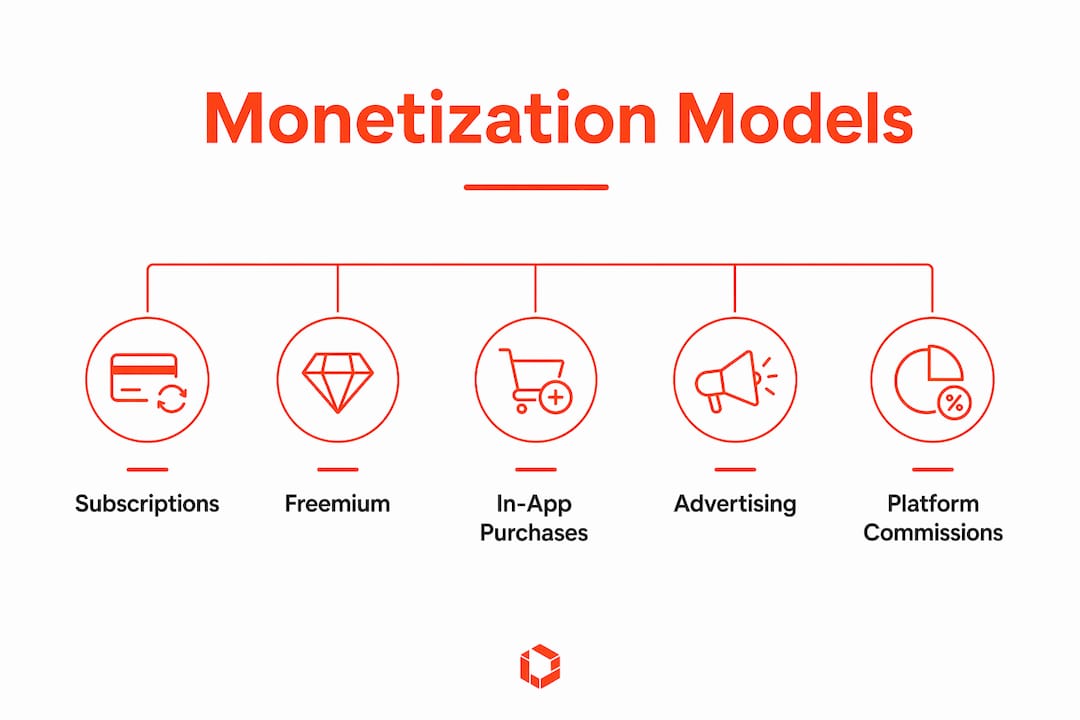
Advertising scales with daily active users, not with willingness to pay. It monetizes the 90% of users who will never open their wallets for a subscription, making it a natural complement to paid tiers rather than a replacement.

Platform commissions App-store fees vary by platform, region, transaction type, developer program, and billing method. Eligible developers may qualify for reduced rates, so startups should calculate fees using the latest Apple and Google terms for their target markets.
The rationale for hybrid monetization is straightforward: different users have different willingness to pay, and a single model cannot serve all of them efficiently. Segmented hybrid approaches increase average revenue per user by tailoring revenue streams to each segment rather than forcing everyone through the same paywall.
How should you structure pricing and subscription tiers?
Pricing is an iterative process, not a launch decision. The most common mistake is treating the initial price as fixed when it should be treated as a hypothesis to test aggressively.
Anchor high first. Test pricing based on your app category, audience, perceived value, and competitor landscape. Treat every initial price as a hypothesis that should be validated with real user data. Lower only if conversion data demands it, not because competitors are cheaper.
Push annual plans early. Annual subscribers retain at more than twice the rate of monthly subscribers. Lead with monthly to reduce signup friction, then feature annual prominently with a meaningful discount.
Test trial lengths. A 3-day trial converts very differently than a 14-day trial. Conversion problems often trace back to onboarding gaps or unclear value delivery, not price itself.
Localize pricing. Region-specific pricing can boost revenue by 30–50% in emerging markets. A user in India who won't pay $9.99/month may readily convert at $2.99. Both Apple and Google provide regional pricing tools; using them from day one is one of the most consistently underused revenue levers.
Add non-consumable IAPs. These capture users who resist subscriptions entirely, increasing ARPU without disrupting subscription dynamics.
Pro Tip: Before cutting your price, audit your onboarding flow. Most conversion failures are not price objections. They are value-perception failures that a better first-run experience would solve. Improving app user experience often moves conversion more than a 30% price reduction.
Churn mitigation deserves equal attention. Involuntary churn, where subscribers lose access due to payment failures rather than active cancellation, accounts for more than 23% of lost subscribers. Addressing this through retry logic and grace periods recovers revenue that most startups simply write off.
Common startup mistakes in app monetization and how to fix them
The most expensive mistake a startup can make is treating monetization as an afterthought. Monetization decisions shape your entire product architecture, and switching models post-launch is technically and economically painful due to deeply embedded infrastructure dependencies. Build your revenue model into the product from day one.
Misaligned feature gating. Gate features after users have experienced clear value, not before. Gate too early and you kill activation. Gate too late and users expect everything for free.
Aggressive ad placement. Poorly placed ads cannibalize potential paying users. Interstitials drive revenue in the short term but accelerate churn. Rewarded video is the highest-eCPM format with the lowest user friction.
Premature monetization asks. Timing matters as much as the offer itself. A paywall shown before a user has experienced the core value of your app is a conversion killer.
Ignoring user segmentation. Not all users are the same. High-intent users respond to annual plan offers. Price-sensitive users respond to limited-time IAPs. Users who will never pay still generate ad revenue. Treat them differently.
AI-powered churn prediction changes the economics of retention. Rather than offering blanket discounts to all at-risk subscribers, predictive churn models identify which users are about to cancel and trigger targeted interventions at the optimal moment. This approach is substantially more cost-effective than generic win-back campaigns after cancellation has already occurred.
Pro Tip: Sequence your monetization asks to match the user journey. A well-designed onboarding flow that delivers clear value in the first session creates the conditions for a paywall to convert. Without that foundation, no pricing strategy will compensate.
AI personalization also extends to ad strategy. Understanding how AI personalizes ad delivery for different user segments helps you maximize ad revenue without degrading the experience for users who are candidates for paid conversion.
What TouchZen's experience across 75+ apps reveals about monetization
The patterns that separate apps that grow from those that stall are consistent across TouchZen's portfolio of over 75 launched apps. Direct involvement of senior developers and designers from kickoff means monetization architecture gets built into the product, not bolted on after the fact. That distinction shows up in outcomes: apps built with monetization-first thinking have achieved results including a 10x increase in user subscriptions and surpassing 100,000 downloads within the first year.
A few principles that consistently drive those results:
Align monetization strategy with product design before writing code. The model you choose determines which features to build, which metrics to track, and which user behaviors to encourage.
Integrate data-focused testing from launch. A/B testing paywalls, trial lengths, and pricing tiers is not optional for startups that want to compete. It is the mechanism by which you close the gap between your initial hypothesis and what users actually do.
Invest in ongoing support post-launch. Apps that grow sustainably are those that continue to evolve based on real user behavior. Monetization optimization is not a launch task; it is a continuous process.
Prioritize user segmentation early. Knowing who your high-intent, mid-intent, and low-intent users are before you design your paywall is the difference between a monetization strategy that fits and one that frustrates.
The startups that reach sustainable revenue are not always the ones with the best product. They are the ones that built the right revenue model into the right product architecture from the start.
TouchZen builds apps designed to generate revenue from day one
TouchZen helps startups build monetization into their products from the beginning, with mobile app development led directly by senior developers and designers. With mobile app development led directly by senior developers and designers, your monetization architecture gets built correctly the first time, not refactored at significant cost six months later.
The track record speaks to the approach: 75+ apps launched, a 10x subscription growth result, and 100,000+ downloads in a single year for clients who committed to building monetization into the product from the start. TouchZen also specializes in AI-powered app development and product strategy consulting, giving startups the technical depth and strategic clarity to implement hybrid monetization models that actually perform. Ongoing support after launch means your revenue model keeps evolving as your user base grows.
Key Takeaways
Hybrid monetization is the single most effective revenue strategy for startups in 2026, combining subscriptions, in-app purchases, and advertising to capture revenue across every user segment.
Point | Details |
|---|---|
Hybrid models dominate | Over 60% of top-grossing apps combine multiple revenue streams to serve diverse user segments. |
Subscriptions lead on ARPU | Subscription apps generate 4.6x higher average revenue per user than ad-only models; annual plans retain at twice the rate of monthly. |
IAPs drive nearly half of earnings | In-app purchases account for approximately 48.2% of all mobile app earnings; design for high-spend users. |
AI personalization lifts conversion | Dynamic paywalls and predictive churn models improve conversion by 15–25% when applied at the right moment in the user journey. |
TouchZen builds revenue-first apps | With 75+ apps launched and results like 10x subscription growth, TouchZen integrates monetization strategy from day one. |
Frequently Asked Questions
What is the best mobile app monetization strategy for a startup?
The best strategy depends on the app’s audience, category, and user behavior. Many startups benefit from a hybrid model that combines subscriptions, in-app purchases, and advertising to serve different user segments.
Should a startup use subscriptions or in-app purchases?
Subscriptions work well when an app provides ongoing value through regularly updated content, services, or features. In-app purchases are often better for one-time upgrades, virtual items, or optional features. Some apps successfully combine both.
When should an app monetization strategy be planned?
Monetization should be considered during the product strategy and design stages. Planning it before development helps ensure that pricing, feature access, analytics, and payment infrastructure are built into the product from the beginning.
How can startups monetize an app without hurting the user experience?
Start by allowing users to experience the app’s core value before presenting a paywall or purchase request. Keep advertisements relevant and minimally disruptive, segment users based on their behavior, and test different offers rather than showing everyone the same message.
Is freemium a good monetization model for startups?
Freemium can work well when the free version attracts a large audience and the premium tier offers a clear reason to upgrade. However, startups should carefully define which features remain free so the app provides real value without removing the incentive to pay.


