

Joy Foroughi
Executive Assistant


App Development Scope Creep: Founders’ One Week Tradeoff Rule
To help prevent scope creep, use a change control process that assesses impact, assigns a decision-maker, and reviews requests regularly. Estimate the cost, schedule impact, and risks of proposed changes before work begins.

To help prevent scope creep, use a change control process that assesses impact, assigns a decision-maker, and reviews requests regularly. Estimate the cost, schedule impact, and risks of proposed changes before work begins.
TL;DR:
Define a one page scope baseline with explicit exclusions and acceptance criteria, since unclear requirements, missing task breakdowns, and weak traceability invite unpriced additions.
Log each request in a separate change cost account, including engineering, QA, integration, schedule, risk, and analysis estimates, before deciding whether to approve it.
Approve an addition only by removing or deferring work of comparable overall delivery effort, including testing and integration, or by explicitly increasing the budget and deadline; never add it by default.
Reserve a discovery or scope review window, then move new enhancements into a later phase unless their measured value justifies replacing current work.
What Scope Creep Is and Why It Threatens Your App Launch
Scope creep is the uncontrolled expansion of a project's requirements without matching adjustments to time, budget, or resources. It differs from an approved change: a change goes through evaluation and sign-off, while scope creep slips in through small, unexamined additions that nobody formally priced.
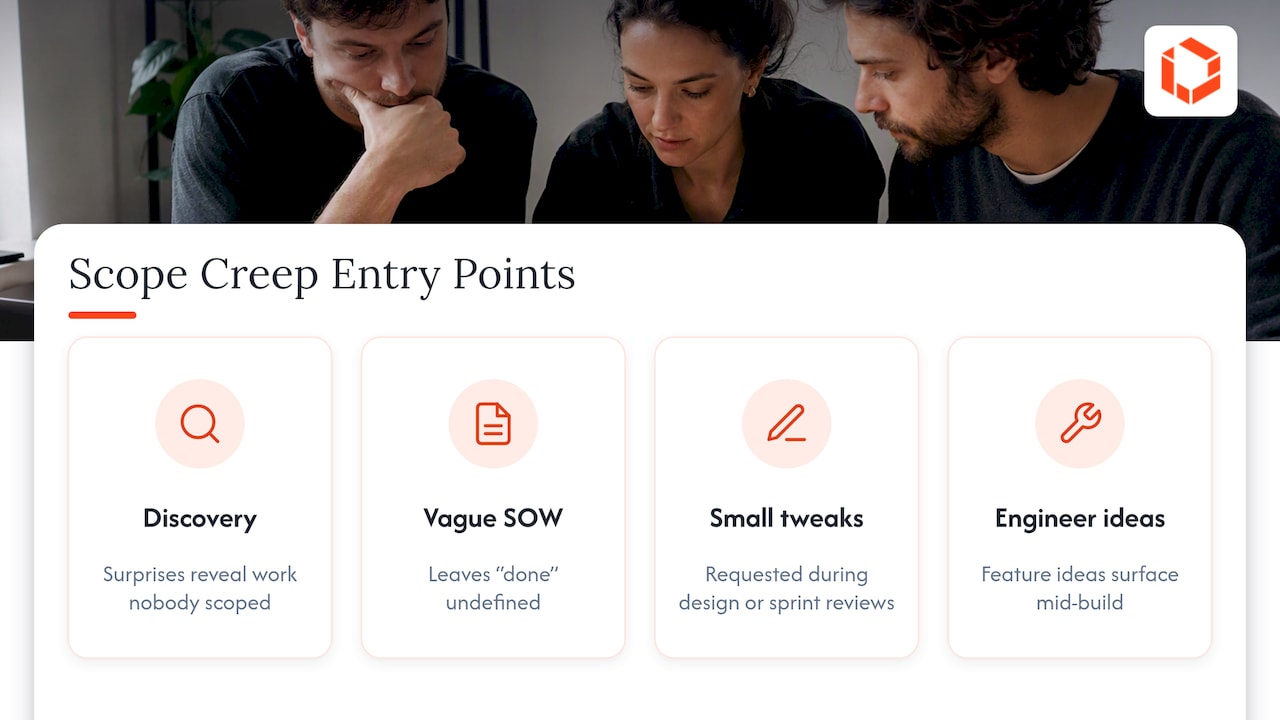
In app development, creep tends to enter through four doors: discovery surprises that reveal work nobody scoped, a vague statement of work that leaves "done" undefined, small tweaks requested during design or sprint reviews, and feature ideas engineers themselves surface mid-build. Each one feels minor in isolation.
The cumulative effect is not minor. Atlassian's guidance on scope creep describes it as unapproved work that expands scope without the time, budget, or resources to match, and the classic triple constraint explains why that matters: every unplanned addition can affect cost, schedule, or quality. Founders who treat each request as a quick favor, rather than a line item against a finite budget, end up paying for it later in a rushed QA cycle or a slipped launch date.
Root Causes Worth Auditing Before You Touch the Process
Most scope creep traces back to a handful of systemic gaps rather than any one bad request. Before building a new process, check whether these issues are already present in how your project runs.
Ambiguous scope or incomplete requirements that leave room for interpretation on both sides.
No empowered sponsor or product owner, which creates decision latency while requests wait for an answer.
Informal change channels, like Slack messages or hallway asks, with no change register to capture them.
A discovery gap between what the original scope assumed and what engineering actually finds once building starts.
Approval processes that are either too loose, letting everything through, or too rigid, blocking valid improvements outright.
Common causes include unclear scope statements, missing task breakdowns, and weak requirements traceability. The fix starts with naming which of these gaps exists in your project, not with adding more approval steps.
Turning a Change Request Into Real Cost and Schedule Numbers
Every added feature consumes engineering hours and QA time, and both of those translate directly into schedule and budget impact. A two-day design tweak rarely stays a two-day tweak once it touches integrations, testing, and review cycles.
Track every incoming request in a separate change cost account, even before you decide whether to approve it. Seeing the accumulated hours and dollars attached to pending requests, rather than approving each one as it lands, makes the pattern visible and makes trade-offs concrete instead of abstract. For a founder working from an existing budget framework, our app development cost breakdown guide is a useful reference point for where hours typically go.
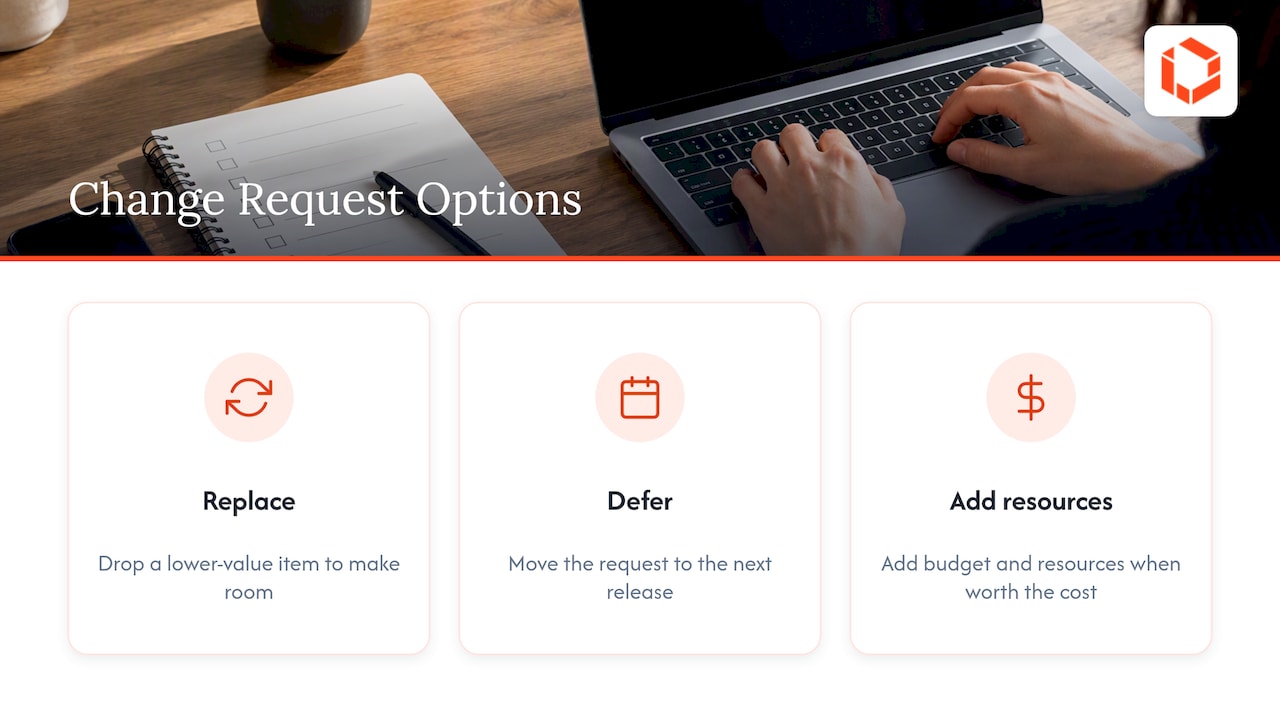
Once you have a number, the trade-off becomes a real decision: drop a lower-value item to make room, defer the request to the next release, or add budget and resources when the request is worth the cost. Each option is valid under different circumstances, but none of them should happen by default.
The Founder's 6-Step Prevention Framework for Controlling Scope
Stopping ad hoc approvals means replacing them with a short sequence you run every time a change surfaces. None of these steps requires a full project management office, just discipline about when and how decisions get made.
Publish a one-page scope baseline with explicit in-scope and out-of-scope lists and clear acceptance criteria for each deliverable.
Name a single empowered product owner or sponsor responsible for trade-off decisions.
Require every change request to include a business rationale, an impact estimate, and a proposed trade-off before anyone discusses approval.
Apply the trade-off rule: no addition gets approved without dropping or deferring an item of comparable overall delivery effort, including testing and integration, or explicitly adjusting the budget and deadline.
Run a weekly change-review cadence so decisions get batched and evaluated together instead of approved in the moment.
Update the scope baseline, backlog, and change log after every approved change, and keep rejected or deferred estimates visible in the change cost account.
Pro Tip: Treat the weekly review as a standing meeting with a fixed agenda, not an open floor. Decisions made outside the meeting should follow the same approval process and be recorded in the change log.
This structure works because it removes two failure modes at once: panic approvals made in real time, and silent scope expansion that nobody tracked. The discovery phase guide we published walks through how to timebox the research that often feeds step three.
A Copy-Ready Change Control Process You Can Use This Week
The sequence is simple: submit, assess, decide, record, update. What makes it work is consistency, not complexity.
Submission fields: who is requesting the change, the business rationale, acceptance criteria, an estimate covering engineering hours, QA, and integration work, and a proposed trade-off.
Impact analysis checklist: engineering hours required, schedule delta in days or weeks, QA and test impact, integration or dependency risk, and which user-facing metrics the change touches.
Decision thresholds: a project manager can approve smaller changes or a modest dollar threshold on their own; anything larger routes to the named sponsor for a trade-off decision.
Recording: log every decision, whether approved, deferred, or rejected, update the backlog immediately, and charge the analysis time itself to the change cost account so the cost of evaluating requests stays visible too.
PMI's controlling scope creep library entry is explicit that this kind of quantified, pre-work assessment, not after-the-fact cleanup, is what keeps change manageable. Pair it with our mobile app development timeline guide when you need real reference points for how a schedule delta plays out in weeks.
Governance: Who Decides, and How Fast
Decision latency, the gap between a request arriving and a decision being made, can leave teams blocked or working from assumptions. The longer a decision sits, the more pressure builds to approve it just to move forward, regardless of whether it is the right call.
Assign clear thresholds: day-to-day scope questions sit with the product owner, anything touching budget or launch date escalates to the sponsor, and both roles commit to a response within the weekly cadence rather than an open-ended wait. A simple RACI matrix at key milestones, naming who is responsible, accountable, consulted, and informed for each approval, prevents both stalled decisions and change requests nobody remembers approving. For founders building out this role for the first time, this guide on product owner responsibilities is a useful primer on what the job actually requires day to day.
The Documents That Make Scope Visible
Three documents do most of the work here, and none of them need to be long.
One-page SOW: objectives, success metrics, core deliverables, explicit out-of-scope items, and acceptance criteria for each deliverable.
Change-request template: requester, rationale, estimate, trade-off proposal, and decision outcome, five fields, nothing more.
Scope register: a running log tagging each request as approved, deferred, or rejected, tied to the change cost account so accumulated impact stays visible over time.
Pro Tip: Your issue tracker, a shared spreadsheet, or a simple board all work equally well. The tool matters far less than whether your team actually updates it every week.
PMI's guidance on scope control frames this kind of lightweight documentation as the structure that protects stakeholder interests without blocking valid improvements, which is exactly the balance founders need.
Handling Discovery Without Derailing Your Launch
Discovery almost always surfaces work nobody scoped at the outset, and treating every discovered item as urgent is how launches slip. Budget an explicit discovery or re-scoping window up front, rather than letting findings bleed directly into the active build.
Define your MVP tightly and push newly discovered enhancements into a clearly labeled next phase instead of folding them into the current baseline. Our MVP budget tiers guide walks through how phased delivery keeps a launch date intact while still capturing good ideas. When discovery turns up something genuinely high-value, run the same cost and benefit check you would for any other change, then apply the swap-or-defer rule rather than adding it on top.
Why Senior-Led Delivery Reduces Rework
A disciplined change process only works as fast as the team executing it. We ensure direct communication with senior developers and designers from kickoff to launch, which keeps decision loops short because the people assessing impact are the same people who will build the change. Senior-led delivery and ongoing post-launch support shorten the distance between a request and a decision, and that distance is where hidden rework usually hides.
What Founders Consistently Get Wrong About Scope Control
Most advice on scope creep focuses on documentation: write a better SOW, define acceptance criteria, build a requirements traceability matrix. That advice is not wrong, but it overstates what paperwork alone can do. A beautifully written scope baseline still fails if nobody is empowered to say no to a change in real time, and it still fails if the only person who can say yes takes too long to answer.
The lever that actually moves outcomes is decision speed paired with a forced trade-off. A sponsor who answers promptly, and who is required to cut or defer something every time they add something, changes behavior faster than any template. Founders should prioritize naming that person and setting that cadence before they spend another hour refining a scope document. The trade-off rule in particular deserves more attention than it gets: it is the single mechanism that stops "yes" from becoming the default answer to every request.
How We Help Founders Keep Scope and Costs Under Control
A tight process only works with a team that executes changes quickly and accurately, which is where direct communication with senior developers and designers pays off: fewer handoffs, faster impact estimates, less rework.

Product Strategy & Consulting for founders who need help building a scope baseline, SOW, and trade-off framework before the build starts.
Mobile App Development with senior engineers who can help shorten the gap between a change request and a working decision.
MVP Development for Start Ups for teams that need a tightly scoped first release with discovered work phased in deliberately.
Ongoing Support & Growth to manage post-launch requests through the same disciplined cadence rather than ad hoc fixes.
Book a discovery call or request a sample SOW through our app development services to see how a senior-led team handles your next change request.

FAQ
How can scope creep be managed?
Scope creep is managed with a formal change control process that estimates cost, schedule, and risk impact before any change is approved, paired with a named decision-maker and a regular review cadence. PMI's guidance ties this kind of upfront quantification directly to fewer unplanned expansions.
What is the act of unauthorized change to a project scope?
An unauthorized change to project scope happens when new work gets added or requirements expand without going through an approval process that checks cost, schedule, and resource impact. This is what separates scope creep from a properly approved change, which is documented and signed off before work begins.
What is the most important factor in helping you manage changeable project scope?
An empowered sponsor or product owner helps manage changing scope by making timely decisions, reviewing impact estimates, and approving clear trade-offs before additional work begins.
What can scope creep lead to?
Scope creep tends to push out timelines, increase costs, and strain quality, since added work consumes engineering and QA hours that were never budgeted. Atlassian's scope creep guidance frames this as unapproved work expanding beyond the resources set aside to deliver it.


