
Joy Foroughi
Executive Assistant


App Development Cost Breakdown: A 2026 Startup Guide
Explore our comprehensive app development cost breakdown. Understand essential expenses to budget effectively for your startup in 2026.

TL;DR:
App development costs range from $15,000 for simple MVPs to over $500,000 for complex enterprise applications.
Feature complexity is the main cost driver, with more advanced features increasing expenses five to ten times.
App development cost refers to the total expenses involved in designing, building, testing, and launching a mobile or web application. That total can range from $15,000 for a simple MVP to over $500,000 for complex enterprise apps, depending on scope, platform, integrations, and compliance requirements. For startup founders, understanding the full app development cost breakdown before writing a single line of code is the difference between a project that ships on budget and one that stalls at 60% complete. This guide gives you the exact cost categories, complexity tiers, and hidden expenses you need to build a realistic app development budget.
What are the main components of an app development budget breakdown?
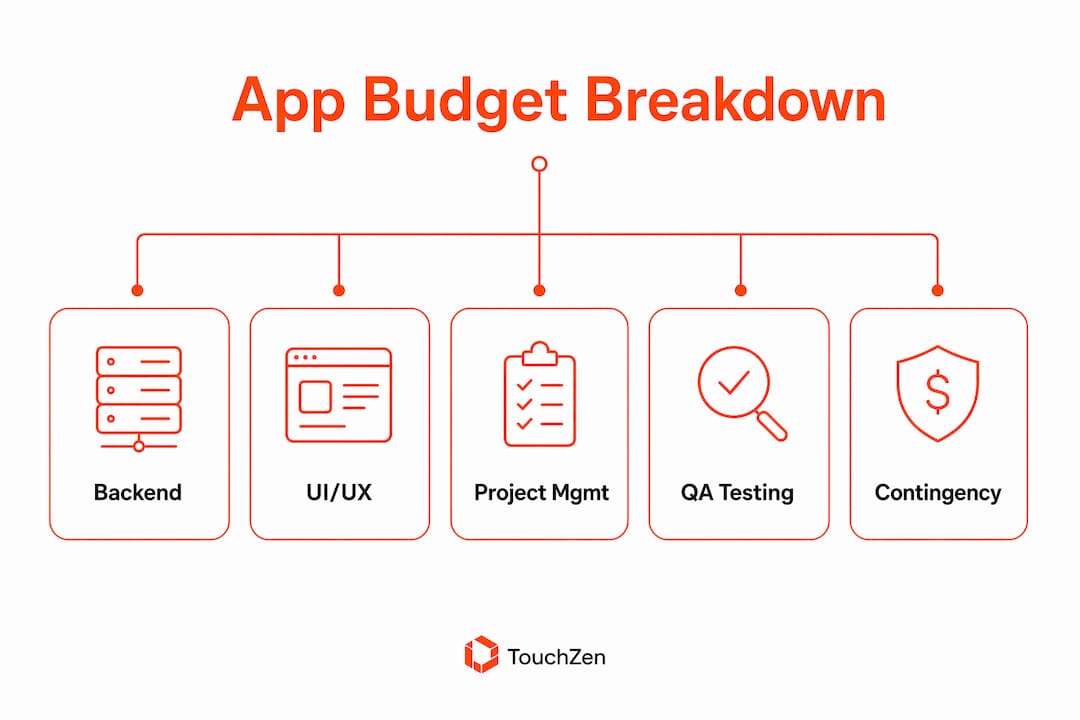
Every app development budget divides into five core categories. Knowing what each one costs, and why, prevents the most common startup budgeting mistake: treating development as a single line item.
Budget Category | Typical Share | What It Covers |
|---|---|---|
Backend development | 25–35% | APIs, databases, server logic, integrations |
Frontend development | 15–20% | UI rendering, client-side logic, navigation |
UI/UX design | 15–25% | Wireframes, prototypes, visual design |
QA and testing | 10–15% | Manual and automated testing, bug fixes |
Discovery and planning | 10–15% | Requirements, architecture, project scoping |
Backend development carries the largest share because it handles API complexity, database architecture, and the core business logic that makes your app actually work. A social platform with real-time messaging, for example, requires significantly more backend engineering than a simple content display app. Standard budget allocation puts development at 40–55% of total spend, with UI/UX design at 15–25%, QA at 10–15%, and planning at 10–15%. These percentages shift based on your app's complexity and the experience level of your team.
UI/UX design is the category founders most often underfund. Poor design decisions made early create expensive rework cycles during development. A well-funded design phase, guided by solid UI design principles, reduces the number of revision rounds and keeps the overall project on schedule.
Pro Tip: Add a 15–20% contingency line to your initial budget before you share it with stakeholders. Scope changes, third-party integration delays, and unexpected technical debt are not exceptions. They are standard parts of every app project.
How does app complexity influence overall development cost?
Feature complexity is the single biggest cost driver in any app project. Basic apps cost 5–10 times less than apps with advanced real-time features, AI components, or complex backend systems. That multiplier is not an exaggeration. It reflects the engineering hours required to build, test, and maintain each additional layer of functionality.

Complexity Tier | Typical Features | Cost Range |
|---|---|---|
Simple / MVP | Static content, basic auth, 1–3 screens | $15,000–$50,000 |
Medium | User profiles, payments, push notifications | $50,000–$200,000 |
Complex | Real-time data, third-party APIs, multi-role access | $200,000–$500,000 |
Enterprise | AI/ML, custom integrations, compliance, multi-platform | $500,000+ |
A simple MVP, such as a basic booking app or a content feed, sits at the low end because it requires minimal backend logic and a small number of screens. A medium-complexity app, like a marketplace with buyer and seller profiles and Stripe payment integration, demands more engineering across both frontend and backend layers. Enterprise apps, which often include AI-powered features, HIPAA or PCI compliance, and support for iOS, Android, and web simultaneously, can reach seven figures when you factor in ongoing development.
The practical lesson for founders is this: every feature you add to your initial scope multiplies cost, not just in build time but in testing, maintenance, and future updates. The most cost-effective approach is to define your MVP with ruthless discipline, launch it, and add complexity based on real user behavior.
What development approaches affect your app budget and timelines?
How you build your app matters as much as what you build. The three primary paths are a full-service agency, independent freelancers, and AI-powered development tools. Each carries a different cost profile, quality ceiling, and management burden.
Full-service agency: Provides a complete team including project managers, designers, and senior developers. Agencies deliver higher accountability and structured processes, but carry the highest upfront cost. This is the right choice when quality, speed, and clear ownership matter most.
Freelancers: Cost 40–60% less than agencies but transfer the project management burden directly to you. Scope creep and timeline delays are common when a founder is coordinating multiple freelancers without a dedicated project manager. The savings are real, but so is the hidden cost in your own time.
AI-powered tools: Can reduce upfront costs for simple, template-driven MVPs, but come with trade-offs in customization, security architecture, scalability, and long-term maintenance. They are best suited for proof-of-concept builds rather than production apps with complex requirements.
The right choice depends on your runway, your technical ability to manage vendors, and your quality expectations. Founders with limited technical experience who choose freelancers to save money often spend more in the long run through rework, delays, and missed launches.
Pro Tip: When evaluating vendors, ask for a fixed-price proposal with a clearly defined scope document. Hourly billing without a clearly defined scope and budget guardrails can increase the risk of budget overruns. A detailed scope document protects both sides.
What hidden costs should startups anticipate beyond initial development?
The quote you receive from a development team covers build costs. It rarely covers everything that comes after. Post-launch and operating costs can materially increase an app’s first-year budget, and many founders only discover this after launch.
App store fees: Apple charges a $99 annual developer fee. Google charges a one-time $25 registration fee. Both platforms take a 15–30% cut of in-app purchases and subscriptions.
Hosting and infrastructure: Cloud hosting on AWS, Google Cloud, or Azure scales with usage. A new app might spend $50–$200 per month at launch, but that number grows quickly with user volume.
Ongoing maintenance: Annual maintenance typically runs 15–20% of the original development cost. This covers bug fixes, OS updates, security patches, and minor feature additions.
Project management overhead: If you are managing freelancers or a distributed team, your own time has a cost. Many founders underestimate this until they are spending 20+ hours per week on coordination.
Compliance and licensing: HIPAA, PCI, and third-party API fees add 15–25% more to development scope and budget. Health, finance, and e-commerce apps face the highest compliance burden, and these costs are almost always absent from initial estimates.
The total cost of ownership for an app is usually higher than the initial build quote once you factor in hosting, maintenance, compliance, app-store fees, and ongoing tools.
How to create an effective app development budget plan for startups
A realistic app development budget plan starts with clarity, not spreadsheets. Follow this process before you contact a single vendor.
Define your MVP scope. List only the features that are required for your first paying customer to get value. Cut everything else. A focused MVP is faster, cheaper, and easier to test.
Prioritize features by business impact. Rank every feature by how directly it drives revenue or retention. Features that score low move to a post-launch roadmap.
Choose your platform intentionally. Native iOS and Android apps cost more than cross-platform builds using frameworks like React Native or Flutter. Web apps cost less still. Choose based on where your users actually are, not where you want them to be.
Get three detailed proposals. Collect fixed-price proposals from at least three vendors. Compare scope documents, not just totals. A lower price with a vague scope is a risk, not a deal.
Add your contingency. Apply a 15–20% contingency to the total. Include year-one maintenance, hosting, and compliance costs in your full budget model.
Plan for iteration. Build your budget in phases. Fund your MVP fully, then allocate the next tranche based on what you learn from real users.
For a deeper look at how platform choices and feature decisions interact with total spend, the founder's cost breakdown covers the full picture with 2026 figures.
Key Takeaways
A realistic app development budget requires accounting for complexity, hidden costs, and ongoing expenses, not just the initial build quote.
Point | Details |
|---|---|
Cost ranges vary widely | Simple MVPs start at $15,000; enterprise apps exceed $500,000 based on features and complexity. |
Backend takes the largest share | Backend development consumes 25–35% of the total budget due to API and database complexity. |
Hidden costs add 30–50% more | Maintenance, hosting, compliance, and store fees expand the real cost well beyond the build quote. |
Development approach changes the math | Agencies cost more upfront; freelancers shift management burden to you; AI tools suit simple MVPs only. |
Phase your budget and scope | Fund your MVP first, validate with real users, then invest in additional features based on evidence. |
What I've learned about startup app budgets after 75+ launches
Founders consistently underestimate two things: the cost of project management and the cost of changing their minds mid-build. I have seen both destroy budgets that looked perfectly reasonable on paper.
The most expensive mistake I observe is treating the initial development quote as the total project cost. It never is. Compliance requirements alone, especially in health and finance, routinely add 15–25% to a project that looked fully scoped at kickoff. The founders who handle this well are the ones who ask for a full cost-of-ownership estimate upfront, including year-one maintenance and infrastructure, before they sign anything.
Phased development is not just a cost-control tactic. It is a quality control mechanism. When you build your MVP, launch it, and gather real data before funding the next phase, you stop building features based on assumptions. You build based on evidence. That shift alone can cut total development spend by 30–40% over the life of a product.
My strongest advice: get deeply involved in your budget conversations. Do not delegate cost discussions to a project manager or technical co-founder and wait for a summary. The founders who understand their own budget at a line-item level make better decisions at every stage, from vendor selection to feature prioritization to fundraising conversations.
— Cyrus
TouchZen builds apps that stay on budget and on schedule
Startup founders who work with TouchZen get direct access to senior developers and designers from day one, not a junior team that escalates problems upward. That structure eliminates the communication delays and scope drift that inflate budgets at traditional agencies.
TouchZen has launched over 75 apps across industries, with results including 10x growth in user subscriptions and 100,000 downloads within the first year of launch. The team provides transparent, fixed-scope proposals so you know exactly what you are paying for before the project starts. If you are ready to build with a team that treats your budget as seriously as you do, explore TouchZen's mobile app development services or connect with an expert directly at TouchZen's app experts page.
FAQ
How much does it cost to develop an app in 2026?
Mobile app development costs range from $15,000 for a simple MVP to over $500,000 for complex enterprise apps, with most SMB projects falling between $80,000 and $150,000.
What is the biggest cost driver in app development?
Feature complexity is the primary cost driver. Apps with real-time interactions, AI components, or complex backend systems cost 5–10 times more than basic apps with simple functionality.
What hidden costs should I budget for beyond development?
Maintenance, hosting, app store fees, and compliance requirements add 30–50% more to your initial build cost. Compliance alone, for HIPAA or PCI-regulated apps, can add 15–25% to total scope.
Is it cheaper to hire freelancers than an agency?
Freelancers cost 40–60% less than agencies upfront, but they require significantly more founder time for project management, which often leads to scope creep and timeline delays.
What is the most cost-effective way to start building an app?
Define a tightly scoped MVP, choose a cross-platform framework if your audience spans iOS and Android, and fund development in phases based on validated user feedback rather than assumptions.