
Joy Foroughi
Executive Assistant


The Software Development Discovery Phase: A Founder's Guide
Unlock the potential of your product with a thorough discovery phase. Learn how to define goals, validate assumptions, and ensure project success.

The discovery phase is a structured, time-boxed sprint that converts your assumptions about a product into validated scope, a prioritized roadmap, and measurable success criteria before a single line of production code is written. For founders, the core outcome is simple: you leave discovery knowing what to build, why it matters, and whether it is technically feasible. That clarity is what separates projects that ship on time from those that spiral into scope creep and budget overruns.
Before you commit to a full build, you should demand these outputs from any discovery engagement:
Problem statement: A single written document defining the user problem, the business opportunity, and the constraints.
Prioritized hypotheses: A ranked list of assumptions your product must validate to succeed.
Wireframes or low-fidelity prototype: A clickable or static visual that tests core user flows.
Technical feasibility notes: A written assessment of architecture, integrations, and any data or AI readiness gaps.
High-level roadmap: A phased delivery plan with milestones and guardrail metrics.
Success metrics and KPIs: Specific, measurable targets tied to business outcomes.
A focused half-day workshop can produce a problem statement and initial hypotheses for a narrow product question. A deeper discovery engagement typically runs one to four weeks, with the longer window justified when your product involves AI/ML components, regulated data, or significant integration complexity.
Key Takeaways
The discovery phase is the highest-leverage investment a founder can make before committing to a full build: it converts assumptions into validated scope, reduces cost overruns, and produces investor-grade artifacts in one to four weeks.
Point | Details |
|---|---|
Demand written artifacts | Require a problem statement, personas, user journeys, wireframes, technical feasibility report, and a roadmap before any build begins. |
Run user interviews at scale | Talk to 20–30 users outside your network to surface real behavioral patterns, not polite feedback from people who know you. |
Check AI data readiness early | Validate data volume, labeling status, and legal consent in week one; a data gap discovered in week eight of a build is a crisis. |
Use RICE or MoSCoW to prioritize | Convert discovery hypotheses into a timeboxed MVP slice using a structured framework, not stakeholder consensus alone. |
TouchZen begins with technical discovery | TouchZen assesses requirements, platform options, and architecture before development begins. |
What Is the Discovery Phase and Why Does It Matter for Startups?
Discovery is not requirements gathering. Traditional requirements work assumes you already know what to build and focuses on documenting it. Discovery assumes you do not yet know, and it uses structured research, rapid prototyping, and stakeholder alignment to find out. That distinction is the entire business case.
For a startup, the cost of building the wrong thing is existential. You burn runway, miss your market window, and lose the trust of early users. Structured early discovery directly reduces these risks by surfacing misaligned assumptions before engineering spends begin. The CHAOS report research on project failure consistently identifies poor requirements and planning as leading contributors to cost overruns and outright project failure.
Statistic callout: Requirements and planning failures are among the top causes of software project failure. Front-loading discovery to validate scope and surface risks is one of the highest-leverage investments a founder can make before committing to a full build.
PMI's guidance on project planning reinforces this directly: proper front-loaded planning improves delivery predictability and reduces the likelihood of scope changes during execution. For founders, that translates to fewer emergency pivots, lower renegotiation costs with vendors, and a cleaner story for investors.
Discovery also produces investor-grade artifacts. A documented problem statement, a hypothesis list with supporting user research, and a technical feasibility report signal to investors that you have done the work. They show you are not building on gut instinct alone. When you walk into a seed round with a validated discovery package, you are presenting evidence, not a pitch deck full of assumptions.
Compared with a traditional spec-driven approach, discovery is faster to start, cheaper to course-correct, and far more likely to surface the real user problem rather than the one you imagined. The agile development approach that reduces rework builds directly on discovery outputs, which is why skipping discovery almost always creates more rework downstream.
What Are the Core Activities That Make Discovery Effective?
These activities are non-negotiable if you want discovery to reduce uncertainty rather than just produce documents. Each one targets a specific type of risk.
Stakeholder interviews surface competing priorities before they become mid-build conflicts. Ask your co-founders, department leads, and key investors what success looks like in 12 months. You will rarely get the same answer twice, and that divergence is exactly the signal you need.
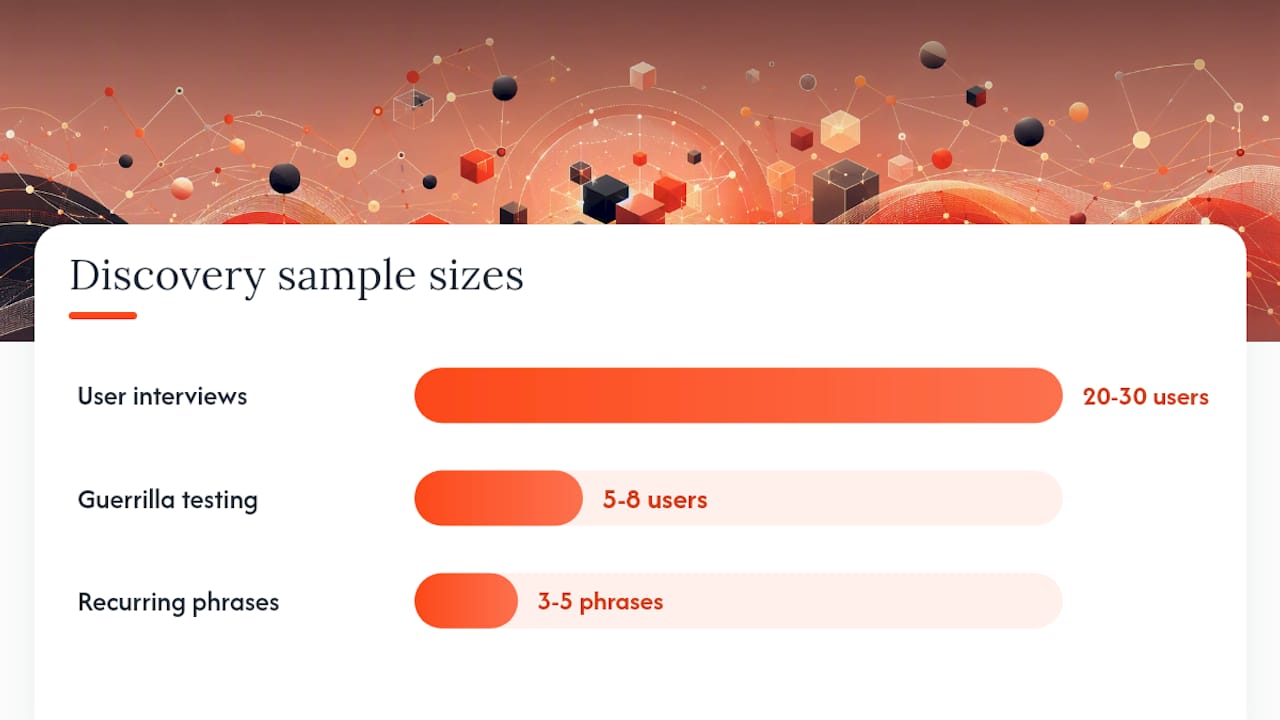
User interviews are where the highest-leverage learning happens. Founder playbooks consistently recommend talking to 20–30 users before committing to a build, using open-ended questions that surface behavior rather than opinions. Here are eight questions worth using:
For user interviews:
"Walk me through the last time you tried to solve [problem]. What happened?"
"What do you do today when [problem] comes up? How long does that take?"
"What part of that process frustrates you most?"
"Have you tried any tools or workarounds? What did you like or dislike about them?"
For stakeholder interviews:
"What does success look like for this product in 12 months?"
"What is the single biggest risk you see in this project right now?"
"Which user segment matters most to the business, and why?"
"What would have to be true for you to consider this project a failure?"
Competitive scan maps what already exists, where incumbents are weak, and what your differentiation must be. Keep it focused: two to three hours of structured analysis beats a 40-slide deck nobody reads.
Journey mapping traces the user's experience from trigger to resolution, exposing friction points that interviews alone may not surface. Process mapping does the same for internal workflows, which matters when your product automates or replaces an existing business process.
Technical spikes are short, time-boxed experiments that answer a specific feasibility question. Can you integrate with that legacy API? Can the model run at acceptable latency on mobile? A spike answers the question in hours, not weeks.
Low-fidelity prototypes test assumptions about user flows before any engineering work begins. A Figma prototype or even a paper sketch can validate whether users understand your core interaction model.
Metrics definition closes the loop. Every discovery engagement should end with a written list of KPIs tied to specific business outcomes, not vanity metrics.
Pro Tip: When synthesizing user interview notes, look for the three to five phrases that appear across multiple conversations without prompting. Those recurring unprompted phrases are your strongest signal about unmet needs. Build your problem statement around them, not around the features users requested.
For startups on a tight budget, guerrilla testing (recruiting five to eight users from a coffee shop or online community), diary studies using a simple Google Form, and analytics heuristics from existing tools like Mixpanel or Amplitude can substitute for formal research when time and money are limited.
What Deliverables Should You Demand from a Discovery Engagement?
Artifacts are the single best proof that discovery produced real decisions rather than just conversations. Without written deliverables, you have no baseline to manage scope, no reference point for investor discussions, and no handoff package for the engineering team. A well-structured product roadmap starts with exactly these discovery artifacts.
Here is the complete list of what to request, with a one-line purpose and a suggested filename for each:
Problem statement and goals (
ProblemStatement_v1.docx): Defines the user problem, business opportunity, and out-of-scope constraints. This is the north star document.Success metrics and KPIs (
SuccessMetrics_v1.xlsx): Specific, measurable targets (e.g., 30-day retention rate, activation rate, revenue per user) tied to business outcomes.Personas (
Personas_v1.pdf): Two to four user archetypes with behavioral attributes, goals, and pain points grounded in interview data.User journeys (
UserJourneys_v1.pdf): Step-by-step maps of how each persona moves from problem trigger to resolution, with friction points annotated.Prioritized hypothesis list (
Hypotheses_Prioritized_v1.xlsx): Ranked assumptions the product must validate, each with a proposed experiment or metric.Wireframes or prototype (
Prototype_FigmaURLorWireframes_v1.pdf): Low-to-mid fidelity visuals of core user flows, testable with real users.Technical feasibility report (
TechFeasibility_v1.docx): Architecture assessment, integration risks, data readiness gaps, and any AI/ML-specific constraints.High-level estimates and roadmap (
Discovery_Roadmap_v1.xlsx): Phased delivery plan with milestones, team size assumptions, and rough cost ranges.Assumptions and risk register (
RiskRegister_v1.xlsx): A living list of open assumptions and risks, each with an owner and a mitigation note.
Store all of these in a shared discovery folder (Google Drive or Notion work well) with version control. The folder becomes your living reference throughout the build. When scope discussions arise with your engineering team or agency, you pull from this folder rather than relying on memory. For a deeper look at how these artifacts connect to cost reduction in delivery, the agile design workflow that cuts costs by 60% illustrates the downstream value of clean discovery handoffs.
How Do You Run a Discovery Workshop That Actually Produces Results?
A tightly run workshop unlocks alignment and produces decision-quality artifacts within a defined timebox. The key word is "tightly." Without a structured agenda and a facilitator who enforces time limits, workshops drift into open-ended debate and produce nothing actionable.
Basecamp's Shape Up methodology makes a compelling case for timeboxed, outcome-focused scoping cycles. The same logic applies to discovery workshops: define the output you need, set the clock, and stop when time is up.
Half-day workshop agenda (4 hours)
0:00–0:30 — Problem framing (Facilitator + Founder): State the business problem in one sentence. Write it on the whiteboard. Challenge it. Rewrite it until the room agrees.
0:30–1:00 — Assumption mapping (Full team): Each participant writes their top three assumptions about users, the market, and the technology on sticky notes. Group and rank by risk.
1:00–1:45 — Persona creation (Design lead + Founder): Draft two primary personas from interview data or best available knowledge. Identify the one persona whose problem the MVP must solve.
1:45–2:15 — Journey mapping (Full team): Map the primary persona's journey from trigger to resolution. Mark the two biggest friction points.
2:15–2:45 — Solution sketching (Technical lead + Design lead): Sketch two to three possible solutions on paper. No screens, no Figma yet.
2:45–3:15 — Dot-voting and prioritization (Full team): Each participant gets five votes. Allocate them to the solution elements that best address the top friction points.
3:15–4:00 — Outcomes and next steps (Founder): Write the agreed problem statement, the top three hypotheses, and the next three actions with owners and deadlines.
For collaborative tooling, Miro works well for sticky-note exercises and journey maps, Figma handles wireframing and prototyping, and Google Slides is sufficient for stakeholder presentations. Ask your agency for a pre-built Miro template before the session starts. Good client-agency communication practices make the difference between a workshop that produces artifacts and one that produces only discussion.
After the half-day workshop, you should leave with: a written problem statement, a ranked assumption list, and three next actions with owners.
How Do You Prioritize Features and Build an MVP Roadmap from Discovery?
Use a simple prioritization framework and convert your ranked hypotheses into a timeboxed MVP slice. The goal is not to build everything discovery surfaced. It is to identify the smallest set of features that tests your riskiest assumptions and delivers measurable value to your primary user.
Framework | Best used when | Scoring method | Limitation |
|---|---|---|---|
RICE | You have multiple features competing for limited engineering time | Reach × Impact × Confidence ÷ Effort | Requires honest effort estimates |
MoSCoW | You need fast stakeholder alignment on scope | Must / Should / Could / Won't | Can become political without a facilitator |
Effort vs. Impact | You want a quick visual sort in a workshop | 2×2 matrix, dot-vote placement | Lacks numeric rigor for complex decisions |
RICE works best when your team can estimate effort with reasonable confidence. MoSCoW is faster and better for stakeholder alignment sessions where you need a shared decision in under an hour. The effort vs. impact matrix is the right tool for a workshop where you need to sort 20 ideas in 30 minutes.
Once you have a prioritized list, convert the top items into a roadmap slice using this hypothesis template:
We believe [user segment] will [desired behavior] if we [solution]. We’ll know this is true when [metric] reaches [target] within [timeframe].
A sample three-to-six-month MVP roadmap might look like this:
Month 1–2 (Foundation): Core user authentication, primary user flow, and analytics instrumentation. Guardrail metric: activation rate above 40%.
Month 3–4 (Validation): First hypothesis-driven feature, user feedback loop, and A/B test setup. Guardrail metric: 7-day retention above 25%.
Month 5–6 (Growth lever): Second hypothesis feature, onboarding optimization, and first monetization experiment. Guardrail metric: revenue per activated user above $X.
For a deeper look at how to structure this roadmap for a mobile product, the mobile app product roadmap guide covers the sequencing logic in detail. If you are moving from roadmap to build, TouchZen's MVP development service is built specifically for founders at this stage.
What Technical and AI Feasibility Checks Should You Run During Discovery?
Technical feasibility is often binary for startups: either the data, integrations, and architecture are realistic given your timeline and budget, or you need to change scope before engineering begins. Discovering that constraint in week one of discovery costs almost nothing. Discovering it in week eight of a build costs everything.
Core technical feasibility checklist:
Is the required third-party API available, documented, and within your cost model?
Does the architecture support the expected load at launch (not at scale, but at launch)?
Are there latency requirements (real-time features, offline mode) that constrain the tech stack?
What are the authentication and authorization requirements? Does the product handle PII?
Are there existing systems (CRM, ERP, legacy databases) that require integration? What are their data formats?
Has a technical spike been run on the highest-risk integration or algorithm?
Is the deployment environment defined (AWS, GCP, Azure, on-premise)?
Are there mobile-specific constraints (iOS App Store review, Android permissions, background processing limits)?
For products with AI or ML components, the feasibility bar is higher. The data readiness check is often the single most important activity in the entire discovery phase.
Pro Tip: Before committing to custom ML development, test the use case with a rule-based system or a suitable pre-trained model using a representative pilot dataset. If the baseline produces weak results, review the data quality, task definition, and evaluation method before investing in custom training.
Include a legal or compliance observer in discovery sessions only when the product handles PHI, financial data, or other regulated information.
Who Should Participate in Discovery Sessions?
The core discovery team should include the founder or product lead, a technical lead, and a design lead. Add a data specialist when AI is in scope, and involve legal or compliance when the product handles regulated data.
Keep workshop decision-makers to three or four people. Gather input from other stakeholders through short interviews before the workshop, then bring the synthesized findings into the session.
How Long Does Discovery Take and What Does It Cost?
Discovery is a small upfront investment that prevents much larger downstream costs. A half-day workshop for a narrow product question might cost a few thousand dollars in facilitation time. A four-week discovery engagement for a complex product with AI components might run $15,000–$40,000 depending on team seniority and scope depth. Neither figure is a hard rule, but both are a fraction of what a misdirected three-month build costs.
Timebox examples by project scope:
Half-day workshop: Best for a single product question or a team that needs alignment on one decision. Deliverable gate: problem statement and ranked assumption list.
One-week discovery: Suitable for a focused MVP with a known user base and no AI components. Deliverable gate: personas, user journeys, wireframes, and a draft roadmap.
Two-to-four-week discovery: Required for products with AI/ML components, significant integration complexity, or regulated data. Deliverable gate: full artifact set including technical feasibility report, data readiness assessment, and a signed-off roadmap.
Primary cost drivers:
Team seniority (senior product, design, and engineering leads cost more but produce better artifacts)
Number of user interviews (each interview adds two to four hours of scheduling, conducting, and synthesis time)
Technical spike complexity (a spike on a novel API or ML pipeline can take three to five days)
Prototype fidelity (a clickable Figma prototype costs more than paper sketches but produces better user feedback)
Number of stakeholder sessions required to reach alignment
Questions to ask a vendor when evaluating a discovery quote:
"Who specifically will run the user interviews — a senior researcher or a junior coordinator?"
"What deliverables are included in the fixed price, and what triggers a change order?"
"Can I see a sample artifact from a previous discovery engagement?"
"What happens if we surface a major pivot during discovery — is there a process for rescoping?"
"Is this a fixed-price discovery or time-and-material? What is the difference in risk for me?"
Fixed-price discovery gives you cost certainty but can create incentives to rush. Time-and-material gives you flexibility but requires tighter oversight. For most founders, a fixed-price discovery with clearly defined deliverable gates is the lower-risk option.
For startups managing early-stage finances alongside discovery costs, understanding your pre-revenue startup accounting helps you categorize discovery spend correctly and plan your runway.
What Red Flags Should Pause or Extend Your Discovery?
The most valuable output of discovery is sometimes the decision not to build. Certain findings should stop or significantly extend the process before any engineering begins.
Red flags that demand a pause or extension:
Unvalidated core assumption: Your product's entire value proposition rests on a single assumption that no user interview, prototype test, or data analysis has yet confirmed. Building on an unvalidated core assumption is the fastest path to a failed launch.
Divergent stakeholder goals: Two or more key decision-makers have fundamentally different definitions of success. No roadmap survives that conflict intact.
Data gaps for AI: Your ML use case requires labeled training data that does not yet exist, or the available data is too small, too biased, or not legally cleared for model training.
Legal or regulatory constraint: Discovery surfaces a compliance requirement (HIPAA, CCPA, financial regulation) that was not in the original scope and requires legal review before architecture decisions can be finalized.
Integration blocker: A required third-party API is unavailable, deprecated, or priced outside your cost model.
No clear primary user: After five or more user interviews, you still cannot identify a single user segment with a consistent, urgent problem.
Decision rules:
Extend discovery when you have a clear direction but one or two critical assumptions remain unvalidated. Add one to two weeks and run targeted experiments.
Pivot scope when user interviews consistently reveal a different problem than the one you set out to solve. Rewrite the problem statement and re-prioritize.
Stop and regroup when stakeholder goals are irreconcilable, the data for an AI use case does not exist, or a legal constraint fundamentally changes the product architecture.
A common founder scenario: you enter discovery planning to build an AI-powered recommendation engine, but your data readiness check reveals you have fewer than 500 labeled examples and no consent framework for collecting more. The right call is to scope the MVP without the ML component, build the data collection mechanism into the product, and revisit the AI feature in a later phase once you have the data to support it.
Your Pre-Discovery Kickoff Checklist
Before the first discovery session, confirm these essentials:
Business outcome: Define what success should look like in 12 months.
Core participants: Confirm the founder, technical lead, and design lead.
User access: Prepare a list of target users available for interviews.
Data and analytics: Grant access to relevant product data and analytics.
Tools and workspace: Set up the shared Figma, Miro, Google Drive, or Notion workspace.
Budget and timeline: Approve the discovery scope, cost, and schedule.
After the first session, the founder should approve the problem statement and ranked assumption list.
What Founders Consistently Underestimate About Discovery
Founders often underestimate how long it takes to gather reliable user signals, how difficult it can be to access clean and legally usable data, and how quickly stakeholder disagreement can slow prioritization. Reduce these risks by recruiting users outside your personal network, auditing data in week one, using structured voting, and maintaining a living risk register throughout discovery.
Discovery is not a formality. It is the process that converts assumptions into an evidence-backed plan before significant engineering time and budget are committed.
TouchZen Runs Discovery the Way Founders Actually Need It
TouchZen begins mobile app projects with technical discovery and architecture planning. The team assesses requirements, selects the appropriate platform approach, and defines a scalable technical foundation before development begins.
From there, TouchZen supports mobile development, integrations, quality assurance, launch, and ongoing optimization based on the needs of each product. Founders can explore TouchZen’s mobile app development services or book a strategy call to discuss their project.
Sources
FAQ
What is the discovery phase in software development?
The discovery phase is a structured, time-boxed process that validates product assumptions, defines scope, and produces a prioritized roadmap before engineering begins. It typically runs one to four weeks and delivers artifacts including a problem statement, personas, wireframes, and a technical feasibility report.
How much does a software discovery phase cost?
Costs vary by scope, team seniority, research depth, and prototype complexity. A focused workshop may cost a few thousand dollars, while a complex two-to-four-week engagement may range from $15,000 to $40,000.
Can you skip discovery for a simple app?
Skipping discovery increases the risk of building the wrong feature set, even for simple products. A half-day workshop is sufficient for narrow product questions and costs a fraction of a single sprint of misdirected engineering work.
What AI-specific checks belong in discovery?
Validate data volume, labeling pipeline, privacy and consent status, and model evaluation plan before committing to any ML component. Run a baseline model on a pilot dataset of 200–500 examples before investing in custom model development.
How does discovery connect to MVP development?
Discovery outputs, specifically the prioritized hypothesis list and the high-level roadmap, define the MVP scope directly. The three to five features that survive prioritization become the MVP build plan, with guardrail metrics set during discovery used to evaluate launch success.