

Joy Foroughi
Executive Assistant


Founders: 5 Protections to Lock IP in Mobile App Development Contracts
Before you sign anything, secure five protections: present-tense IP assignment, a Statement of Work with objective acceptance criteria, milestone payments tied to verifiable deliverables, written data-security obligations, and guaranteed transition assistance. Ask for repository access from day one, a signed assignment instrument, a breach-notice timeline, and a named escalation path before funds move. Cite the Copyright Act and FTC security guidance when your counsel reviews the draft.
Before you sign anything, secure five protections: present-tense IP assignment, a Statement of Work with objective acceptance criteria, milestone payments tied to verifiable deliverables, written data-security obligations, and guaranteed transition assistance. Ask for repository access from day one, a signed assignment instrument, a breach-notice timeline, and a named escalation path before funds move. Cite the Copyright Act and FTC security guidance when your counsel reviews the draft.
TL;DR:
A clear, signed present-tense IP assignment at project start is essential to ensure ownership of the code remains with your company.
Milestone payments should be strictly tied to specific, testable acceptance criteria to prevent disputes over scope and completion.
Your contract must specify data security obligations, including breach-notice timing in hours and SDK disclosure, to meet FTC and legal standards.
Change control should be documented with a formal process, fixed estimates, and written approval before work on scope modifications begins.
Transition support and full repository access must be explicitly listed as deliverables, with staged handovers tied to milestones to secure post-launch continuity.
Clause-by-clause checklist: what to ask for and the language to insist on
Every contract clause exists to answer one question: what happens when something goes wrong? Walk through each clause below with that question in mind, and push back wherever the answer is vague.
Start with the Statement of Work. A weak SOW says "build a social app with messaging and profiles." A strong one defines each milestone with pass/fail acceptance tests: specific screens, specific user flows, specific performance thresholds (load time under a stated number of seconds, crash rate below a stated percentage). Without measurable criteria, "done" becomes whatever the developer says it is.
Payment terms should follow the SOW, not the calendar. Tie each payment to a milestone's acceptance, not to time elapsed. For larger engagements, consider a small retainer held in escrow or released in stages, so the developer has skin in the game and you have leverage if a milestone slips.
IP assignment deserves its own paragraph in the contract, not a buried sentence. Look for present-tense language: "Developer hereby assigns" rather than "Developer will assign upon completion." The distinction matters legally and practically, since a future promise to assign is far weaker leverage than a signed transfer you already hold.
Confidentiality and data-security obligations need specifics, not platitudes. Ask for named measures: encryption in transit and at rest, a breach-notice window measured in hours or days, and the right to request a security audit. TouchZen's own guidance on mobile app security testing covers what a reasonable baseline looks like for a startup-stage app.
Warranties and remediation should guarantee a defect-fix window after each milestone's acceptance, typically a defined number of days, during which the developer fixes bugs at no additional cost. Remedies should be tied to acceptance testing, not left to goodwill.
Limitation of liability and indemnities are where developers try to cap their exposure tightly. Push back on caps that exclude carve-outs for IP infringement, gross negligence, or willful misconduct: those three categories should sit outside any liability ceiling.
Change control needs a written process: a change-request template, a defined re-estimation window, and a rule that work pauses until both sides approve cost and timeline changes in writing.
Maintenance, support, and SLAs should specify response and resolution windows for incidents, plus a full handover package at the end of the engagement: repository access, CI/CD keys, architecture diagrams, and admin credentials.
Subcontractor and key-person protections matter more than most founders realize. Require written disclosure before anyone outside the named team touches your codebase, and ask for a replacement commitment if a lead developer leaves mid-project.
Termination and transition assistance close the loop: define both termination for cause and termination for convenience, with reasonable notice periods, and require staged code handover regardless of why the contract ends.
Insist on present-tense IP assignment signed at kickoff, not promised at completion.
Require repository access with admin-level permissions from day one.
Tie every payment to an objective, testable acceptance milestone.
Name specific security measures: encryption, breach notice timing, audit rights.
Demand a written change-order process before any scope shifts.
Lock in transition assistance obligations regardless of how the contract ends.
Pro Tip: Ask for a redline of the SOW before you sign anything else. If the developer resists adding measurable acceptance criteria, treat that resistance as your answer.
How the contract model you choose changes your risk
The pricing structure you pick shapes which clauses matter most and how tightly you need to write them.
Fixed-price contracts work well for a clearly scoped MVP where requirements are stable. The risk sits with the developer to deliver within budget, but that only holds if the SOW is airtight. A vague fixed-price contract invites disputes over what counts as "in scope."
Time and materials contracts suit projects where requirements will evolve, like an AI-powered feature still being validated with users. The risk shifts to you as the founder, so acceptance criteria and change control become the two clauses you cannot skip. Without them, hours accumulate with no clear deliverable to show for it.
Milestone-based contracts, often layered onto either model, break payment into stages tied to working software. This is generally the safest structure for early-stage founders because it limits exposure at each checkpoint and gives you a natural point to walk away if quality slips.
Fixed-price: best for a stable, well-defined MVP; demands a precise SOW.
Time and materials: best for evolving scope; demands strict change control.
Milestone-based: best overall risk control; demands granular, testable milestones.
Whichever model you choose, size your contingency budget around the number of milestones, not the total project length: more, smaller milestones give you more exit points if something goes wrong.
What US copyright law means for who owns your app's code
Many founders assume that because they paid for the work, they automatically own it. That assumption is wrong under 17 U.S.C. §§ 101 and 201, which makes clear that custom-commissioned software does not automatically become a "work made for hire." Ownership defaults to the creator unless a written agreement signed by both parties states otherwise.
That written agreement needs one more feature: present-tense assignment. Under Title 17's ownership and transfer provisions, a transfer of copyright ownership is not valid unless it is recorded in a written instrument signed by the owner. A promise to assign later is not the same as an assignment executed now and recordation gives you constructive notice and priority if a dispute ever arises.
The operational side matters as much as the legal text. Demand repository access with commit history visible from day one, not delivered as a final export. Demand deployment keys transferred as milestones close, not held back until the final invoice clears.
Require a signed assignment instrument at kickoff, not a promise to assign later.
Get admin-level repository access before development starts, not after launch.
Tie each milestone payment to a corresponding IP handover, not a lump sum at the end.
A written, signed assignment is a key mechanism for clearly transferring ownership of commissioned code to your company. Without clear assignment language, ownership rights may remain with the person who built the app.
Data security and privacy obligations your contract must cover
Outsourcing development does not outsource your legal responsibility. The FTC's guidance for app developers states plainly that companies remain responsible for consumer data security even when a third party builds the app, and expects a documented, comprehensive security program regardless of who wrote the code.
Your contract needs to convert that expectation into vendor obligations. Require a written security program commitment, an annual risk assessment, and a breach-notice window specified in hours, not left as "promptly." Recent FTC enforcement orders have required documented vendor security programs, regular vulnerability scanning and penetration testing, a pattern worth mirroring in your own vendor terms.
Third-party code deserves its own clause. Research presented at FTC PrivacyCon found that development teams frequently fail to vet or correctly configure third-party SDKs, a gap that becomes your compliance problem once the app ships. Require the developer to document every SDK used, disclose its data practices, and test configuration after integration.
Require a documented security program with named technical controls, not a general assurance.
Set a breach-notice window in hours, tied to a specific point of discovery.
Require SDK disclosure and post-integration configuration testing before launch.
Pro Tip: If your app touches health or financial data, name the applicable framework (HIPAA, state privacy law) directly in the contract rather than relying on general security language. Our HIPAA-compliant app checklist breaks down the specific controls that belong in those contracts.
Setting fair warranties, liability caps, and indemnities
A warranty clause with no teeth is worse than none, because it gives you false confidence. Ask for a defect-remediation window, commonly 30 to 90 days after each milestone's acceptance, during which the developer fixes bugs at no charge. Tie that remedy directly to the acceptance test that closed the milestone, and consider a small payment holdback released only after the warranty window closes clean.
Liability caps are standard, but the carve-outs matter more than the number. Consider negotiating carve-outs from the liability cap for IP infringement, gross negligence, and willful misconduct, since applying the same low ceiling as an ordinary bug may significantly limit protection against higher-impact failures.
Indemnity language should obligate the developer to defend and cover costs if a third party claims their code infringes a patent or copyright. Without it, a lawsuit over borrowed code becomes your problem alone.
Set a defect-remediation window tied to each milestone's acceptance date.
Consider negotiating carve-outs from the liability cap for IP infringement, gross negligence, and willful misconduct.
Require the developer to indemnify you against third-party IP infringement claims.
Building a change-order process that protects your runway
Scope creep rarely arrives as one big ask. It arrives as a dozen small ones, each reasonable on its own, that together blow through your budget and timeline. A written change-order process stops that drift before it compounds.
Require every scope change to be submitted in writing, with a cost and timeline estimate attached.
Set a fixed window, typically 3 to 5 business days, for the developer to deliver that estimate.
Require both parties' written approval before work on the change begins.
Pause unrelated work if a pending change threatens to affect a milestone already in progress.
Watch for "subject to change" language buried in the SOW. That phrase, left unqualified, can let a developer expand or shrink scope unilaterally, undermining the acceptance criteria you negotiated elsewhere in the contract.
Locking in post-launch support and a clean handover
A launched app that nobody can maintain is a liability, not an asset. Your SLA should define what counts as an incident (a crash, a security flaw, a broken core flow) and set response and resolution windows for each severity level, not a vague promise to "get to it soon."
Handover deliverables belong in the contract itself, not in a goodwill email after launch: full repository access, CI/CD keys, runbooks, architecture diagrams, and admin credentials for every service the app depends on.
Define incident severity levels with specific response and resolution windows.
Require full repository, CI/CD, and admin credential handover as a contract deliverable.
Include at least one structured knowledge-transfer session before support ends.
Pro Tip: Ask for the handover package as a staged deliverable tied to a milestone, not a one-time dump at project close. Staging it gives you time to verify everything works before the developer walks away.
Guarding against subcontractors and losing a key developer
The person who pitched you the project is not always the person writing your code. Require written disclosure and approval before any subcontractor touches core IP, and make sure your confidentiality and security obligations flow down to them automatically, not as a separate negotiation.
Key-person clauses protect you when your lead developer leaves mid-project, which happens more often at smaller agencies than founders expect. Ask for a replacement commitment with a defined ramp-up window, so a departure does not silently stall your timeline.
Require written approval before any subcontractor accesses core code or data.
Flow down your IP and security obligations to every approved subcontractor automatically.
Include a key-person clause with a defined replacement and ramp-up timeline.
Structuring termination rights and dispute resolution that protect you
Termination clauses fail founders most often when they are one-sided: easy for the developer to exit, hard for the founder to enforce. Balance termination for convenience (either party can exit with notice, typically 30 days) against termination for cause (immediate exit for material breach, like missed milestones or security failures).
Whatever the trigger, transition assistance should be non-negotiable: stepwise repository handover, export of all user data, and at least one knowledge-transfer session, regardless of who initiated the termination.
For disputes, favor a structured path that keeps the project moving: escalation to named executives first, mediation second, and arbitration only as a limited last resort. Full litigation rarely serves a startup's timeline or budget.
Balance termination for convenience with clear, enforceable termination for cause.
Require full transition assistance regardless of which party ends the contract.
Set escalation, then mediation, then limited arbitration as the dispute path.
A one-page checklist to print before you sign
Before you sign anything, run through this fast pass. If any item is missing, hold the next payment in escrow until it is added.
Present-tense IP assignment, signed, not promised for later.
Repository access granted at kickoff, with admin permissions.
SOW with objective, testable acceptance criteria per milestone.
Named data-security measures and a breach-notice window in hours.
Written change-order process with a fixed estimate turnaround.
Transition assistance deliverables listed explicitly, not implied.
Item missing | What to request instead |
|---|---|
No present-tense assignment | Signed assignment instrument before next payment |
No repository access | Admin-level access granted immediately |
Vague acceptance criteria | Testable pass/fail conditions per milestone |
Keep every signed assignment instrument and every screenshot of repository access on file. That paper trail is your evidence if a dispute ever reaches counsel.
How TouchZen applies this checklist on real projects
TouchZen structures engagements around the same protections outlined above: senior developers and designers work directly with founders from kickoff, repository access is granted early, and IP handover is tied to milestone payments rather than a final lump sum.
Senior-led communication from day one, not delegated to junior staff mid-project.
Repository and deployment access granted early, staged with milestone acceptance.
Ongoing support and growth retainers cover the post-launch period the checklist calls for.
The team has launched more than 75 apps across industries.
Key takeaways: what to negotiate before you sign
Negotiate these five before signing anything: present-tense IP assignment, testable acceptance criteria, milestone-linked payments, named security obligations, and transition assistance.
"We need present-tense IP assignment signed now, and repository access from day one."
"Each milestone payment releases only after a written acceptance test passes."
Involve counsel specifically for IP assignment, liability caps, and indemnity language.
IP infringement indemnification and third-party claims
If your app's code infringes someone else's patent or copyright, without an indemnity clause, you absorb that risk alone even though you did not write the infringing code. Indemnification shifts that responsibility back to the party best positioned to avoid it: the developer who chose the libraries, SDKs, and code patterns.
A workable indemnity clause obligates the developer to defend you against third-party IP claims tied to their work product and to cover resulting damages and legal costs. It should apply specifically to code the developer wrote or selected, including open-source components and SDKs integrated during the build.
Carve out exceptions where they make sense: if you supplied proprietary code or specified a particular third-party library against the developer's advice, indemnification may reasonably narrow. But the default position, absent your own contribution to the risk, should place infringement liability on the party controlling the codebase.
This clause pairs directly with the liability-cap carve-outs discussed earlier: IP infringement should sit outside any general liability ceiling, because a patent claim can produce damages far beyond a typical bug-fix dispute. Ask your counsel to review this clause specifically, since indemnity language is often the densest, most consequential paragraph in the entire agreement.
Force majeure and unforeseen events clauses
A force majeure clause excuses delayed performance when something genuinely outside either party's control disrupts the project: a natural disaster, a war, a government shutdown, a widespread infrastructure outage. It is standard, reasonable, and you should expect to see one.
The risk is scope. A force majeure clause written too broadly can excuse delays caused by ordinary business problems that have nothing to do with genuine emergencies, like staffing shortages or a missed subcontractor deadline. Read the definition carefully and push back if it reads more like a general escape hatch than a list of specific, extraordinary events.
A well-drafted clause also specifies what happens next: a notice requirement (the affected party must notify the other within a set number of days), a duty to mitigate, and a termination right if the disruption extends beyond a defined period, often 30 to 60 days. Without that back half, force majeure becomes an open-ended pause with no resolution.
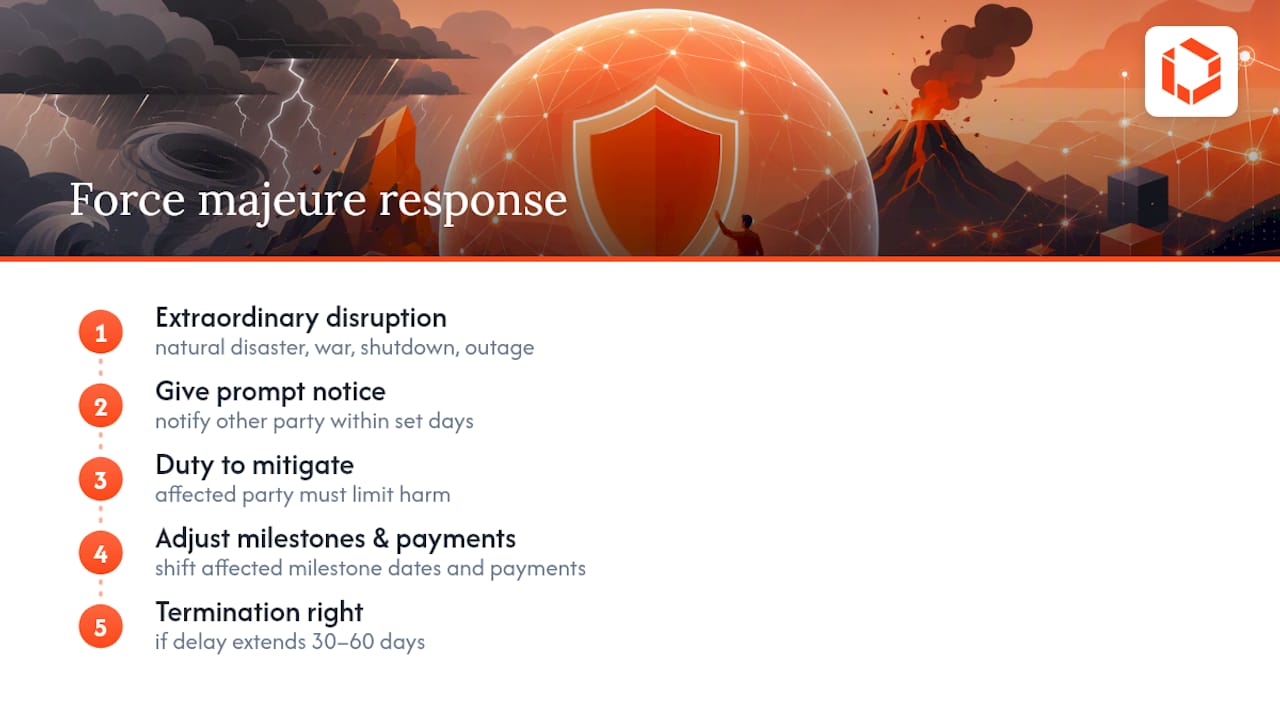
Tie the clause back to your milestone structure. If a force majeure event delays one milestone, the clause should specify how subsequent milestones and payments shift, rather than leaving the entire schedule undefined until someone renegotiates it.
Performance benchmarks and consequences of non-performance
Every milestone needs a benchmark that is testable, not aspirational. "The app should feel fast" is not a benchmark. "Screen load time under a stated number of seconds on a stated device" is. Vague language here is where most disputes over "is this milestone actually done" originate.
Once benchmarks are defined, the contract needs consequences attached to missing them. A reasonable structure includes a cure period, commonly 10 to 15 business days, during which the developer fixes the shortfall at no additional cost. If the benchmark still fails after the cure period, the contract should specify next steps: a payment holdback, an extended warranty window, or in repeated cases, a right to terminate for cause.
Repeated non-performance across multiple milestones is a different problem than one missed benchmark, and your contract should treat it differently. Consider a clause that triggers escalated review, perhaps involving both parties' senior leads, after two consecutive missed milestones, rather than waiting until the entire project has drifted off track.
Document every benchmark result in writing as it happens. That record becomes your evidence if a cure period expires without resolution and you need to invoke termination or a holdback clause elsewhere in the agreement.
Privacy compliance requirements for app data handling
If your app collects personal data from users in the European Economic Area, the GDPR's obligations apply regardless of where your company is based, and your contract with the developer needs to reflect that reality rather than assume it only concerns your own compliance team. If your app serves California residents, the CCPA imposes its own set of consumer rights and business obligations, again independent of company location.
Your development contract should require the vendor to build data-handling features that support both frameworks where relevant: mechanisms for data export, deletion requests, and consent management, built into the app's architecture rather than bolted on after a compliance review flags the gap.
Specify which regulatory categories apply to your app directly in the contract rather than relying on general "compliant with applicable law" language, which tells a developer nothing about which laws actually apply to your data flows. If your app touches health data, name that requirement explicitly, since the controls differ meaningfully from general consumer privacy obligations.
Because privacy law varies by the personal data your app collects and the residency of your users, confirm the specific frameworks that apply to your case with counsel before finalizing this section of the contract.
What founders keep getting wrong in these negotiations
The two most common mistakes: delaying IP assignment until "later" and accepting a SOW too vague to test against. Protect core IP and acceptance gates hard, stay flexible on non-core features, and use this line under time pressure: "Let's sign the IP and milestone terms today; we can finalize the nice-to-haves next week."
A senior-led path through this checklist
Every clause above works best when the team writing your code treats it as a shared standard, not a legal hurdle. TouchZen's model puts senior developers and designers in direct contact with founders from kickoff, which means fewer surprises when it's time to confirm acceptance criteria or hand over repository access.

Mobile App Development engagements structured around milestone-linked payments and acceptance tests.
MVP Development for Start Ups built with staged IP handover from the first sprint.
Ongoing Support & Growth retainers that cover the post-launch SLA period your contract should require.
If you're evaluating your next development partner, review our Mobile App Development service page or start with a complete design and development consultation to see how the checklist above plays out in practice.
Sources
This article is general information, not a substitute for advice from a qualified lawyer. Consult a qualified legal professional about your own circumstances before acting on anything here.

FAQ
What is the most important clause in a mobile app development contract?
IP assignment is the clause most founders regret skipping, because without a present-tense, signed transfer, ownership of the code can default to the developer under the Copyright Act. Acceptance criteria and milestone payments come close behind, since they determine whether you can enforce the rest of the contract.
Do I automatically own the code I paid a developer to build?
No. Custom-commissioned software does not automatically qualify as a work made for hire under US copyright law, so ownership needs a written, signed assignment agreement to transfer to you.
Who is responsible for data security if I outsource development?
You are. The FTC's guidance for app developers makes clear that companies remain responsible for consumer data security even when a third party builds the app, so your contract needs to lock in the vendor's security obligations directly.
Should I use a fixed-price or time and materials contract for my app?
Fixed-price works best for a clearly scoped MVP with stable requirements, while time and materials suits projects where features are still being validated. Milestone-based payment structures, which can layer onto either model, generally offer early-stage founders the safest balance of cost control and quality checkpoints.
What should I do if a developer refuses to sign an IP assignment clause?
Treat that refusal as a serious warning sign and do not proceed to the next payment until it is resolved. A reputable development partner should have no objection to a present-tense, signed IP assignment tied to milestone payments, since it is standard practice recommended under current copyright transfer rules.


