
Joy Foroughi
Executive Assistant


App RFP Template That Forces Comparable Proposals for Product Teams
The single change that produces comparable proposals is a short, tightly scoped RFP that requires a fixed response template, publishes your evaluation weights up front, and asks every vendor for a multi-year total cost of ownership. Skip that structure and you get a stack of documents that are impossible to line up side by side.

The single change that produces comparable proposals is a short, tightly scoped RFP that requires a fixed response template, publishes your evaluation weights up front, and asks every vendor for a multi-year total cost of ownership. Skip that structure and you get a stack of documents that are impossible to line up side by side. A senior-led development team with experience in shipped apps fits well against this kind of evaluation because it answers the questions procurement teams actually score. The next section breaks the RFP into copyable sections.
TL;DR:
Using a fixed response template, published evaluation weights, and a detailed total cost of ownership ensures comparable proposals and clearer vendor differentiation.
Clearly defining scope, technical requirements, and design deliverables prevents mismatched bids and simplifies side-by-side evaluation.
Mandatory inclusion of line-item pricing, named senior personnel, and verified portfolio links accelerates assessment and exposes vendors’ actual capabilities.
Scoring should weight technical approach, team experience, demos, and long-term costs equally to ensure a balanced evaluation process.
A structured timeline with designated milestones and stakeholder involvement is key to maintaining a fair and thorough procurement process.
The RFP sections you need and what goes in each
A comparable RFP starts with a document vendors can respond to in the same shape every time. Loose, narrative RFPs invite loose, narrative answers, and loose answers are what make evaluation slow and subjective. Structure the document into these sections and fill each with specifics, not aspirations.
Organization and project overview. Give vendors two paragraphs of real context: who you are, who the app serves, the problem it solves, and the KPI that defines success (retention rate, transaction volume, support-ticket reduction). Vendors who understand the business behind the build price and plan more accurately.
Goals and measurable success criteria. State goals as SMART targets rather than ambitions. "Reduce onboarding drop-off from the app store to first login" is vague; "cut onboarding drop-off to under 20% within 90 days of launch" gives evaluators something to hold vendors accountable to later.
Scope and exclusions. This is the section most RFPs get wrong, and it is the single biggest driver of comparability. Business of Apps recommends separating confirmed MVP features from optional phase 2 work, since that distinction alone prevents vendors from bidding apples against oranges. List explicitly what is out of scope: no admin dashboard, no third-party payment integration, no localization at launch.
Technical requirements and integrations. Specify platform (iOS, Android, or both), backend architecture preferences, required APIs, analytics tooling, security expectations, and accessibility standards. Vendors should know upfront whether you expect WCAG-aligned accessibility testing baked into acceptance criteria, not addressed as an afterthought.
Design requirements. Define deliverables (wireframes, high-fidelity mockups, a design system), who owns the final files, and what "done" looks like for design sign-off.
State the MVP feature list separately from phase 2 wishlist items.
Name every integration, API, and analytics tool the app must support.
Define who owns design files and code repositories after launch.
How to require a comparable proposal format from every vendor
Comparability breaks down the moment vendors choose their own proposal structure. Fix that by mandating the format before anyone starts writing.
Require a one-line executive summary stating the vendor's recommended approach and price range.
Require a technical approach section describing architecture, frameworks, and integration plan.
Require named team members with roles, not job titles alone, plus their availability percentage on your project.
Require a timeline broken into phases with dates, not durations.
Require line-item pricing by phase, not a single lump sum.
Require portfolio links to live apps, not screenshots, plus two client references.
Ask for PDF submissions with a page limit (10 to 15 pages plus appendices) and demand evidence you can verify: live App Store or Google Play links, sample code repositories, and resumes for named senior staff. According to WizardRFP's guide to response best practices, mapping every requirement to a response section through a compliance matrix speeds up evaluation and forces vendors to answer each point directly instead of burying gaps in marketing language. Attach a blank compliance matrix as a mandatory appendix so every vendor fills the same grid.
Pro Tip: Ask for pricing broken into build, launch, and first-year support columns. A single number hides where the real cost sits.
Scoring vendors fairly: weights, demos, and true cost
Evaluation only works when every proposal is scored against the same weighted criteria, published before vendors submit. According to the Department of Education's RFP evaluation guide, publishing evaluation weights in the RFP itself reduces variance in vendor responses because vendors tailor their proposals to what you say matters most.
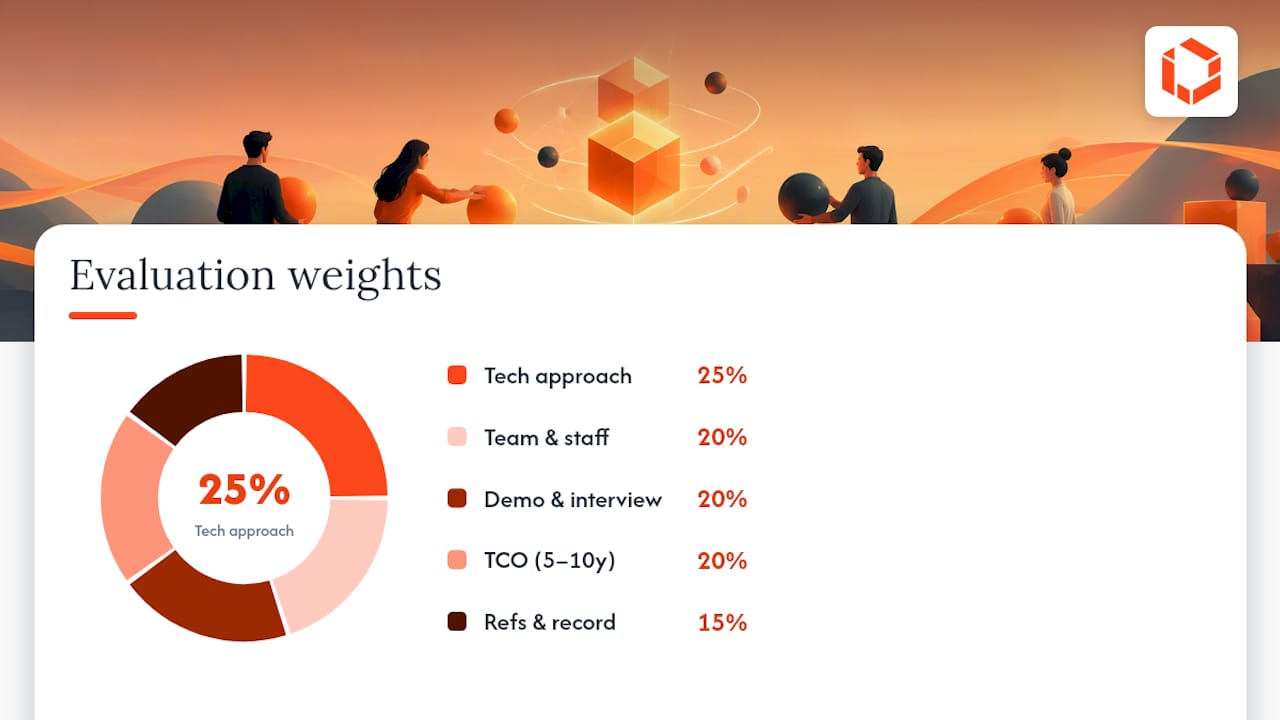
A workable weighting split looks like this:
Technical approach and architecture fit: about one quarter
Team experience and named personnel: about one fifth
Demo and interview performance: about one fifth
Total cost of ownership, not just build price: about one fifth
References and past delivery record: about one seventh
The same source states that vendor demonstrations and structured scripts are among the most decisive evaluation elements, and should be weighted at least as heavily as portfolio aesthetics. Schedule demos after the written round narrows the field to three or four vendors, and score each demo against the same script: same test scenario, same questions, same rubric.
Total cost of ownership matters more than the headline build quote. Calculate a 5- or 10-year TCO by adding the build price to annual maintenance and hosting costs, support retainers, and any planned phase 2 work. A vendor with a lower build price and a vague support plan often costs more by year three.
The mistakes that quietly wreck comparability
Most RFPs fail not because vendors misbehave but because the document itself invites inconsistent answers.
Vague scope statements let vendors define the project on their own terms, which makes bids impossible to compare.
Open platform choices ("iOS and/or Android, vendor's discretion") produce wildly different cost structures for the same product.
Missing acceptance criteria mean nobody can agree on when a milestone is actually complete.
No post-launch support terms leave you negotiating maintenance costs after you've already signed.
Watch for red flags inside proposals themselves: unnamed staff ("a senior developer will be assigned"), bundled pricing with no line items, and timelines that promise a launch faster than the scope reasonably allows. Mitigate these by flagging opaque proposals early, enforcing required fields on every submission, and tying payments to milestones defined by acceptance criteria rather than calendar dates. On the process side, limit your vendor list to five or six qualified firms, set a firm response window, and run a go/no-go checklist before you even release the document, confirming budget band, target vendor list, and evaluation weights are locked.
Setting a realistic timeline for questions, addenda, and decisions
A rushed procurement produces rushed, incomparable answers. Give the process room to breathe.
Release the RFP with a 3 to 4 week response window for projects above roughly $50,000, per Techradiant's evaluation criteria guide; smaller projects can run a shorter discovery conversation instead of a formal RFP.
Open a 5 to 7 day question window, publish every vendor's question and your answer as a single addendum so no vendor has private information.
Close submissions, then run written evaluation over 3 to 5 business days using your published scoring matrix.
Invite finalists to demos and interviews within 2 weeks of submission close.
Complete reference checks and enter final negotiations before signing.
Assign at least three people to the evaluation team: someone technical, someone commercial, and someone representing the end user, and have each score independently before comparing notes.
A one-page checklist and response form you can attach today
Before you send anything, run this go/no-go check: budget band defined, target vendor list of five or six firms, evaluation weights drafted, acceptance criteria written for each milestone.
Attach a minimal vendor response form requiring a one-line executive summary, a named team list with availability percentages, a line-item pricing table, and portfolio links to live apps. Business of Apps notes that incomplete or unfinished proposals cost organizations real opportunity value, which is exactly why mandatory fields matter more than polite suggestions.
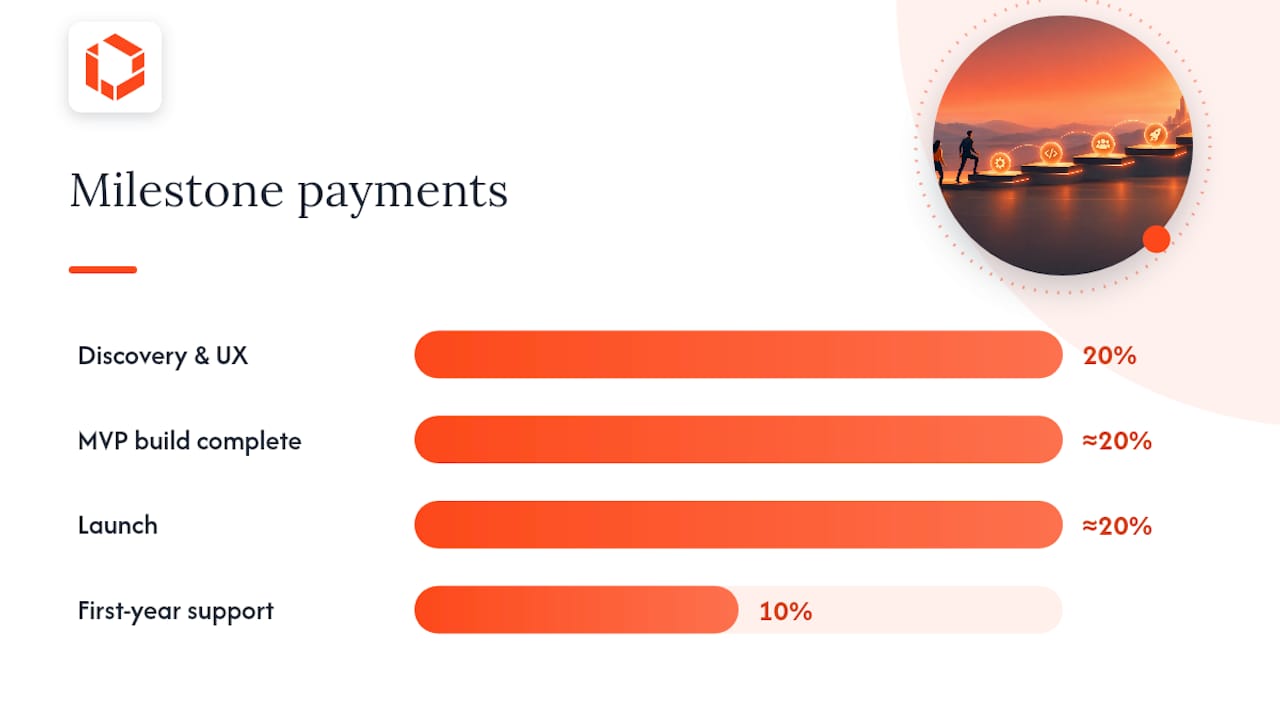
Milestone | Payment | Acceptance criteria |
|---|---|---|
Discovery and UX approved | 20% | Signed-off wireframes and user flows |
MVP build complete | about one fifth | Passes test plan on staging environment |
Launch | about one fifth | App live in app stores, KPIs tracked |
First-year support | 10% | Support tickets resolved within SLA |
How a senior-led team changes what you should look for
A senior-led delivery model shifts several evaluation priorities. A senior-led delivery model assigns senior developers and designers directly to a project from kickoff to launch rather than routing work through junior staff, which changes what "named personnel" should mean in a proposal: ask every vendor whether the people named in the proposal are the people who will actually write the code.
When proposals list senior titles but junior delivery teams, the gap usually shows up first in missed milestones, not in the initial demo.
Some vendors have launched many apps across industries and continue supporting them after launch, which is the track record worth checking against any vendor's references.
Pro Tip: Ask finalists directly who attends weekly standups. If the answer changes between the sales call and the kickoff call, treat it as a scored red flag.
What most RFP advice gets backward
Most guidance on writing an app development RFP treats the document as a formality, something to get through before the "real work" of picking a vendor begins. That's backward. The RFP is the real work. The evaluation weights you publish, the acceptance criteria you write, and the pricing format you demand do more to determine project success than any interview question you ask later.
The conventional advice overweights portfolio aesthetics and underweights total cost of ownership. A polished case study tells you a vendor can design; it tells you nothing about what year two of support will cost. Prioritize the compliance matrix and the TCO calculation before you ever schedule a demo. If a vendor resists a required response template or dodges line-item pricing, that reluctance is itself the most useful data point you'll get before signing anything.
Where TouchZen fits when you're ready to move
If you'd rather have a senior team review your draft RFP or join the vendor pool directly, Some firms offer the kind of direct, senior-led engagement that a well-built evaluation matrix is designed to surface.

Relevant services for this stage include Product Strategy & Consulting for founders still defining scope and goals, MVP Development for Start Ups for teams ready to build a first version, and full Mobile App Development for end-to-end delivery with direct access to senior engineers throughout.
Request a review of your draft RFP before you send it to vendors.
Book a short discovery call to scope your MVP and budget band.
Compare TouchZen's approach against other proposals using the same weighted matrix.
Start at Touchzen to request a template review or set up a discovery call.
Templates and guides worth reading next
For readers who want to build out scoring details further, a few external resources are worth the time.
The Department of Education's evaluation guide walks through TCO modeling and defensible scoring in more procurement-heavy detail.
Business of Apps' RFP research covers app-specific proposal requirements and common completion gaps.
Techradiant's RFP template guide and WizardRFP's response best practices both offer scoring matrix examples worth adapting.
For accessibility scoring criteria, Baby Love Growth's accessibility and SEO guide explains why compliance belongs in your technical requirements section.
Sources

FAQ
What are common RFP mistakes to avoid?
The most damaging mistakes are vague scope statements, open platform choices left to vendor discretion, and missing acceptance criteria for milestones. These gaps make proposals impossible to compare fairly and often lead to disputes after signing, so requiring a fixed response template and explicit exclusions list fixes most of them at once.
How do I write an RFP for a mobile app project?
Start with organization context and measurable goals, then define scope by separating MVP features from later phases, list technical and design requirements, and require a fixed vendor response format. Publish your evaluation weights in the document itself so vendors tailor their proposals to what you're actually scoring, per the Department of Education's evaluation guide.
What are the typical steps in an RFP process?
A typical process runs from releasing the draft RFP, through a question and addenda window, written proposal evaluation, vendor demos and interviews, reference checks, and final negotiation before signing. Each step should have a firm date so the process stays fair to every vendor involved.
What are the three C's of proposal writing?
Definitions vary, but a common version centers on clarity, compliance, and conciseness: answering exactly what was asked, mapping each response to the RFP's requirements, and avoiding padding that obscures the answer. A compliance matrix is the practical tool vendors use to satisfy the compliance piece directly.
How do I evaluate app development proposals fairly?
Score every proposal against the same published weighting for technical approach, team experience, demo performance, and total cost of ownership rather than build price alone. Running demos with a shared script and rubric, as recommended in procurement evaluation guidance, keeps the comparison objective instead of impressionistic.