
Joy Foroughi
Executive Assistant


7 Research Backed Mobile App Gamification Tactics for Product Teams
Use these seven tactics to lift active days and retention: reward-and-progression loops, progress visualization, adaptive personalization, social mechanics, thoughtful reinforcement schedules, onboarding integration, and continuous experimentation.

Use these seven tactics to lift active days and retention: reward-and-progression loops, progress visualization, adaptive personalization, social mechanics, thoughtful reinforcement schedules, onboarding integration, and continuous experimentation. Trial data links these mechanics to measurable gains in active days and session length, but the effect depends on disciplined testing, not blind copying. The rest of this guide breaks down how to build and measure each one.
TL;DR:
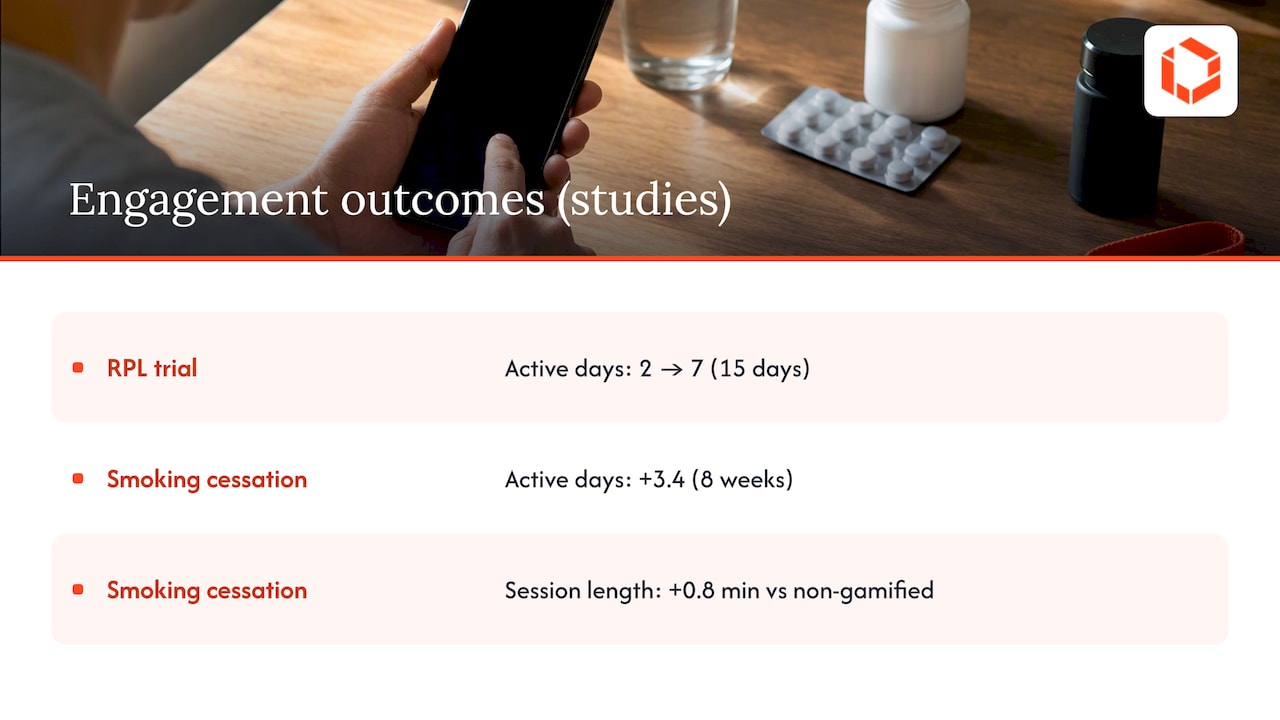
A preliminary study with 20 participants reported a median of 7 active days over 15 days with a reward-and-progression loop, compared to 2 without it; larger studies are needed.
Progress visualization can make skill growth visible, but trial results are mixed: one study found no improvement in adherence compared with the control group.
Adaptive personalization based on user behavior is a tactic to test against static reward schedules; its effect on retention and session growth must be measured in your app.
Social features improve relatedness but must be designed carefully to avoid negative competition and social pressure.
All gamification tactics require rigorous measurement, control testing, and gradual rollout to ensure they positively impact retention without unintended consequences.
1. Reward-and-progression loops for active-day lift
A reward-and-progression loop (RPL) is a UI pattern that shows a user moving toward a goal through progress bars, levels, or sequential unlocks. In a preliminary 15-day breathing training study published in 2026, 20 participants were randomly assigned to an RPL or control condition. Participants who used the RPL logged a median of 7 active days versus 2 for controls without the loop. Session duration was comparable between groups. These findings suggest that progression mechanics may support more frequent use, but they do not establish lasting habit change or predict the same result in other apps.
Keep feedback cycles short: reward progress within the same session, not days later.
Tie every reward to the app's core value, never to an unrelated point system.
Set a measurable target, such as median active days per cohort, before you launch the loop.
Adjust’s Gaming App Insights Report: 2026 Edition discusses reward-driven mechanics alongside broader gaming trends. This provides industry context for testing RPLs, rather than evidence that progression mechanics caused the reported session growth.
2. Progress visualization builds a sense of competence
Self-determination theory ties motivation to three needs: autonomy, competence, and relatedness. Progress visualization speaks directly to competence by giving users clear, visible evidence that they're improving. A randomized trial compared skill-progression visualizations, automated peer encouragement, and a control condition in a digital mindfulness intervention. Neither strategy improved adherence compared with the control, and user experience ratings were comparable across groups. The smaller-than-planned sample and high attrition warrant caution, reinforcing the need to test visualization in your own product rather than assume it improves engagement.
Use capability charts that show skill growth over time, not just point totals.
Add micro-badges only when they mark a real skill milestone, not a login streak.
A/B test whether visualization alone changes flow and session length before adding complexity.
Pro Tip: Tie every progress bar to a real capability the user can point to, not an arbitrary score.
3. Personalization and adaptive difficulty done right
Fixed reward schedules and static difficulty curves treat every user the same, which may overlook differences in ability, goals, and usage patterns. Adaptive systems adjust pacing, difficulty, or reward timing based on behavior. Adjust’s 2026 gaming report announcement discusses retention, reward-driven mechanics, and AI-generated creatives as industry trends. It does not establish that adaptive difficulty or AI-driven reward personalization caused session growth, so treat these systems as hypotheses to test rather than proven improvements.
Start with simple rule-based tiers (light, medium, heavy user) before investing in machine learning.
Track session length, drop-off point, and reward redemption rate as your core adaptivity signals.
Respect App Tracking Transparency opt-in choices and minimize the behavioral data you collect to what the feature actually needs.
Once you have enough usage data to segment reliably, compare adaptive systems with a fixed-schedule control group. Their value depends on whether they improve your primary outcome without adding friction or unnecessary data collection.
4. Social mechanics that create relatedness
Relatedness, the third pillar of self-determination theory, comes from feeling connected to other people through the product. A 2021 structural-equation-model study of mHealth app users found associations between gamification-induced feelings and intention to continue using the apps, with autonomy carrying the strongest statistical weight among autonomy, competence, and relatedness. This models users’ reported intentions rather than proving a causal increase in observed retention. Relatedness still matters enough to design for deliberately.
Build opt-in buddy systems or small team challenges rather than forced public leaderboards.
Add guardrails against negative competition, such as capping visible rankings or allowing private groups.
Track invite-to-accept conversion and retention lift specifically among users who join a social cohort.
5. Reward schedules that balance cost and engagement
Not all rewards carry the same cost or the same psychological pull. Monetary rewards can encourage activity but require an ongoing budget, while virtual rewards or early access may cost less to provide. Whether either approach sustains engagement depends on the audience, the reward’s relevance, and the progression design. A reinforcement-schedule study on mHealth incentives found that three schedules had similar effects on engagement, while the variable schedule with immediate payouts had the lowest reported cost per participant. This suggests a potential cost advantage in that study’s setting, rather than a general engagement advantage for unpredictable rewards. Compare both cost and user outcomes before adopting a schedule.
Test variable-ratio payouts against fixed schedules on a small user segment before a full rollout.
Keep goal systems clear and manageable rather than leaving users without guidance; test whether goal-setting complexity contributes to confusion or abandonment in your app.
Track per-user reward cost against retention uplift monthly, and scale a schedule only after it clears that bar.
6. Fit gamification into onboarding without distracting from it
Gamification earns its place only when it supports the task the user came to do. A progress bar that celebrates account setup helps; a badge system layered on top of a checkout flow just adds friction. The safest place to test a new mechanic is inside onboarding, where micro-goals and progressive disclosure can nudge a user toward their first meaningful action without asking them to learn anything extra.
Introduce one micro-goal at a time during onboarding, not a full dashboard of tasks.
Use progressive disclosure so advanced mechanics appear only after a user completes core actions.
Watch your core conversion funnel closely: any gamification layer that lowers completion is a failure, regardless of engagement numbers elsewhere.
Pairing this with a deliberate first-run flow gives you a coherent experience to test. Measure Day-7 retention to determine whether the mechanic helps users return after onboarding.
7. Test, measure, and evolve every tactic you ship
None of the six tactics above should ship without a measurement plan attached. Treat each one as an experiment with a defined holdout group, a run length long enough to capture at least one full retention curve, and a clear stop or scale decision at the end.
Choose a control-group size based on traffic, baseline performance, and the effect you need to detect. A 10 to 20% holdout may suit some rollouts, but it is not a universal rule.
Allow at least 30 days of follow-up for each cohort included in Day-30 retention, plus the time needed to enroll users. Set the total test duration according to traffic and the sample size needed for a meaningful comparison.
Track active days, session length, and a lifetime-value proxy alongside retention curves.
Scale a tactic only when it beats the control group on your primary metric without hurting a secondary one.
When a metric plateaus, rotate the reward type or adjust the difficulty curve before abandoning the mechanic entirely.
Retention benchmarks vary by app category, audience, acquisition channel, and measurement method. Use your own baseline and comparable, clearly sourced category benchmarks before calling a tactic a win. Solid analytics instrumentation makes this whole cycle possible.
How TouchZen applies these tactics: process and proof points
TouchZen brings product strategy, design, and development into the gamification planning process, connecting the proposed mechanic to the app’s core user journey. The project scope should identify who is responsible for implementation, measurement, and refinement so that expectations are clear from the start.
A typical engagement to embed one gamification tactic follows a predictable arc:
Discovery to identify which tactic fits your core flow and current retention gaps.
A focused sprint to design and build the mechanic, from RPL to adaptive reward tuning.
A measurement plan built alongside the feature, not bolted on after launch.
An iteration cycle based on the holdout results, scaling what works and retiring what doesn't.
Teams engaging an agency for this work should expect direct access to the people writing the code and designing the flows, plus a support relationship that continues past launch.
Examples of successful mobile app gamification across different industries
Gamification shows up differently depending on what the app is trying to accomplish, but the strongest examples share one trait: the mechanic reinforces the app's actual purpose rather than sitting beside it.
In digital health, breathing and mindfulness apps have used progression loops and skill-based achievement systems to extend daily engagement, with the preliminary, 20-participant breathing study cited earlier reporting a median of 7 versus 2 active days over 15 days. In a separate 2024 randomized trial of the Inner Dragon game within the Smoke Free app, participants given access to the game averaged 0.8 more minutes per session over an 8-week follow-up. These are findings from specific interventions, not guaranteed gains for every health app.
In fitness and habit tracking, streaks, levels, and visible skill charts turn a single workout log into a running story of improvement, which plays directly to the competence need at the center of self-determination theory.
In finance apps, progress bars toward a savings goal or milestone rewards for consistent budgeting behavior borrow the same mechanics without turning the app into a game, keeping the focus on the underlying financial task.
In productivity and goal-tracking tools, point systems and small unlocks reward task completion streaks, echoing the pattern TouchZen applied in its own Level Up Goal Tracker work, where progression mechanics were built around the core habit-tracking function rather than layered on top of it.
Across every one of these categories, the mechanics that hold up over months are the ones tied to a real outcome the user already wanted, not a novelty feature designed purely to create busywork.
Psychological pitfalls and ethical considerations in gamification
Gamification borrows techniques from game design that are effective precisely because they can override a user's better judgment about how much time or money to spend. That power comes with real risk. Variable-ratio reward schedules, the same mechanic behind slot machines, can push some users toward compulsive checking behavior rather than healthy habit formation, especially in apps aimed at younger users or people prone to compulsive use patterns.
Manipulation risk rises when a reward system is designed to maximize time-in-app rather than a genuine user outcome. A leaderboard that quietly punishes users who fall behind, or a streak mechanic that induces guilt for missing a single day, crosses from motivation into pressure. Teams should ask a direct question before shipping any mechanic: does this reward the behavior the user actually wants, or does it reward the behavior that helps our metrics?

Badge inflation is a related trap. When every action earns a badge, the signal stops meaning anything, and users disengage from the entire reward system rather than just the weakest part of it. Self-determination theory offers a useful design framework: ask whether a mechanic supports autonomy, competence, or relatedness rather than relying on badge counts alone. The studies cited here do not establish that these designs universally outperform badge systems for long-term adherence, so test both user outcomes and continued engagement beyond the initial novelty.
The practical guardrail is transparency. Let users see how a reward system works, give them a way to opt out of social or competitive features, and avoid designs that rely on guilt, shame, or artificial scarcity to keep people engaged.
Integration challenges and best practices for implementing gamification features in existing apps
Adding gamification to a live app is a different problem than designing it into a new one because existing user habits, data models, and technical debt all shape what's realistic to ship without breaking the product people already rely on.
The first challenge is data. Reward and progression systems need reliable event tracking, and many existing apps were not instrumented with gamification in mind. Retrofitting analytics before building the feature avoids a common failure mode: shipping a reward system, then discovering months later that you can't measure whether it worked.
The second challenge is scope creep. A simple progress bar can balloon into a full points economy, badge catalog, and social layer if the team doesn't set a boundary early. Ship the smallest version of one tactic, measure it, then expand only what the data supports.
The third challenge is legacy user expectations. Long-time users of an app without gamification can react negatively to sudden, unexplained changes to their workflow. Rolling a new mechanic out to a small percentage of users first, then expanding gradually, protects both the experiment's validity and the goodwill of your existing base.
Best practice across all three challenges is the same: treat gamification as a feature with its own product requirements, not a design flourish added at the end of a sprint. Define the metric it needs to move, instrument it before launch, and give it a fair testing window before deciding whether it earns a permanent place in the app.
Author perspective: core lessons and pragmatic cautions
Autonomy, competence, and relatedness provide a useful framework for evaluating the tactics discussed here. Reward loops, progress bars, and social features should support a meaningful user need rather than simply add game dressing to an app. Trial results remain mixed, so product teams should assess what users gain from each mechanic alongside the engagement metrics it changes.
Badge inflation and unmeasured rollouts are the two fastest ways to waste a gamification budget. Our rule for any product team: if you can't name which of the three needs a new mechanic serves, don't ship it yet.
Turning these tactics into a shipped feature
Knowing which tactics work is only half the problem. Building a reward loop that's instrumented correctly, an adaptive system that respects privacy rules, or a social feature with the right guardrails takes design and engineering time most product teams don't have spare. A dedicated team handles product strategy, UX/UI design, and mobile app development directly, with clearly defined responsibilities for implementation, analytics, and post-launch refinement.

A pilot can start small: one tactic, one measurement plan, and a focused implementation scope. Agree on the delivery timeline after reviewing the app’s existing architecture and analytics, then allow enough follow-up time to evaluate the result.
Product Strategy & Consulting to pick the right tactic and define success metrics before writing code.
UX/UI Design to build the progress visuals, reward flows, or social mechanics your users will actually see.
Mobile App Development to implement the feature and the instrumentation it needs to prove itself.
Ongoing Support & Growth to iterate on the mechanic after launch based on real retention data.
If you're ready to test one of these tactics inside your app, start with TouchZen's full service list to find the right entry point for your team.
Where these tactics and figures come from
Breathing training RPL field study (2026): the preliminary, 20-participant study reporting median active days of 7 versus 2 over 15 days. The separate Inner Dragon study below concerns smoking cessation, not breathing training.
Persuasive design RCT (PMC): mixed evidence on skill-progression visualization and automated peer encouragement; neither strategy improved adherence compared with the control.
SDT and mHealth continued-use intention (JMIR, 2021): the structural-equation model relating autonomy, competence, and relatedness to reported intention to continue using mHealth apps.
Reinforcement schedule study (Electronics, 2021): cost and structure data for reward design.
Adjust’s Gaming App Insights Report: 2026 Edition announcement: industry context on gaming engagement and retention trends, rather than causal evidence for a particular gamification tactic.
Sources

FAQ
What is the most effective mobile app gamification tactic?
No single tactic wins for every app. Reward-and-progression loops have preliminary evidence supporting more frequent engagement: one preliminary 15-day study with 20 participants found that RPL users logged a median of 7 active days versus 2 for the control group. That small study does not establish which tactic is most effective across app categories. The right choice still depends on which of the three self-determination needs, autonomy, competence, or relatedness, your app currently satisfies least.
How does self-determination theory apply to app gamification?
Self-determination theory holds that motivation grows from three needs: autonomy, competence, and relatedness. A 2021 study of mHealth app users found associations between feelings related to these needs and intention to continue using the apps, with autonomy showing the strongest statistical relationship in that model. It did not establish a causal increase in observed retention.
Can gamification hurt user experience if overused?
Yes. Badge inflation, forced competition, and unclear goal systems can overwhelm users or create pressure. Watch for confusion, unwanted competition, and abandonment in your own product rather than assuming any mechanic is harmless. The safest approach folds one mechanic at a time into the core flow and measures the effect before adding another.
What metrics should I track to measure gamification success?
Track Day-1, Day-7, and Day-30 retention alongside active days per user and average session length, using a holdout group so you can attribute any lift to the mechanic itself. Compare results with your app’s baseline and relevant, sourced category benchmarks. For Day-30 retention, allow at least 30 days of follow-up for each measured cohort, in addition to enrollment time.
Is AI-driven personalization worth adding to a gamification strategy?
AI-driven personalization may be worth testing once you have enough usage data and a specific problem it could solve. The industry report cited here does not prove that AI reward personalization improves retention. Start with simple rule-based tiers, compare them with a control group, and consider a model only when the expected user benefit justifies the added complexity.