
Joy Foroughi
Executive Assistant


Mobile App Development Timeline: How Long to Build
Discover the mobile app development timeline. Learn how long it takes to build an app and the key phases involved for a successful launch.

TL;DR:
Most startup apps take three to nine months to develop a minimum viable product, with an additional three to six months for full deployment. Development duration varies primarily based on app complexity, team size, and feature scope, with coding phases occupying most of the timeline. Effective planning requires accounting for feedback, testing, and post-launch work to ensure realistic project completion estimates.
The mobile app development timeline is defined as the total time from initial planning to a working, deployable product. For most startups and business owners, that window spans 3 to 9 months for a minimum viable product, with production-ready apps requiring an additional 3 to 6 months after launch. The exact app development duration depends on three variables above all others: app complexity, feature scope, and team composition. Understanding these variables before you sign a contract or set a board deadline is the difference between a realistic roadmap and a costly surprise.
What are the major phases of the mobile app development timeline?
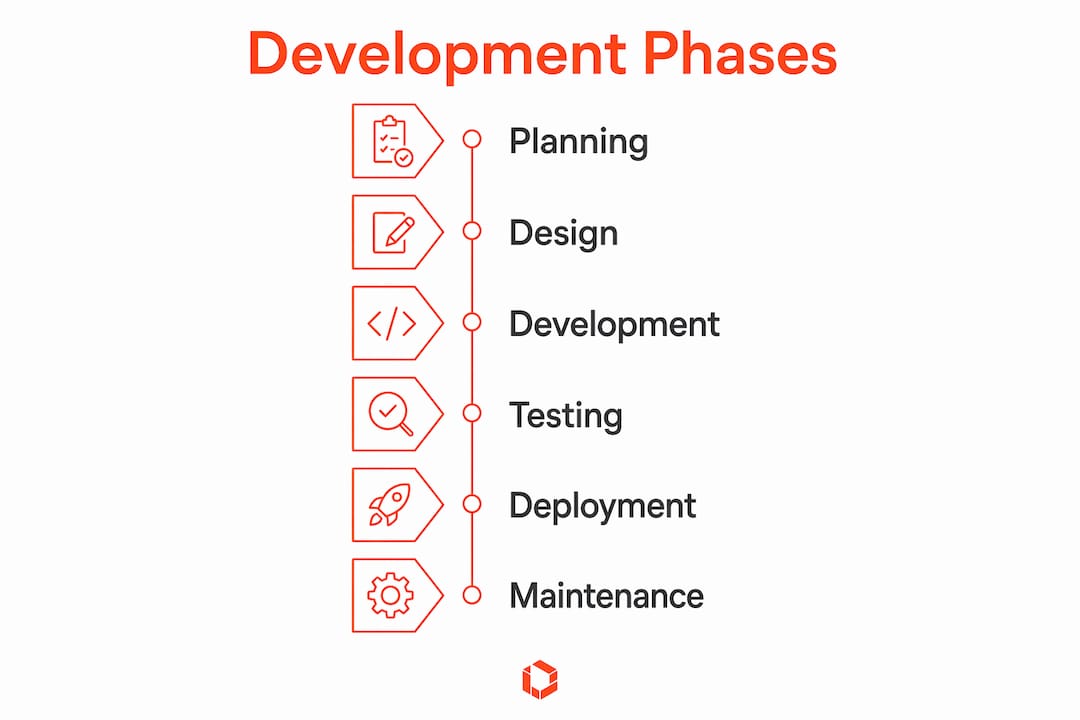
The mobile application timeline follows six distinct phases. Each phase has a predictable duration, and each one feeds directly into the next. Skipping or rushing any phase adds time later, not less.
Planning and research (2–3 weeks). This phase defines the product vision, target users, technical requirements, and competitive positioning. Weak planning is the single most common cause of scope creep later in the build.
Design (2–4 weeks). UX wireframes and UI mockups are produced and approved here. Design rounds that require multiple stakeholder sign-offs routinely push this phase to the upper end of the range.
Development and coding (3–6 months). This is the largest block in any app build schedule. The development phase consistently consumes 40% to 60% of the total project timeline. That proportion holds across simple apps and complex platforms alike.
Quality assurance and testing (3–6 weeks). Functional testing, performance testing, and security checks happen here. Cutting this phase to save time creates post-launch bugs that cost far more to fix than the weeks saved.
Deployment (1–2 weeks). App Store and Google Play submissions, server configuration, and final environment setup. Android submissions often take longer due to device fragmentation across manufacturers.
Post-launch activities (2–4 weeks). Monitoring, crash reporting, and initial user feedback cycles. This phase is frequently underbudgeted by first-time founders.
Pro Tip: Build your project plan around the development phase first, then add the other five phases around it. The coding block is your anchor. Everything else is scaffolding.
A typical mobile app development timeline spans roughly 20 to 40 weeks across all six phases. That range is wide because complexity and team velocity vary enormously between projects.
How does app complexity impact development timeline?
App complexity is the single biggest driver of app development duration. A simple utility app and a fintech platform are both "mobile apps," but they occupy completely different time frames.

App type | MVP timeline | Production-ready timeline |
|---|---|---|
Simple app (single function, basic auth) | 4–8 weeks | 3–5 months |
Medium complexity (e-commerce, user accounts) | 10–16 weeks | 5–8 months |
Complex app (social network, fintech, marketplace) | 6–9+ months | 9–12+ months |
Simple apps with one user type and basic authentication reach MVP in 4 to 8 weeks. That speed is only possible when the feature list is genuinely minimal. The moment you add a second user role or a payment flow, you move into medium complexity territory.
Medium complexity apps, such as e-commerce platforms or SaaS tools with user accounts, typically require 10 to 16 weeks for a working MVP. The added time comes from backend architecture, third-party integrations, and the increased surface area for bugs.
Complex apps, including social networks, fintech products, and multi-sided marketplaces, routinely take 6 to 12 months or more. Features that add the most time include:
Payment processing and financial compliance layers
Multi-role user permission systems
Real-time messaging or live data feeds
Marketplace mechanics with buyer and seller flows
Advanced security and data encryption requirements
Pro Tip: If your app requires payments, user roles, or real-time data, add at least 6 weeks to your initial estimate before you present it to stakeholders. These features almost always take longer than the first scoping session suggests.
Android development frequently takes longer than iOS development. The reason is device variety. Android runs on thousands of hardware configurations, and testing across that range adds weeks to the QA phase.
How does your development team affect the app creation time frame?
Team composition is the most underestimated variable in any app creation time frame. The same feature set can take three months with one team and eight months with another.
A competent team of 2 to 3 full-time members can hit standard MVP timelines reliably. Part-time or fragmented teams, where developers split attention across multiple projects, can multiply the calendar timeline by 2.5 times or more. That is not a small difference. It is the gap between launching in Q2 and launching in Q4.
AI-powered coding tools are changing the equation, but not as dramatically as the headlines suggest. Tools that assist with code generation and autocompletion can reduce coding hours by 20% to 35%. That is a real gain. However, AI tools do not reduce testing time, design cycles, or stakeholder approval rounds. Those phases remain fully human-paced. For a deeper look at how specific tools compare, the Cursor vs Copilot analysis breaks down where AI coding assistants actually save hours.
Several other factors extend calendar time beyond raw development hours:
Decision latency. Slow stakeholder approvals add days or weeks between phases.
Scope creep. Adding features mid-build is the most common cause of timeline overruns.
Unclear requirements. Writing clear, stable requirements before development starts can save 4 to 6 weeks on average.
Communication gaps. Teams that rely on asynchronous updates without regular syncs lose velocity quickly.
Pro Tip: Treat your requirements document as a contract with your future self. Every vague requirement is a future change request. Every change request costs time.
The difference between a senior-led team and a junior-heavy team is not just code quality. Senior developers make architectural decisions faster, catch integration problems earlier, and require fewer revision cycles. That experience compounds across every phase of the build.
How to realistically plan your mobile app build schedule
Realistic planning starts with accepting that your calendar timeline will always be longer than your raw development hours. MVP development typically requires 8 to 16 weeks of focused work, but calendar time stretches further due to feedback loops and approval cycles. The standard recommendation is to add a 25% to 50% buffer on top of your estimated working weeks.
Here is a practical framework for setting your timeline:
Start with MVP scope. Define the smallest version of your app that delivers real value to users. Cut every feature that is not essential to that core value proposition.
Build in feedback cycles. Every design review, stakeholder demo, and user test adds calendar days. Account for these explicitly in your project plan.
Plan for post-MVP work. Founders consistently underestimate this phase. Reaching production-ready status after MVP typically requires 3 to 6 additional months of development for scaling, security hardening, and performance work. The mobile app scalability guide covers what that post-launch work actually involves.
Freeze scope before coding starts. Mid-build feature additions are the fastest way to blow a deadline. If a new idea surfaces during development, log it for version 2.
Common pitfalls that cause the most delays:
Changing the tech stack after development begins
Skipping user testing to save time
Underestimating App Store review and rejection cycles
Treating the launch date as the finish line rather than the starting line
Pro Tip: Set your public launch date 4 weeks after your internal target. That buffer absorbs App Store delays, last-minute bug fixes, and the inevitable "one more thing" requests from stakeholders.
Balancing time, cost, and feature scope is a constant negotiation. You can have two of the three. Choosing all three without trade-offs is how projects miss every milestone.
Key Takeaways
A realistic mobile app development timeline runs 3 to 9 months for MVP, with production-ready apps requiring an additional 3 to 6 months of post-launch development.
Point | Details |
|---|---|
Average MVP timeline | Most apps take 3 to 9 months to reach a working MVP, depending on complexity and team. |
Development phase dominates | Coding consumes 40% to 60% of total project time across all app types. |
Team composition matters most | Part-time or fragmented teams can extend timelines by 2.5 times compared to full-time teams. |
Buffer time is non-negotiable | Add 25% to 50% to raw development estimates to account for approvals and feedback cycles. |
Post-launch work is underestimated | Reaching production-ready status after MVP typically requires 3 to 6 more months of development. |
What I've learned about app timelines after 75+ launches
The most consistent mistake I see from startup founders is treating the MVP launch as the project's finish line. It is not. It is the point where the real work begins. Real users expose edge cases, performance bottlenecks, and security gaps that no amount of pre-launch testing fully predicts. Founders who plan for 3 months of post-launch development are the ones who build products that actually scale.
The second pattern I notice is over-reliance on AI coding tools as a timeline shortcut. AI assistants genuinely reduce coding hours, and that matters. But I have watched teams cut their development estimate by 30% because of AI, only to discover that testing, design revisions, and stakeholder cycles were never going to shrink. The calendar time barely moved. AI accelerates the coding phase. It does not compress the human parts of the process. For a grounded view of where AI actually helps versus where it falls short, the AI-generated vs human-led apps breakdown is worth reading before you set expectations with your team.
My honest advice: plan for continuous development, not a fixed endpoint. The apps that reach 100k downloads and sustain user growth are the ones where the founding team committed to iterating after launch, not just shipping once and moving on.
— Cyrus
How TouchZen builds apps on time for startups
TouchZen works directly with startup founders and business owners who need a clear, honest timeline from day one. The team has launched over 75 apps across iOS and Android, with results including 100k downloads in the first year and 10x growth in user subscriptions.
TouchZen's senior developers handle every project directly, with no handoffs to junior staff. The team uses AI-powered development to reduce coding hours without cutting corners on testing or security. If you are ready to get a realistic build schedule and a team that delivers on it, the mobile app development service page outlines exactly how TouchZen approaches each phase, from planning through post-launch support.
FAQ
How long does it take to build a simple app?
A simple app with one user type and basic authentication reaches MVP in 4 to 8 weeks. Production-ready status typically requires 3 to 5 months total.
What is the average time to build an app for a startup?
Most startup apps take 3 to 9 months to build a working MVP. Adding post-launch development for scaling and security brings the full timeline to 6 to 15 months.
Does building for Android take longer than iOS?
Android development often takes longer due to device variety. Testing across the wide range of Android hardware configurations adds weeks to the QA phase compared to iOS.
How much does team size affect the app development duration?
A full-time team of 2 to 3 senior developers hits standard timelines reliably. Part-time or fragmented teams can multiply the calendar timeline by 2.5 times or more.
Can AI tools speed up mobile app development?
AI coding tools reduce coding hours by 20% to 35%, but they do not shorten design, testing, or approval cycles. Total calendar time savings are real but more modest than raw coding estimates suggest.