

Joy Foroughi
Executive Assistant


Match Expo vs New Architecture to Hire React Native Developers in 2026
Match Expo vs New Architecture, run four quick non-technical screens, and set the right pay bands. Practical hiring checks proven across 75+ launched apps.

TL;DR:
Hiring for native modules or architecture migration requires candidates with real experience in JSI, Turbo Modules, and Fabric, not just Expo or basic React Native skills.
Technical screening should confirm the candidate's last React Native version, native editing activity, and the complexity of bugs they've resolved, especially related to native modules.
The salary for senior Native Architecture specialists averages around $145K to $185K, while mid-level Expo developers typically cost $100K to $128K, affecting hiring timelines and budgets.
Using project-specific questions during interviews can effectively distinguish native experts from generalists, preventing costly misfits on complex builds.
Relying solely on job boards can miss senior candidates, so sourcing on GitHub repositories with native contributions or issue resolutions is crucial for identifying true architecture fluency.
How to Hire React Native Developers in 2026: Match the Profile to the Project
Most bad hires happen before the first interview. The job description asks for "React Native experience" as if it's one skill, then the hiring manager wonders three weeks in why the candidate who aced the phone screen can't debug a native crash log. React Native in 2026 splits into distinct skill tiers, and each one solves a different problem.
Junior (Expo-managed). Comfortable inside Expo's managed workflow, competent with React state management and API integration, but has rarely touched a Podfile or a Gradle build script. Right fit for an MVP, a content app, or a straightforward CRUD product with no hardware dependencies.
Mid-level, JS-layer specialist. Strong React and TypeScript fundamentals, can navigate Expo config plugins, and troubleshoots most UI and state bugs independently. Right fit for scaling an existing Expo app or adding moderate complexity like push notifications or in-app purchases.
Senior, New Architecture specialist. Works fluently with JSI, Turbo Modules, and Fabric, and can write or debug native modules in Swift, Kotlin, or Objective-C. Right fit for hardware integrations, performance-critical screens, or any migration off the legacy bridge architecture.
Staff or architect level. Sets technical direction across multiple native modules, mentors mid-level developers, and owns build pipeline decisions. Right fit for teams scaling past a single app or managing a complex, multi-platform codebase.
Your JD needs to specify:
The exact React Native version and whether the project runs Expo-managed, Expo bare, or fully bare workflow
Every hardware or native SDK dependency (camera, NFC, biometrics, Bluetooth)
Whether the role includes migration work off the legacy architecture
Expected ownership scope (feature work versus architecture decisions)
Skip any of these, and you'll filter candidates by resume keywords instead of actual fit. That's how a bare-workflow project ends up with an Expo-only developer who stalls the moment a hardware integration lands on their desk.
What Should a 10-Minute Technical Screen Cover?
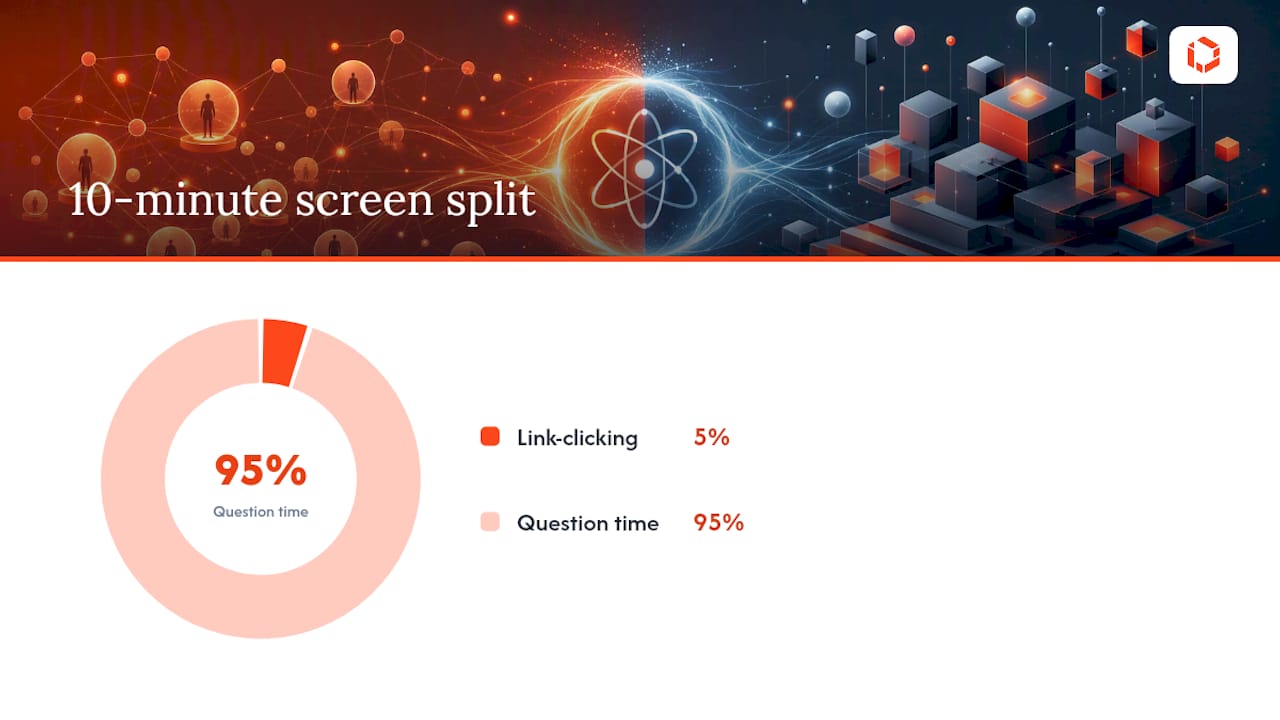
You don't need a computer science degree to run a first-pass technical screen. You need four questions and thirty seconds of link-clicking.
React Native 0.76 made the New Architecture the default, introducing the modern native-module system and Fabric renderer while allowing a gradual migration path for existing libraries and code. By React Native 0.82, the Legacy Architecture was no longer supported. For roles involving custom native modules, migration work, or difficult platform-level bugs, screen for practical experience with the project’s React Native version, native build tooling, and the relevant native code—not simply familiarity with Expo.
Here's the non-technical version of the screen, usable by any founder or hiring manager regardless of coding background:
Ask for the exact RN version they last shipped. "0.72" and "0.77" are different jobs. If they can't answer precisely, that's already informative.
Ask for live App Store or Google Play links to apps they built. Not GitHub demos, not portfolio screenshots. Actual published apps with their name attached to the commit history if possible.
Ask whether they've edited a
Podfileorbuild.gradlefile in the last six months. A yes points toward bare-workflow, native-integration experience. A no isn't disqualifying for an Expo-managed role, but it's a hard stop for a New Architecture position.Ask them to describe one bug that took longer than a day to fix. Vague answers ("performance issues") signal shallow experience. Specific answers ("a Fabric re-render loop caused by an unmemoized callback") signal the real thing.
For technical interviewers screening senior New Architecture candidates, dig deeper into the resume and portfolio before the call:
Codegen or Turbo Module pull requests on public repositories. Candidates who've written Codegen specs for native module interfaces have touched the real machinery, not just the JavaScript surface.
Fabric-related issue threads where the candidate diagnosed a rendering bug, not just reported one.
Native-language commits in Swift, Kotlin, or Objective-C inside a React Native project, which confirm the candidate can step outside JavaScript when a bug demands it.
Pro Tip: Ask for a screen share of their local development environment during the first technical call. Watching someone navigate Xcode or Android Studio for thirty seconds tells you more about real native experience than any resume line.
If your team already has strong technical hiring instincts but wants a second opinion on architecture tradeoffs, TouchZen's breakdown of Flutter versus React Native decisions after 75-plus app builds covers the same screening logic from an agency's vantage point.
Which Interview Questions Actually Separate Skill Levels?
Generic React interview questions won't tell you whether a candidate can handle your specific project. Targeted prompts, grouped by workflow, will.
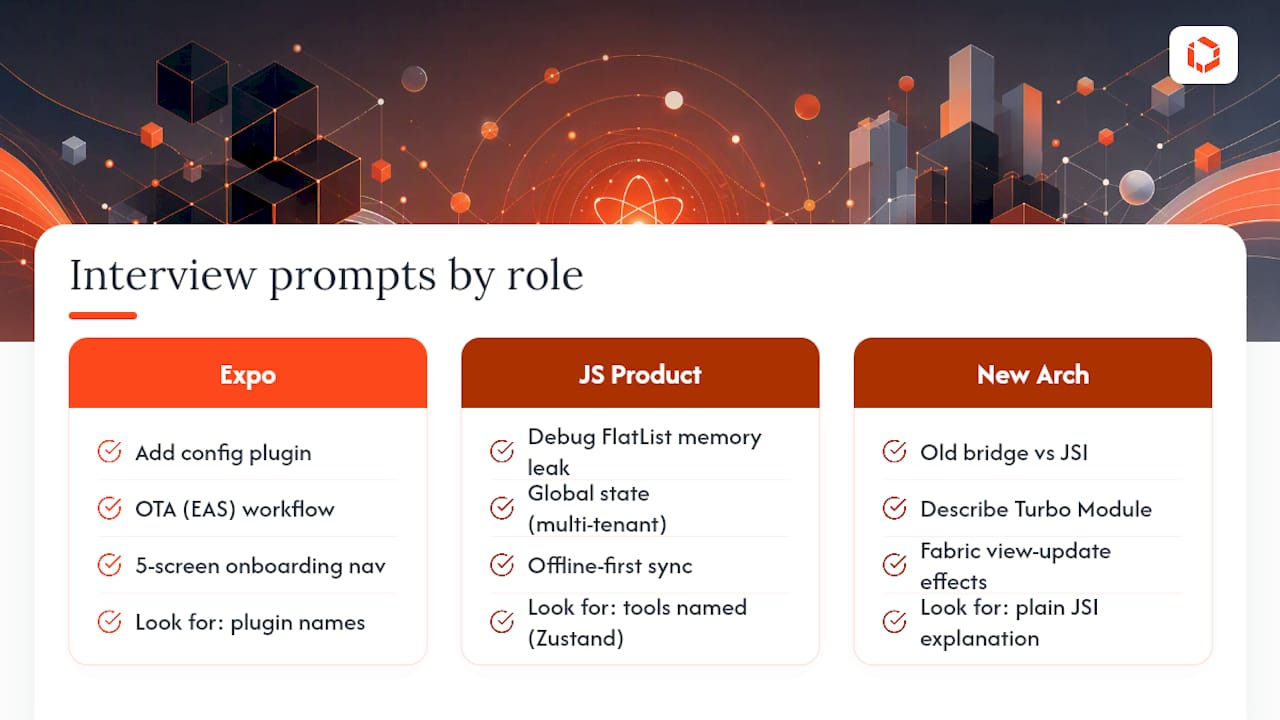
For Expo-managed roles, ask candidates to walk through how they'd add a new Expo config plugin, how they handle over-the-air updates with EAS, and how they'd structure navigation for a five-screen onboarding flow. Weak answers stay abstract. Strong answers reference specific plugin names and config file structure.
For JS product-layer roles, ask how they'd debug a memory leak in a FlatList with thousands of items, how they'd structure global state for a multi-tenant app, and how they'd handle offline-first data sync. Listen for whether they mention specific tools like Zustand, Redux Toolkit, or React Query by name.
For native-bridge and New Architecture roles, ask them to explain the difference between the old bridge and JSI in their own words, describe a Turbo Module they've written or debugged, and walk through how Fabric changes view hierarchy updates. A candidate who can't explain JSI in plain language almost certainly hasn't worked with it directly.
A short take-home test works better than a long one. For Expo-managed candidates, a two-hour task building a small feature (a settings screen with persisted state) reveals code quality fast. For New Architecture candidates, a task involving a small native module wrapper, even a stub that just returns device info, shows whether they can navigate the native project files at all. Correct submissions include working native build configuration, not just JavaScript that compiles in isolation.
Score submissions on three axes: does it run without your intervention, is the native/JS boundary handled correctly for the role tier, and did the candidate ask clarifying questions before starting. That third one matters more than people expect. Candidates who ask about edge cases before writing code tend to communicate better on real projects too.
Pro Tip: If a senior New Architecture candidate clears your take-home cleanly and answers the JSI question with specifics, move to offer within 72 hours. Top-tier native specialists routinely run four to five concurrent interview processes, and hesitation costs you the hire.
More screening logic, including questions to run before you even schedule an interview, is covered in TouchZen's guide on what to ask before hiring an app developer.
What Are the Biggest Red Flags When Hiring React Native Developers?
Some warning signs show up in the resume. Others don't surface until week three of onboarding, when it's already expensive to walk away.
Technical red flags to catch early:
No verifiable evidence of relevant production work. Store links can help, but some developers cannot share client work publicly. In those cases, ask for alternative evidence such as a walkthrough of a non-confidential project, a code sample, references, public contributions, or a detailed discussion of a recent production issue.
Claims Expo-managed experience for a role that requires native module work. This mismatch is the single most common cause of stalled projects three to four weeks into a bare-workflow build.
Zero mention of Xcode, Android Studio,
Podfile, orbuild.gradlewhen the role explicitly requires native integration work.Can't describe a specific bug that took real effort to solve. Everyone who has shipped production apps has at least one war story.
Process and communication red flags:
Gives a project timeline with zero clarifying questions about scope, target devices, or backend dependencies. Confidence without curiosity usually means underestimated complexity.
No testing strategy mentioned unprompted. Developers who skip testing tend to ship regressions that surface after launch, not before.
Refuses or deflects a live code walkthrough. A developer confident in their work will screen-share without hesitation.
Verification steps that confirm or kill a red flag:
Ask for store links when they can be shared publicly and use them as one piece of evidence. Public store listings usually do not identify each individual developer or prove their exact contribution, so confirm relevant experience through a project walkthrough, code sample, references, or a technical discussion. For senior roles, ask for a native build log from a recent project. A candidate with real Turbo Module or Fabric experience can produce one without scrambling.
None of these checks require your own coding background. They require asking for proof instead of taking claims at face value.
What Do React Native Developer Salaries Look Like in 2026?
Compensation splits sharply by architecture tier, and treating it as one number is the fastest way to either overpay for Expo-managed work or underpay a senior native specialist right into a competitor's offer.
Published salary averages vary because sources often combine different locations, seniority levels, and employment types. Use market-specific compensation data as a starting point, then adjust for the role’s scope, the candidate’s native-platform experience, and whether you are hiring an employee, contractor, or agency.
Time-to-hire follows the same logic. Mid-level Expo-managed roles usually fill in about a month due to a larger candidate pool and lower screening requirements. Senior New Architecture roles often take longer because qualified candidates are fewer and handle multiple offers.
Once you've identified a strong senior candidate, move fast. Top-tier native specialists often run several concurrent interview processes at once, and a 72-hour offer window after the final interview is the difference between landing them and losing them to a faster-moving competitor. For a deeper breakdown of hourly contractor rates versus full-time comp, TouchZen's 2026 pricing guide covers freelance and agency benchmarks side by side.
Broader labor-market context from the Bureau of Labor Statistics confirms software development compensation has stayed on an upward trend industry-wide, which supports treating these bands as a floor rather than a ceiling in competitive markets.
Where Should You Actually Look for Candidates?
Job boards get you volume. GitHub gets you proof. The two channels solve different problems, and most hiring managers only use one.
Standard job boards (LinkedIn, Indeed, We Work Remotely) work fine for Expo-managed and mid-level roles where the candidate pool is deep and the bar is more about React fundamentals than native specifics. Post with the exact RN version and workflow in the title, not just "React Native Developer," to filter mismatches before they apply.
For senior New Architecture roles, GitHub and contributor scouting outperform job boards because repository evidence beats a resume claim. Prioritize these signals when reviewing a candidate's public work:
Codegen specification files in a React Native project, which prove hands-on Turbo Module setup
Merged pull requests touching Turbo Modules or native module bridging code
Issue threads where the candidate diagnosed or fixed a Fabric rendering bug
Contributions to popular native-integration libraries like
react-native-vision-camera, which demand real native-bridge fluency
Search GitHub with terms like turbomodule combined with .podspec, or fabric combined with codegenConfig, scoped to repositories with recent commit activity. On job boards, boolean searches combining "React Native" with "Turbo Modules" or "JSI" filter out a large share of Expo-only applicants automatically. Specialized communities (React Native's own Discord, the Infinite Red community, and niche Slack groups for mobile engineers) tend to surface passive senior candidates who aren't actively browsing job boards at all.
How Do You Right-Size the Team and Onboard Without Losing Momentum?
The wrong team shape kills momentum faster than the wrong hire. A single mid-level developer thrown into a native migration project will burn weeks chasing bugs a senior specialist would isolate in an afternoon.
For migration projects or apps with heavy native dependencies, pair a product-layer developer with a senior native mentor or architect. This two-role pattern reduces retention risk because the mid-level hire isn't stuck debugging alone, and fault isolation during native crashes happens in hours instead of days. For straightforward Expo-managed builds, one strong mid-level developer is often sufficient without a dedicated architect on standby.
A practical onboarding checklist:
Days 1 to 30: Verify local build success on both iOS and Android, confirm CI pipeline access, and assign a small, contained bug fix as a first task.
Days 30 to 60: Assign one feature with clear scope and a defined native dependency, if applicable, with daily check-ins tapering to twice weekly.
Days 60 to 90: Expect independent ownership of a feature area, with milestone reviews replacing daily check-ins.
Plan for a real ramp period. A developer coming from web React typically needs two to three months before they're fully productive on native-layer issues, even if their JavaScript skills are strong on day one.
Pro Tip: Set one measurable 30-day milestone before the hire even starts, like "ship the onboarding flow to TestFlight." Vague ramp expectations are the top reason new hires feel lost and disengage early.
What Legal and Contractual Terms Should You Nail Down Before Hiring?
Get the contract structure right before the first sprint starts, not after a dispute forces the conversation. Whether you're hiring a full-time employee, a contractor, or an agency team, three terms matter more than the rest.
IP assignment needs to be explicit and in writing. Confirm the contract clearly assigns ownership of the code, designs, and other project deliverables to your company, subject to the applicable contract and local law. This matters especially with freelancers, where ambiguous language can leave ownership contested later.
Classification determines your tax and compliance exposure. Full-time employees and independent contractors carry different obligations under U.S. labor law, and misclassifying a long-term contractor as a 1099 worker when they function like an employee creates real liability. The U.S. Department of Labor publishes employer-facing guidance on worker classification that's worth reviewing before you finalize any contract structure.
Confidentiality and non-compete scope should be reasonable and specific. Overly broad non-compete language can scare off strong senior candidates who already have other clients or side projects, particularly freelancers who work across multiple industries.
Put a termination clause in writing too, covering notice period and handoff expectations, so a mismatched hire doesn't turn into a drawn-out disengagement. A short review by qualified legal counsel before signing can help ensure that the agreement is appropriate for the engagement and the applicable jurisdiction.
Freelance, Full-Time, or Agency: How Do You Evaluate Each Model?
Each hiring model solves a different problem, and evaluating them on the same criteria misses what actually matters for each.
Freelance developers win on flexibility and speed to start, often within days rather than weeks. Evaluate them on portfolio depth, availability overlap with your team's working hours, and whether they're juggling multiple concurrent clients. Timezone alignment matters more than people expect. Worldwide developer working-hours data shows meaningful variance across regions, which affects how much real-time collaboration you'll get.
Full-time hires win on long-term continuity and deep product context that accumulates over months. Evaluate them on culture fit, growth trajectory, and whether the role has enough scope to retain them past the first year. The 4 to 8 week hiring timeline is the tradeoff for that continuity.
Agencies win on immediate senior-level access without a multi-week hiring cycle, plus built-in redundancy if one team member is unavailable. Evaluate an agency on its track record with comparable projects, whether you get direct access to senior staff or get routed through account managers, and how support works after launch.
There's no universally correct choice here. A pre-seed startup testing an MVP concept has different needs than a Series B company scaling an existing app across three platforms.
How Do You Assess Cultural Fit and Communication in a Screen?
Technical skill without communication skill creates a different kind of expensive problem: the developer who ships correct code nobody can maintain because nothing was documented or explained along the way.
During screening, pay attention to how a candidate handles being told they're wrong. Present a deliberately flawed architecture decision during the technical interview and watch whether they push back with reasoning or simply agree to avoid friction. Both extremes, reflexive agreement and defensive rigidity, predict friction later.
Ask how they've handled disagreement with a product manager or designer on a past project. Strong answers describe a specific instance and a resolution. Weak answers stay abstract or shift blame entirely onto someone else.
For distributed or async-heavy teams, run at least one part of the interview process over async written communication, like a Loom video walkthrough of a code sample instead of a live call. How clearly someone explains a technical decision in writing often predicts how well they'll document code and communicate blockers once they're on your team, working mostly without direct supervision.
Why Do Diversity and Inclusion Considerations Matter in Technical Hiring?
Homogeneous hiring pools produce homogeneous blind spots, and mobile apps ship to a genuinely diverse user base. A screening process that only sources from one network or one type of program tends to miss strong candidates by default, not by design.
Widen your sourcing beyond the usual referral network. Bootcamp graduates, self-taught developers with strong GitHub portfolios, and candidates from non-traditional backgrounds often bring real New Architecture experience even without a computer science degree, particularly in native module work learned by necessity on a previous project.
Structure your screening questions the same way for every candidate, and score take-home tests against a written rubric agreed upon before you see a single submission. Removing the improvisational element from evaluation reduces the chance that unconscious bias creeps into what should be a purely technical decision. Include at least one interviewer from outside the immediate hiring manager's team on final-round calls, since a second perspective catches blind spots the first interviewer might miss entirely.
Our Take: Why the Architecture Split Is the Whole Game
Most hiring guides treat React Native as one homogenous skill and spend their word count on generic interview tips. That's backwards. The single biggest driver of a bad React Native hire in 2026 isn't a weak candidate. It's a mismatched candidate hired against a job description that never specified which React Native they actually needed.
Across its React Native projects, TouchZen has seen a consistent pattern: the projects that stall aren't the ones with a shortage of talent. They're the ones where an Expo-managed developer got dropped into a hardware-integration build that needed native-bridge fluency from day one. On one project involving biometric authentication, choosing a senior native specialist over a generalist at the outset avoided a rebuild that would have cost months of runway.
Our staffing model puts senior developers in direct contact with founders from kickoff, not routed through account layers, specifically because architecture decisions made in week one determine whether week twelve is smooth or painful. We pair that with mentorship structures for less experienced team members and post-launch support, because the developers who ship your v1 should still understand your codebase when v2 needs a rewrite.
The uncomfortable truth is that most hiring managers can't tell the difference between Expo-managed and New Architecture experience until they've already made the hire. That's exactly the gap a technical screen, or a staffing partner who's made this call 75 times, exists to close.
— Cyrus
How TouchZen Removes the Guesswork From React Native Staffing
TouchZen is the alternative to running your own multi-week hiring cycle: instead of screening a stack of resumes for JSI and Turbo Module experience, you get direct access to senior React Native developers with experience evaluating architecture requirements and native integrations.
Our team handles the full lifecycle, from choosing between Expo-managed and New Architecture approaches at the planning stage through native module integration, launch, and the post-launch support window where most apps actually need continued senior attention. You can begin with a team that has been evaluated for the technical requirements of your project, without running the full hiring process yourself. Founders who want senior-level React Native expertise without carrying full-time headcount often start with our fractional development team option, which gives direct access to experienced developers on a flexible engagement.
If you're planning a build with hardware integrations, a migration off the legacy architecture, or a performance-critical feature set, book a consultation through our mobile app development services page and walk through your architecture requirements with a senior developer before you write a single job posting.
Sources
FAQ
How Much Does It Cost to Hire a React Native Developer in 2026?
Mid-level Expo-managed developers typically run $100K to $128K annually, while senior New Architecture specialists with JSI and Turbo Module experience command $145K to $185K.
How Long Does It Take to Hire a React Native Developer?
Mid-level Expo-managed hires typically close in 4 to 5 weeks, while senior New Architecture roles take 6 to 8 weeks due to a smaller qualified candidate pool.
What's the Biggest Red Flag When Screening React Native Candidates?
Claiming general React Native experience without specifying Expo-managed versus bare workflow history is the most common mismatch, especially for roles requiring native module or hardware integration work.
Should I Hire a Freelancer, Full-Time Developer, or Agency?
Freelancers suit short, well-defined tasks; full-time hires suit long-term product ownership; agencies like TouchZen suit teams that need immediate senior-level access without a multi-week hiring cycle.
What Questions Reveal Real New Architecture Experience?
Ask a candidate to explain JSI in their own words and describe a specific Turbo Module or Fabric bug they've fixed. Vague or textbook answers usually mean the experience is theoretical, not hands-on.


