Joy Foroughi
Executive Assistant


Third-Party API Integration: What Founders Must Know
Unlock success with Third-Party API Integration. Discover what founders need to know before building and save time and resources.

TL;DR:
Using third-party APIs accelerates development by handling commodity functions, freeing teams to focus on core features. Proper integration involves careful planning, structured logging, resilience design, and vendor management to avoid technical debt and outages. Early architectural decisions and vendor evaluations significantly influence long-term reliability and regulatory compliance.
Use third-party APIs for commodity capabilities. Build only where the feature is your core competitive differentiator. That single rule, applied consistently, determines whether your engineering team ships product or spends quarters maintaining plumbing. Before your next kickoff meeting, run through these checkpoints:
Is this feature a differentiator? If customers would not choose you over a competitor because of it, buy it.
Does the API cover most of your requirements? A 90% fit with a mature provider beats a 100% custom build that takes six months.
Can your team own the maintenance? Every connector you add becomes a recurring operational surface, not a one-time project.
Do you have the expertise to build it securely? Payments, identity, and communications carry compliance obligations that take years to get right.
If you answered "no" to any of these, the default answer is to buy, not build. The rest of this guide tells you exactly how to do that without creating the technical debt that kills early-stage products.
What is a third-party API integration, exactly?
A third-party API integration is three things at once: application code that calls an external service, a service contract that defines what that service will and will not do, and an operational surface you now own in production. Most founders think only about the first part. The second and third are where the real cost lives.
In practical terms, the integration is the connection between your app and a capability you did not build. Three examples that cover most startup use cases:
Payments (e.g., Stripe). Your app sends a charge request; Stripe handles payment infrastructure, card-network interactions, fraud tooling, and settlement while helping reduce the PCI compliance burden. Your business still retains PCI responsibilities depending on the integration. You get a webhook confirming success or failure. The operational surface includes webhook signature validation, idempotency on retries, and monitoring for 402/429 responses.
Transactional email (e.g., SendGrid or Postmark). Your app triggers an event; the provider handles delivery, bounce handling, and ISP reputation. Your operational surface includes delivery rate monitoring, bounce-list management, and template version control.
Data enrichment (e.g., Clearbit or Apollo). Your app sends a domain or email; the provider returns firmographic data. Your operational surface includes rate-limit handling, schema change detection, and fallback logic when the provider returns null.
The TL;DR on buy vs. build: buy when the capability is a commodity with a mature market, when compliance requirements make DIY prohibitive, or when time-to-market matters more than marginal customization. Build when the feature is genuinely proprietary, when no provider covers your requirements at acceptable cost, or when data residency rules make third-party processing impossible.
Why founders add third-party APIs, and what the tradeoffs actually cost you
The benefits are real and well-documented. Speed to market is the most obvious: a payments integration that would take a dedicated team months to build securely can be live in days with a mature provider. Feature maturity matters too. Providers like Twilio or Stripe have handled edge cases your team has not imagined yet, from carrier routing failures to disputed chargebacks. Compliance support is another benefit: mature providers may offer certifications, security controls, and contractual agreements that can reduce implementation burden, but using a compliant provider does not automatically make your product compliant. Predictable, usage-based pricing also lets you match cost to revenue growth rather than front-loading infrastructure spend.
The tradeoffs are less often discussed honestly:
Operational dependence. When the provider has an outage, your product has an outage. Your status page reflects their reliability, not just yours.
Latency and performance. Every synchronous external call adds round-trip time. A checkout flow that chains several API calls can add noticeable latency before you have written any slow code.
Vendor lock-in. Data models, webhook schemas, and SDK conventions differ enough between providers that switching is a multi-sprint project, not an afternoon task.
Hidden maintenance costs. Subscription price is only a fraction of total cost of ownership; engineering time, changelog monitoring, and incident remediation often dominate the real number.
The decision rule that holds up across most startup contexts: buy commodity features, build core differentiators. Operationalize it by asking one question at every planning session: "Would a customer choose us over a competitor specifically because of this feature?" If the answer is no, the feature is a commodity.
What risks do you need to plan for before signing with a provider?
Security, privacy, legal exposure, and business continuity all carry distinct failure modes. The table below maps each risk category to the specific controls founders should require before production cutover.
Risk Category | Specific Risk | Required Control |
|---|---|---|
Secret management | API keys committed to source control or exposed in logs | Secrets manager (AWS Secrets Manager, HashiCorp Vault); never hardcode credentials |
Token handling | OAuth tokens stored in plaintext or not rotated | Encrypted storage, automatic rotation, short-lived tokens where the provider supports it |
Least-privilege scopes | Overly broad API permissions increase blast radius on compromise | Request only the scopes the integration actually uses; document scope justification |
Webhook hardening | Unsigned webhooks allow spoofed events | Validate HMAC signatures on every inbound webhook; reject unsigned payloads |
CCPA compliance | User data processed by a third party without a Data Processing Agreement | Require a signed DPA; map all data fields sent to the provider |
HIPAA considerations | PHI transmitted to a non-BAA provider | Require a signed BAA before any health data flows; confirm the provider is BAA-eligible |
Cross-border data transfer | EU/EEA personal data transferred to a third country without appropriate safeguards | Confirm data residency options and the appropriate transfer mechanism, such as an adequacy decision or Standard Contractual Clauses where required |
Vendor pricing changes | Provider reprices mid-contract | Negotiate price-lock clauses or at minimum a 90-day change-notice requirement |
SLA gaps | Provider SLA covers uptime but not latency or error rate | Require SLA terms that cover p95 latency and error rate, not just availability percentage |
Termination rights | Provider can terminate with 30-day notice; you have no data export path | Require data portability clauses and a minimum 90-day termination notice window |
Liability limits | Provider caps liability at one month of fees | Negotiate higher caps for integrations that touch revenue or user data |
For app security best practices that go beyond API-specific controls, the principles around authentication and secrets management apply directly here.
Contractual checklist before you sign: SLA with defined error-rate and latency terms, 90-day change-notice clause, rollback window for breaking changes, data portability on termination, liability cap negotiation, and a signed DPA (plus BAA if health data is involved).
Engineering rules your team should follow from day one
Most integration failures are not caused by a lack of tools. They come from missing engineering discipline: unclear contracts, brittle mappings, unsafe retries, and authentication that quietly expires at 2 AM. The following requirements should appear in your tickets and acceptance criteria before a single line of integration code is written.
Core requirements:
Timeouts on every call. Set both connection and read timeouts. A provider that stops responding should not hang your request thread indefinitely.
Retries with exponential backoff and jitter. Retry transient failures (5xx, network errors) with increasing delays and randomized jitter to avoid thundering-herd problems. Do not retry 4xx errors except for 429s with the provider's
Retry-Afterheader.Circuit breakers. After a configurable failure threshold, open the circuit and return a fast failure rather than queuing requests against a degraded provider.
Idempotency keys for all write operations. Any call that creates or modifies data must carry an idempotency key so safe retries do not produce duplicate records.
Observability requirements:
Attach a correlation ID to every outbound request and log it with the response. Track p95 and p99 latency per provider endpoint, 429 and 5xx rates, and retry rates. Failure modes follow a predictable cadence: Timeouts, rate-limit responses, server errors, and breaking changes can occur at different frequencies depending on the provider and workload. Set alert thresholds based on your own baseline, traffic patterns, and provider SLA.

Error handling and user messaging:
Familiarity with a provider's error response format directly improves both application robustness and the quality of user-facing messages. Map provider error codes to internal error types at the integration boundary. Surface a user-friendly message ("Payment could not be processed. Please try again or use a different card.") while logging the full provider response internally for debugging.
A minimal structured log entry for an outbound API call should include: timestamp, correlation_id, provider, endpoint, http_status, latency_ms, retry_attempt, and error_code. That schema lets you query incidents without guessing what happened.
Retry policy template for acceptance criteria: "All calls to [Provider] must implement exponential backoff starting at 500ms, doubling on each attempt, with ±100ms jitter, up to a maximum of 3 retries. Circuit breaker opens after 5 consecutive failures within 60 seconds. Idempotency keys are required for write operations where the provider supports them.
Pro Tip: Wrap all third-party calls in a single internal service layer rather than calling provider SDKs directly from feature code. This gives you one place to enforce timeouts, retries, logging, and circuit-breaker logic, and it makes provider swaps a one-file change instead of a codebase-wide refactor.
Which architectural patterns actually protect you at scale?
Architecture decisions made in the first sprint are the hardest to undo at Series A. The two patterns that pay the most consistent dividends are the unified API layer and multi-provider fallback.

Pattern | When to use it | What it costs | What it protects against |
|---|---|---|---|
Unified API layer (hub-and-spoke) | Any integration that will be called from more than one service or feature | 1–2 sprint investment upfront | Provider swaps, inconsistent retry logic, scattered logging |
Multi-provider fallback | Business-critical capabilities (payments, notifications, auth) | 2–4 sprints plus ongoing sync | Single-provider outages that take your product down |
Async queue (SQS, RabbitMQ) | Non-real-time operations (email, webhooks, enrichment) | Low; queue infrastructure is commodity | Spike-driven overload, retry storms, lost events |
Response caching | Read-heavy, low-volatility data (exchange rates, enrichment, config) | Minimal | Unnecessary API calls, rate-limit exhaustion, latency |
Canonical data model | Multi-provider or multi-tenant integrations | Medium; requires upfront schema design | Provider-specific data leaking into your domain model |
Industry leaders recommend multi-provider fallback and a unified API layer for any capability where downtime directly affects revenue or user trust. The practical question is when that investment is worth making at your stage.
For many pre-Series A products, establishing a small internal integration layer early can be worthwhile. It requires some upfront architecture and implementation effort but can reduce future retrofit work. Multi-provider fallback should be reserved for capabilities where downtime would materially affect revenue, access, or user trust, based on the product’s specific risks and complexity.
Sync vs. async is a simpler decision: if the user is waiting for the result, the call must be synchronous. If the user is not waiting, make it async. Webhook vs. polling follows the same logic: prefer webhooks for event-driven updates, but always implement a polling fallback for providers whose webhook reliability is unproven.
For deeper reading on system architecture patterns that apply to integration design, the trade-offs between synchronous and event-driven approaches are covered in detail there.
For founders thinking about how these patterns interact with mobile app scalability, the same hub-and-spoke principle applies: centralize your integration logic so the mobile client never calls a third-party provider directly.
How do you evaluate a third-party API provider before committing?
Vendor selection is where most founders spend the least time and pay the highest long-term price. The checklist below is organized into three categories. Score each item 1–3 and require a minimum threshold before contracting.
Technical checklist:
Documentation is complete, versioned, and includes error code definitions (not just happy-path examples)
A sandbox environment is available and mirrors production behavior closely enough to catch real bugs
SDKs exist for your stack and are actively maintained (check the GitHub commit history, not just the README)
Versioning policy is explicit: how much notice does the provider give before deprecating an endpoint?
Pagination, rate limits, and error formats are documented with concrete examples
OpenAPI or equivalent machine-readable spec is available for contract testing
Business checklist:
SLA covers uptime, error rate, and p95 latency, not just availability percentage
Uptime history is publicly available (status page with historical data, not just current status)
Support availability matches your on-call hours (24/7 for critical providers, business hours for non-critical)
Pricing tiers and metering model are transparent; you can model cost at 10x your current volume
No surprise overage clauses that trigger at thresholds you will hit in normal growth
Operational checklist:
Change-notice policy: provider commits to a minimum notice window (90 days preferred) before breaking changes
Data export and portability: you can retrieve all your data in a standard format on termination
Legal terms include indemnification for IP infringement and a liability cap you have negotiated
Compliance attestations are current: SOC 2 Type II, HIPAA BAA availability, PCI DSS where relevant
Negotiation red flags that should pause or stop the integration:
No sandbox environment or sandbox that does not match production
No published SLA or SLA that covers only uptime with no latency or error-rate terms
No data portability clause in the standard contract
Pricing that changes on less than 30 days' notice
No changelog or deprecation policy
Vendor selection should be scored on documentation quality, change-notice discipline, sandbox completeness, and export options, not just subscription price. A provider with excellent documentation and a clear deprecation policy will cost your team far less in maintenance than a cheaper provider with opaque changelogs.
What does a solid testing and rollout plan look like?
Shipping an integration to production without a structured rollout plan is how a single provider incident becomes a customer-facing outage. The sequence below is the minimum viable playbook.
Write contract tests against the sandbox. Before writing a line of production code, define the expected request/response schema for every endpoint you will call. Tools like Pact or a simple JSON schema validator (Zod in TypeScript) let you automate these. Run them in CI so a provider schema change breaks your build before it breaks production.
Validate in staging with production-equivalent data volumes. Sandbox environments often do not enforce rate limits or simulate realistic latency. Run a load test in staging that reflects your p95 traffic scenario, not just a happy-path smoke test.
Define health gates before canary rollout. A canary release exposes the new integration to a small percentage of traffic (typically 5–10%) before full cutover. Health gates should include: error rate below your baseline threshold, p95 latency within acceptable bounds, and dead-letter queue (DLQ) depth at zero or near-zero.
Run the canary for a defined window. For non-critical integrations, 24 hours is usually sufficient. For payments or authentication, run the canary for at least 72 hours and monitor across a full business cycle.
Document the incident playbook before go-live. The runbook should specify: what triggers a rollback (error rate threshold, latency spike, DLQ depth), who is on call and how they are paged, how to activate the fallback provider or degrade gracefully, and what customer communication goes out if the incident exceeds 15 minutes.
Require the following as part of your Definition of Done: contract tests passing in CI, staging load test results documented, health gates defined and agreed, runbook written and reviewed, monitoring dashboards live, and on-call rotation confirmed.
A production-grade integration playbook includes data contracts, auth rules, idempotency, DLQs, correlation IDs, structured logs, metrics, and staged rollouts. That is not a checklist for large engineering teams. It is the minimum for any integration that touches user data or revenue.
What does API integration actually cost in time and money?
Founders consistently underestimate integration cost by focusing on the subscription fee and the initial build sprint. The real cost model has three components: build, maintain, and remediate.
Phase | Typical Duration | Engineering Effort | Cost Drivers |
|---|---|---|---|
Sandbox proof of concept | 1–3 days | 1 engineer-week | Documentation quality, SDK maturity |
Production-ready integration | 1–3 sprints | 2–6 engineer-weeks | Error handling, observability, security controls |
Resilience hardening | 1–2 additional sprints | 2–4 engineer-weeks | Circuit breakers, fallback logic, load testing |
Ongoing maintenance (per connector, per year) | Continuous | 1 engineer-week/quarter | Changelog monitoring, deprecation handling, incident response |
Incident remediation (per major incident) | 1–5 days | 1–5 engineer-days | Severity, fallback availability, runbook quality |
A single integration expands into ongoing maintenance work; eight to ten connectors require centralized architecture and dedicated capacity. That is not a warning to avoid integrations. It is a planning input. If you are building a product that will rely on ten connectors at scale, budget for a platform engineer or an integration-focused agency relationship before you hit that number.
Role ownership matters as much as headcount. Assign a named owner for each connector: someone who monitors the provider's changelog, owns the runbook, and is on the incident rotation. Without a named owner, maintenance work accumulates silently until a breaking change hits production undetected.
Building resilience requires additional upfront engineering effort, and the amount varies by integration complexity and risk. Retrofitting resilience after a production incident can be considerably more disruptive in both engineering time and customer impact.
What integration lessons do founders often miss?
Two findings consistently separate founders who ship reliable integrations from those who spend quarters firefighting.
The buy-vs-build misallocation problem. Founders frequently direct senior engineering time toward building commodity capabilities because the feature feels important or the team wants full control. The discipline is to default to buying any feature that does not meaningfully differentiate the product. Authentication, email delivery, payments, and SMS are almost never differentiators. Building them from scratch does not create competitive advantage. It creates maintenance obligations that compound over time and pull senior engineers away from the work that actually moves the product forward.
The practical test: write down the three features that would cause a customer to choose you over your closest competitor. If the integration you are considering is not on that list, buy it.
Single-provider reliance is an architecture failure for critical capabilities. Not a risk to manage. An architecture failure. If your payments provider goes down and you have no fallback, your product is down. For any capability where downtime directly affects revenue or user trust, plan multi-provider fallback from the start, even if you only activate the secondary provider in an emergency.
Changelog monitoring is underinvested. Most teams discover breaking changes when production breaks, not when the provider publishes the deprecation notice. Subscribe to provider changelogs, set up automated contract tests in CI, and assign a named owner to each connector's changelog.
The maintenance tax compounds. One connector is manageable. Five connectors with no centralized architecture means five separate retry policies, five separate logging schemas, and five separate incident runbooks. Invest in the unified API layer before you hit that number, not after.
Your 30/60/90 execution plan for this quarter
Convert the guidance above into a concrete plan with owners and non-negotiable deliverables.
Days 1–30: Foundation and vendor selection.
Complete the vendor evaluation scorecard for every planned integration.
Negotiate and sign contracts with SLA, change-notice, data portability, and DPA terms.
Assign a named owner to each connector.
Stand up the unified API layer architecture (even if only one connector uses it initially).
Set up secrets management and confirm no credentials are in source control.
Days 31–60: Build and test.
Complete sandbox proof of concept for each integration.
Write contract tests for every endpoint; integrate into CI pipeline.
Implement error handling, retries, circuit breakers, and idempotency keys.
Build structured logging with correlation IDs and set up monitoring dashboards.
Run staging load tests and document results.
Days 61–90: Rollout and hardening.
Execute canary rollout with defined health gates for each integration.
Write and review incident runbooks before full production cutover.
Confirm on-call rotation and alerting thresholds are live.
Complete multi-provider fallback implementation for any business-critical capability.
Conduct a post-launch review: are DLQ depths at zero? Are p95 latencies within SLA? Are retry rates stable?
Must-have deliverables before launch: signed contracts with SLA and DPA terms, monitoring dashboards live, runbooks written and reviewed, contract tests passing in CI, and canary rollout completed with health gates met.
Risk checkpoints before full production cutover: error rate below baseline threshold, p95 latency within agreed bounds, DLQ depth at zero, fallback mechanism tested, and on-call engineer confirmed and paged.
Key Takeaways
Third-party API integration decisions made before building determine whether your product ships fast and stays reliable, or accumulates technical debt that slows every sprint that follows.
Point | Details |
|---|---|
Buy commodity, build differentiators | Default to third-party APIs for any feature that does not create competitive advantage for your product. |
Resilience costs less upfront | Designing for resilience adds some additional upfront build time but avoids far higher retrofit costs after production incidents. |
Maintenance is a recurring obligation | Each connector requires ongoing changelog monitoring, incident ownership, and quarterly engineering attention. |
Vendor evaluation goes beyond price | Score providers on documentation quality, SLA terms, sandbox completeness, and data portability, not subscription cost alone. |
TouchZen handles this end-to-end | TouchZen's senior team manages vendor evaluation, integration architecture, and post-launch maintenance so founders stay focused on product. |
How TouchZen approaches third-party API integrations for clients
The gap between a working integration and a production-grade integration is almost always an engineering discipline problem, not a technology problem. At TouchZen, the workflow for every integration engagement starts with a discovery session that maps the required capability against the buy-vs-build framework. If a third-party API is the right call, the team evaluates two or three providers against the scorecard described above before writing a line of code.
By default, TouchZen enforces the unified API layer pattern, structured logging with correlation IDs, and contract tests in CI on every integration project. Founders get direct access to the senior engineers making those decisions, not a project manager relaying questions to a junior team. That direct line matters most when a provider publishes a breaking change or an incident hits at an inconvenient hour.
Post-launch, TouchZen's ongoing support model includes changelog monitoring, incident response, and maintenance sprints so integrations do not degrade silently after the initial build. The team has launched over 75 apps across industries where third-party integrations are load-bearing, from fintech to health tech, and the operational patterns described in this guide are the defaults, not the premium tier.
TouchZen can scope your integration project this week
Founders who have read this far know exactly what a well-architected integration requires. The harder question is whether your current team has the bandwidth to execute it correctly while also shipping product.

TouchZen's mobile app development team handles the full integration lifecycle: vendor evaluation, contract negotiation support, architecture design, implementation with production-grade error handling and observability, and ongoing maintenance. You get senior engineers on every call, a named owner for each connector, and a post-launch support model that keeps integrations healthy as providers change.
To get an accurate estimate, send TouchZen the following: the integrations you need (provider names or capability descriptions), expected data volumes and transaction rates, compliance requirements (CCPA, HIPAA, PCI), your target launch date, and whether you need ongoing maintenance included. That scoping information lets the team turn around a proposal in 48 hours. Start the conversation here and get your integration architecture right before the first sprint begins.
Useful sources for founders building with third-party APIs
These are the authoritative references that informed this guide. Each one is worth bookmarking for your engineering team.
The Integration Engineering Playbook | ThinkBot: The most complete operational reference for production-grade API integrations. Covers contract testing, DLQs, idempotency, correlation IDs, and staged rollouts in one place.
Build Resilient API Integrations | APIScout: Detailed guidance on failure modes, monitoring thresholds, multi-provider fallback, and the cost trade-off of building resilience upfront versus retrofitting it.
Third-Party Integrations: Buy vs Build | Startupbricks: The clearest articulation of the buy-vs-build decision framework, including the wrapping pattern and circuit-breaker requirements.
Third-Party API Integration: The Dependency Problem at Scale | APIdeck: Honest analysis of how maintenance obligations compound as connector count grows, and when centralized architecture becomes necessary.
When Does It Make Sense to Add Third-Party APIs | Fundz: Practical TCO framework covering subscription cost, engineering time, and scale constraints.
Best Practices for Using Third-Party APIs | Square Developer: Concrete guidance on error response handling and user-facing messaging from a team that operates one of the most-integrated payment APIs in the market.
5 Steps to Building API Integrations Successfully | Merge.dev: A repeatable five-stage workflow from requirements to documentation that maps directly to the rollout checklist in this guide.
FAQ
What are the best practices for integrating third-party APIs?
Wrap all third-party calls in a unified service layer, implement retries with exponential backoff and jitter, use circuit breakers, assign idempotency keys to all write operations, and instrument every call with structured logging and correlation IDs. Validate provider error response formats before writing production code so your error handling and user messaging are accurate from day one.
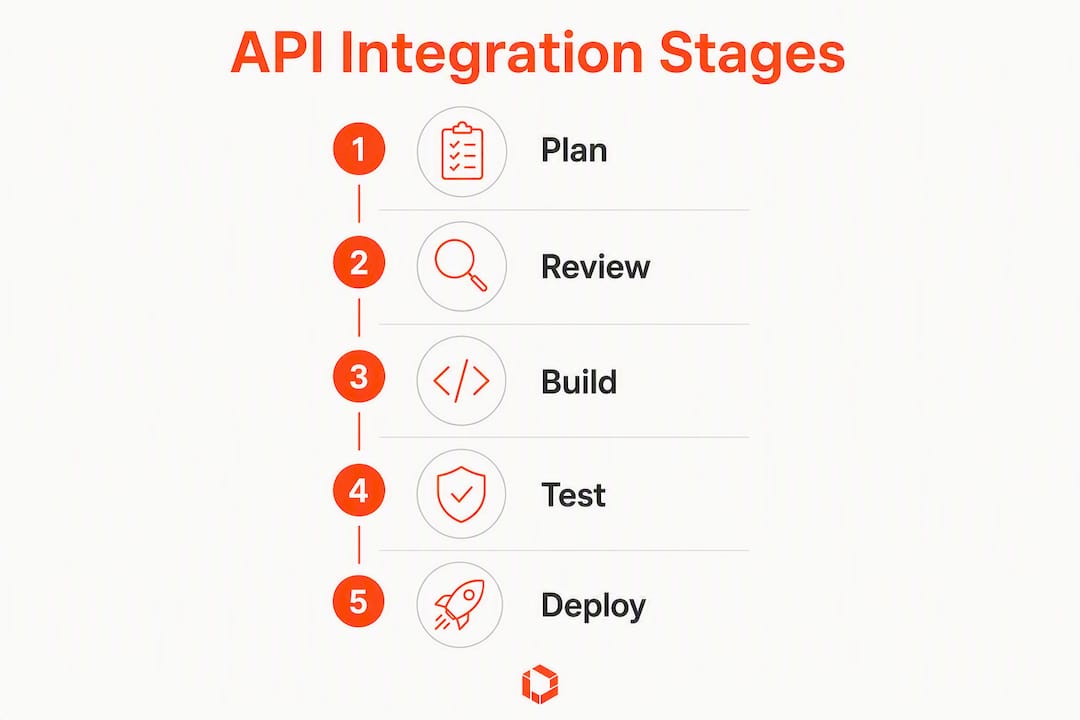
What are the five stages of API integration?
The commonly cited stages are: plan requirements, review provider documentation, build to the defined endpoints, test the integration in sandbox and staging, then document and hand off with runbooks and monitoring in place. Each stage has a defined exit criterion before the next begins.
What are the requirements for a production-ready API integration?
A production-ready integration requires timeout and retry logic, circuit breakers, idempotency keys on writes, structured logging with correlation IDs, monitoring dashboards covering p95 latency and error rates, contract tests in CI, a signed vendor contract with SLA and DPA terms, and a written incident runbook.
How do you handle API versioning and breaking changes?
Subscribe to the provider's changelog and set up automated contract tests that run in CI against the current API schema. When a breaking change is announced, the contract test fails in CI before it fails in production, giving your team time to adapt. Require a minimum 90-day change-notice window in your vendor contract.
When should a startup use TouchZen for API integration work?
When your team needs to ship a production-grade integration without pulling senior engineers off core product work, or when compliance requirements (HIPAA, PCI, CCPA) make the security and contractual controls non-trivial to get right. TouchZen's team handles vendor evaluation, architecture, implementation, and ongoing maintenance with direct senior-engineer access throughout.