
Joy Foroughi
Executive Assistant


Agile App Development: Build Faster With Less Rework
Discover how Agile app development helps startups build faster with less rework. Adapt swiftly and meet market demands effectively!

TL;DR:
Agile app development uses short cycles called sprints to minimize rework and align with market needs. It emphasizes continuous feedback, stakeholder collaboration, and flexible planning to speed up delivery and improve product fit. Implementing specific frameworks like Scrum or Kanban helps startups build and test their MVP efficiently within a lean, iterative process.
Agile app development is an iterative approach to building software that breaks work into short cycles, collects feedback continuously, and adjusts course before mistakes compound. For startup founders and product managers, this method directly solves the most expensive problem in early-stage development: building the wrong thing for too long. 71% of companies use Agile with iteration cycles of 1–2 weeks, showing that iterative development has become a widely adopted industry practice. Agile replaces months of locked-in planning with small, validated experiments that keep your product aligned with what the market actually wants.
How Agile app development helps startups build faster with less rework
The core mechanic of Agile is the sprint. A sprint is a fixed work period, typically one to two weeks, during which a cross-functional team designs, builds, and tests a defined set of features. At the end of each sprint, you have working software, not a status report. That distinction matters enormously for startups operating under time and budget pressure.

Traditional Waterfall development locks requirements upfront and delivers a finished product months later. If the market shifted or the original assumptions were wrong, you absorb the full cost of rework at the end. Agile reduces that risk by reducing the cycle of uncertainty through continuous feedback, turning a single high-stakes bet into a series of small, correctable decisions.
The practical benefits of Agile's iterative rhythm include:
Faster detection of bugs and design flaws. Testing happens inside every sprint, not after months of development. Defects found early cost a fraction of what they cost when found post-launch.
Continuous stakeholder alignment. Sprint reviews give founders and product managers a regular checkpoint to confirm the product is heading in the right direction.
Reduced scope creep. Prioritized backlogs force teams to rank features by value, which keeps the build focused and prevents feature bloat.
Lower rework costs. Because each sprint produces a tested increment, you never accumulate months of untested code that needs to be rebuilt from scratch.
Pro Tip: Set a firm "definition of done" before each sprint starts. If a feature is not tested and reviewed by the end of the sprint, it does not count as complete. This single rule prevents the most common source of rework in early-stage teams.
Research confirms the numbers behind these benefits. Teams adopting Agile show strong correlations with efficiency (r=.73), flexibility (r=.69), and stakeholder satisfaction (r=.65). These are not marginal gains. They represent a fundamentally different output quality compared to traditional project management.
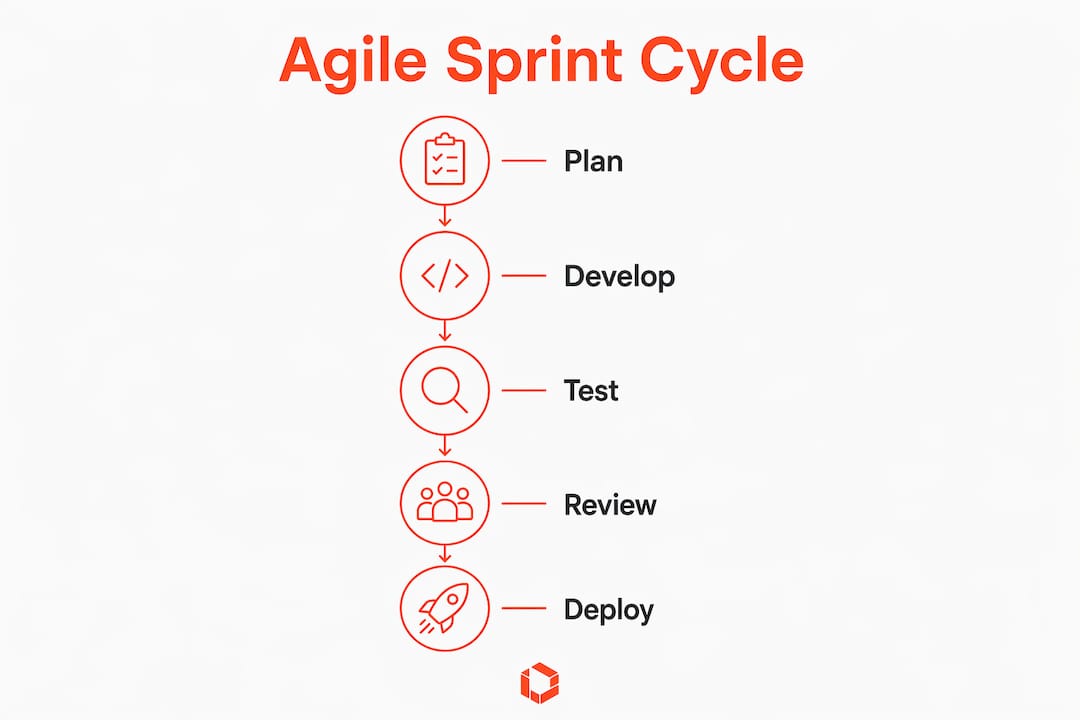
What Agile principles drive adaptability and stakeholder satisfaction?
Agile is not just a scheduling method. It represents a shift in how teams relate to customers, requirements, and change. The Agile Manifesto prioritizes customer collaboration over contract negotiation and welcomes changing requirements even late in development. For a startup, that flexibility is not a luxury. It is a survival mechanism.
The principles that matter most for startup founders are:
Customer collaboration at every stage. Agile teams treat stakeholders as active participants, not passive recipients. Regular demos and feedback sessions keep the product grounded in real user needs.
Working software over documentation. Every sprint delivers something functional. This builds trust with investors and co-founders because progress is visible and tangible.
Responding to change over following a plan. Markets shift. Competitors launch. User behavior surprises you. Agile gives your team permission to adapt without treating every change as a project failure.
Iterative planning over big upfront design. You plan in detail only what you are about to build, which keeps planning time proportional to actual value delivered.
"Agile transforms product development from a high-risk, long-term effort into a series of small, validated experiments that foster trust and better market fit. Continuous feedback loops replace guesswork with evidence, giving startups the confidence to move fast without losing direction."
Agile Project Management in the Digital Era
Agile teams improve communication through daily standups and continuous interaction, which reduces the confusion that derails traditional projects. For a startup where every team member wears multiple hats, that clarity is a direct productivity multiplier. Nearly half of organizations surveyed globally have used Agile for three years or longer, which signals that this is not a trend. It is the new baseline for software delivery.
How to implement Agile frameworks and build your MVP faster
Knowing Agile's principles is one thing. Applying them in a startup context requires choosing the right framework and tools for your team's size and pace.
Scrum vs. Kanban for early-stage startups
Scrum organizes work into fixed sprints with defined roles: a Product Owner who prioritizes the backlog, a Scrum Master who removes blockers, and a development team that executes. Scrum iterations typically last about two weeks, with cross-functional teams handling planning, building, and testing within each cycle. Scrum works best when your startup has a clear product roadmap and a team of three or more people.
Kanban uses a visual board to manage continuous flow without fixed sprints. Work items move through columns (To Do, In Progress, Done) with limits on how many tasks can be active at once. Kanban suits very small teams or solo founders who need flexibility without the overhead of sprint ceremonies.
Framework | Best for | Sprint length | Key strength |
|---|---|---|---|
Scrum | Teams of 3+ with defined roadmap | 1–2 weeks | Structured delivery and accountability |
Kanban | Small teams or continuous workflows | No fixed sprint | Visual flow and flexibility |
Hybrid | Complex projects with mixed needs | Variable | Combines structure with adaptability |
Building your MVP with Agile
The Minimum Viable Product (MVP) is Agile's most powerful tool for startups. An MVP is the smallest version of your product that delivers real value to real users. Studies show that 64%–80% of software features remain unused after launch. That statistic means most teams build far more than they need to. An Agile MVP strategy forces you to ship only what users will actually use, then iterate based on what they tell you.
Follow this sequence to build your MVP with Agile:
Define your core user problem. Write one sentence describing the problem your app solves. Every backlog item must connect to this sentence.
Build a prioritized backlog. List every feature you want, then rank them by user value and development effort. Cut everything below the top 20%.
Run your first sprint. Build only the highest-priority features. Ship them to real users at the end of the sprint.
Collect feedback immediately. Use in-app analytics, user interviews, or short surveys. Feed findings directly into the next sprint's planning session.
Repeat and expand. Add features only when user data confirms demand. This keeps your app development process lean and evidence-driven.
No-code and low-code platforms have accelerated this process significantly. The integration of no-code platforms is changing startup app development by enabling faster builds without abandoning Agile principles. Tools in this category let founders prototype and test ideas in days rather than weeks, which compresses the feedback loop even further.
Pro Tip: Treat your MVP launch as sprint zero for your growth phase. The goal is not a perfect product. The goal is the fastest path to real user data. Everything you learn in the first 30 days of launch is worth more than six months of internal planning.
What challenges do startups face when adopting Agile?
Agile adoption is not automatic. The most common failure point is cultural, not technical. Teams that have worked in Waterfall environments often resist the transparency and pace that Agile demands.
The challenges you are most likely to face include:
Resistance to daily accountability. Daily standups expose blockers and slow progress in real time. Team members used to working independently can find this uncomfortable at first.
Unclear product ownership. Agile requires a single Product Owner who makes final calls on backlog priority. Startups with multiple co-founders often struggle with this role because no one wants to be the decision-maker who says no.
Underestimating Agile training. Agile is a discipline, not just a meeting schedule. Teams that skip formal training or coaching tend to run "Agile in name only," which delivers none of the speed benefits.
Tool overload. Digital collaboration tools are essential to Agile's effectiveness, but adopting too many at once creates friction. Start with one board tool and one communication channel before adding complexity.
Losing sight of scalability. Speed without architecture planning creates technical debt. As you build fast, keep one eye on mobile app scalability so your MVP can grow without a full rebuild.
For complex projects, a hybrid approach works well. You can apply Scrum's sprint structure to core feature development while using Kanban for bug fixes and ongoing maintenance. The key is to keep the feedback loop intact regardless of which framework you choose. Agile's value comes from iteration, not from any specific ceremony or tool. Investing in an Agile coach for even two to three months at the start of your development process pays back in reduced rework and faster team alignment. Pairing that with AI-driven organizational agility tools can further shorten uncertainty cycles and improve team decision-making speed.
Key Takeaways
Agile app development reduces startup rework and accelerates delivery by replacing long planning cycles with short, feedback-driven sprints that keep the product aligned with real market needs.
Point | Details |
|---|---|
Sprints eliminate costly rework | 1–2 week cycles catch errors early, before they compound into expensive rebuilds. |
MVP focus saves resources | 64%–80% of features go unused; build only what users confirm they need. |
Scrum and Kanban serve different teams | Choose Scrum for structured roadmaps and Kanban for continuous, flexible workflows. |
Cultural adoption is the hardest part | Assign a clear Product Owner and invest in Agile coaching before your first sprint. |
Agile scales with your startup | Pair iterative development with scalability planning to avoid technical debt as you grow. |
Why speed without feedback is just expensive guessing
I have watched founders treat Agile as a productivity hack, a way to ship faster by holding more meetings and calling them standups. That misses the point entirely. The real value of Agile is not speed. It is the elimination of confident wrongness.
The most dangerous phase of startup app development is not when you are moving slowly. It is when you are moving fast in the wrong direction. Waterfall gives you momentum without correction. Agile gives you correction before momentum becomes a liability. Every sprint review is a chance to hear something uncomfortable from a real user and act on it before you have built three more months of features on top of a flawed assumption.
What I tell every founder I work with is this: your first sprint should make you slightly uncomfortable. If you are shipping something that feels too small, you are probably doing it right. The goal of the MVP is not to impress anyone. It is to generate the data that tells you what to build next.
Transparent communication between your development team and your stakeholders is not a soft skill. It is the mechanism that makes Agile work. Without it, sprint reviews become theater and backlogs become wish lists. With it, you get a product that earns its next feature through evidence, not assumption. If you want to launch your app in 90 days, Agile is one of the most effective methods for shipping something users actually want within that window.
— Cyrus
How TouchZen builds startup MVPs with Agile at the core
TouchZen works directly with startup founders and product managers who need to move from idea to launched product without the delays that come from working through layers of junior staff.
Every project at TouchZen runs on an Agile framework with senior developers and designers communicating directly with you from day one. The team has launched over 75 apps across industries, including results like 100k downloads in the first year. TouchZen's MVP development for startups service is built around iterative sprints, continuous stakeholder feedback, and a clear path from validated concept to mobile app launch. If you are ready to build faster and with less rework, TouchZen is the partner that keeps your development aligned with your market from the first sprint to post-launch growth.
FAQ
What is Agile app development?
Agile app development is an iterative software delivery method that breaks work into short cycles called sprints, collects user feedback continuously, and adjusts the product based on real data rather than upfront assumptions.
How does Agile reduce rework in startup projects?
Agile reduces rework by testing and reviewing features inside every sprint, which catches errors early. Teams adopting Agile show an efficiency correlation of r=.73 compared to traditional project management methods.
What is the best Agile framework for a small startup team?
Kanban works best for very small teams or solo founders because it manages continuous workflow without fixed sprint ceremonies. Scrum suits teams of three or more with a defined product roadmap.
How does an MVP fit into Agile development?
An MVP is the smallest version of your product that delivers real user value. Agile builds the MVP through prioritized sprints, then expands features only when user feedback confirms demand, avoiding the 64%–80% of features that typically go unused.
How long does it take to see results from Agile adoption?
Most teams see measurable improvements in delivery speed and stakeholder alignment within the first two to three sprints, typically within four to six weeks of starting a structured Agile process.