

Joy Foroughi
Executive Assistant


How to Improve App User Retention: 7 Proven Ways
Learn how to improve app user retention with these 7 proven ways to keep users coming back. Boost growth and engagement today!

TL;DR:
User retention measures the percentage of users returning after their first visit. Focusing on onboarding, personalization, and targeted notifications enhances long-term engagement and reduces drop-off. Building habit loops into the app architecture is more effective than relying solely on marketing or push notifications.
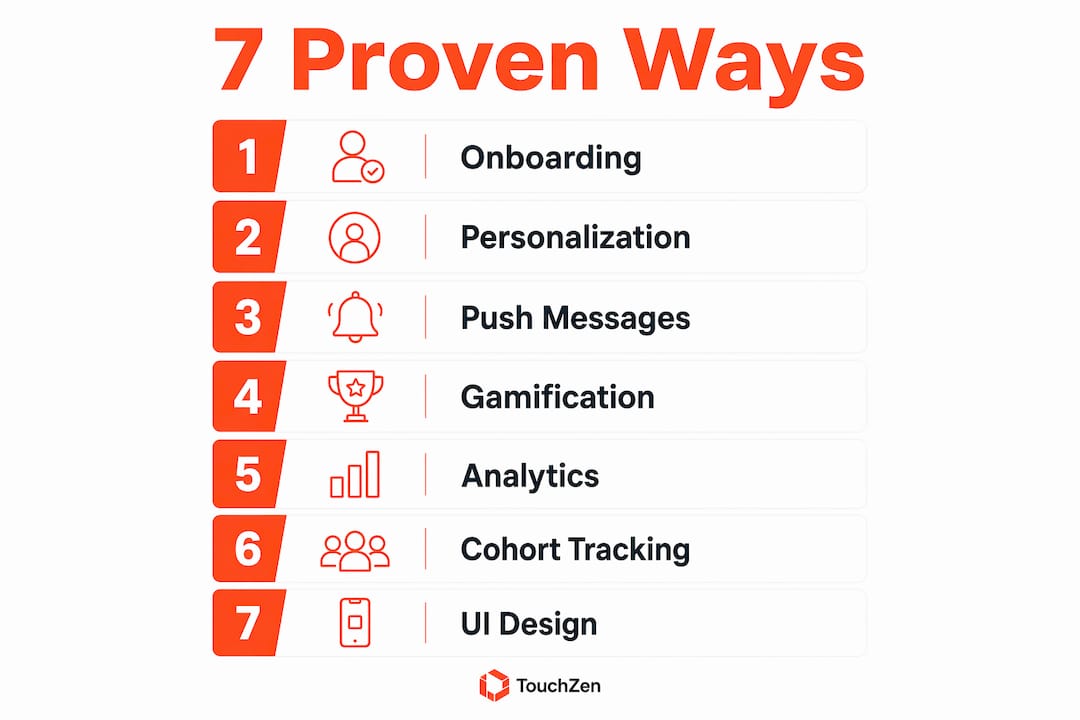
App user retention is defined as the percentage of users who return to your app after their first visit. It is the single most important metric for sustainable app growth, because acquiring a new user costs 5–10x more than re-engaging an inactive one. Most apps lose the majority of their users within the first week. The seven strategies covered here address that drop-off directly, using behavioral psychology, product design, and data-driven iteration to keep users coming back.
How to improve app user retention starts with onboarding
Onboarding is where retention is won or lost. Failing to deliver value in the first session drops a user's probability of returning below 15%. That single data point should reshape how you allocate development time.

The goal of onboarding is to hit the "time-to-value" milestone as fast as possible. Time-to-value is the moment a user first experiences the core benefit your app promises. Getting there in under 60 seconds yields 2–3x higher retention rates compared to onboarding flows that delay or bury that moment.
Here is what separates high-retention onboarding from average flows:
Segment from the start. Ask one or two setup questions and route users into a personalized experience. Segmented onboarding improves engagement by up to 25% compared to generic flows.
Use progressive disclosure. Show only what the user needs right now. Reveal advanced features after they complete their first core action.
Replace static tutorials with interactive walkthroughs. Let users accomplish something real during setup, not just watch a slideshow.
Remove every unnecessary step. Each extra screen is a drop-off risk. Audit your onboarding flow and cut anything that does not directly move the user toward value.
Confirm the win. After the user completes their first meaningful action, acknowledge it. A simple confirmation screen or micro-animation signals that the app is working for them.
Pro Tip: Track your Day 1 completion rate for onboarding separately from your Day 1 retention rate. If users finish onboarding but still do not return, the problem is value delivery, not flow design. These are two different problems with two different fixes.
For a deeper look at first-run flow patterns, the TouchZen team has documented onboarding patterns that lift retention specifically through Day 7.
What strategies use personalization and habit loops to keep users engaged?
Personalization is not a feature. It is a retention mechanism. Apps that enable customization and earned progress create psychological ownership that raises the cost of switching to another product. Users who have invested effort into an app feel reluctant to abandon it. Behavioral scientists call this the IKEA effect: people assign higher value to things they helped build.
The Hook Model, developed by Nir Eyal, explains how habit-forming products work. It cycles through four phases: trigger, action, variable reward, and investment. The investment phase is where personalization lives. Every time a user customizes their dashboard, earns a badge, or reaches a new tier, they deposit more of themselves into the product. That deposit makes them more likely to return.
Here is how to build personalization into your retention architecture:
Dashboard customization. Let users arrange, pin, or hide features. Even small choices create a sense of ownership.
Earned progress indicators. Show users how far they have come, not just how far they have to go. Progress bars and milestone markers activate the completion drive.
Tiered rewards. Structure your rewards so users always have a next level to reach. Flat reward systems lose their pull quickly.
Behavioral triggers. Use in-app triggers based on what a user has already done, not generic prompts. "You are 2 steps away from unlocking X" outperforms "Check out our new feature."
Content that adapts. If your app surfaces content, recommendations, or tasks, make them reflect the user's past behavior. Relevance is the fastest path to habit formation.
Pro Tip: Build your retention architecture into the product UI from day one. If your app only re-engages users through push notifications, you have already lost the structural battle. Notifications are a supplement, not a foundation.
How do push notifications and in-app messages drive retention without causing churn?
Push notifications are one of the most misused tools in mobile development. Used correctly, they bring users back. Used carelessly, they accelerate uninstalls. The difference comes down to timing, relevance, and frequency.
Push notifications sent within 3 days of inactivity result in 2–3x higher user return rates compared to waiting longer. That window is critical. After three days, users have mentally moved on, and a notification feels like an interruption rather than a helpful reminder.
The best practices for notifications that retain rather than repel:
Personalize every message. Reference the user's last action, their progress, or a specific feature they have not tried. Generic broadcast messages perform significantly worse than context-aware prompts.
Respect timing windows. Send notifications when your analytics show that specific user segment is most active. Sending at 2:00 AM is not just ineffective. It trains users to ignore you.
Limit frequency. One well-timed, relevant notification outperforms five generic ones. Set frequency caps per user segment.
Use in-app messages to guide, not interrupt. In-app messages appear when the user is already engaged. Use them to surface the next logical step, not to promote unrelated features.
A/B test your copy. Small wording changes in notification copy produce measurable differences in open rates. Test one variable at a time.
Re-engaging at-risk users with messages personalized to their last action brings users back more effectively than any broadcast campaign. The cost advantage is also significant: re-engagement costs a fraction of new user acquisition.
What role do gamification and variable rewards play in keeping users engaged?
Gamification works because unpredictability is neurologically compelling. The brain releases dopamine not when it receives a reward, but when it anticipates one. Variable rewards and unpredictability sustain long-term engagement better than static, predictable experiences. This is the same mechanism that makes slot machines difficult to walk away from, and it applies directly to app design.
The most effective gamification elements are not decorative. They are structural. Streaks, surprise badges, tiered leaderboards, and loot-style reward reveals all create what the Hook Model calls "rewards of the hunt." The user keeps returning because the next session might deliver something unexpected.
The table below compares gamification approaches by their retention impact and implementation complexity:
Gamification element | Retention impact | Implementation complexity |
|---|---|---|
Daily streaks | High: creates daily return habit | Low |
Tiered leaderboards | Medium: drives social competition | Medium |
Surprise badges | High: unpredictability sustains curiosity | Low |
Progress milestones | High: activates completion drive | Low |
Dynamic challenges | Very high: combines novelty and mastery | High |
One caution: gamification should reinforce your core value, not distract from it. If users are chasing badges instead of experiencing the product's primary benefit, the gamification is working against retention. Design rewards that celebrate meaningful actions within the app, not arbitrary ones.
How can analytics and cohort tracking sharpen your retention strategies?
Average retention metrics hide more than they reveal. A single retention percentage tells you nothing about which users are churning, when they leave, or why. Cohort analysis provides more actionable insights than average metrics alone because it groups users by when they joined and tracks their behavior over time.
The three checkpoints that matter most are Day 1, Day 3, and Day 7 retention. Each one tells a different story. Day 1 measures onboarding effectiveness. Day 3 measures whether users found a reason to return. Day 7 measures whether a habit has begun to form. Users who return three or more times in the first week are 10x more likely to remain active at Day 30. That correlation makes early-week engagement the highest-leverage target in your retention strategy.
Pro Tip: Map your user journey and mark every point where a user must make a decision or complete a step. Each of those points is a potential drop-off. Cohort data will show you which ones are actually causing churn. Fix the highest-drop-off point first, then re-measure before touching anything else.
Use your analytics to segment users by behavior, not just demographics. A user who completed onboarding but never used a core feature is a different re-engagement problem than a user who used the app daily for two weeks and then stopped. For a detailed comparison of analytics tools built for this kind of tracking, the Firebase vs Mixpanel breakdown on the TouchZen blog covers the trade-offs directly.
A/B testing your onboarding and engagement flows based on cohort data closes the loop. You are not guessing which change improved retention. You are measuring it against a control group and iterating with confidence.
Key Takeaways
Retention is a product design problem, and the teams that treat it as one consistently outperform those that rely on marketing alone to bring users back.
Point | Details |
|---|---|
Onboarding drives Day 30 retention | Users who return 3+ times in week one are 10x more likely to stay active at Day 30. |
Time-to-value under 60 seconds | Hitting the core value moment fast yields 2–3x higher retention rates. |
Personalization raises switching costs | Customization and earned progress create ownership that makes users reluctant to leave. |
Notifications require precision | Push messages sent within 3 days of inactivity produce 2–3x higher return rates. |
Cohort analysis beats averages | Day 1, Day 3, and Day 7 checkpoints reveal where users drop off and why. |
Retention is a design problem, not a marketing problem
After working on app products across multiple industries, the pattern I keep seeing is the same: teams pour budget into user acquisition, watch retention numbers stay flat, and then reach for push notifications as a fix. That sequence is backwards.
Retention architecture belongs inside the product, not in your marketing stack. The apps that hold users long-term are the ones that build habit loops directly into the UI. The trigger is in the product. The reward is in the product. The investment is in the product. Notifications are a last resort, not a strategy.
The other mistake I see constantly is treating personalization as a nice-to-have feature added late in development. Personalization is most powerful when it is baked into the onboarding flow from the first screen. By the time a user reaches their second session, the app should already feel like it was built for them specifically.
Simplicity matters more than feature count. Every new feature adds cognitive load. The apps with the highest long-term retention are rarely the most feature-rich. They are the ones that do one or two things exceptionally well and make those things feel effortless. Build for that. Measure it with cohort data. Iterate relentlessly.
— Cyrus
How TouchZen builds retention into every app it ships
TouchZen has launched over 75 apps across industries, and retention is never an afterthought. The team designs onboarding flows, personalization layers, and engagement triggers from the first sprint, not as a post-launch patch. That approach has produced results like a 10x increase in user subscriptions and 100,000 downloads within the first year for client apps.
If you are building a mobile app and want retention built into the product architecture from day one, the mobile app development team at TouchZen works directly with founders and product managers. No junior handoffs. Senior developers and designers own your project from kickoff to launch. You can also explore TouchZen's AI-powered app solutions for personalization and engagement features that adapt to user behavior automatically.
FAQ
What is a good app retention rate at Day 30?
Day 30 retention rates vary by category, but most high-performing apps target above 25%. Apps that optimize onboarding and hit time-to-value quickly consistently outperform category averages.
How do I reduce churn in the first week?
Focus on getting users to return at least three times in the first seven days. Users who hit that threshold are 10x more likely to remain active at Day 30, making early-week engagement your highest-priority retention lever.
Are push notifications effective for re-engagement?
Yes, when timed correctly. Push notifications sent within 3 days of inactivity produce 2–3x higher return rates. Generic or high-frequency notifications have the opposite effect and accelerate uninstalls.
What is cohort analysis and why does it matter for retention?
Cohort analysis groups users by their join date and tracks their behavior over time. It reveals exactly when and where users drop off, which average retention metrics cannot show. Use Day 1, Day 3, and Day 7 checkpoints as your primary diagnostic tool.
How does gamification improve long-term retention?
Gamification elements like streaks and surprise rewards create variable reward cycles that keep users returning for the next potential payoff. The key is tying rewards to meaningful in-app actions, not arbitrary milestones.


