
Joy Foroughi
Executive Assistant


Why Experience Matters in App Studios: 2026 Guide
Discover why experience matters in app studios for successful user retention and business growth. Learn to choose wisely in our 2026 guide!

Experience in app studios is the single most reliable predictor of whether your product will retain users, scale cleanly, and deliver measurable business results. Most startup founders evaluate studios on portfolio aesthetics and hourly rates. The ones who get burned learn too late that 25% of users abandon an app after a single use. That number reflects a failure of experience, not just design. Studios that understand why experience matters in app studios build products around user journeys, business alignment, and proven architecture. Studios that don't build features. The difference shows up in your retention metrics within 30 days of launch.
Why experience matters in app studios more than anything else
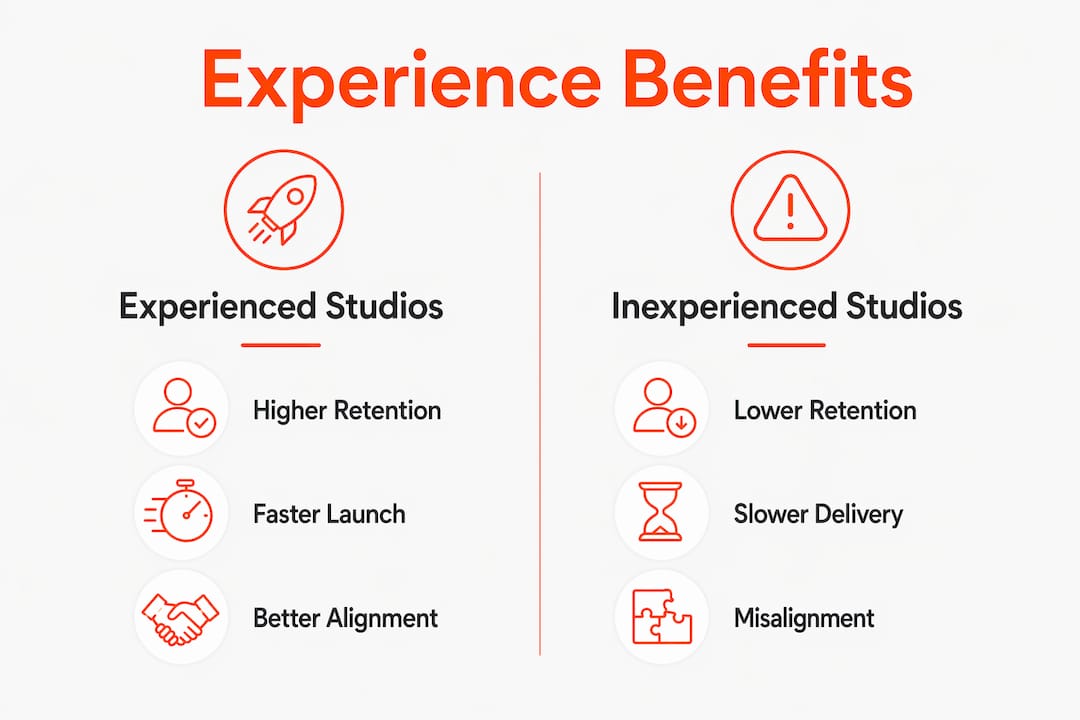
Experience in mobile app studios is not a credential. It is a set of practiced behaviors: designing for user psychology, writing code that scales, and communicating across functions without losing context. The industry term for this is experience-driven development, and it stands in direct contrast to feature-driven development, where teams ship functionality without validating whether it moves the user forward.
The gap between these two approaches is measurable. Studios that commit to experience-driven development achieve 15% higher user retention compared to feature-focused teams. Retention is the metric that determines whether your app becomes a business or a write-off.
Three capabilities define a genuinely experienced studio:
User journey ownership. Experienced teams map every interaction from first launch to power user behavior, not just the screens in a wireframe.
Scalable architecture. They write code that handles 10x growth without a full rewrite, using modular patterns and documented systems.
Business alignment. They understand your revenue model, your KPIs, and how each feature connects to both.
When you evaluate studios, these three capabilities are what you are actually buying.
How does experience impact app quality and user retention?
App quality is not a function of how many features you ship. It is a function of how well each interaction serves the user's goal at that moment. Experienced studios know this. They prioritize the first five minutes of user interaction above everything else, because onboarding is where retention is won or lost.
A weak onboarding flow does not just frustrate users. It permanently removes them from your funnel. Experienced teams design first-run flow patterns that reduce drop-off at Day 1, Day 3, and Day 7, the three checkpoints where most apps hemorrhage their install base.
Beyond onboarding, experienced studios build engagement systems that adapt to user behavior over time. They use tools like Firebase and Mixpanel to track where users stall, where they convert, and where they churn. That data feeds directly back into product decisions. Inexperienced teams treat analytics as a reporting tool. Experienced teams treat it as a retention driver.
The most advanced studios are now building AI-native apps that personalize the user journey dynamically. AI-driven trend analysis improves product-market fit by anticipating what users need before they articulate it. This is not a future capability. It is a current differentiator between studios with deep experience and those without it.
Pro Tip: Ask any studio you evaluate to walk you through their Day 7 retention strategy before you discuss features. If they cannot answer that question with specifics, they are building for launch, not for growth.
What unique processes do experienced app studios use?
Experienced studios do not start every project from scratch. They build internal systems that make each new project faster, more reliable, and easier to maintain. This is where the importance of experience in app development becomes a structural advantage, not just a soft skill.

The most concrete example is the use of internal SDKs and modular libraries. Experienced studios invest in reusable components that handle authentication, push notifications, analytics integration, and payment flows. These components are tested, documented, and battle-hardened across multiple products. The result: 50% reduction in time-to-market for new features compared to teams building from scratch each time. That is not a marginal efficiency gain. It is the difference between a 12-week launch and a 24-week one.
Here is how experienced studios operationalize these advantages:
Foundational frameworks. Pre-built architecture templates for iOS and Android that enforce consistent patterns across every project.
Strict documentation standards. Every module, API, and release includes written specs so any developer can onboard without a knowledge transfer meeting.
QA automation pipelines. Regression testing runs automatically on every pull request, catching issues before they reach staging.
Release note protocols. Structured changelogs that keep clients, product managers, and engineers aligned on what shipped and why.
Cross-project knowledge sharing. Lessons from one product feed into the next, compounding the studio's collective intelligence over time.
Process | Inexperienced Studio | Experienced Studio |
|---|---|---|
Feature development | Built from scratch each time | Reusable SDK components |
Documentation | Ad hoc or absent | Structured specs per module |
QA | Manual, end-of-sprint | Automated, continuous |
Client communication | Reactive, on request | Proactive, scheduled updates |
Time-to-market | Unpredictable | Consistently faster |
Pro Tip: Before signing a contract, ask the studio to show you their internal component library. A mature library with version history is one of the clearest signals of genuine operational experience.
How does experience shape team communication and business alignment?
Technical excellence alone does not guarantee a successful app. The studios that consistently deliver results are the ones where engineers understand the business context behind every feature they build. This is the role of expertise in app design that most founders overlook when they focus only on technical credentials.
Experienced developers ask questions that junior teams do not. They ask why a feature exists, what metric it is meant to move, and what the cost of delaying it is. That context changes how they build. A developer who knows a feature is tied to a paid conversion event will prioritize its performance differently than one who sees it as a checkbox on a spec sheet.
The communication practices of experienced studios also reduce management overhead for founders. Instead of waiting to be asked for updates, they proactively surface blockers, flag scope risks, and propose solutions. This matters enormously for startups where proactive stakeholder communication directly reduces decision latency and keeps timelines intact.
Key behaviors that distinguish experienced teams in this area:
They translate engineering decisions into business language without being prompted.
They flag when a requested feature conflicts with a stated business goal.
They own outcomes, not just tasks. The question is not "did we ship it?" but "did it work?"
They use client-agency communication frameworks that create shared accountability between the studio and the startup.
What risks do startups face with inexperienced app studios?
The most common failure mode for startup apps is not a crash or a security breach. It is a product that works technically but fails commercially. Poor user experience drives higher churn, negative reviews, and reduced revenue potential even when the underlying code is clean. That is the risk of hiring a studio with strong coding skills but limited product experience.
"The code was perfect. The app still failed." This is not a hypothetical. It is the documented outcome of teams that treat development as an execution task rather than a product strategy. Inexperienced studios deliver what was specified. Experienced studios deliver what was needed.
Specific risks you take on with inexperienced teams include:
Static user experiences. One-size-fits-all flows that ignore behavioral differences between user segments.
Feature misalignment. Building what was asked for rather than what drives engagement or revenue.
Communication gaps. Delays caused by unclear handoffs, undocumented decisions, and reactive rather than proactive updates.
Costly rework. Architecture decisions made early without scalability in mind that require full rewrites at growth stage.
The compounding effect of these risks is significant. A startup that launches with a poorly retained user base faces higher acquisition costs, lower lifetime value, and a longer path to product-market fit.
How to evaluate and select experienced app studios
Selecting the right studio is a due diligence process, not a vendor comparison. The criteria that matter most are not visible in a portfolio. They show up in how a studio answers your questions before the contract is signed.
Follow this evaluation sequence:
Request retention data from past projects. Ask specifically about Day 7 and Day 30 retention rates. Studios with genuine experience may be able to share relevant retention benchmarks or case-study outcomes.
Review their UX process documentation. Ask to see a sample user journey map or onboarding flow spec from a previous project.
Assess their codebase practices. Ask whether they use internal SDKs, modular libraries, and automated QA. Request a sample of their documentation standards.
Evaluate communication structure. Ask how they handle scope changes, how often they provide updates, and who your primary point of contact will be.
Examine case studies for business impact. Look for measurable outcomes: retention improvements, download milestones, revenue growth. Avoid studios whose case studies only describe features shipped.
Evaluation Criterion | Green Flag | Red Flag |
|---|---|---|
Retention metrics | Specific Day 7 and Day 30 data | "Our apps perform well" |
UX process | Documented journey maps and flows | Portfolio screenshots only |
Codebase practices | Internal SDKs, automated QA | "We build custom each time" |
Communication | Scheduled proactive updates | "We'll reach out as needed" |
Case studies | Revenue and retention outcomes | Feature lists only |
The benefits of experienced app developers are most visible in this evaluation stage. Studios with real depth welcome these questions. Studios without it deflect them.
Key takeaways
Experienced app studios deliver measurably better retention, faster time-to-market, and stronger business alignment because they treat development as a product strategy, not a coding task.
Point | Details |
|---|---|
Retention is the core metric | Studios with experience-driven development achieve 15% higher user retention than feature-focused teams. |
Onboarding determines survival | The first five minutes of user interaction have the highest impact on whether users stay or leave. |
Internal frameworks accelerate delivery | Reusable SDKs and modular libraries reduce new feature time-to-market by 50%. |
Communication is a deliverable | Proactive updates and business-aligned thinking reduce scope creep and decision latency for founders. |
Evaluation requires specific questions | Ask for retention data, UX process docs, and business-impact case studies before signing any contract. |
The startup advantage you are probably underpricing
I have watched founders spend months optimizing their pitch deck and 48 hours selecting their development studio. That inversion is expensive. The studio decision shapes everything downstream: your retention curve, your architecture debt, your ability to iterate fast, and your relationship with your own product.
The uncomfortable truth about experienced app developers vs inexperienced ones is that the gap is not visible until after launch. Both types of studios will show you polished mockups and confident timelines. The difference shows up in Week 6 when an experienced team flags a scalability risk you had not considered, or in Month 3 when your Day 30 retention is 40% instead of 12%.
What I have found consistently is that startups underestimate the value of experience until they have paid for the lesson once. The studios that charge more upfront because they bring reusable frameworks, documented processes, and senior engineers on every call are not overpriced. They are priced for the outcome, not the hours.
The significance of skill in app creation is not abstract. It is the difference between a product that compounds in value over time and one that requires a rebuild before it reaches scale. Invest in the team that has already solved the problems you have not encountered yet.
— Cyrus
Build your app with a team that has done this before
If you are evaluating studios and want to understand what genuine experience looks like in practice, Touchzen is worth a direct conversation.
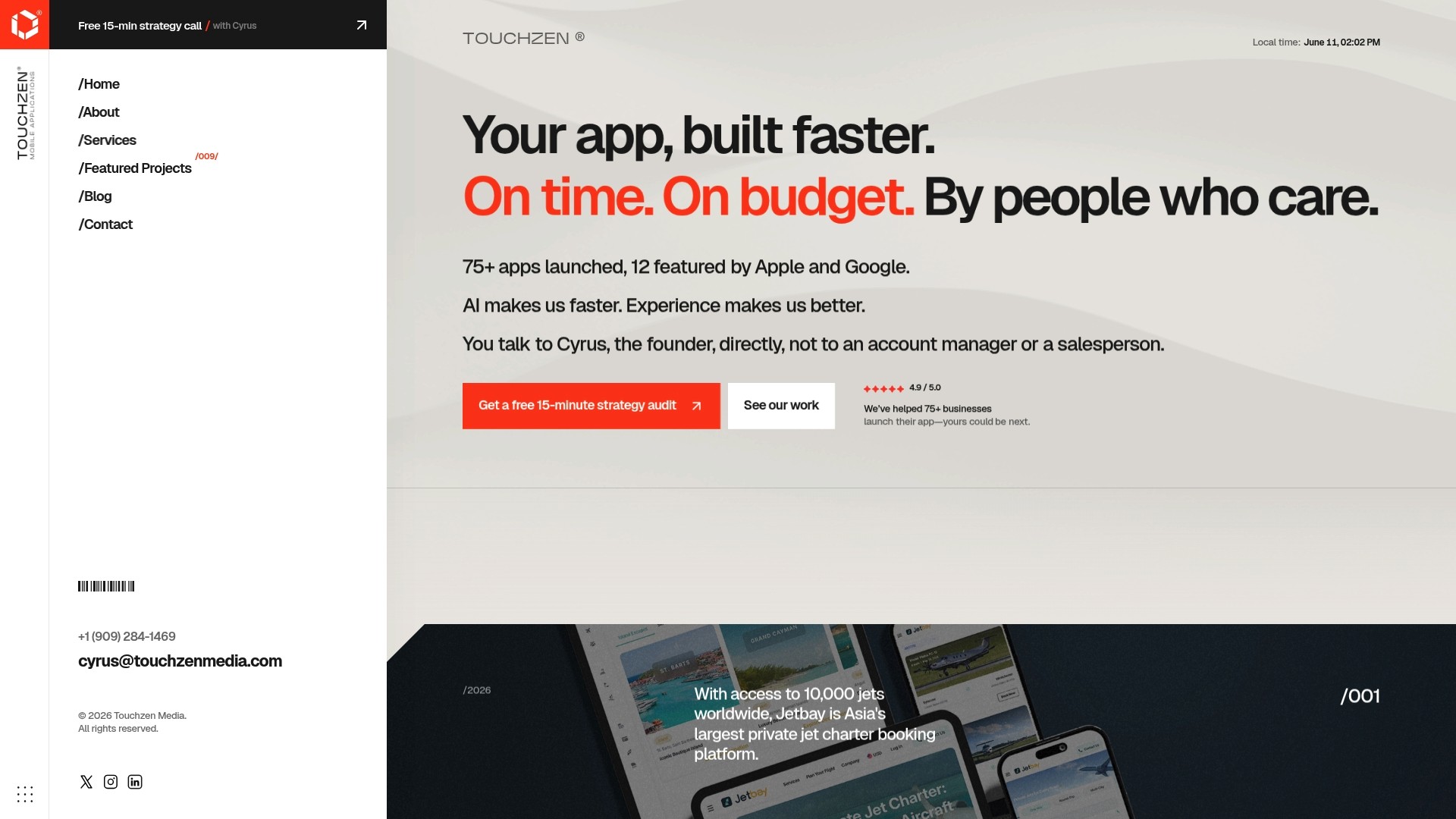
TouchZen has launched over 75 apps across iOS and Android, with results including 10x growth in user subscriptions and 100,000 downloads within the first year of launch. Every project runs through senior developers and designers from kickoff to post-launch support. No delegation to junior staff. No communication gaps. The team brings internal frameworks and reusable components that accelerate your timeline without cutting corners on architecture or UX. If you are ready to build something that retains users and scales cleanly, explore Touchzen's iOS and Android development services or review their standing among top-ranked app developers in the US.
FAQ
Why does experience matter more than technical skill alone?
Technical skill is the baseline, not the differentiator. Experienced studios add business alignment, user journey design, and communication practices that determine whether a technically sound app actually retains users and drives revenue.
What retention improvement can experienced studios deliver?
Studios focused on experience-driven development achieve 15% higher retention rates compared to feature-focused teams. That gap compounds significantly over a 12-month growth period.
How do internal SDKs reduce development time?
Experienced studios use reusable modular libraries for common functions like authentication and analytics integration. This approach cuts new feature time-to-market by up to 50% compared to building from scratch on each project.
What is the biggest risk of hiring an inexperienced app studio?
The primary risk is a product that works technically but fails commercially. Poor UX drives churn, negative reviews, and reduced revenue even when the code is clean, making user experience quality the most consequential factor in app success.
How should startups evaluate app studio experience before hiring?
Ask for specific Day 7 and Day 30 retention data from past projects, review their UX process documentation, and request case studies that show measurable business outcomes rather than feature lists.