
Joy Foroughi
Executive Assistant


7 App Proposal Red Flags That Quietly Inflate Cost
Discover seven red flags in app development proposals that inflate costs. Learn to avoid these issues and save on your project.

Seven red flags in an app development proposal reliably drive up cost and scope: vague scope language, missing acceptance criteria, the phrase "unforeseen technical realities," no App Store readiness plan, thin discovery, vendor lock-in, and unrealistic timelines. Cost bands for these projects run $5,000 to $50,000 for simple apps, $50,000 to $120,000 for medium complexity, and $120,000-plus for complex builds, and federal procurement guidance under FAR 15.403-2 shows what real cost justification looks like versus a vague estimate. Senior-staffed teams, the model TouchZen builds around, catch most of these before contract signing.
Here's your immediate action plan:
Vague scope: Require a signed scoping addendum before the first invoice.
Missing acceptance criteria: Ask for written sign-off standards per milestone.
"Unforeseen technical realities": Demand a technical architecture review during discovery.
No App Store readiness: Get store compliance written into the deliverables list.
Thin discovery: Push back if discovery is under 10% of the timeline.
Vendor lock-in: Confirm you own source code and credentials at contract end.
Unrealistic timelines: Compare the quote against your own realistic benchmarks.
Pro Tip: Print this list and hand it to whoever signs the contract. If a vendor bristles at any of these seven requests, that reaction is itself a red flag.
Key Takeaways
Proposal red flags inflate cost by shifting undefined risk from the vendor's estimate onto your invoice after the contract is signed.
Point | Details |
|---|---|
Name the seven red flags | Vague scope, missing acceptance criteria, "unforeseen technical realities," no App Store plan, thin discovery, vendor lock-in, unrealistic timelines. |
Benchmark against real cost bands | Simple apps run $5,000 to $50,000, medium $50,000 to $120,000, complex $120,000-plus. |
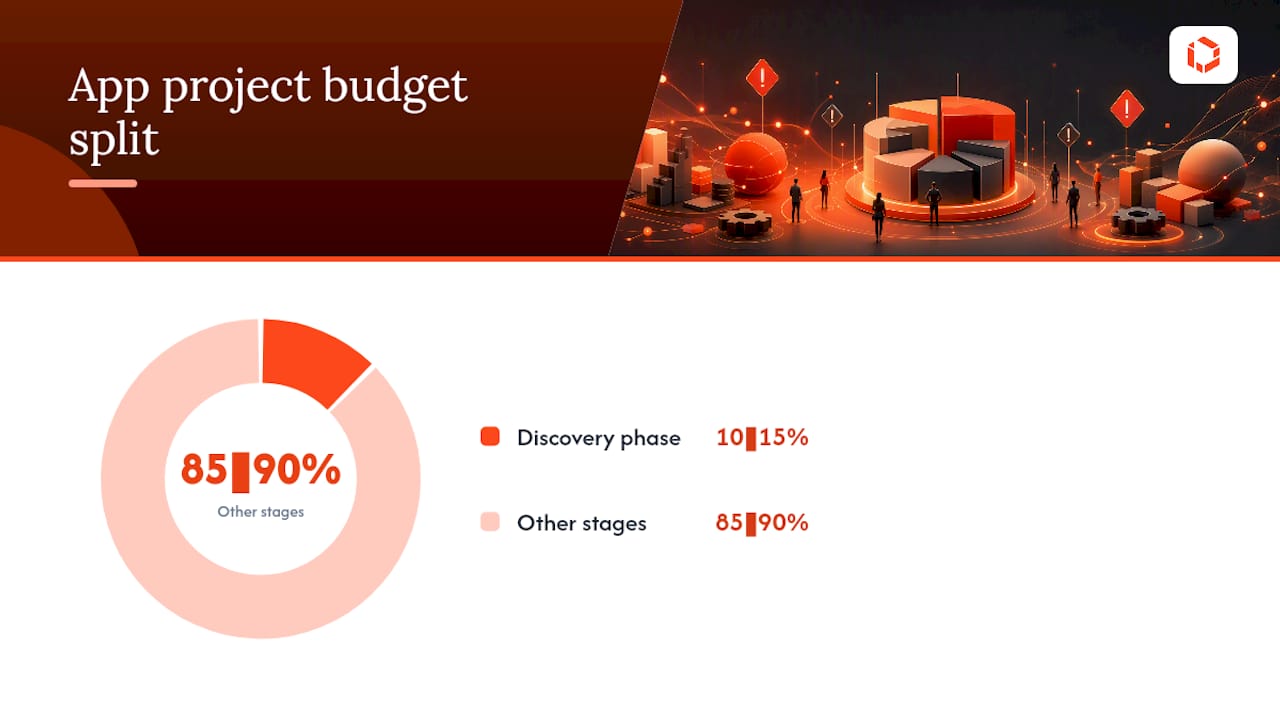
Protect the discovery phase | Discovery should run 10 to 15% of budget with named deliverables, not a flat weeklong add-on. |
Budget for maintenance upfront | Expect 15 to 25% of development cost annually for post-launch support. |
Choose senior-staffed delivery | TouchZen keeps senior developers on projects from kickoff to launch, a structure tied to results like 10x subscription growth. |
7 App Development Proposal Red Flags That Inflate Cost and Scope
A proposal that looks clean on page one can still bury the mechanisms that will double your final invoice. Each of the seven items below follows the same pattern: a specific cost driver, a way to spot it before you sign, and the exact question that forces the vendor to show their hand.
1. Vague scope language
Cost mechanism: undefined scope gives the vendor room to bill for "additional work" that should have been in the original quote. Spotting signs: phrases like "core features," "standard functionality," or "TBD" without a feature list attached to a number. What to ask instead: "Can you provide a numbered feature list with a scope boundary statement for each item, and what happens if I request something not on this list?"
2. Missing acceptance criteria
Cost mechanism: without a defined "done," disagreements over whether a milestone is complete become billable disputes. Spotting signs: milestones described by deliverable name only ("design phase complete") with no measurable standard. What to ask instead: "What specific, testable criteria determine when each milestone is accepted, and who signs off?"
3. "Unforeseen technical realities" language
Cost mechanism: this phrase often signals the vendor skipped real architecture planning and is pre-loading an excuse for scope creep. What to ask instead: "Walk me through the technical architecture review you'll complete before development starts, and what happens to pricing if a technical issue surfaces mid-build?" A vendor citing surprise complexity midway through a build usually means the discovery phase never tested the hard parts of the system.
4. Absent App Store readiness
Cost mechanism: Apple rejected nearly a quarter of app submissions in a recent transparency report, and most rejections trace to items that should have been caught during development, not after. Missing privacy manifests or account-deletion flows are common culprits, and Apple's own developer guidance treats these as development-stage failures. Spotting signs: no line item for App Store or Play Store compliance testing. What to ask instead: "Does the proposal include a pre-submission compliance review, and who absorbs the cost of a rejection cycle?"
5. Thin discovery phase
Cost mechanism: skipping or shrinking discovery pushes cost-driving decisions into development, where fixes are far more expensive. Research on infrastructure project overruns found that planning-stage lock-in before costs and benefits are fully assessed is a primary driver of later escalation. Spotting signs: discovery quoted at a flat fee under a week, or folded into "kickoff." What to ask instead: "What specific deliverables come out of discovery, and how do they change the final price?"
Statistic callout: A realistic discovery phase runs 10 to 15% of total project budget. A proposal that skips it isn't saving you money. It's deferring the cost to a more expensive stage.
6. Vendor lock-in
Cost mechanism: proprietary code repositories, undocumented systems, or exclusive support agreements force you back to the same vendor for every future change, regardless of price. What to ask instead: "Do I retain full source code, credentials, and documentation access if I end this engagement?"

7. Unrealistic timelines
Cost mechanism: a timeline shorter than comparable projects usually means either understaffing or a plan to renegotiate scope once you're already invested. What to ask instead: "How does this timeline compare to your last three similar projects, and what happens to the price if it slips?"
Pro Tip: A senior-led discovery phase costs more upfront but prevents the double-charge pattern: paying once to build the wrong thing, then paying again to fix it.
What Realistic App Costs and Budget Splits Actually Look Like
Simple apps typically run $5,000 to $50,000, medium-complexity builds run $50,000 to $120,000, and complex apps exceed $120,000. Within any budget, the stage split usually falls into a consistent pattern.
Maintenance adds another line: expect 15 to 25% of original development cost annually, which on an $80,000 build lands between $12,000 and $20,000 a year. Our maintenance budgeting guide breaks this down further.
Contract Terms That Prevent Surprise Charges
A proposal is a pitch. A contract is what actually protects your budget. Insist on these terms before signing anything:
IP ownership: You own all code, designs, and assets outright upon final payment.
Acceptance criteria: Written, testable standards attached to every milestone, not just deliverable names.
Change-request process: A defined procedure for pricing and approving anything outside the original scope.
Staffing commitments: Named senior team members, not "a team to be assigned."
Warranty and support period: A defined window (commonly 30 to 90 days) for post-launch bug fixes at no charge.
Termination and transition terms: A clear path to retrieve all assets if the relationship ends early.
App Store readiness: Submission and compliance testing named explicitly as a deliverable, not an assumption.
Under FAR 15.403-2, certain circumstances (like exercising a pre-set contract option) don't require certified cost or pricing data. That's federal procurement language, but the underlying logic applies to your negotiation too: ask for detailed cost justification when a price seems disconnected from scope, and accept firm-fixed pricing only when the scope is genuinely locked.
Pro Tip: Tie your final payment milestone to a working App Store submission, not just "code complete." That single change eliminates most last-mile disputes.
A One-Page Checklist for Comparing Proposals
Run every proposal through these yes/no questions before you compare pricing:
Does the proposal include a numbered, boundary-defined feature list? Y/N
Does each milestone have written acceptance criteria? Y/N
Is discovery quoted as 10 to 15% of total cost with named deliverables? Y/N
Are App Store and Play Store compliance testing named as line items? Y/N
Are senior team members named, not just "assigned"? Y/N
Do you retain full source code and credential ownership? Y/N
Is the timeline benchmarked against similar past projects?
Send vendors this clarification request when answers are unclear: "Before we move forward, can you confirm in writing: (1) acceptance criteria per milestone, (2) named senior staff assigned to this project, and (3) what triggers a change-request versus what's included in the base price?"
Score proposals by counting "No" answers. Two or fewer is workable with negotiation. Three or more means the proposal likely underprices the real scope.
How Senior-Led Discovery Prevents These Red Flags
TouchZen has launched 75-plus apps across industries, with results including 10x increases in user subscriptions and 100k downloads within a first year, by keeping senior developers and designers on the project from kickoff through launch rather than routing work through junior staff.
When discovery is run by senior engineers instead of account managers, the "unforeseen technical realities" excuse mostly disappears, because the hard architectural questions get answered before a single line of code gets written.
That structure translates into specific practices founders should demand from any vendor:
Senior-staffed weekly demo cadence, not monthly status reports.
Acceptance criteria written during discovery, not negotiated after delivery.
Phased MVP scoping that limits first-release risk.
Pro Tip: Ask any prospective vendor how many of the people in your kickoff call will still be on the project at launch. A high-turnover answer predicts a high-surprise budget.
What I'd Tell a Founder Before They Sign Anything
Most cost overruns aren't dishonesty. They're the predictable result of skipped discovery and vague contracts. Prevention beats renegotiation every time. Print the checklist above, insist on the contract terms, and treat any pushback on acceptance criteria as your answer before you've even signed.
Get a Proposal Reviewed Before You Sign
TouchZen reviews app development proposals the way this article just taught you to: checking for scope boundaries, acceptance criteria, and realistic staffing before you commit a dollar. Where a traditional agency routes your project through junior staff and hopes discovery catches problems later, TouchZen keeps senior developers and designers on your project from kickoff to launch, which is exactly the structure that prevents the seven red flags above from ever reaching your invoice.
If you have a proposal in hand right now and want a second set of senior eyes on it, request a proposal review through TouchZen's app development team before you sign anything. For founders who haven't gotten a quote yet, start with a discovery conversation so your scope gets defined correctly the first time.
Sources
Why Do Mobile App Development Budgets Keep Missing the Real Cost Driver in 2026? - JoriPress
Apple Developer news on App Store review and submission requirements
FAQ
What is the most common app proposal red flag?
Vague scope language is the most common, since it lets a vendor bill for work that should have been included in the original quote.
How much should discovery cost in an app development proposal?
Discovery should run 10 to 15% of the total project budget with named, specific deliverables attached.
What should I ask if a proposal mentions "unforeseen technical realities"?
Ask the vendor to walk through their technical architecture review process and what happens to pricing if a technical issue surfaces mid-build.
How much should I budget for app maintenance after launch?
Plan for 15 to 25% of your original development cost annually in ongoing maintenance.
Does TouchZen offer proposal reviews before I sign a contract?
Yes, TouchZen reviews proposals and can run a scoped discovery phase using senior developers and designers who stay on the project through launch.