Joy Foroughi
Executive Assistant


Free Video Editors vs. a Custom Video App: The 2026 Reality Check
Discover the best free video editing apps in 2026. Learn what you get without paying and explore paths to build a custom solution.

Free mobile editors are fine for social posts. They are not a substitute for a production-grade, white-label video editing app, and no amount of watching tutorials changes that math. If you're a founder or PM deciding how to build video editing into your product, you have four real paths: use consumer free apps for ad-hoc content, bolt on a freemium SDK or cloud editing API, assemble open-source libraries in-house, or commission a specialist agency to build the whole thing.
Most startups that need owned IP, scale, or custom AI features land on the last two. Here's the practical shortlist:
Posting content, not building a product? Free consumer apps work today.
Need one or two embedded features fast? A freemium SDK or cloud API gets you there in weeks.
Have engineering bandwidth and want full control? Open-source plus in-house build.
Need a scalable, IP-owned product? Hire a specialist agency.
Before you talk to anyone, write a one-page brief and budget for a paid discovery phase.
Key Takeaways
A production-grade, IP-owned video editing app may require a discovery-driven agency build once free tools and SDKs reach their customization and ownership limits.
Point | Details |
|---|---|
Free apps have a ceiling | Consumer editors work for social content but offer no SDK, no ownership, and no white-label path. |
SDKs trade speed for control | Freemium SDKs and cloud APIs shorten time-to-market but cap customization and export terms. |
In-house builds shift the burden | Open-source assembly gives full control but makes your team responsible for architecture and maintenance forever. |
Discovery reduces risk | A paid discovery phase of two to four weeks produces the wireframes and architecture brief that make quotes comparable. |
Lock down IP early | Require source-code ownership and app-store account clauses in writing before development starts. |
Agency builds fit scaled, owned products | TouchZen runs discovery through launch and post-launch support for startups that need a custom, scalable editing app. |
Best Free Video Editing Apps in 2026: What You Actually Get Without Paying, and What You Don't
The honest answer is that free tools solve a narrower problem than most founders assume. They're built for individual creators making short-form content, not for companies that need a repeatable, brandable editing experience shipped inside their own app. Once you frame the decision that way, the four solution categories stop looking like a spectrum of "cheap to expensive" and start looking like four different products with different owners, timelines, and risk profiles.
DIY: consumer free mobile editors. This is the zero-cost, zero-commitment option: your team downloads an app, edits a clip, posts it. It costs nothing upfront and works well for a founder cutting a demo reel or a marketer producing one-off social content. It does not give you an SDK, an API, or any path to embedding that editing experience inside your own product. There's no ownership of the underlying code and no way to white-label the interface.

Freemium SDKs and cloud editing APIs. Here you're licensing pre-built editing capability and wiring it into your app. This shortens time-to-market considerably compared to building from scratch, because someone else has already solved trim, transitions, and rendering. The trade-off is control: you're bound by the vendor's roadmap, pricing tiers, and export limits, and deep customization usually hits a ceiling fast.
Open-source libraries plus in-house build. Teams with real engineering capacity can assemble components like FFmpeg for rendering and open-source compositing libraries, then write the glue code themselves. This buys the most flexibility and the lowest licensing cost, but it shifts the entire maintenance burden, including layered architecture work for media queues and GPU workers, onto your own payroll indefinitely.
Specialist app agency (custom build). This is the route for startups that need a production-grade, scalable, IP-owned editing product and don't have the bandwidth to build the infrastructure themselves. A senior-led development team handles discovery, architecture, native and cross-platform engineering, and post-launch support as one accountable engagement.
If you're validating a feature idea, an SDK gets you a demo fast. If the editing experience is your product, an in-house or specialist agency build can give you greater ownership of the code, architecture, and roadmap.
How Do You Vet an App Development Partner Before You Commit?
Getting a real, comparable quote from three agencies requires giving them the same brief. Skip this step and you'll get three answers to three different questions.
Write a one-page brief first. State your goal, your target users, your top three features, whether iOS or Android comes first, and the metric that defines success (downloads, retention, subscription conversion).
Ask about discovery. A paid discovery phase, typically two to four weeks, should produce wireframes and an architecture brief before any code gets written. Vendors who skip this step are guessing at your scope.
Ask who actually writes the code. Confirm named senior developer access, not a rotating pool of junior contractors you meet after signing.
Ask about QA as a separate function. If testing is "whatever the developer has time for," expect bugs in production.
Ask about security and compliance. For anything touching user media or payment data, this isn't optional.
Nail down IP and source-code ownership in writing. Require explicit IP assignment clauses and confirm who holds the app-store account before work starts, not after launch.
Ask for the post-launch SLA. A defined bug-fix window, commonly 30 to 90 days, plus a plan for ongoing optimization, tells you whether the relationship ends at launch or continues.
Score each vendor on technical fit, process maturity, references from comparable projects, and cost transparency. The strongest engagement model runs paid discovery, then a short pilot, then full delivery. This is your best defense against the vague "we'll figure it out as we go" proposal.
Pro Tip: Ask every vendor the exact same question about who owns the source code if the engagement ends early. The clarity of their answer tells you more about how they operate than their portfolio does.
Why Senior-Led Discovery Changes the Outcome
Founders underestimate how much rework comes from vague scoping, not bad code. When senior developers sit in discovery instead of handing scoped requirements to junior staff after the sale, decisions get made once. The value of senior-led discovery becomes clearest when a project involves complex AI features, large-scale media processing, or custom integrations.
What to Expect When You Bring the Editing Build to TouchZen
If free apps and off-the-shelf SDKs have shown you the ceiling of what's editable without engineering effort, the next step is a build that's actually yours. TouchZen runs a discovery phase that turns your one-page brief into wireframes and an architecture plan, then moves into prototype, native and cross-platform engineering across iOS, Android, Flutter, and React Native, and AI feature integration for automated cuts, captions, or effects.
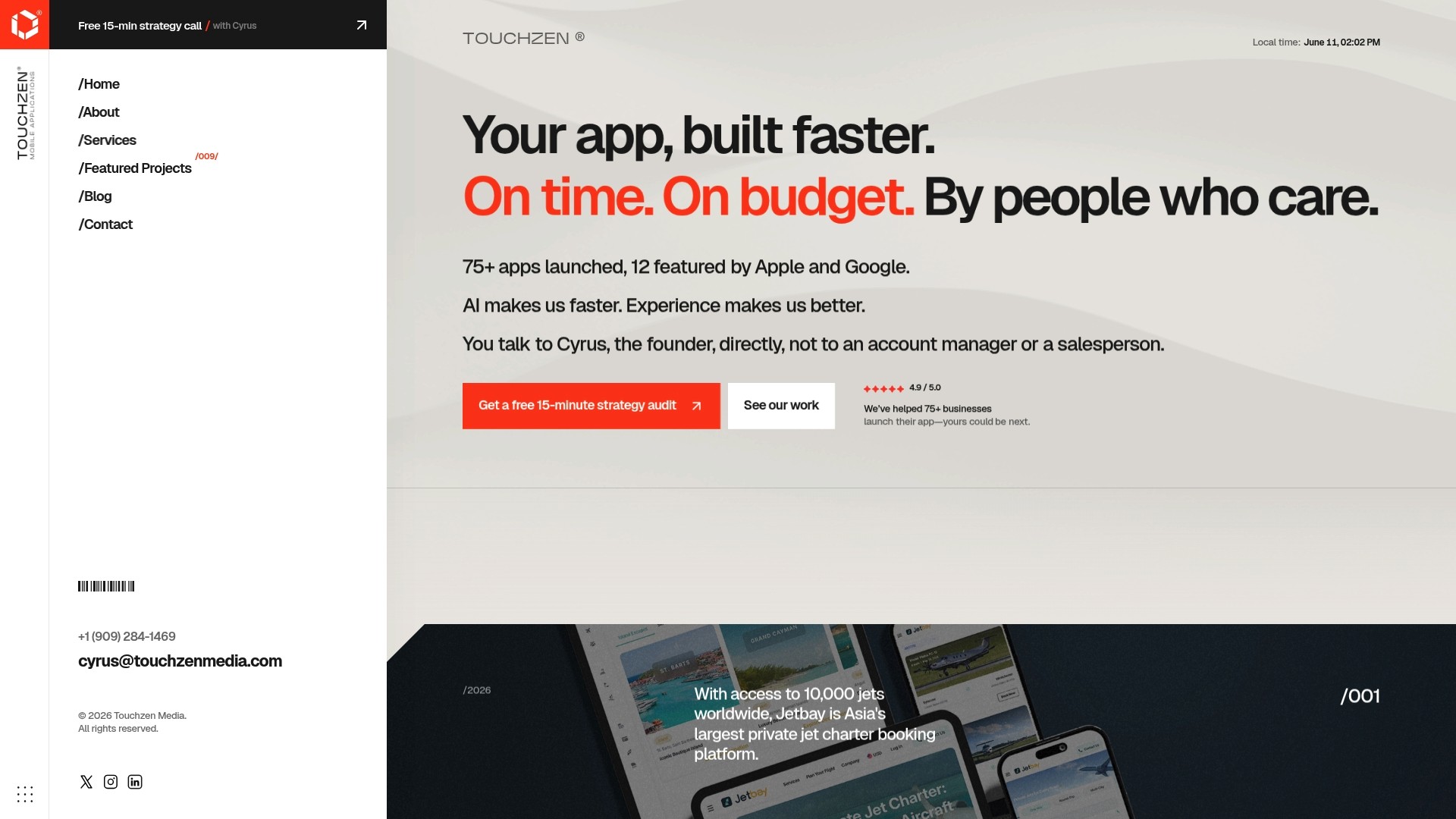
Every engagement includes post-launch support, so bug fixes and optimization don't stop the day you ship. You can review recent work through TouchZen's top-ranked development track record or see the AI-specific capabilities on the AI-powered apps page. If your product needs a leaner starting point, the MVP development track is built for exactly that constraint. The next move is simple: bring your one-page brief to a paid discovery session on the mobile app development services page and get a scoped estimate instead of a guess.
Sources
How to Choose a Software Development Company Without Getting Burned | AgencyReview
AI Video Editing App Development: Complete Guide to Features & Cost - Galaxy Weblinks
FAQ
Can a free video editing app replace a custom-built product?
No. Free apps work for one-off social content, but they offer no SDK, no white-label interface, and no path to owning the code your product depends on.
How long does it take to build a custom video editing app?
Discovery typically runs two to four weeks, with MVP timelines extending several months depending on AI features and platform scope, according to phase-level project estimates.
What should a paid discovery phase produce?
A completed discovery phase should deliver wireframes, an architecture brief, and a scoped estimate you can compare across vendors, per vendor evaluation guidance.
Should I integrate AI editing features via API or build them myself?
Integrating established AI APIs speeds up your MVP, while custom models make sense later once usage data justifies the investment, based on AI video app development trade-offs.
Does TouchZen handle both design and engineering for a video editing app?
Yes. TouchZen manages discovery, prototyping, native and cross-platform engineering, AI integrations, and post-launch support as one accountable engagement through its mobile app development service.