Joy Foroughi
Executive Assistant


Founders: 6 Things to Prepare Before Hiring a Prototyping Team
Before you bring on a prototyping team, you need six things ready: a clear user outcome, one to three primary user flows, a prioritized feature list, low-fidelity wireframes or sketches, written acceptance criteria, and your target platforms. A focused prototype engagement typically runs two to eight weeks depending on fidelity and scope, with cost driven mainly by how many interactive states and platforms you need covered.

Before you bring on a prototyping team, you need six things ready: a clear user outcome, one to three primary user flows, a prioritized feature list, low-fidelity wireframes or sketches, written acceptance criteria, and your target platforms. For planning purposes, a focused prototype engagement may take two to eight weeks depending on fidelity and scope, with cost driven mainly by how many interactive states and platforms you need covered.
TL;DR:
Prototyping should focus on testing core flows with five to ten representative users before investing in extensive MVP development.
Clear user outcomes, one to three primary personas, and a prioritized feature list are essential for scope and estimate accuracy.
Fidelity determines scope and cost, with low-fidelity wireframes suitable for flow logic and high-fidelity prototypes necessary for stakeholder buy-in.
Validating assumptions through quick, low-cost tests like landing pages or clickable prototypes reduces risks and guides design priorities.
Engaging a senior-focused prototyping team and defining scope upfront help control timelines, costs, and ensure quality delivery.
Why prototype first instead of jumping to an MVP
A prototype and a minimum viable product solve different problems, and confusing them is one of the costliest mistakes founders make before hiring a team. A prototype is a disposable or semi-disposable model built to test assumptions: does this flow make sense, will people understand the onboarding, does the core interaction feel right. An MVP is the smallest usable version of a product or service that delivers value to real users and helps test demand. Depending on the idea, it may use custom code, no-code tools, or manually delivered services, with actual usage providing evidence for the next investment decision.
Fidelity separates the two sharply. A prototype might be clickable screens in Figma with no backend logic at all. A software MVP may need authentication, a database, and enough engineering to support actual usage, depending on the core functionality it must deliver. Skipping the prototype stage and jumping straight into MVP development means you discover flow problems after you have already paid for infrastructure, not before.
This sequencing also changes how investor conversations go. A tested prototype gives you evidence: real users completed a task, real friction points got fixed before a single engineer wrote production code. That is a different pitch than "we think this will work."
Strong design practices are associated with better business performance, according to McKinsey's research on the business value of design, which tracked design practices and financial performance across 300 companies over five years. The study found a correlation rather than proof that prototyping alone causes financial gains. The takeaway for founders is practical: prototyping can help surface assumptions and usability problems early, giving teams a chance to reduce rework before committing to a larger development budget.
What a prototype buys you before you scale:
A cheap way to kill bad ideas before they become expensive code.
Evidence of user behavior instead of assumptions about user behavior.
A shared reference point so your team and your stakeholders are solving the same problem.
A natural checkpoint to adjust scope before locking in an MVP budget.
Practical checklist: artifacts and decisions to prepare before you hire a team
The faster a team can understand your product, the faster and more accurately they can estimate it. Walking into a kickoff with these eight items ready turns a vague discovery phase into a working session.
Clarify the user outcome and your success metric. Write one sentence describing what changes for the user when your app works, and attach a measurable signal, such as successful task completion or recurring points of confusion, that tells you whether the prototype succeeded.
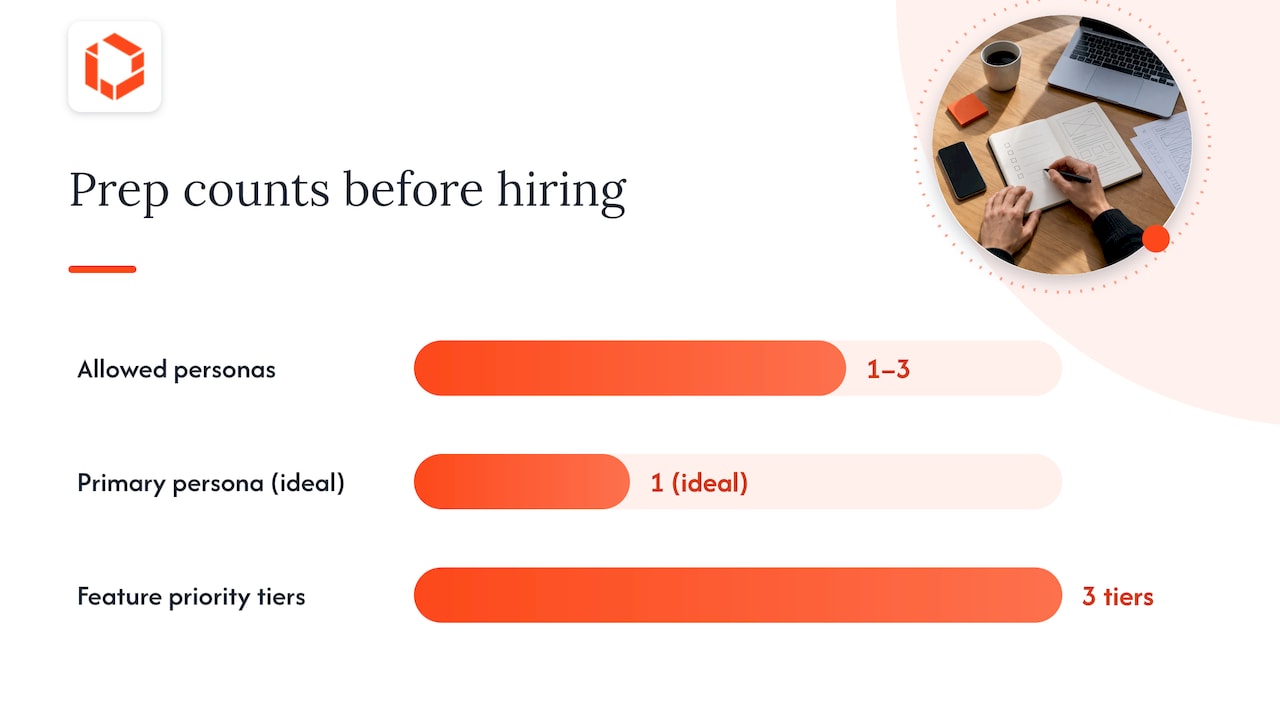
Define one to three primary personas and their journeys. A simple template works: persona name, their goal, their current workaround, and the single flow they would use in your app. Three personas is a ceiling, not a target. Most early-stage apps serve one dominant user type well before they serve three.
Prioritize features into must, should, and nice. Must-have features are the ones without which the prototype cannot test your core hypothesis. Should-have features support the experience but are not make-or-break. Nice-to-have features get cut from the prototype entirely and parked for later.
Create low-fidelity wireframes or annotated sketches. These do not need to be polished. Hand-drawn screens with arrows showing flow direction communicate intent faster than a paragraph of description, and they give a design team something concrete to react to instead of a blank page. Our guide on mobile app wireframes walks through this for founders without a design background.
Write acceptance criteria and key tasks for usability testing. For each primary flow, state the specific task a test user must complete and what "success" looks like, such as "user locates and books an appointment within three taps."
Specify platform targets, integrations, and technical constraints. iOS, Android, or both, native or cross-platform, any required third-party integrations like payment processors or calendar sync, and any constraints from existing systems you need to connect to.
Document non-functional requirements and known dependencies. Data handling rules, security expectations if you touch sensitive information, and any external dependencies like a partner API that is not yet finalized all belong in writing before kickoff, not discovered mid-sprint.
Gather existing analytics, competitor categories, and marketing channels. Even rough numbers from a landing page, waitlist, or existing product give a prototyping team a sense of who your users actually are and how they found you, which shapes onboarding design decisions.
Pro Tip: Bring your prioritized feature list even if it is imperfect. A team that can react to a draft moves faster than a team waiting on a founder who is still deciding.
None of this needs to be polished or final. A prototyping team expects revisions as testing surfaces new information. What they need is a starting point specific enough that the first week is not spent extracting basic requirements from your head.
How to validate your idea before committing to a full team
Testing assumptions before you hire anyone is the cheapest insurance you will buy in this entire process. Representative participants matter more than large sample sizes at this stage: five people who match your actual target user tell you more than fifty random testers who do not.
Screening matters as much as recruiting. If you are building a scheduling app for freelance contractors, test with freelance contractors, not with whoever answers a generic survey panel fastest.
For qualitative usability testing, five representative users can be a useful starting point, according to NN/g's research on small-sample testing. The often-cited estimate of finding 85% of usability issues comes from a mathematical model with specific assumptions; it is not a guaranteed result for every prototype or user group. Use an initial round to identify friction, fix the problems, and test the revised design again. A small usability study helps improve a flow, but it does not by itself establish market demand or determine when a product is ready for development.
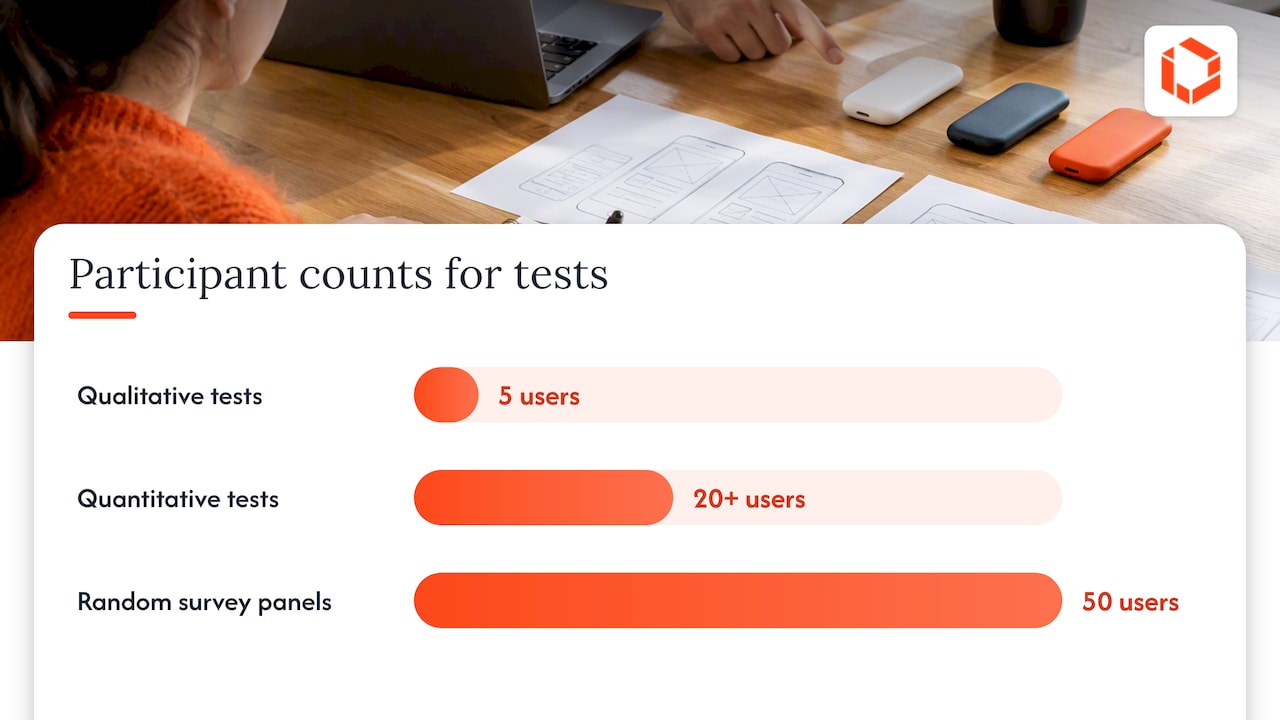
Quantitative testing serves a different purpose entirely. NN/g's guidance on responding to skepticism about small test groups explains that qualitative tests identify a list of usability problems, while quantitative studies estimate usability metrics across a user population and require a sample size suited to the study design and desired precision, often substantially larger than five participants. Early in prototyping, you almost always want qualitative first.
Low-cost validation options worth running before you hire a team:
A landing page smoke test measuring email signups or waitlist conversion.
A small ad funnel testing whether your value proposition gets clicks at all.
A concierge MVP where you manually deliver the service to a handful of early users.
A clickable Figma prototype tested with five representative users on a specific task.
Each of these produces a brief a prototyping team can act on immediately: what worked, what confused people, and which flow deserves the most design attention first. Our piece on validating a mobile app idea before writing code walks through running these tests on a founder's timeline and budget.
Define prototype scope and deliverables so proposals are comparable
Fidelity choice is a scope decision, not a style preference, and getting it wrong is how founders end up with mismatched vendor quotes that are impossible to compare side by side.
Low-fidelity wireframes work when you are testing whether a flow makes logical sense: does the user know where to tap next, does the information architecture hold together. Mid-fidelity prototypes add visual hierarchy and basic interactivity, useful when you need stakeholder buy-in or want test users to react to something closer to a real product. High-fidelity, fully clickable prototypes with real content and interactive states make sense when you are close to an investor pitch or a final usability round before development begins.
Request these deliverables from any team you are evaluating:
Annotated screens showing flow logic and state changes, not just static visuals.
A clickable prototype covering your one to three primary flows end to end.
A written test plan with the specific tasks test users will attempt.
Handoff specs if the prototype is expected to inform a development team later.
Your acceptance criteria directly shape cost and timeline. A prototype that only needs to demonstrate a single onboarding flow is a different quote than one that needs five interactive states, two platforms, and a payment integration mockup. Interactive states, cross-platform coverage, and third-party integration mockups are the three line items that most reliably drive price up, so naming them explicitly in your brief, rather than discovering them during a scoping call, keeps proposals honest and comparable.
Budget and timeline: realistic ranges and how to structure work to limit risk
As an illustrative planning range, a focused prototype engagement may take two to eight weeks, with fidelity and scope among the main variables. A low-fidelity, single-flow wireframe set may wrap in under two weeks. A high-fidelity, multi-platform clickable prototype with several interactive states and a formal test plan may need six to eight weeks or longer. Confirm the estimate with the team after accounting for research, participant recruitment, feedback cycles, and any technical exploration.
Cost scales with the same variables: number of flows, fidelity level, how many platforms you need represented, and whether the prototype needs to include integration mockups. Rather than asking "what does a prototype cost," ask "what does testing this specific flow at this specific fidelity cost," because that framing produces comparable numbers across vendors.
A few structural choices reduce both cost and risk:
Timebox the engagement into a fixed sprint rather than an open-ended hourly arrangement.
Favor a senior-lean team over a large junior-heavy one, since fewer handoffs mean fewer misunderstandings and less rework.
Lock scope to a fixed set of flows before kickoff and treat anything beyond that as a separate, priced addition.
Set aside a small budget for validation activities themselves: participant incentives, a prototyping tool subscription, and basic analytics tracking.
A project timeline template can help you map these sprints and communicate the schedule to your team before work starts, which also makes it easier to catch scope creep early rather than after a deadline slips.
Questions to ask and red flags when choosing a prototyping team
The questions you ask during a sales call tell you more about how a project will go than the proposal document itself. Use these to separate teams that talk well from teams that deliver well.
Who will actually work on my project, senior staff or junior staff? Ask for names and roles, not just a company bio.
What does your testing process look like, and who recruits participants? A team with no answer here is planning to skip validation.
How often will we communicate, and with whom? Weekly check-ins with a project manager are different from direct access to the designer building your screens.
How do you handle scope changes once we start testing? Good teams expect findings to shift priorities and have a process for it.
What happens after the prototype is done? Ask specifically whether handoff documentation and post-prototype support are included or billed separately.
Red flags worth walking away from: vague answers about who does the actual work, no mention of usability testing anywhere in the proposal, and pricing that bundles everything into one number with no breakdown by deliverable. Compare proposals on four axes: deliverables list, timeline, whether a test plan is included, and what post-prototype support looks like. Our breakdown of questions to ask before hiring an app developer goes deeper into evaluating technical proposals specifically.
How we deliver faster, higher-quality prototypes
Experience with launching apps across industries shapes how we approach every new prototype: we have seen which shortcuts cause rework later and which ones are safe to take.
Our approach emphasizes experienced developers and designers from kickoff, with the specific roles and involvement defined for each engagement. That matters because senior involvement means fewer rounds of "that's not quite what we meant," which shortens timelines and reduces the rework that eats most prototype budgets.
Our support continues beyond the prototype phase:
We can support MVP development so validated design decisions carry forward, with implementation and handoff requirements defined in the next phase.
Ongoing support and growth work help ensure your app keeps evolving after launch instead of stalling once the initial build ships.
Direct access to experienced staff throughout the engagement aims to keep decisions moving without delays from relayed feedback.
Founder perspective: common mistakes and a week-before-kickoff checklist
The biggest mistake we see founders make is over-specifying. You do not need twelve flows mapped in perfect detail. You need your one or two riskiest assumptions identified and a plan to test them. A prototype that tries to prove everything at once proves nothing well.
The second mistake is outsourcing early research without a clear plan for who counts as a representative participant. A test with the wrong users produces confident, wrong conclusions, which is worse than no data at all.
Here is what to finish in the week before kickoff:
Write your one-sentence user outcome and attach a measurable success signal.
Finalize your must-have feature list and be ready to defend every item on it.
Sketch your primary flow, even roughly, by hand if needed.
Draft acceptance criteria for at least one core task.
Confirm your target platforms and any non-negotiable integrations.
Line up three to five representative people willing to test early screens.
TouchZen services that help founders prototype
If you have the checklist above but not the internal team to execute it, that is exactly the gap we work in. We handle Product Strategy & Consulting to turn your research into a testable brief, UX/UI Design to build the wireframes and clickable prototype itself, and MVP Development for Start Ups for when your prototype is validated and ready to become a real product.

Our approach emphasizes direct collaboration with experienced developers and designers, with communication and staffing arrangements defined for your project to help keep decisions moving and reduce avoidable back-and-forth. Our Mobile App Development work covers both native and cross-platform builds, so your platform choice from the checklist above translates directly into an execution plan.
Pricing and engagement options depend on the agreed scope, deliverables, and support needs, and should be confirmed in your proposal before work begins. If you have your outcome, flows, and feature priorities ready, the next step is a scoping conversation to map your specific prototype against a realistic timeline and budget.

FAQ
How do you build a prototype for an app?
Start by defining your core user outcome and one to three primary flows, then create low-fidelity wireframes showing how a user moves through those flows. From there, build a clickable version of the highest-priority flow and test it with a small group of representative users before adding polish.
What are the 7 stages of app development?
Common frameworks include research and discovery, strategy and planning, UX and UI design, prototyping, development, testing and quality assurance, and launch followed by ongoing support. Exact naming varies by team, but prototyping consistently sits between design and full development across most frameworks.
What are the key considerations when designing a mobile app?
Design decisions should center on the user outcome you are solving for, the primary flows that deliver it, and the platform constraints of iOS and Android. Non-functional concerns like data handling and performance also shape design choices even before visual styling begins.
What comes before prototyping?
Idea validation comes first: talking to representative users, testing demand through a landing page or waitlist, and clarifying your prioritized feature list. Skipping this step is how founders end up prototyping the wrong flow entirely.