
Joy Foroughi
Executive Assistant


How to Validate Your Mobile App Idea Before Writing a Single Line of Code
A practical guide to mobile app idea validation. How to test demand, interview users, prototype, and know when your idea is ready for development. Before you spend a dollar on development, you can spend a few weeks proving the idea is worth building. Here's a practical guide to mobile app idea validation—covering user interviews, landing pages, prototypes, and the signals that tell you when an idea is ready to ship.
Introduction: Why a Good App Idea Is Not Enough
Every founder we meet shows up with conviction. They've seen the problem, they know the solution, and they're ready to start building. That energy is what makes a startup possible. But it's also the exact moment when most app projects quietly start going wrong.
A good idea is not the same as a validated idea. The difference between them—measured in time, money, and emotional commitment—is the difference between a launch that finds users and one that finds silence. Every experienced app development agency has watched founders skip this step and pay for it later. The build looks fine. The design looks fine. Then the app ships, and the metrics tell the truth.
The good news: validating a mobile app idea is faster, cheaper, and less mysterious than most first-time founders assume. The work that actually moves the needle can usually be done in three to six weeks, without writing a single line of production code. This guide walks through how. TouchZen Media mobile app development services
Why Validation Matters Before Development
The cost of a mobile app increases exponentially the further along the process you go. Changing a feature during user interviews costs a conversation. Changing it during prototyping costs an afternoon. Changing it during development costs sprints. Changing it after launch costs users.
Validation isn't about delaying the build. It's about narrowing the build to the things that actually matter. Founders who validate well tend to:
Build smaller, more focused MVPs
Spend less on features that get cut later
Onboard their first users faster
Raise capital more easily because they have evidence, not just a deck
Founders who skip validation often build apps that are technically excellent and commercially invisible.
Step 1: Define the Problem Clearly
Almost every weak validation effort starts here. The founder describes the app—"It's an AI-powered scheduling assistant for dentists"—instead of describing the problem the app solves.
A problem statement is sharper than a product description. It names a real frustration, a real person experiencing it, and a real reason the current alternatives fall short. A useful template:
"[Specific group of users] is trying to [do something specific] but [today's options] make it [hard, slow, expensive, or frustrating]. They need [the outcome they actually want]."
If you can't fill in this sentence with concrete details, you don't have a validated problem yet. You have a hunch.
Step 2: Understand Your Target Users
A target user is not a demographic. It's a behavior pattern. "Women aged 25–45" tells you nothing useful. "Working parents who plan weekly meals on Sunday evenings and currently use three different apps to do it" tells you almost everything.
Spend time describing:
The user's daily workflow and where the problem shows up
What they're using today as a workaround
How urgent the problem feels (annoyance vs. real pain)
Whether they're already paying for related tools
Founders who can describe their target user in that level of detail rarely build the wrong thing.
Step 3: Research Competitors and Market Gaps
If no one else is solving the problem, that's a signal—but rarely a good one. Either the market is too small, the problem isn't real, or someone has tried and quietly given up.
A practical competitor audit:
List five to ten apps that solve a similar or adjacent problem
Read recent App Store and Google Play reviews, especially the 2- and 3-star ones
Note where users repeatedly complain or wish for more
Identify gaps no one is addressing well
The 2- and 3-star reviews are where the real product insights live. 1-star reviews are usually unfocused frustration; 5-star reviews are usually too generous. The middle is where users tell you exactly what's broken and what would make them switch.
Step 4: Talk to Real Potential Users
If you do nothing else in validation, do this. Ten to fifteen real conversations with target users will teach you more than any market report.
A few rules that make these interviews actually useful:
Don't pitch the app. The point is to learn, not to sell.
Ask about the last time they faced the problem, not what they would do hypothetically. People are bad at predicting their own behavior.
Listen for the exact language they use. That language becomes your marketing copy later.
Ask what they've tried, why they stopped, and what they wish existed.
After ten to fifteen interviews, patterns become impossible to ignore. Either the problem is real and acute, or it isn't. Either users are already looking for a solution, or they've made peace with the current state.
Step 5: Test Demand With a Landing Page or Waitlist
A simple one-page website can validate an enormous amount before any app is built. The goal isn't to launch a brand—it's to test whether anyone clicks, signs up, or asks to be notified.
A useful test:
One clear headline that names the problem and the solution
Three to five sentences explaining how it works
A single email capture or waitlist signup
A small targeted ad spend, $200 to $500, driving traffic from the audience you described in Step 2
What you're measuring isn't conversion rate alone. You're measuring whether your message resonates enough that strangers leave their email. If signup rates are strong, you have early demand. If they're flat, the problem statement, audience, or solution needs more work before you build anything. TouchZen Media UX/UI design services
Step 6: Prioritize the MVP, Not the Full Dream Product
Most founders walk into the MVP phase with a 30-feature list. The MVP usually needs five to eight. Validation doesn't just confirm that the idea is good—it sharpens the scope of what the first version should actually do.
A simple way to prioritize:
Must-haves: Features without which the app cannot solve the core problem
Nice-to-haves: Improvements that can wait for version 1.1
Out of scope: Everything else
If a feature isn't required to deliver the single most important moment of value, it doesn't belong in the MVP. Save it. Document it. Build it later, once real users tell you it matters.
Once the idea is validated, the next step is turning it into a focused MVP roadmap. For a deeper breakdown of that stage, read TouchZen’s guide to → MVP to Market: How to Launch Your First Mobile App in 90 Days
Step 7: Use Wireframes or Prototypes Before Writing Code
A clickable Figma prototype costs a fraction of development and answers the most important question: does the experience work?
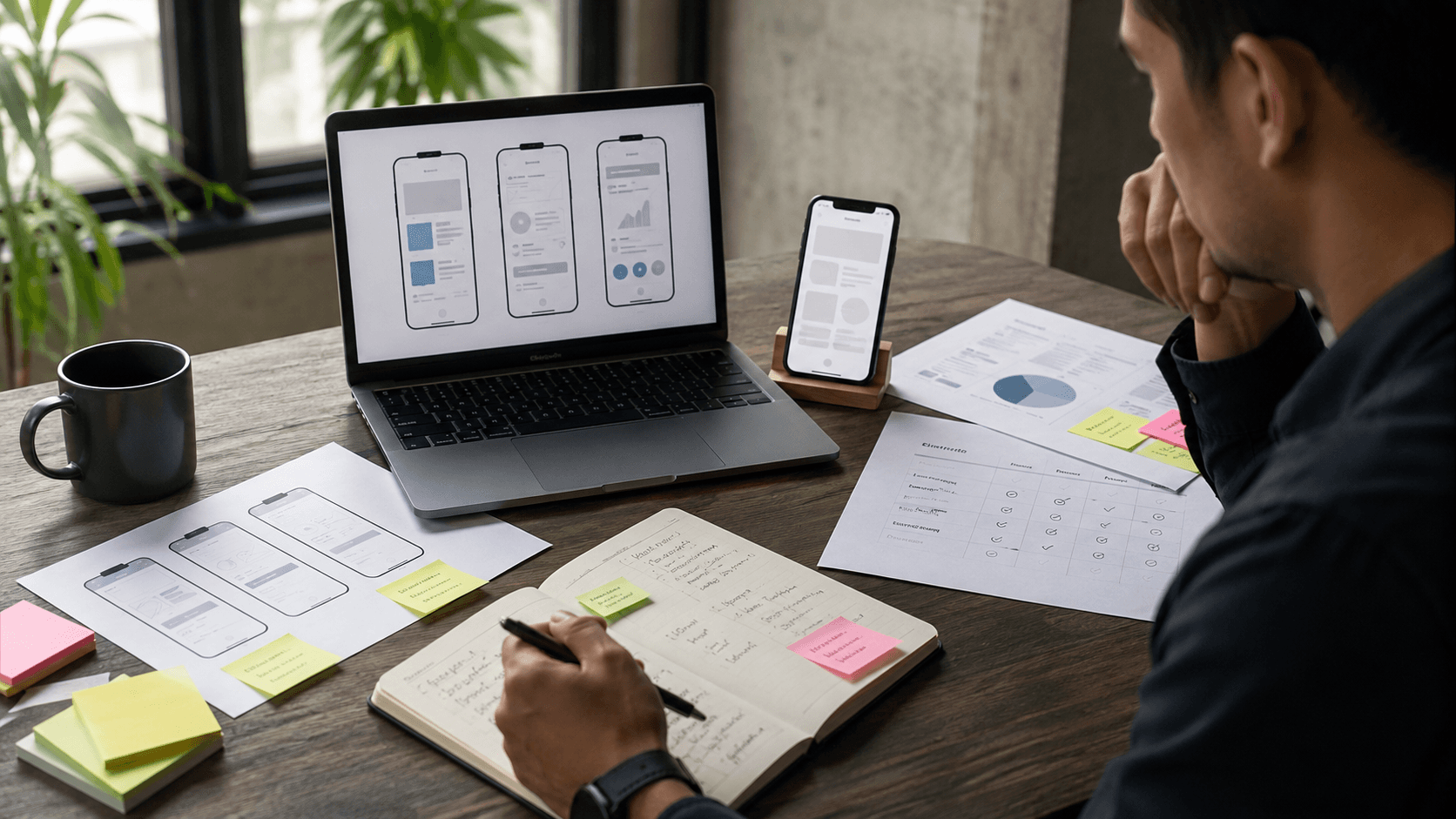
Wireframes are useful for testing structure—where things live, how flows connect, what's discoverable. Higher-fidelity prototypes are useful for testing emotion—whether the app feels modern, trustworthy, and worth opening tomorrow.
Put the prototype in front of five to ten target users. Watch them use it without your help. Where they hesitate is where the design needs work. Where they confidently tap is where you got it right.
This step is one of the cheapest, highest-leverage moves in the entire app development process. Founders who skip it routinely pay for it in rework once the codebase exists. TouchZen Media design and prototyping services
Step 8: Know What Validation Signals to Look For
Not all signals are equal. A founder's friends saying "I'd totally use that" is not a signal. A target user offering to pre-pay is a strong one. A few markers worth treating as real:
Waitlist signups that grow without you pushing the link constantly
Conversations where target users describe the problem better than you do
Unprompted referrals—users telling friends about your landing page
Willingness to pay, even a small amount, before the product exists
Direct feedback from prototype users describing specific moments they liked
Soft signals to discount: vague praise, "I'd consider it," "sounds interesting." None of those predict real behavior.
Common Mistakes Founders Make During Validation
A short list of patterns that show up again and again:
Validating with friends and family. They love you; they're not your market.
Asking leading questions. "Would you use an app that…" almost always gets a polite yes. Ask about past behavior instead.
Confusing interest with intent. Someone curious about your idea is not someone ready to buy or commit.
Stopping at one validation method. Five interviews and a landing page are stronger together than either is alone.
Validating the wrong thing. Founders often confirm the problem is real but skip confirming that their specific solution is the right one.
Building too soon. A validated problem and a clear MVP scope are the green light. Anything earlier than that is expensive guessing.
When Your App Idea Is Ready for Development
Validation isn't an endless loop. There's a point at which you've learned enough to start building. A reasonable readiness checklist:
The problem is described in one clear sentence that target users agree with
You can name the specific user and describe their workflow in detail
Ten to fifteen user conversations have shown a consistent pattern
A landing page or waitlist has produced measurable demand
A clickable prototype has been tested with target users and refined
The MVP scope is five to eight features, not thirty
You can articulate why your solution wins over existing alternatives
If most of these are true, the idea is ready. The next step is to build it well, fast, and lean. TouchZen Media portfolio of shipped apps
Conclusion
The best mobile apps almost always come from founders who slowed down before speeding up. They spent weeks understanding the problem before months building the product. They learned from real users before writing code. They tightened scope before opening their wallets. The result, in nearly every case, is a launch that lands instead of one that hopes.
At TouchZen Media, we've helped founders move from idea to App Store across more than 75 mobile apps, collectively reaching 20+ million downloads and earning 12+ features from Apple and Google. We work with founders on strategy, UX/UI design, prototyping, mobile development, and post-launch support—often starting with the kind of validation work this article describes. If you're sitting on an app idea and trying to figure out whether it's ready to build, we'd be glad to talk through where you are and what the next step should look like.
TouchZen Media homepage and contact page
Frequently Asked Questions
1. How do I know if my mobile app idea is worth building? An app idea is worth building when you can name a specific user, describe a real problem they face, and show that they're actively looking for or willing to pay for a better solution. Worth is measured in evidence, not enthusiasm—target user conversations, waitlist signups, and prototype feedback are what tell you the idea has legs.
2. Can I validate a mobile app idea without coding? Yes, and you should. The most effective validation methods—problem interviews, competitor research, landing pages, waitlists, and clickable Figma prototypes—all happen before a single line of code is written. Validation without coding is almost always faster, cheaper, and more honest than validation through a half-built product.
3. How long does mobile app idea validation usually take? For most founders, three to six weeks is realistic. That window covers a focused round of user interviews, competitor analysis, a simple landing page test, and a clickable prototype reviewed with target users. The goal isn't to drag the process out—it's to learn enough to scope the MVP with confidence.
4. What should I validate first: the problem or the solution? Always the problem. A real, painful, frequent problem is what makes an app worth building in the first place. Once the problem is confirmed, you can test whether your specific solution is the right one. Founders who skip straight to validating their solution often end up building elegant answers to questions nobody was asking.
5. What happens after validating a mobile app idea? Once the idea is validated, the next step is moving into MVP development. That means tightening scope to five to eight must-have features, finalizing the design system, and starting build sprints with a clear definition of done. A validated idea, a focused MVP scope, and an experienced team are the three ingredients that turn a strong concept into a successful launch.