
Cyrus Kiani
Founder / CEO



Build an app or buy SaaS? How startup leaders decide
The question used to feel simple: why build when you can buy? But 35% of enterprises have already replaced at least one SaaS tool with custom software, and 78% plan to build more in 2026. That shift is not a coincidence. It reflects a deeper reckoning with vendor lock-in, rising subscription costs, and the growing realization that off-the-shelf software rarely fits the way your business actually works. This guide breaks down the build vs buy decision using current data, real-world examples, and a practical framework so you can move forward with confidence.
Key Takeaways
Point | Details |
|---|---|
Market shift underway | A growing number of companies are now replacing SaaS tools with custom software to gain control and differentiation. |
Build for core advantage | Building custom apps is best for unique workflows or proprietary value, while SaaS fits commodity needs. |
AI accelerates custom build | AI technology has slashed app build costs, making custom solutions more viable for startups. |
Frameworks clarify choices | Tools like decision matrices and five-year TCO help ensure an objective, strategic build vs buy decision. |
Integration is critical | Hidden integration and scalability challenges are key risks with both SaaS and custom solutions. |
Why the build vs buy debate matters more than ever
SaaS was supposed to solve everything. Fast deployment, predictable pricing, no infrastructure headaches. And for a while, it did. But as the market matured, so did the problems. Subscription costs compound. Integrations break. Vendors sunset features or raise prices without warning. The result is what many founders now call "SaaS sprawl," a tangle of tools that don't talk to each other and quietly drain your budget.
📊 Here's a snapshot of where the market stands today:
Metric | SaaS adoption | Custom build |
|---|---|---|
Enterprises replacing SaaS with custom | 35% | Growing |
Companies planning more custom builds in 2026 | 78% | Accelerating |
The economics of building have also changed. AI-assisted development, better open-source tooling, and experienced agency partners have all reduced the barrier to entry. If you're choosing between in-house and agency development, the calculus looks very different today than it did even three years ago.
"The old default of 'buy everything non-core' is being replaced by a more strategic question: what do we actually need to own?" — Build vs buy SaaS analysis
Understanding total cost of ownership (TCO) and strategic flexibility is now essential before signing any software contract.
What it really means to 'build' or 'buy' software
Let's clarify how these two paths actually differ, because the misconceptions here are costly.
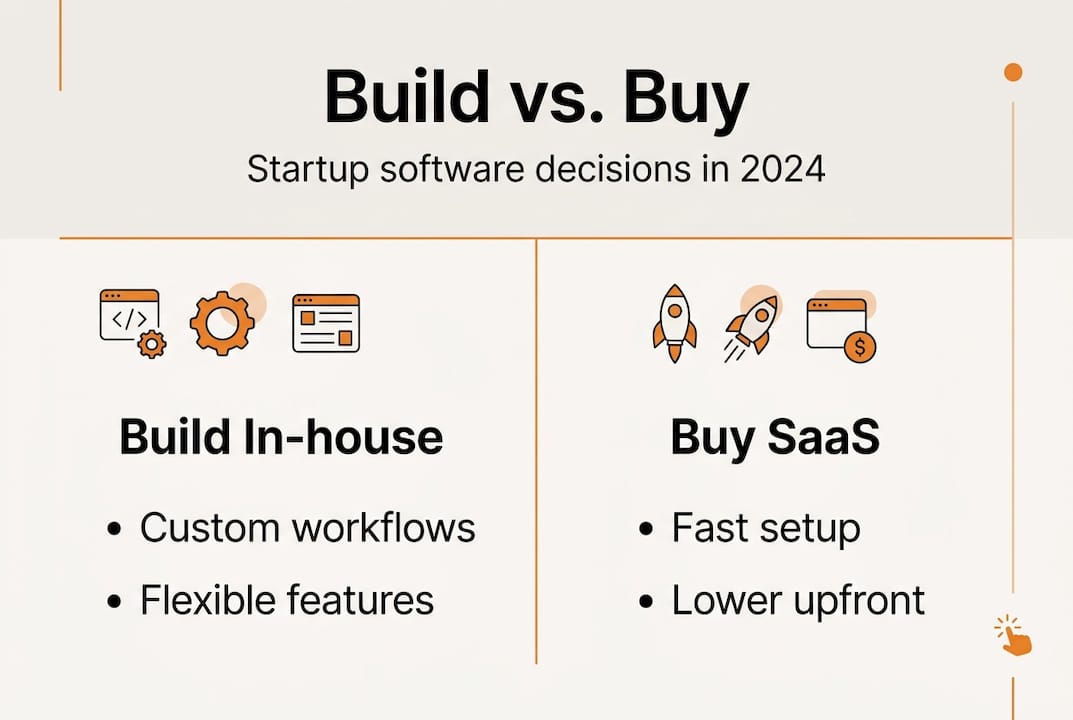
Building means commissioning or developing a custom application tailored to your specific workflows, data structures, and user needs. You own the code, control the roadmap, and can define custom app development to fit your exact business model. The tradeoff is longer initial timelines and higher upfront investment.

Buying means subscribing to a SaaS product built for a broad market. You get instant deployment and predictable monthly costs, but you're working within someone else's product vision. Customization is limited, and your data lives on their infrastructure.
✔ Best use cases for building:
Unique workflows that no SaaS product supports well
Proprietary data that forms a competitive moat
Products where UX differentiation drives retention
Replacing multiple low-utilization SaaS tools with one custom solution
Regulated industries where data residency matters
✔ Best use cases for buying:
Standard functions like payroll, HR, or basic CRM
Early-stage validation before committing to custom development
Non-core operations where speed matters more than fit
Teams without technical capacity to maintain custom software
AI is reshaping this list fast. Build costs have dropped by 30 to 90% for simple workflows, which means tools you would have bought two years ago are now worth building. Understanding app success factors before you commit to either path is critical.
💡 Pro Tip: Before deciding, map every software need into two buckets: "core" (directly tied to your competitive advantage) and "context" (everything else). Build your core. Buy your context.
The new decision framework: Differentiation, value, and cost
With the definitions clear, let's use a proven framework to structure your decision. The most reliable approach scores each option across four dimensions: total cost of ownership, time-to-market, integration compatibility, and capacity for differentiation.
📊 Build vs buy comparison across key decision factors:
Factor | Build (custom) | Buy (SaaS) |
|---|---|---|
Upfront cost | Higher | Lower |
Long-term TCO | Lower (if scaled) | Higher (subscriptions) |
Time-to-market | Slower initially | Faster |
Customization | Full control | Limited |
Integration flexibility | High | Vendor-dependent |
Competitive differentiation | Strong | Weak |
Data ownership | Complete | Shared/vendor-held |
The decision matrix methodology recommends scoring each factor over a five-year horizon, not just your immediate needs. Here are the five strategic questions to ask before deciding:
Will this software directly differentiate us from competitors? If yes, build.
What is the realistic five-year TCO for each path? Include migration costs, not just subscriptions. Review our app development cost guide for benchmarks.
How critical is time-to-market right now? Early-stage startups often benefit from buying first.
What are the integration requirements? Complex data flows favor custom builds.
Do we have the internal capacity to maintain a custom app? If not, factor in agency or DevOps costs.
💡 Pro Tip: Think in two timelines. Ask what you need in 24 months and what you'll need in 60 months. A SaaS tool that works today may become a ceiling that limits your growth in year three.
How AI has shifted the build vs buy equation
The landscape shifts even further when you factor in how AI changes the equation. This is not theoretical. AI-native companies grow two to three times faster than top-quartile SaaS benchmarks. That growth gap is partly explained by the speed and cost advantages AI brings to product development.
🚀 Statistic callout: AI tools now reduce build costs by 30 to 90% for simple workflows, making custom development accessible to startups that previously had no choice but to buy.
Here's where AI specifically changes your options:
Rapid prototyping: You can validate a custom solution in days, not months, using AI-assisted development tools
Replacing low-use SaaS: If you're using 20% of a SaaS product's features, AI can help you build a leaner custom replacement faster than ever
Enhancing core differentiation: AI can be embedded directly into your custom app as a feature, not bolted on through a third-party integration
Shadow IT reduction: Teams are already building internal tools with AI; formalizing this reduces risk and improves quality
But watch the pitfalls. AI accelerates development, it doesn't eliminate complexity. Overestimating what AI can handle in terms of UX nuance, edge cases, or regulatory compliance is a common and expensive mistake. Understanding app revenue challenges and staying current on UI trends with AI will help you set realistic expectations.
Real-world examples: Build or buy in action
Theory is great, but how are real companies deciding, and what results do they see?
📌 Startup A (analytics platform): Switched from a third-party SaaS analytics tool to a custom-built solution after hitting data export limits. Result: 50% productivity gain and full ownership of their data pipeline within six months.
📌 Startup B (HR tech): Chose SaaS for HR management at launch and scaled quickly. By year two, API rate limits and rigid reporting structures forced a costly workaround. They're now evaluating a partial custom build.
📌 Startup C (health and wellness): Used SaaS for early-stage operations, then migrated core IP features to a custom app as their user base grew. The hybrid approach let them move fast early without sacrificing long-term control.
The pattern here is consistent with what industry-specific case studies show across sectors: validate with SaaS, then migrate when limits appear. This is now mainstream strategy, not a workaround.
"Owning your data is not just a technical preference. In a world of SaaS sprawl and vendor lock-in, it's a future competitive moat." — Build vs buy analysis
Reviewing custom app outcomes from companies that have made this transition can give you a realistic picture of what to expect.
Integration, scalability, and the hidden challenges
Whether you build or buy, some risks are easy to underestimate until they become urgent problems.
Scalability looks different on each path. Custom apps need a clear maintenance roadmap from day one. Without it, technical debt accumulates fast. SaaS tools, on the other hand, can hit plan ceilings or performance limits as your usage grows, forcing expensive tier upgrades or migrations.
Integration is where both paths get complicated. APIs break, vendors deprecate endpoints, and shadow IT (unauthorized tools adopted by teams) creates security gaps. Framework integration tips and solid CMS integration strategies can reduce friction on either path.
📌 Top 5 overlooked integration issues for both paths:
API versioning: SaaS vendors update APIs without warning; custom apps need versioning discipline from the start
Data portability: Extracting your data from a SaaS platform can be harder and more expensive than expected
Authentication complexity: SSO and identity management get messy fast when you mix custom and SaaS tools
Compliance drift: Security and regulatory requirements evolve; neither path is "set and forget"
Vendor dependency: Even custom apps can become dependent on third-party libraries or cloud services that change
The fact that 78% of enterprises plan to build more in 2026 suggests these integration headaches are pushing companies toward greater ownership, not away from it. Working with IT integration specialists early in your planning process can prevent the most common and costly mistakes.
Expert help for your build vs buy decision
Making the wrong call here is not just a technical problem. It's a strategic one that can cost you months of runway and significant capital. The right guidance at the decision stage can de-risk everything that follows.
At TouchZen Media, we've helped startups and growing companies across insurance, health, travel, and fitness navigate exactly this decision. Whether you need a custom iOS or Android app, a web platform, or a hybrid strategy that starts with SaaS and scales to custom, our senior developers work directly with your team from day one. As a recognized top app developer in California, we bring both the technical depth and strategic perspective to help you build what matters and buy what doesn't. Ready to map out your path? Speak to our app experts and get a clear, honest assessment of your options.
Frequently asked questions
Which is usually more cost-effective: building an app or buying a SaaS?
Buying SaaS is typically more affordable upfront, but custom apps often deliver better long-term value by eliminating recurring subscription costs and addressing unique needs. Five-year TCO scoring is the most reliable way to compare both paths accurately.
How has AI changed the build vs buy equation for startups?
AI has made building significantly more accessible by cutting build costs by 30 to 90% for simple workflows, meaning custom solutions that once required large budgets are now within reach for early-stage startups.
What is the biggest risk when building your own custom app?
The biggest risk is underestimating the ongoing maintenance effort and integration complexity that grows as your business scales. Planning for this from the start, ideally with an experienced development partner, is essential.
Can you start with SaaS and switch to custom later?
Absolutely. Many successful companies validate with SaaS first, then migrate to custom builds once their needs become too specific or their growth outpaces what the SaaS platform can support.