

Joy Foroughi
Executive Assistant


Founders: HIPAA Compliant Mobile App Checklist With Six Assigned Controls
A founder-focused, assignable checklist to make your mobile app HIPAA-compliant: scope PHI, run a risk assessment, sign BAAs, implement six core controls,...

Scope your PHI exposure first, then run a documented risk assessment, sign BAAs before protected data reaches a vendor, and document safeguards appropriate to your risk profile—such as encryption, server-enforced RBAC, MFA, audit logs, and mobile-specific hardening. Validate the controls with appropriate security testing, then finalize your incident response plan. Hand this sequence to your CTO or product lead this week. Enterprise buyers and hospital partners may ask for evidence of these steps.
TL;DR:
Conduct a thorough PHI scope and risk assessment before building or sharing any health data with vendors, and keep detailed documentation for audits.
Sign BAAs with all third-party vendors handling PHI before any data exchange, ensuring contracts address permitted uses, safeguards, breach notifications, and data return or destruction.
Implement six specific technical controls: TLS 1.2+ for data in transit, AES-256 at rest, role-based access, MFA, tamper-evident logs, and mobile device hardening, with regular testing.
Perform ongoing security testing, including SAST/DAST scans, dependency audits, and annual penetration tests, with remediation tracked until closure.
Establish clear security ownership, policies, training, and quarterly risk reassessments to create a sustainable governance program that withstands compliance reviews.
Does Your App Actually Need to Be HIPAA-Compliant?
HIPAA applies when your app creates, receives, maintains, or transmits protected health information (PHI) on behalf of a covered entity or business associate, according to HHS's guidance for mobile health app developers. A symptom tracker that never touches a doctor's office is a different animal from a patient portal that syncs with an EHR. HHS built the Mobile Health Apps Interactive Tool specifically because founders keep guessing wrong on this point, in both directions.
Run the applicability test before writing another line of code, then inventory every place PHI could live or pass through:
Device storage, local caches, and offline-first databases
Mobile client code and any third-party SDKs (analytics, crash reporting, push)
Backend APIs and cloud infrastructure
Backup systems and support/helpdesk tools that touch tickets or screenshots
The deliverable here is not a paragraph in a pitch deck. It's a one-page PHI inventory and a data-flow diagram your engineering team can point to when a partner or auditor asks, "Where does this data actually go?"
How Do You Run a HIPAA Risk Assessment?
A documented risk assessment is the backbone of the Security Rule, and skipping it is the single fastest way to fail a compliance review. Start by scoping every asset that touches PHI, then map realistic threats against each one: lost or stolen devices, insecure SDKs pulling data into third-party analytics, misconfigured APIs left open to the internet.
List assets (app, APIs, databases, third-party integrations).
Identify threats and vulnerabilities specific to each asset.
Score likelihood and impact to prioritize what gets fixed first.
Assign an owner and a deadline to every identified risk.
Track residual risk after mitigation, not just the original finding.
The output is a risk register, not a slide. Each row needs an owner, a mitigation plan, a deadline, and a residual-risk rating once the fix ships. NCBI's implementation commentary on HIPAA controls frames this as an ongoing discipline rather than a one-time audit, and that framing matters: reassess after every meaningful feature or vendor change, and at minimum once a year even if nothing changed.
Pro Tip: Keep the executive summary to one page. Enterprise buyers and hospital procurement teams will read that page before they read anything else you send them.
What Technical Safeguards Does a HIPAA App Need?
Six controls do most of the heavy lifting, and vague promises like "we encrypt everything" won't satisfy a buyer's security questionnaire. You need specifics.
Encryption. Use current, industry-standard encryption for data in transit and at rest, selected and documented through your risk analysis. Store keys using platform-appropriate protected storage (such as Secure Enclave on iOS or Keystore on Android) and define a key-management and rotation approach.
Authentication and sessions. OIDC or OAuth2 with PKCE is commonly used for mobile clients. Keep access tokens short-lived, consider MFA where appropriate to the risk, and protect locally cached data with biometric or PIN verification where needed.
Access control. Enforce role-based access server-side, never in the mobile client alone. Build a break-glass procedure for emergency access, and log every use of it. Scope tokens tightly so a compromised session can't walk across your entire dataset.
Audit logging. Log who accessed what and when, but never log PHI content itself inside those logs. Retention policies and tamper-detection (write-once storage, hash chaining) turn a log into evidence, not just noise.
The HIPAA Security Rule addresses access control, audit controls, integrity controls, and transmission security. Select and document safeguards that are appropriate to your organization’s risk analysis.
Mobile-specific gaps sink otherwise solid architectures. Push notification content should never include PHI, even in a preview banner. Detect jailbroken or rooted devices before allowing PHI access. Strip PHI from crash telemetry before it reaches a third-party monitoring tool. Finally, define your recovery time and recovery point objectives for backups, encrypt those backups, and actually test restores on a schedule, not just when something breaks.
Which Vendors Need a Business Associate Agreement?
Any vendor that creates, receives, maintains, or transmits PHI on your behalf is a business associate under HIPAA, and that relationship requires a signed BAA before any real PHI flows to them. Cloud hosts, analytics platforms, crash reporting tools, customer support software, and even some AI model providers can fall into this category depending on what data reaches their servers.
The most common compliance failure isn't a broken encryption scheme. It's a missing signature. Teams sign a vendor contract, start pushing production data, and only discover months later that no BAA exists.
Before you send PHI anywhere, confirm the contract covers:
Permitted and required uses of PHI
Required safeguards matching Security Rule expectations
Breach notification obligations and timelines
Subcontractor flow-down (your vendor's vendors need BAAs too)
Return or destruction of PHI at contract termination
HHS publishes sample BAA provisions you can use as a starting checklist when negotiating vendor contracts. Major cloud providers, including Microsoft's HIPAA and HITECH program, publish which specific services fall under their BAA and how to configure them correctly. Do not disclose PHI to a vendor unless the relationship, agreement, and safeguards meet applicable HIPAA requirements.
What Security Testing Do HIPAA Apps Require?
Shift security left in your build process, then verify it with independent testing before launch and on a recurring schedule after. Static analysis (SAST) catches vulnerable patterns during code review; dependency pinning and a software bill of materials (SBOM) show you know exactly what's running in production.
Run SAST on every pull request, not just before release.
Run DAST and API fuzzing against staging environments regularly.
Scan for hardcoded secrets and credentials before every deploy.
Commission independent penetration testing on a schedule appropriate to your risk profile and after major architecture changes.
Track remediation to closure, with dates, not just a report that sits in a drawer.
Pro Tip: Enterprise buyers and hospital partners will ask for your most recent pen-test report before they ask about your feature roadmap. Have it ready as a PDF, not a promise.
Buyers increasingly expect a specific evidence packet: a recent pen-test report, a SAST/DAST summary, CI build logs showing scans actually ran, and an SBOM. Assembling this after the fact under deadline pressure is far harder than building it into your release process from day one.
What Happens After a Data Breach?
Containment comes first. Isolate affected systems, preserve logs and forensic evidence before anything gets overwritten, and loop in legal counsel immediately, not after the internal investigation wraps.
HHS sets notification and reporting obligations based on the circumstances and scale of a breach. For example, affected individuals generally must be notified without unreasonable delay and no later than 60 days after discovery; reporting deadlines to HHS differ for breaches affecting fewer than 500 people. Business associates must notify the covered entity without unreasonable delay, since downstream obligations may begin from that notice.
Your incident response plan needs:
A defined containment and evidence-preservation procedure
Clear thresholds mapped to OCR's breach reporting portal requirements
Named points of contact for covered-entity and vendor coordination
A post-incident root-cause process that updates your risk register
How Do You Turn Controls Into a Governance Program?
Controls without ownership drift within a quarter. Assign a named security or privacy owner, even if that person wears three other hats at your startup, and document exactly what they're responsible for.
Write core policies: access control, data retention and destruction, incident response, and vendor management.
Train your workforce on these policies before they touch PHI, and log who completed training and when.
Review access logs on a set cadence, not reactively.
Run a quarterly sprint dedicated to closing open remediation items.
Re-run your full risk assessment annually, or sooner after major changes.
CMS's HIPAA privacy and security overview reinforces that documentation and training records are what turn good intentions into a defensible program during an audit.
What Should Your Compliance Tracker Look Like?
Copy this structure into whatever tool your team already uses, whether that's Linear, Jira, or a shared spreadsheet.
Timeframe | Checklist item | Owner | Evidence produced |
|---|---|---|---|
— | PHI scoping decision, data-flow diagram | CTO / Product | Written applicability memo |
— | Initial risk assessment | Security officer | Risk register with mitigations |
— | Signed BAAs with all PHI-touching vendors | Legal / Founder | Countersigned BAA documents |
— | Encryption, RBAC, MFA, audit logging live | Engineering | Architecture doc, code review sign-off |
— | SAST/DAST integrated into CI | Engineering | CI build logs, scan summaries |
Ongoing | Penetration test | External vendor | Pen-test report with remediation tracking |
Ongoing | Workforce training | HR / Security officer | Training completion records |
Annual | Full risk reassessment | Security officer | Updated risk register |
Enterprise and hospital buyers treat a signed BAA and a recent pen-test report as the two non-negotiable artifacts. Everything else on this table supports those two documents.
TouchZen's Practitioner Notes on Building These Apps
Compliance work moves fastest when the people writing code understand the Security Rule implications of their decisions. TouchZen helps founders scope healthcare app requirements from discovery through launch, keeping technical, product, and compliance considerations aligned.
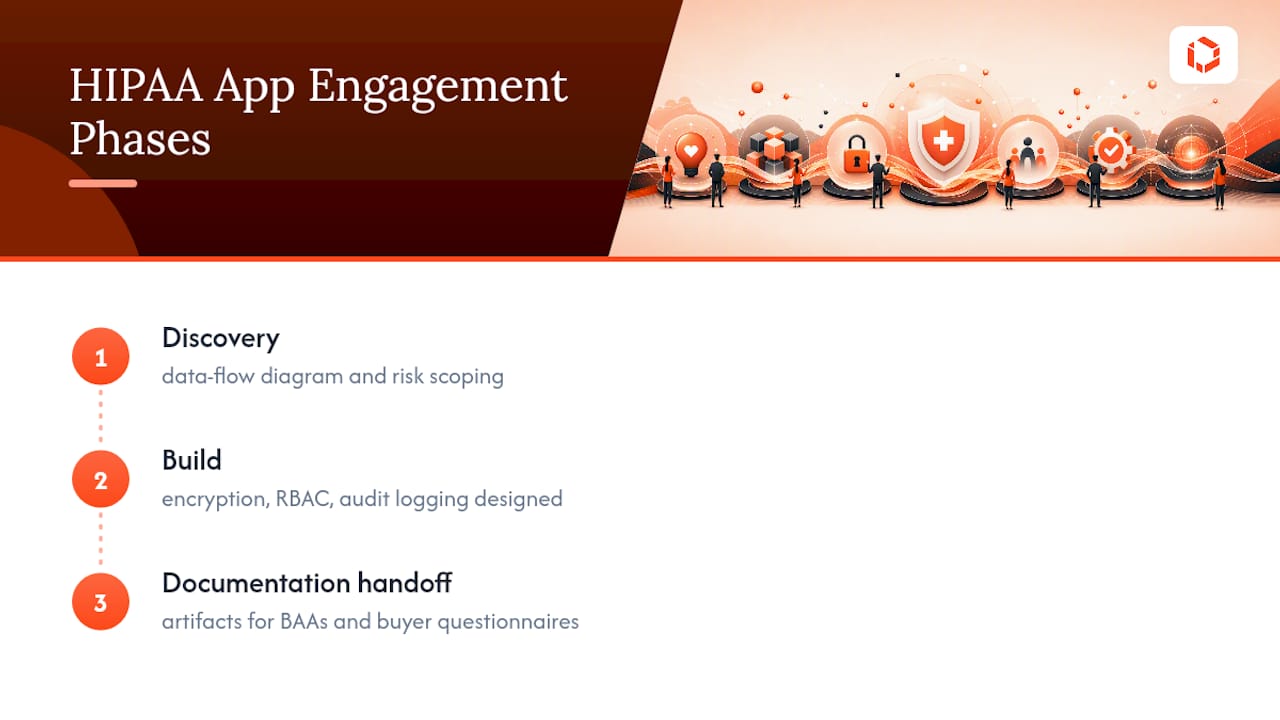
A typical engagement stages the work in phases: a rapid discovery sprint to map PHI flows and architecture decisions, a compliance-focused build phase covering encryption and access control, and a handoff package with documentation artifacts your next investor or enterprise buyer will ask to see.
Useful next reads before you scope a build:
The Checklist Founders Actually Get Wrong
HIPAA compliance is not a one-time certification. Teams should reassess their risk register after meaningful changes, such as a vendor swap or architecture update, so safeguards and documentation remain aligned with how the app actually operates.
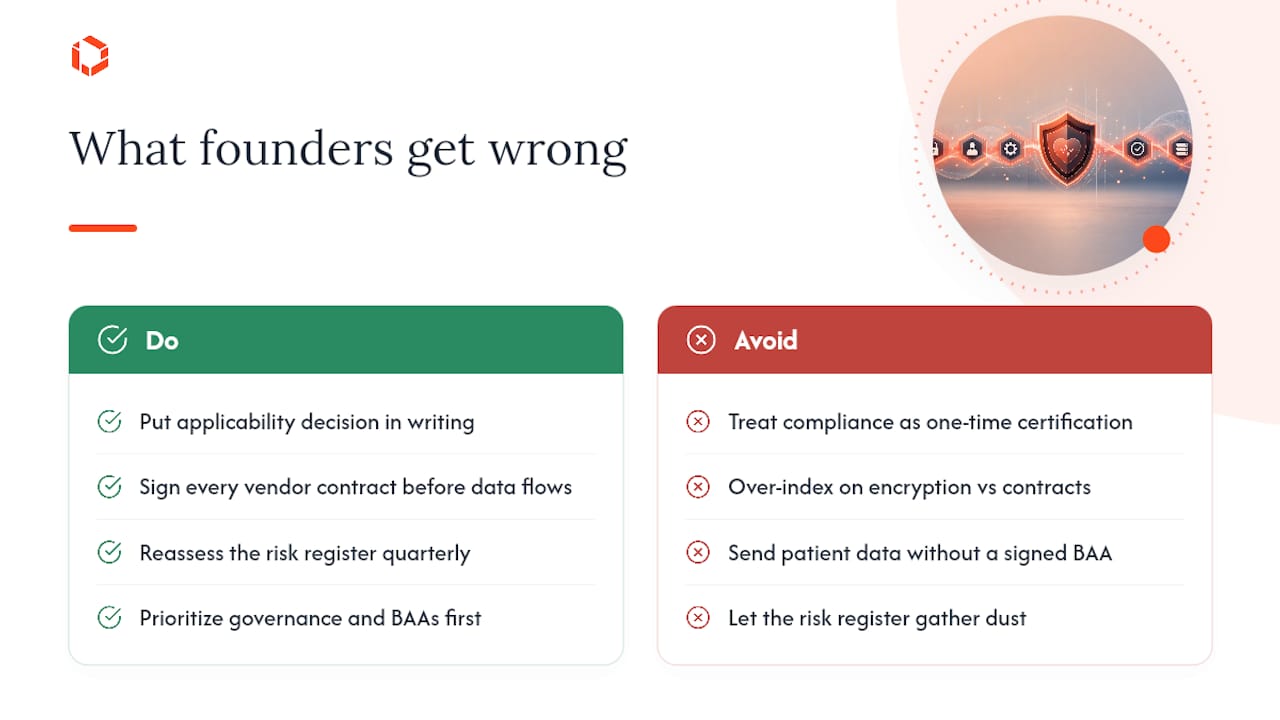
The conventional checklist also over-indexes on encryption and under-indexes on the BAA. Founders spend weeks debating AES-256 key rotation schedules while sending real patient data to a support tool with no signed agreement in place. That's the gap that actually gets companies in trouble. It's a paperwork failure, not a cryptography failure.
If you take one thing from this, prioritize the boring stuff first: get the applicability decision in writing, get every vendor contract signed before data flows, and build the habit of reassessing quarterly instead of treating your risk register as a launch-day artifact you never open again. The technical controls matter, but they're the part most engineering teams already know how to build. The governance discipline is what separates apps that survive an audit from apps that just look secure on the surface.
Ready to Build Your HIPAA-Compliant App?
This approach brings compliance considerations into the architecture conversation early, helping founders address encryption, access control, vendor agreements, and documentation before they become costly rework.

Engagements can begin with a discovery phase that maps data flows and risk-scoping decisions, then move into a build phase that incorporates appropriate encryption, access control, and audit logging. A documentation handoff can help legal and security teams review vendor agreements and buyer questionnaires. If your app includes AI features that may touch patient data, factor model-provider agreements and data-handling requirements into the architecture early.
Start with a scoping conversation about your custom mobile app development needs, and get a straight answer on what compliant architecture looks like for your specific PHI flows before you commit to a build.
Official Resources Worth Bookmarking
Keep these on hand for policy language, reporting obligations, and technical reference:
HHS Mobile Health Apps guidance and interactive tool for applicability decisions
OCR's breach reporting portal for filing and browsing past incidents
HIPAA Security Rule resources for safeguard definitions
NCBI Bookshelf's HIPAA implementation summary for practical risk-analysis commentary
CMS's HIPAA privacy and security overview for training and documentation guidance
This article is for general informational purposes only and does not constitute legal, compliance, or security advice. Consult qualified legal and compliance professionals for guidance specific to your organization.
Sources
FAQ
How Do You Build a HIPAA-Compliant App?
Confirm whether your app handles PHI, run a documented risk assessment, sign BAAs with every vendor touching that data, and implement encryption, RBAC, MFA, and audit logging before testing with SAST/DAST and a penetration test.
How Much Does a HIPAA-Compliant App Cost to Build?
Costs vary widely based on feature scope, vendor selection, and testing depth, since compliance work adds architecture, documentation, and testing time on top of standard app development. There's no single published figure that applies across projects, so get a scoped quote based on your specific PHI flows.
Does HIPAA Apply to All Mobile Health Apps?
No. HIPAA applies only when an app creates, receives, maintains, or transmits PHI on behalf of a covered entity or business associate, which is why HHS built an interactive tool specifically to help developers make that determination.
What Belongs on a HIPAA Compliance Checklist?
A working checklist covers PHI scoping, a documented risk assessment, signed BAAs, six core technical safeguards, security testing evidence, an incident response plan, and ongoing governance like training and quarterly log reviews.
What Happens if a Vendor Won't Sign a BAA?
Do not send that vendor any PHI. A refused BAA is a disqualifying signal, and the sample BAA provisions HHS publishes exist precisely so founders know what language to require before any contract is signed.


