
Joy Foroughi
Executive Assistant


Building an App for Under $5,000: What's Realistic
Discover if you can build an app for under $5,000. Learn what's realistic and what’s not for creating a focused MVP on a budget.

TL;DR:
A $5,000 budget can fund a focused minimum viable product for app validation, not full products.
Building a successful MVP requires scope control, choosing the right tools, and disciplined planning.
$5,000 can fund a real, working app, but only if you accept that it buys a focused minimum viable product (MVP), not a full-featured product. The question of whether you can build an app for under $5,000 comes down to scope control, tool selection, and founder discipline. Traditional app development costs range from $25,000 to $500,000+, which makes the $5,000 tier feel like a different category entirely. It is. With no-code platforms, AI-assisted coding, and a single-workflow focus, a working MVP is achievable at this price. The trade-offs are real, and understanding them before you commit a dollar is the most valuable thing you can do.
Can you build an app for under $5,000? What's realistic and what's not
A $5,000 budget covers a single-workflow MVP built for validation, not scale. That means one core user flow, standard authentication, and minimal design customization. You are not getting custom branding, complex third-party integrations, or native mobile features at this price point.
The apps that fit this budget share a common profile. They do one thing well, rely on off-the-shelf UI components, and use standard authentication flows. Think waitlist apps, simple lead capture tools, content display apps, or basic booking forms. These are not toy projects. They are real products that can validate a business idea before you invest more.
What falls outside this budget is equally clear:
Custom UI design and branded visual identity
Native iOS and Android builds (native apps cost 30–40% more than cross-platform web apps)
Complex integrations with payment processors, CRMs, or external APIs
Admin dashboards with reporting and analytics
Real-time features like chat, notifications, or live data feeds
A well-scoped MVP with Stripe payments, user accounts, and a dashboard costs closer to $8,000. At $5,000, you get a narrower version of that. The budget forces prioritization, which is actually useful. Founders who try to squeeze a full product into $5,000 consistently run out of money before launch.
Pro Tip: Write a one-page product spec before any developer conversation. List exactly one user flow, one problem solved, and one success metric. This single document prevents scope creep from consuming your entire budget.
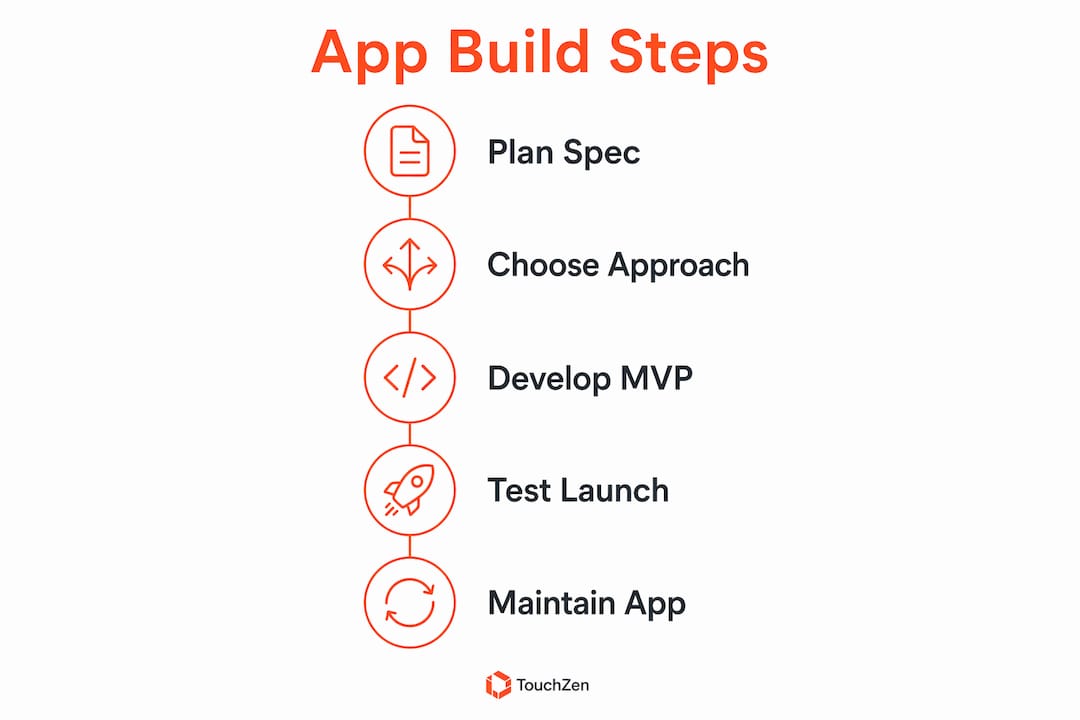
What development approaches work at this budget?
Three paths exist for building an app at this price: no-code platforms, AI-assisted custom coding, and hybrid approaches that combine both. Each has a distinct cost profile and set of trade-offs.

Approach | Time to launch | Monthly cost | Best for | Key limitation |
|---|---|---|---|---|
No-code platform | 3–7 days | $25–$500 | Simple forms, content apps | Vendor lock-in, scaling costs |
AI-assisted custom code | 7–10 days | Minimal after build | Validation MVPs | Requires senior engineer |
Hybrid (no-code + custom) | 10–14 days | $30–$200 | Moderate complexity | Maintenance complexity |
No-code and AI-powered builders reduce development costs by 40–60% compared to traditional agencies. A simple app can go live in 3–7 days on these platforms. The subscription fees run $25–$500 per month, which adds up over time but keeps the upfront cost low.
AI-assisted custom coding takes a different approach. Modern AI tooling collapses boilerplate coding by up to 90%, compressing tasks like authentication setup, payment wiring, and admin scaffolding from days to hours. A senior engineer using these tools can deliver 30–40 hours of strategic engineering within a $5,000 budget. That is the effective rate at roughly $130 per hour for senior-level work. The result is a custom-coded app that is yours to own, with no platform dependency.
The hybrid path uses no-code for front-end screens and custom code for specific logic. It works well for moderate complexity but creates maintenance challenges when the two layers need to stay in sync.
Pro Tip: Choose cross-platform web apps over native iOS and Android builds whenever possible. Cross-platform development costs 30–40% less and covers both platforms from a single codebase, which matters enormously at a $5,000 budget.
What hidden costs catch startups off guard?
The sticker price of a $5,000 build is only part of the real cost. Post-launch expenses are where founders consistently get surprised.
Platform subscription fees. No-code platforms charge monthly fees of $30–$500 for data storage, API calls, and collaborator seats. A $50 per month platform costs $600 per year. At scale, overage fees for additional users or API calls can push that number significantly higher.
Scope creep during development. Unclear specifications are the single biggest budget killer at this price point. Every feature added mid-project consumes hours that were budgeted for something else. Founders who skip the planning phase spend their budget on discovery instead of coding.
Vendor lock-in. No-code platforms own your app's infrastructure. Moving to a custom-coded solution later requires rebuilding from scratch. Some platforms allow code export to avoid lock-in, but this varies by platform and plan level.
Design and branding gaps. At $5,000, you rely on standard UI component libraries. If your product requires a distinctive visual identity, that work either gets cut or pushes you over budget.
Founder time as a hidden cost. Cheaper development options create a false impression that building is easy. You still need to write specifications, review work, test features, and manage the project. That founder time has real value, even if it does not show up on an invoice.
Pro Tip: Budget $200–$500 per month for post-launch platform fees and maintenance before you sign any development contract. Founders who plan for ongoing costs avoid the painful choice between scaling and shutting down.
How to plan and execute a $5,000 app project successfully
Execution at this budget requires discipline at every stage. The planning phase determines whether the build succeeds or stalls.
Define a razor-thin scope first. Identify the single user flow that proves your core assumption. Everything else is a future feature. A one-page spec with one problem, one solution, and one success metric is the foundation of every successful low-budget build.
Validate with a prototype before coding. Use a tool like Figma to create clickable mockups and test them with real users before spending a dollar on development. Discovering that users do not understand your core flow at the prototype stage costs nothing. Discovering it after launch costs everything.
Choose cross-platform over native. A cross-platform web app covers iOS and Android from one codebase. Native builds cost significantly more and are not justified at the MVP stage.
Work with senior engineers, not junior teams. AI tooling enables senior engineers to compress boilerplate hours drastically, meaning your $5,000 pays for strategic decisions rather than manual coding. Junior teams without AI tooling burn the same budget on tasks that take far longer.
Plan for the next phase now. Your MVP is not the final product. Decide before launch whether you will stay on a no-code platform or migrate to custom code when you hit user growth. That decision shapes every technical choice during the build.
Set clear milestones with your developer. Break the project into three stages: spec sign-off, working prototype, and final build. Each stage should have a defined deliverable and a payment tied to it. This structure keeps both sides accountable and prevents budget drift.
The product strategy decisions you make before a single line of code is written determine whether $5,000 produces a working product or a half-finished prototype.
Key Takeaways
A $5,000 app budget is viable only for a tightly scoped MVP built with no-code tools or AI-assisted engineering, with clear planning and realistic expectations about post-launch costs.
Point | Details |
|---|---|
Budget buys a focused MVP | Expect one core user flow, standard UI, and no complex integrations at this price. |
No-code cuts upfront cost | Platforms launch in 3–7 days but add $25–$500 per month in ongoing fees. |
AI tooling stretches hours | Senior engineers using AI compress 30–40 hours of work into a $5,000 budget. |
Hidden costs are real | Platform fees, scope creep, and founder time add significant cost beyond the build price. |
Planning determines success | A one-page spec and prototype validation prevent budget overruns before coding starts. |
The uncomfortable truth about $5,000 app builds
I have seen founders walk into a $5,000 budget with the mental model of a $50,000 product. The disappointment is predictable and avoidable.
The honest reality is that $5,000 buys you a proof of concept, not a product. That is not a failure. A well-built MVP that validates your core assumption is worth more than a bloated product that tries to do everything and does nothing well. The founders who succeed at this budget treat the $5,000 as a learning investment, not a product launch.
What I have found actually works is this: founders who write a one-page spec, validate it with a prototype, and then hand it to a senior engineer with clear milestones consistently get a working app. Founders who skip those steps consistently run out of money before launch. The development approach matters less than the planning discipline.
The other thing worth saying plainly: no-code platforms are not a permanent solution for most growth-stage startups. The long-term cost of platform fees and scalability limits will catch up with you. Plan your migration path before you need it, not after you are locked in.
If you are a startup founder evaluating a $5,000 build, the right question is not "can I build an app for this price?" The right question is "what is the smallest thing I can build that proves my idea works?" Answer that first. The budget follows the scope, not the other way around.
— Cyrus
How TouchZen helps startups build within budget
TouchZen works directly with startup founders who need a working MVP without the cost of a full-scale agency engagement. Every project starts with a direct conversation with a senior developer, not a junior account manager, so your budget goes toward building, not internal handoffs.
TouchZen's AI-powered app development approach compresses boilerplate engineering hours, which means a $5,000 budget covers more strategic work than it would at a traditional agency. The team has launched over 75 apps across industries, including products that reached 100,000 downloads in their first year. For founders ready to define their scope and move fast, TouchZen offers a consultative quote with no commitment. Reach out through the app experts page to start the conversation.
FAQ
Can you really build a working app for under $5,000?
Yes, but only for a tightly scoped MVP with one core user flow and no complex integrations. A single-workflow MVP built with AI-assisted tools or a no-code platform is achievable at this price.
What type of app fits a $5,000 budget?
Waitlist apps, simple booking forms, content display apps, and lead capture tools all fit within this budget. Apps requiring payments, user accounts, and dashboards typically cost closer to $8,000 or more.
How long does it take to build an app for under $5,000?
No-code platforms can launch simple apps in 3–7 days. Custom-coded MVPs with AI tooling typically take 7–10 calendar days from a finalized spec.
What are the ongoing costs after a $5,000 app build?
No-code platforms charge $30–$500 per month for hosting, storage, and API usage. Custom-coded apps have lower monthly costs but require occasional maintenance and updates.
Is no-code or custom code better for a $5,000 budget?
No-code is faster and cheaper upfront but creates vendor lock-in and growing monthly fees. Custom code with AI-assisted development costs more upfront but gives you full ownership and a cleaner path to scaling.