
Joy Foroughi
Executive Assistant


How to Find a Reliable Flutter Developer for Your Project
Learn how to find a reliable Flutter developer for your project. Discover key criteria and platforms to ensure a successful hire.

TL;DR:
Verifying real production experience is essential when hiring a reliable Flutter developer.
Testing recent apps, technical depth, and communication skills ensures you choose qualified candidates.
Finding a reliable Flutter developer means verifying real production experience, not just reviewing a polished resume. The best candidates have shipped apps on the Apple App Store or Google Play, understand modern Dart 3.x constructs, and communicate with the clarity your project demands. Knowing how to find a reliable Flutter developer for your project separates startups that launch on time from those stuck in endless revision cycles. Platforms like Upwork, specialized agencies, and community sources like Flutter Discord each offer different tradeoffs in speed, cost, and vetting rigor. This guide gives you the exact criteria, questions, and methods to hire with confidence.
What skills and expertise should you expect from a reliable Flutter developer?
A reliable Flutter developer in 2026 must demonstrate fluency in Dart 3.x and modern state management, not just familiarity with older patterns. Dart 3.x introduced records, sealed classes, and pattern matching. These are not optional extras. Senior developers use them daily in production code.
State management is where many candidates fall short. The three frameworks you will encounter most are:
Riverpod 2: The current standard for dependency injection and reactive state. Ask candidates to explain code generation with
@riverpodannotations.BLoC: Preferred for large teams needing strict separation between UI and business logic. Candidates should know when BLoC adds overhead versus when it pays off.
Provider: Still common in legacy codebases. A strong developer knows its limitations and when to migrate away from it.
Beyond state management, a reliable developer must know Flutter's UI layer deeply. That means Material 3 and Cupertino widget systems, platform-specific implementations for iOS and Android, and local storage options like Drift, Isar, and Hive. Async programming with Future, Stream, and Isolate is non-negotiable for any app handling real-time data.
Performance optimization is another signal of seniority. Ask candidates about Impeller, Flutter's rendering engine that replaced Skia as the default. A developer who cannot discuss Impeller's impact on jank reduction has not shipped a production app recently. Testing coverage across unit, widget, and integration tests rounds out the profile of a developer you can trust with your timeline.

Pro Tip: Ask candidates to walk you through a specific performance problem they solved in a past app. Vague answers like "I used best practices" are a red flag. Specific answers about widget rebuild reduction or Isolate offloading signal real experience.
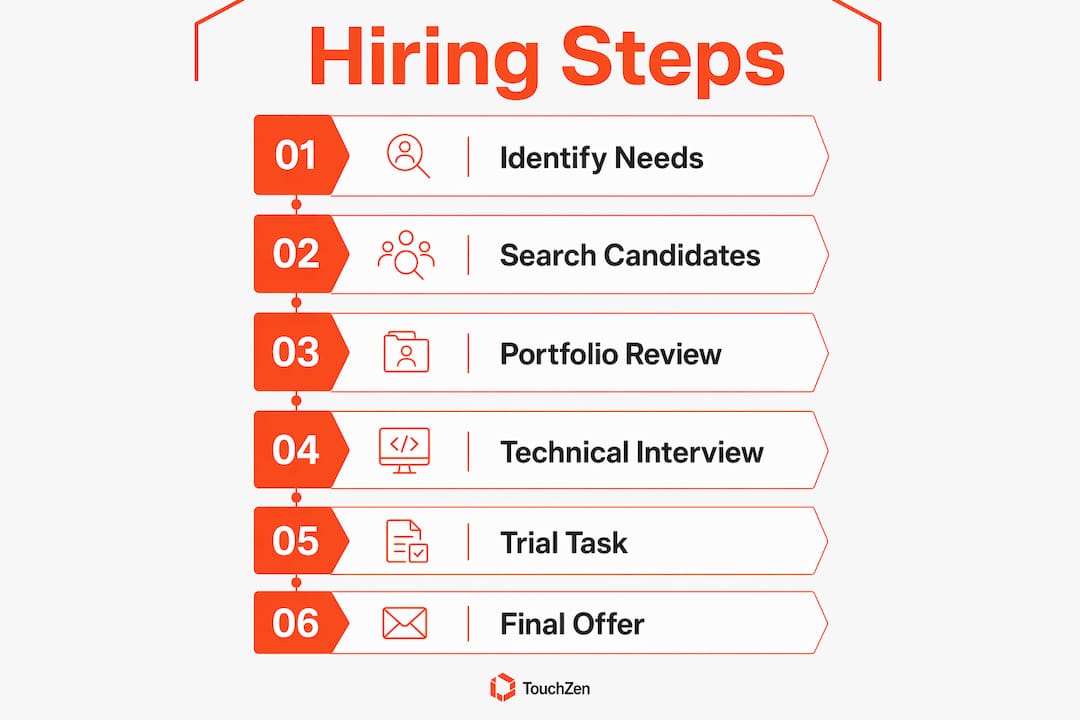
Where and how can you find reliable Flutter developers for your project?
The sourcing channel you choose determines how fast you hire and how much vetting you do yourself. Each channel has a distinct tradeoff.
Freelance marketplaces (Upwork, Freelancer): Large talent pools with ratings, portfolios, and client reviews. You control the vetting process, which takes time. Best for defined, short-term scopes.
Specialized agencies: Pre-vetted teams with project management built in. Agencies provide accountability and long-term support that freelancers typically cannot match. Best for complex, multi-phase projects.
Community sources (Flutter Discord, FlutterCon alumni): Direct access to developers who are active in the ecosystem. Vetting is entirely on you, but the talent quality is often high.
Booking platforms: Compress start times to as little as 48 hours by matching you with pre-screened developers. You trade some control over selection for speed.
Source | Speed | Vetting burden | Best for |
|---|---|---|---|
Upwork / Freelancer | Medium | High (you vet) | Short-term, defined scope |
Specialized agency | Medium | Low (pre-vetted) | Complex, long-term projects |
Flutter Discord / community | Slow | High (you vet) | Niche expertise, ecosystem insiders |
Booking platforms | Fast (48 hrs) | Low (pre-vetted) | Urgent starts, validated talent |
When comparing US-based vs offshore teams, the decision comes down to communication overlap and accountability. Offshore teams can cut costs significantly, but timezone gaps create decision latency that compounds on tight launch schedules.
Pro Tip: Before posting a job on Upwork, search for Flutter developers who have published apps in your target category. Message them directly. Developers with live apps in your niche understand your user expectations before the first call.
How to effectively vet and verify Flutter developers before hiring?
Vetting is where most founders lose time or make costly mistakes. A structured checklist eliminates guesswork.
Require 3+ published apps with developer attribution. Verify developer attribution in the App Store or Google Play listing. Download each app and test it yourself for stability, load times, and UI polish.
Ask for a detailed walkthrough of the app submission process. A developer who has shipped knows the exact steps: signing certificates, provisioning profiles, targetSdk requirements, and handling rejection notices. Vague answers here are disqualifying.
Check for recent app updates. An app last updated in 2022 suggests the developer has not maintained production code through Flutter's major version changes. Active maintenance is a reliability signal.
Run a live coding test in their actual IDE. Live coding in the candidate's editor reveals how they actually work, not how they perform under artificial whiteboard conditions. Give a real task: build a Riverpod-backed list view with offline cache via Drift or Isar.
Evaluate communication quality directly. Watch for prompt replies, clear status updates, and realistic scope boundaries. Communication rhythm and release ownership are the strongest reliability signals for remote engagements.
Check references from previous clients. Ask references specifically about deadline adherence, how the developer handled blockers, and whether they would hire again.
You cannot take agency claims at face value. Require evidence. Count the apps. Test them yourself.
What interview questions and trial methods reveal the best Flutter developers?
Technical interviews for Flutter developers fail when they rely on abstract questions. Real-world coding tasks in the candidate's own development environment predict actual work quality far better than whiteboard tests.
Start with state management depth. Ask the candidate to compare BLoC and Riverpod for a specific scenario, such as a multi-step checkout flow with async validation. A strong answer covers testability, boilerplate tradeoffs, and when each framework creates unnecessary complexity. Candidates who cannot articulate state management tradeoffs are not ready for production work.
Follow with architecture questions. Ask how they structure a large Flutter app with 20+ screens. Look for answers that mention feature-first or layer-first folder structures, separation of data and presentation layers, and dependency injection patterns. Disorganized folder structures in their portfolio apps confirm a weak answer.
Use a scoped take-home task to observe their workflow. Job-relevant coding tasks reveal code structure, edge case handling, test coverage, and technical curiosity in ways that a 30-minute call cannot. Keep the task small enough to complete in 2–3 hours. Review the Git commit history, not just the final output.
Watch for these red flags during interviews:
Cannot explain how Impeller differs from Skia or why it matters for rendering performance
Describes
build_runnerfailures as "just run it again" without understanding code generation dependenciesPromises unlimited revisions without scoping what a revision means
Cannot name a single app they shipped with a specific crash-free rate metric
Pro Tip: Ask candidates to share their screen and open a past project. Watch how they navigate the codebase. Developers who know their own code move quickly and explain decisions confidently. Developers who struggle to find their own files are telling you something important.
How do budget, timeline, and engagement model affect your hiring decision?
Cost and timeline expectations vary significantly by engagement model. Senior Flutter contract rates in the US range from $60 to $180 per hour. Mid-level full-time salaries average $105,000 to $140,000 depending on location and market conditions. Recruiter-led hiring cycles run 4–8 weeks. Booking platforms compress that to 48 hours.
Engagement model | Typical cost | Time to start | Best for |
|---|---|---|---|
Freelance (Upwork) | $40–$120/hr | 1–2 weeks | Short, defined projects |
Booking platform | $80–$150/hr | 48 hours | Urgent, validated talent |
Specialized agency | Project-based | 1–3 weeks | Complex, multi-phase builds |
Full-time hire | $105K–$140K/yr | 4–8 weeks | Long-term product ownership |
App store deployment adds timeline risk that many founders underestimate. Google Play review timelines averaged 1–7 days in 2026, with requirements like targetSdk=35 and Android App Bundles affecting approval speed. Build in buffer time. A developer who has handled rejections before will flag these risks early.
A few principles to guide your decision:
Use freelancers for short, well-defined scopes where you can manage the project directly.
Use agencies when you need project management, accountability, and post-launch support built into the engagement.
Use full-time hires when the app is your core product and you need long-term ownership.
Budget for mobile app development costs before you post a job. Underfunded projects attract underprepared developers.
Key Takeaways
Hiring a reliable Flutter developer requires verifying real shipped apps, testing technical depth in live coding sessions, and matching the engagement model to your project's scope and timeline.
Point | Details |
|---|---|
Verify production apps | Require 3+ published apps with developer attribution on App Store or Google Play. |
Test Dart 3.x fluency | Screen for records, sealed classes, and modern state management with Riverpod or BLoC. |
Use live coding tests | Run real Flutter tasks in the candidate's IDE, not abstract whiteboard exercises. |
Match engagement to scope | Use freelancers for short projects and agencies for complex, multi-phase builds. |
Budget for deployment delays | Google Play reviews can take 1–7 days; build that buffer into every launch plan. |
What I've learned after watching dozens of Flutter hires go wrong
The most common mistake I see founders make is treating the interview as the main filter. They ask good questions, get confident answers, and hire based on how the conversation felt. Then the first sprint reveals the developer cannot structure a feature module without guidance.
Portfolio evidence is the real filter. Before any call, I look at the apps. I download them. I test them on a real device. A developer who has shipped a polished, stable app with recent updates has already proven more than any interview can. The interview confirms what the portfolio suggests.
Communication rhythm matters as much as technical skill. A developer who responds to messages within a few hours, sends weekly demo videos, and flags blockers before they become delays is worth more than a technically brilliant developer who goes silent for days. Scope creep and missed deadlines almost always trace back to communication failures, not skill gaps.
For startups with complex projects, I consistently recommend agencies over solo freelancers. Not because freelancers lack skill, but because agencies bring built-in accountability, project management, and someone to escalate to when things go sideways. For a small, well-defined feature build, a strong freelancer from Upwork with verified apps is often the faster and cheaper path. Know your scope before you choose your model.
— Cyrus
TouchZen builds Flutter apps with senior developers from day one
Startups that partner with TouchZen skip the vetting process entirely. TouchZen's team has launched over 75 apps across industries, with results including 100,000 downloads in the first year and a 10x increase in user subscriptions for clients. Every project runs with direct access to senior developers and designers, not junior staff handed a brief.
TouchZen's staff augmentation service lets you scale your Flutter team quickly without the 4–8 week recruiter cycle. If you need a full build, the mobile app development team covers iOS, Android, and cross-platform delivery with post-launch support built in. TouchZen is ranked among the top app developers in the US, with a track record that speaks for itself.
FAQ
How do I verify a Flutter developer's real experience?
Require 3+ published apps with their name in the developer account and recent update history. Download and test each app yourself before scheduling an interview.
What is the best interview method for Flutter developers?
Live coding in the candidate's own IDE using a real Flutter task predicts work quality far better than whiteboard tests or abstract questions.
How much does a senior Flutter developer cost in the US?
Senior Flutter contract rates range from $60 to $180 per hour. Full-time mid-level salaries average $105,000 to $140,000 depending on location.
Should I hire a freelancer or an agency for my Flutter project?
Freelancers suit short, defined scopes where you manage the project directly. Agencies are the better choice for complex builds that need project management, accountability, and post-launch support. See a detailed freelancer vs agency comparison to weigh your options.
What are the biggest red flags when hiring Flutter developers?
Inability to discuss Impeller rendering, vague answers about app submission processes, and no published apps with recent updates are the clearest disqualifiers.