
Cyrus Kiani
Founder / CEO



How to Raise Funds for Your App: Proven Strategies for 2026
Raising capital for a mobile or web app in 2026 is genuinely harder than it looks from the outside. Only 0.05% of startups ever secure venture capital funding, which means the vast majority of founders need a smarter, broader playbook. The good news? The funding ecosystem has never been more varied. From revenue-based financing to accelerators, grants, and hybrid models, there are more paths to capital than ever before. This guide walks you through the real funding landscape, the metrics investors care about most, and the practical steps that give your app the best shot at getting funded in 2026. 📊

Key Takeaways
Point | Details |
|---|---|
VC odds are slim | Only a fraction of app startups secure VC, so consider alternative funding. |
Proof outshines ideas | Demonstrating traction and real user growth is essential for attracting investors. |
Choose the right funding | Evaluate trade-offs between equity and non-dilutive options for each app stage. |
Nail your pitch deck | A data-driven, concise, and mobile-friendly pitch deck makes a strong first impression. |
Focus on users | Building sustainably with real market feedback and milestones increases funding success. |
Understanding the 2026 fundraising landscape
The funding climate in 2026 is defined by two competing forces: massive capital concentration at the top and fierce competition at every other level. Global VC investment hit $285.5B in Q1 2026 alone, with 42% of that flowing into AI-related companies. If your app does not have an AI angle or a clear revenue story, you are competing for a shrinking slice of investor attention.
Here is how the funding stages typically break down in 2026:
Stage | Median check size | What investors want |
|---|---|---|
Pre-seed | $750K | Idea, team, early prototype |
Seed | $3.2M | MVP, early users, some traction |
Series A | $15M | Proven growth, strong unit economics |
Median check sizes at pre-seed are $750K, seed is $3.2M, and Series A sits at $15M. These numbers sound accessible, but the bar for each stage has risen sharply. Investors are now milestone-driven, meaning they want to see specific proof points before writing a check, not just a compelling story.
Key forces shaping who gets funded right now:
AI premium: Apps with genuine AI integration attract disproportionate attention and higher valuations
Revenue focus: Investors reward capital efficiency and early monetization over growth-at-all-costs
Warm introductions: Cold outreach conversion rates have dropped; network access matters more than ever
Milestone-tied asks: Founders who tie their funding ask to specific, measurable milestones close faster
"Capital efficiency is the new growth hack. Investors in 2026 want to see what you can do with less before they give you more."
Understanding why most apps never reach $1K in revenue is critical context here. Investors know the odds, and they fund accordingly. Building with app security baked in from day one also signals maturity to sophisticated investors who do technical due diligence.

All funding options explained: Pros, cons, and when to use each
Understanding the landscape sets the stage. Now let's get specific about your actual choices. Every funding path involves trade-offs between speed, dilution, control, and requirements. Picking the wrong one at the wrong stage can cost you ownership, momentum, or both.
Funding type | Dilution | Speed | Best stage | Key requirement |
|---|---|---|---|---|
Venture capital | 20-40% | Slow (4-6 months) | Seed to Series A | Strong traction |
Angel investors | 10-25% | Medium | Pre-seed to seed | Warm intro |
Accelerators | 5-10% | Fast | Pre-seed | Competitive selection |
Revenue-based finance | None | Fast | Post-revenue | Proven monthly revenue |
Grants | None | Slow | Any | Eligibility criteria |
Bootstrapping | None | N/A | Any | Personal capital |
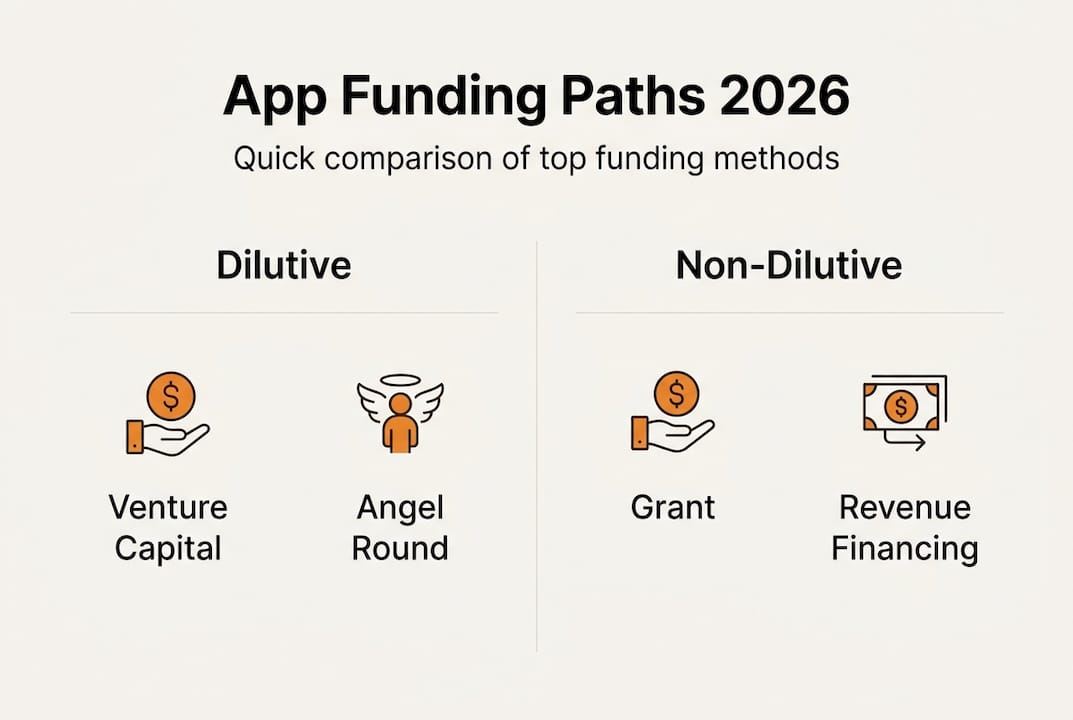
Equity funding like VC and angel rounds enables fast growth but dilutes your ownership by 15-40%, while non-dilutive paths like revenue-based financing and grants preserve control but typically require proven revenue. Neither is universally better. The right choice depends on your stage, your growth rate, and how much control you want to keep.
Here is a quick breakdown of when each option makes sense:
Bootstrapping: Best when you have a clear path to early revenue and want to retain full ownership before proving the concept
Angel investors: Ideal at pre-seed when you need $100K to $500K and can leverage a personal or professional network
Accelerators: Great for first-time founders who need mentorship, network access, and a small check to build credibility
VC funding: Right for founders with proven traction who need $3M or more to scale aggressively
Revenue-based financing (RBF): Perfect for post-revenue apps that want growth capital without giving up equity
Grants: Worth pursuing if you are in health tech, climate, or government-adjacent sectors where grant programs are active
Pro Tip: Hybrid approaches are gaining traction in 2026. Many founders bootstrap to an MVP, raise a small angel round to get to revenue, then use RBF to scale before approaching VCs. This sequence protects ownership at every stage. When you are ready to scale, scaling your app strategically becomes just as important as the funding itself. 🚀
How to prove traction and impress investors
Choosing your funding path is easier when you know what investors actually want to see. In 2026, the answer is simple: proof. Not potential. Not vision. Proof.
Here are the five milestones that matter most to investors evaluating app startups:
Monthly growth rate: Consistent 15-20% month-over-month (MoM) growth signals product-market fit better than any pitch slide
LTV/CAC ratio: Your lifetime value to customer acquisition cost ratio should exceed 3x. This shows your business model actually works
Retention curves: Day-30 and Day-90 retention rates tell investors whether users find lasting value in your app
Revenue milestones: Even $10K monthly recurring revenue (MRR) demonstrates real demand and willingness to pay
Market validation: Letters of intent, waitlists, or partnership agreements show external demand beyond your own enthusiasm
📊 Key stat: Investors fund proof, not ideas. A 20% MoM growth rate and an LTV/CAC ratio above 3x are the benchmarks that move serious investors from curious to committed.
Bootstrapping your MVP to get real metrics is not just a cost-saving move. It is a credibility-building strategy. Founders who show up with six months of user data and a clear monetization story close rounds faster and at better valuations than those pitching pure concepts.
Pro Tip: Build your pitch deck metrics section around a before-and-after narrative. Show what the problem cost users before your app, then show what your retention and revenue numbers look like after. This framing makes abstract metrics emotionally resonant. Understanding the real revenue hurdles most apps face will help you set realistic targets, while proving scalability early gives investors confidence in your long-term vision. 💰
Winning the fundraising process: Building decks, pitching, and timing
You are ready to attract investors, so here is how to pitch and close the deal. The mechanics of fundraising matter as much as the substance of your story.
Start with your pitch deck. Investors spend an average of 3:44 reviewing a deck, which means every slide must earn its place. The standard 10-slide structure that works in 2026:
Title: Company name, one-line value proposition, contact info
Problem: The specific pain point you solve, with data
Solution: Your app and how it works, shown not just described
Market size: TAM, SAM, SOM with credible sourcing
Traction: Your best metrics, growth charts, and milestones
Business model: How you make money, pricing, and unit economics
Team: Why this team wins in this market
Financials: 18-month projections with clear assumptions
Competition: Honest landscape map showing your differentiation
Ask: Exact amount, use of funds, and milestones it unlocks
For deeper context on what makes decks stand out in 2026, pitch deck insights from experts are worth reviewing before you finalize yours.
On timing and targeting:
Test your pitch with 40 to 60 targeted investors, not hundreds of cold emails
Prioritize warm introductions through your network, accelerator alumni, or advisors
Plan for a four to six month fundraising timeline from first meeting to close
Avoid raising during major holidays or immediately after a market downturn
"The biggest mistake founders make is pitching hype instead of evidence. Investors in 2026 have seen every trend. They fund the founders who show them numbers."
Your app's design also signals quality before a single word is spoken. Decks and demos that reflect current app UI trends communicate that your team understands the market and builds products users actually want to use.
Why app founders should stop chasing VCs—and what to do instead
Here is the uncomfortable truth most fundraising guides skip: chasing VC is often the worst strategy for app founders, especially early on. The fundraising process is time-consuming, emotionally draining, and statistically unlikely to succeed. Founders who spend six months pitching VCs instead of building product and acquiring users often end up with neither funding nor traction.
The pressure to raise from prestigious funds creates a hype cycle that distorts decision-making. Founders optimize for investor optics instead of user value. They inflate metrics, chase vanity growth, and take on terms that ultimately limit their options. Most apps struggle to reach meaningful revenue not because they lacked funding, but because they lacked focus on the right problems.
The alternative mindset is straightforward: start small, focus on users, and let traction pull capital toward you rather than chasing it. Non-dilutive funding, hybrid models, and bootstrapped growth preserve your ownership and force the discipline that actually builds durable businesses. When you do approach investors, you do it from a position of strength, not desperation. That shift changes everything about how deals get done. 👉
Partner with experts to give your app the best start
Fundraising strategy only goes so far without a product that investors and users actually believe in. At TouchZen Media, we work with startup founders from the earliest MVP stage through investor-ready builds, combining strategic consulting, user-centric design, and scalable development into one focused partnership.
Our track record as a top app developer in California means we understand what investors scrutinize during technical due diligence and what users demand from day one. Whether you need a polished prototype to anchor your seed pitch or a production-ready app to hit your Series A milestones, our team of mobile app development experts is ready to help. Book a discovery call today and let's build something investors and users will love. 🚀
Frequently asked questions
What is the average amount raised by app startups in 2026 at each funding stage?
In 2026, median funding amounts are $750K at pre-seed, $3.2M at seed, and $15M at Series A, though actual raises vary widely based on sector, team, and traction.
How long does fundraising usually take for app startups?
Fundraising for app startups typically takes four to six months from initial preparation through to closing, so plan your runway and product roadmap accordingly.
Are there non-dilutive funding options for apps with little to no revenue?
Yes, grants and some accelerators offer non-dilutive capital, but most non-dilutive methods like revenue-based financing require demonstrated revenue or meaningful traction to qualify.
What are the most important milestones to show investors?
Investors prioritize consistent growth rates, a strong LTV/CAC ratio, and clear evidence of market demand. Investors fund proof, not ideas, so your metrics need to tell a credible, data-backed story.