Joy Foroughi
Executive Assistant


Mobile App Consulting: Save Time and Budget
Unlock success with mobile app consulting services when expert guidance saves time and budget. Streamline your project and cut costs today!
TL;DR:
Mobile app consulting can reduce development time and costly rework when the savings created by clearer scope and faster decisions exceed the consulting fee. They provide strategic guidance, such as prioritized roadmaps and architecture recommendations, which help accelerate decisions and control scope before development begins. Engaging early, especially during discovery or MVP definition, delivers measurable savings and improves project outcomes.
Hire mobile app consulting services when the engagement will reduce development time, scope risk, or repeated rework by more than its fee. That threshold is met more often than most founders expect. A well-structured consulting engagement typically pays for itself through three mechanisms: a prioritized scope that cuts build time, faster architecture decisions that eliminate decision latency, and fewer costly reworks caused by late-stage requirement changes.
When to call a consultant now:
Your product goals are still ambiguous or shifting week to week
You have a budget and a deadline but no validated feature set
A previous build stalled, shipped late, or failed to gain traction
You are migrating a legacy platform and do not know which architecture to target
What to expect from a short engagement: A 1–3 week discovery produces a prioritized feature roadmap, a risk register, and a technology-stack recommendation. That output alone is enough to sharpen an RFP or reduce a vendor quote by eliminating unnecessary scope.
The cheapest time to get help is pre-development. Post-launch rescue engagements cost significantly more because every rework cycle compounds.
What do mobile app consulting services actually cover?
Mobile app consulting is the practice of bringing in senior product, design, and technical advisors to guide decisions before and during a build, without necessarily handing them the build itself. The consultant's job is to reduce decision latency, clarify scope, and de-risk the technical path so that whoever builds the app, whether an in-house team or an external agency, spends time on the right things.
A typical consulting engagement delivers concrete outputs: a prioritized feature roadmap, a validated prototype, an architecture recommendation, a vendor evaluation framework, and a go-to-market plan. These are the artifacts you can hand to a development team on day one to eliminate the "figure it out as we go" phase that inflates timelines.
Where consulting differs from a standard agency build is in accountability. A build team's incentive is to ship what is scoped. A consultant's incentive is to make sure what is scoped is worth building. Those two roles overlap during technical advisory phases, but they are distinct at the strategic level. Even experienced in-house teams can benefit from an external perspective that challenges product assumptions and identifies potential scaling risks early.
When should you hire a mobile app consultant?
The scenarios where mobile app consulting delivers measurable time and budget savings fall into six clear categories. Mapping your situation to one of them is the fastest way to decide whether you need help now.
Pre-development strategy. You have a business idea and a rough budget but no validated product definition. A consultant runs discovery, maps user needs to features, and hands you a scoped roadmap instead of a blank whiteboard.
MVP definition. You know what you want to build but not what to cut. Consultants apply prioritization frameworks (impact vs. effort, user-value scoring) to reduce a 40-feature wishlist to the 8–12 that will validate the core hypothesis.
Project rescue. A build is over budget, behind schedule, or technically unstable. A consultant audits the codebase, identifies the root causes, and produces a stabilization plan before more money goes in.
Platform modernization. A legacy app needs to move to React Native, Flutter, or a new backend architecture. Consulting provides the migration roadmap and risk assessment before the engineering team touches a file.
Scaling architecture. Your app is growing and the current infrastructure is showing strain. An architecture review identifies bottlenecks and recommends solutions before they become outages. For founders thinking ahead, mobile app scalability guidance is worth reviewing alongside any consulting engagement.
Go-to-market strategy. You have a working app but no clear launch plan. A consultant sequences your acquisition channels, sets up ASO fundamentals, and prioritizes paid versus organic spend based on your audience and budget.
Quick diagnostic: If you answer yes to two or more of these questions, consulting will likely save you more than it costs.
Are your product goals still changing week to week?
Is your scope larger than a 3–4 month build?
Do you have compliance, security, or data-privacy requirements you have not fully mapped?
Are you launching in the next 60 days with unresolved technical unknowns?
Has a previous version of this product already failed to gain traction?
What core services does a mobile app consultant provide?
The deliverables from a consulting engagement are specific and tangible. Here is what you are actually paying for, mapped to the phase that produces each output.
Strategy and product advisory
User research synthesis and persona validation
Prioritized feature roadmap with effort and impact scoring
Business-case modeling to justify build investment to stakeholders
Competitive analysis to identify gaps and differentiation opportunities
Design and validation
UX audits of existing apps or wireframes
Interactive prototypes for user testing before engineering begins
Usability testing plans and success criteria
Technical advisory
Technology-stack recommendation (native iOS/Android vs. Flutter vs. React Native)
Architecture review for scalability, security, and maintainability
Component reuse assessment to avoid rebuilding what already exists
Pre-build risk reduction
Vendor evaluation and RFP preparation
Engineer onboarding criteria and team structure recommendations
QA strategy and test planning before the first sprint
Launch and growth planning
App Store Optimization (ASO) fundamentals for discoverability
Channel sequencing for launch: paid installs for speed, organic for long-term retention
User-acquisition prioritization based on audience fit and budget
Pro Tip: Ask any consultant to show you a sample deliverable from a previous engagement before you sign. A roadmap template or architecture doc tells you more about their working style than any sales call.
How does consulting actually save time and reduce your budget?
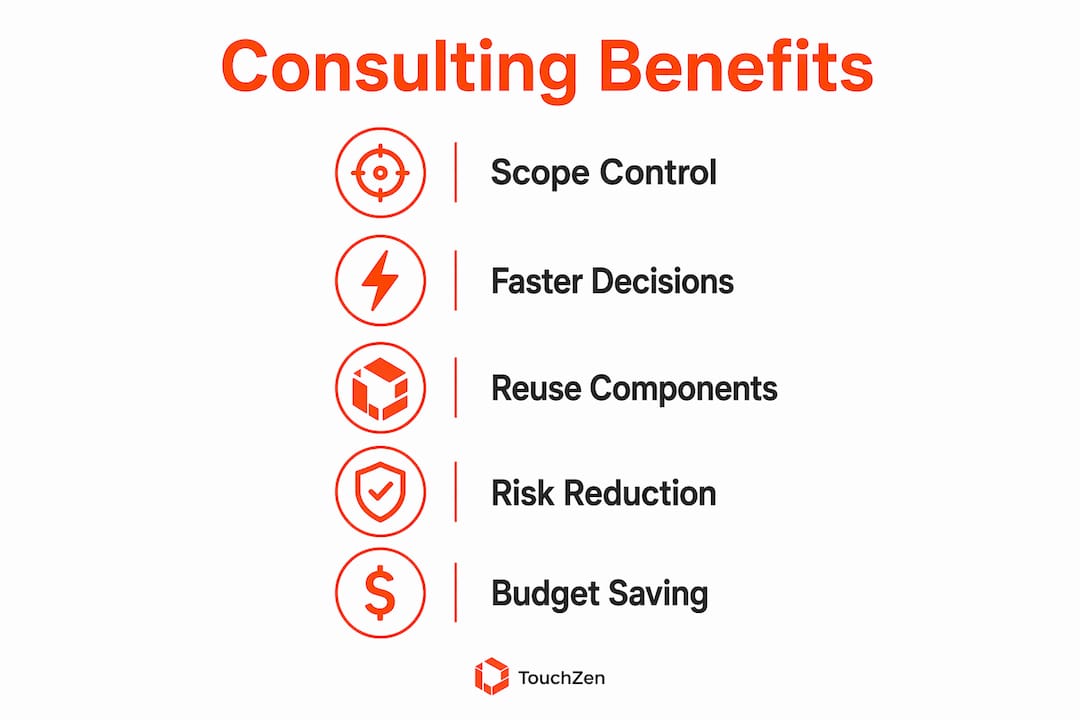
The savings are not abstract. They come from five specific mechanisms, each of which removes a predictable cost from the development cycle.

Scope control. Feature bloat is the single largest driver of budget overruns. A consultant applies a structured prioritization process to cut scope before engineering begins, which means fewer sprint cycles, smaller vendor quotes, and a faster path to a shippable product.
Faster architecture decisions. When a team debates which database, which API pattern, or which cross-platform framework to use, every day of indecision costs engineering time. A consultant with cross-project experience makes that call in hours, not weeks.
Component reuse. Experienced consultants know which libraries, SDKs, and third-party services can replace custom builds. Reusing a proven authentication library instead of building one from scratch can save two to three weeks of engineering time on a single feature.
Vendor negotiation. A consultant who has evaluated dozens of vendors knows the real market rate for development work and can identify when a quote is padded. That knowledge alone can reduce a vendor contract by a meaningful margin.
Improved QA processes. Late-stage bug discovery is expensive. Consultants who build QA strategy into the pre-build phase, including test planning, acceptance criteria, and pre-launch beta testing, reduce the volume of post-launch fixes that drain maintenance budgets.
Statistic to know: TouchZen clients have achieved outcomes including a 10x increase in user subscriptions and 100,000 downloads within the first year in select cases. Those results reflect what happens when consulting-driven scope control and launch strategy are applied from the start.
Pro Tip: Before your first consulting session, document every feature your team has discussed in the last 30 days. Bring that list to the discovery call. A good consultant will help identify which features are essential now and which can be postponed, creating meaningful budget savings before development begins.
What does a typical consulting engagement look like from start to finish?
A well-run consulting engagement follows a predictable sequence of phases. The timeline varies by scope, but the structure is consistent.
Phase sequence and typical durations
Phase | Duration | Key deliverable |
|---|---|---|
Discovery | 1–3 weeks | Scope definition, risk register, user research summary |
Strategy and roadmap | 1–2 weeks | Prioritized feature roadmap, business-case model |
Prototyping and validation | 2–4 weeks | Interactive prototype, usability test results |
Technical advisory | Concurrent with build | Architecture docs, stack recommendation, QA plan |
Launch support | 1–2 weeks | ASO setup, channel sequencing plan, launch checklist |
Post-launch monitoring | Ongoing (monthly retainer option) | Analytics review, iteration backlog |
What each phase requires from you
Discovery. Expect 3–5 hours of stakeholder interviews and document sharing. You provide business goals, existing research, and any prior build artifacts.
Strategy and roadmap. One or two working sessions to validate priorities. You approve the feature ranking and confirm the business-case assumptions.
Prototyping. You review and test the prototype with real users or internal stakeholders. Feedback cycles typically take 2–3 rounds.
Technical advisory. Lighter touch during the build phase. Weekly check-ins, architecture sign-offs, and escalation support for technical blockers.
Launch support. You provide app store assets and marketing copy. The consultant finalizes ASO, reviews the launch checklist, and confirms analytics are tracking correctly.
Post-launch. Monthly reviews of retention, crash rates, and user feedback to feed the next iteration cycle.
For a startup MVP, the full consulting arc from discovery through launch support typically runs several weeks to a few months. An enterprise modernization engagement with a longer build phase may extend the advisory period to half a year or more. The key difference is not the consulting hours but the build complexity the consultant is advising around.

How much does mobile app consulting cost in the US?
Consulting fees in the US follow three engagement models, each suited to a different stage and risk profile.
Common mobile app consulting pricing models
Mobile app consulting in the US is commonly priced through fixed-fee discovery engagements, hourly advisory support, or ongoing retainers. The right model depends on the project’s complexity, required deliverables, and the level of continued involvement.
How to think about ROI. Map each consulting deliverable to a cost it prevents. A prioritized roadmap prevents scope creep. An architecture review prevents a costly platform migration 18 months later. A vendor evaluation prevents an inflated contract. Add those avoided costs and compare them to the consulting fee. Compare the consulting fee with the cost of the rework, delays, or unnecessary development it may prevent.
Pro Tip: When comparing consulting bids, ask each firm to itemize their deliverables and the hours allocated to each. A firm that cannot tell you what a $20,000 discovery produces in concrete outputs is not ready to be your advisor.
How do you choose the right mobile app consultant?
The selection process comes down to five criteria, a set of direct questions, and a short list of red flags that disqualify candidates quickly.
Selection criteria
Domain experience. Has the consultant worked in your industry or on a similar app type? A fintech app has different compliance and architecture requirements than a consumer lifestyle app.
Senior-access guarantee. Will the people who sold you the engagement actually do the work? Many agencies assign junior staff after the contract is signed. Insist on knowing who will be in every working session.
Clear deliverables. Every phase should have a named output. If a proposal says "strategic guidance" without specifying what that produces, push back.
Measurable case studies. Ask for examples with numbers: time saved, features cut, downloads achieved, subscriptions lifted. Vague success stories are not evidence.
Compatibility with your development model. If you have an in-house team, the consultant needs to work alongside them, not around them. Confirm the handoff process before you sign.
Questions to ask in a scoping call
"Show me a similar technical risk you identified and how you resolved it."
"Who specifically will run our discovery sessions and prototype reviews?"
"What does your roadmap deliverable look like? Can I see a sample?"
"How do you handle scope changes mid-engagement?"
"What metrics do you use to define a successful engagement?"
Red flags
Vague deliverables with no named outputs per phase
No case studies with quantified outcomes
Junior staff doing the hands-on work after a senior-led sales process
Opaque pricing with no itemized breakdown
No process for post-engagement handoff to your build team
Trust signals that matter
Measurable client outcomes (downloads, subscription lift, time-to-market reduction)
Clutch ranking with verified reviews
Direct references from clients in a similar industry
A clearly documented engagement process you can review before signing
TouchZen's Clutch recognition and IT consulting credentials are publicly verifiable trust signals worth reviewing during your evaluation.
How do you integrate a consultant with your existing team?
Bringing an external consultant into an active development workflow creates friction if the integration is not planned from day one. The goal is to position the consultant as a force multiplier for your team, not a parallel track that creates competing priorities.
Define the consultant's lane clearly. Before the engagement starts, document which decisions the consultant owns (architecture recommendations, feature prioritization, vendor selection) and which remain with your internal team (sprint planning, code review, deployment). Ambiguity here is the most common source of conflict.
Use shared tools, not parallel ones. If your team works in Jira, Linear, or Notion, the consultant should work in the same environment. Separate documents and separate Slack channels create information silos that slow decisions. A single source of truth for the roadmap and the risk register keeps everyone aligned.
Schedule structured touchpoints, not open-ended access. Weekly advisory sessions with a defined agenda are more productive than ad hoc calls. Reserve async communication for low-stakes updates and use synchronous time for decisions that require input from both sides.
Plan the handoff before the engagement ends. The most common failure mode in consulting engagements is a clean deliverable that never gets implemented because the transition to the build team was not planned. At the midpoint of the engagement, start documenting the handoff package: annotated roadmap, architecture decision records, vendor contacts, and QA criteria. That package is what converts consulting value into shipped product.
Key Takeaways
Expert mobile app consulting pays for itself when it prevents scope creep, accelerates architecture decisions, and reduces post-launch rework before a single sprint begins.
Point | Details |
|---|---|
Hire before you build | Discovery engagements (1–3 weeks) surface scope risks that cost far more to fix mid-build. |
Consulting fees vs. build savings | Fixed-fee discovery and prototype engagements are common; full custom app build costs in the US range significantly. Consulting fees are typically a fraction of build costs, and strategic consulting can prevent costly rework, providing positive ROI. |
Senior access is non-optional | Insist on knowing who does the hands-on work; junior-led engagements lose the pattern recognition that drives savings. |
Measure three outcomes | Track downloads, subscription lift, and rework reduction to confirm the consulting fee delivered net savings. |
TouchZen as your partner | TouchZen has launched 75+ apps with outcomes including a 10x subscription lift and 100,000 first-year downloads. |
TouchZen brings consulting-grade expertise to your build
If you have read this far, you already know that the right consulting engagement can cut your development timeline, protect your budget, and give your app a measurable advantage at launch. TouchZen delivers exactly that, with a team that has launched over 75 apps across industries and a process that keeps senior developers and designers in direct contact with you from the first discovery session to post-launch support.
The outcomes speak for themselves: a 10x increase in user subscriptions and 100,000 downloads within the first year in select client engagements. TouchZen's product strategy consulting covers the full arc from pre-build discovery through go-to-market planning, and the MVP development service is built specifically for founders who need a validated, shippable product without the scope creep that kills early-stage budgets.
The next step is straightforward: book a discovery session with a senior TouchZen consultant. In a brief consultation, you will gain insight into your project's risks and what a scoped engagement would cost to address them.
Useful sources and further reading
TouchZen product strategy consulting — Details on TouchZen's discovery and roadmap services for founders at the pre-build stage.
TouchZen MVP development — Scope and process for startup MVP builds with a consulting-first approach.
Mobile app marketing strategies — Practical acquisition tactics and CPI benchmarks for post-launch growth.
Go-to-market strategy for mobile apps — Channel sequencing and launch strategy best practices from Moburst.
Mobile growth marketing best practices — Acquisition metrics and channel prioritization guidance for 2026 from MayaPush.
FAQ
How much does mobile app consulting cost?
Consulting fees in the US vary widely depending on engagement type and scope. Fixed-fee discovery and prototype engagements are common, as are hourly advisory rates. Consulting fees are typically a fraction of build costs, and strategic consulting can prevent costly rework, providing positive ROI.
Is $100 an hour a fair rate for app consulting?
It can be, depending on the consultant’s experience, location, specialization, and the engagement scope. Instead of evaluating the hourly rate alone, compare the consultant’s track record, seniority, deliverables, and the value of the risks or rework they may help you avoid.
What are the main types of mobile apps?
The four primary categories are native apps (built for a single platform, iOS or Android), cross-platform apps (Flutter, React Native), web apps (browser-based, no app store required), and hybrid apps (web code wrapped in a native shell). The right choice depends on your audience, performance requirements, and budget. TouchZen's guide to app types covers the trade-offs in detail.
What does a mobile app consulting engagement actually produce?
A well-structured engagement delivers a prioritized feature roadmap, an architecture recommendation, an interactive prototype, a vendor evaluation framework, and a go-to-market plan. These outputs reduce the "figure it out as we go" phase that inflates timelines and budgets on development contracts.
When is the best time to bring in a mobile app consultant?
Pre-development is usually the highest-value moment, particularly during discovery and before engineering begins. That window is when scope decisions, architecture choices, and vendor selection have the greatest leverage over total project cost and timeline.