

Joy Foroughi
Executive Assistant


Founders: Build or Integrate Video Apps in 2026 Using Six Subsystems
For most founders, the right move is to license a video-editing SDK when the editor supports your product, and hire a senior-led agency when it drives your revenue.
For most founders, the right move is to license a video-editing SDK when the editor supports your product, and hire a senior-led agency when it drives your revenue. TouchZen is a direct option worth a discovery call for teams that want a single accountable partner from architecture through launch. Before choosing either path, check two things: your real timeline, and whether the editor itself is the product or just a feature inside it.
TL;DR:
Licensing a video-editing SDK like Banuba is the fastest option for integrating a supporting editor in less than a month, with costs including licensing fees and integration.
Building a custom editor with a senior agency is suitable only if editing is your product's core, as it typically takes four to eight months and requires ongoing support and dedicated ownership.
Offshore teams offer lower costs but depend heavily on vendor documentation and testing quality, whereas onshore agencies provide tighter collaboration and legal ease, though at higher rates.
When selecting a vendor, verify their device testing matrix, ensure they have experienced senior staff, and request evidence of prior launches to reduce the risk of improvised QA processes.
Choose to build your own editor if your product roadmap depends on features the SDK cannot expose, but prefer integration if editing is just a supporting feature to avoid lengthy development cycles.
Build vs. Integrate Video Apps in 2026: Which Approach Fits Your Team?
Every founder building a video-creation app faces the same fork: build a custom editor from scratch, or integrate a licensed engine like Banuba and move faster. The right answer depends on who's doing the work and what you're actually optimizing for, so here's the shortlist of viable partner types.
TouchZen operates as a senior-driven agency, meaning your project gets direct access to the developers and designers actually writing code, not a junior team relaying decisions upward. That structure suits founders who need product ownership, accountability on a fixed roadmap, and support that continues after launch, since editor quality tends to degrade quietly on new OS versions if nobody owns it.
An onshore boutique agency offers similar collaboration benefits: tighter timezone alignment, easier legal and IP conversations, and design-first thinking. The tradeoff is usually smaller team capacity and, often, a higher hourly rate than offshore alternatives.
Offshore and nearshore development teams win on cost and raw engineering capacity. If your budget is the binding constraint and you can tolerate structured async communication, this category can deliver a comparable feature set for less, though quality control depends heavily on how well the vendor documents its testing process.
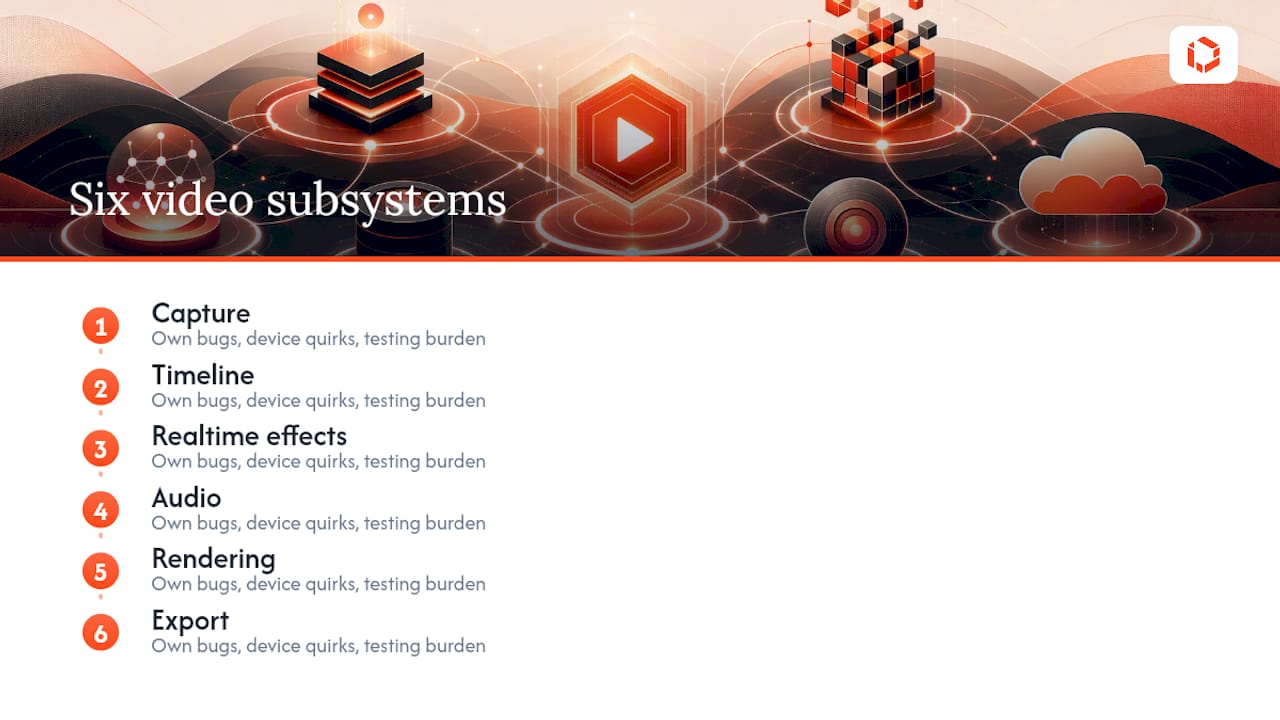
A video-editing SDK vendor such as Banuba is the fastest route when the editor is a supporting feature, not your core differentiator. Licensing an SDK supplies the six subsystems every mobile editor needs (capture, timeline, realtime effects, audio, rendering, and export) as a working component, which can cut integration time from months to weeks.
Approach | Best for | Speed to market | Approx. cost range | Customization | Maintenance & ownership |
|---|---|---|---|---|---|
TouchZen (custom agency) | Founders wanting a senior-led, full-lifecycle partner for a custom video app | Moderate (full build) | Mid to high | Full | Agency handles post-launch support and updates |
Onshore boutique agency | Teams needing tight collaboration, design focus, and easier IP alignment | Moderate | Mid to high | Full | Client owns product; smaller team may limit ongoing capacity |
Offshore/nearshore agency | Teams prioritizing cost and feature breadth under a strict budget | Moderate to slow | Lower | Full | Varies by vendor; requires clear SLA for updates |
Video-editing SDK (e.g. Banuba) | Teams that need a working editor fast and prefer integration over building each subsystem | Fastest | Licensing fee plus integration cost | Limited to SDK's exposed features | Vendor maintains the engine; you maintain the app shell |
The decision triggers are simple. If the editor is your product, meaning users open the app specifically to edit video, custom development protects your differentiation. If editing is a supporting feature bolted onto a larger app (a social platform, a fitness app with highlight reels), licensing an SDK is the pragmatic choice.
How Do You Choose the Right Vendor?
Picking a vendor for a custom video-creation app is a research and negotiation problem more than a design one. A structured evaluation reduces the risk of hiring a team that looks great on a pitch deck and struggles on a mid-tier Android phone six weeks in.
Run the evaluation in four phases:
Discovery. Ask for a one-page brief response: how would they scope your MVP, and what's their first architecture recommendation?
Longlist and RFP. Request a written proposal covering timeline, cost range, and team composition.
Deep evaluation. Review their device testing matrix, CI/CD pipeline, and prior launch metrics.
Contract. Negotiate ownership of code, IP, and post-launch support terms before signing.
Ask these questions during evaluation:
Product: "Walk me through how you'd scope our MVP in the first two weeks."
Engineering: "Do you build the video subsystems from scratch, or integrate a licensed SDK, and why?"
QA: "What does your device testing matrix look like for a mid-tier Android phone released in 2026?"
Support: "What happens to our app three months after launch if we're not paying a monthly retainer?"
Watch for red flags: vague answers about who will actually write the code, no named senior developer, and no real device matrix beyond "we test on our own phones." A reliable selection process requires named senior staff, documented QA coverage, and evidence of prior launches, not just a polished portfolio site.
Pro Tip: Ask every vendor for one specific artifact: a device testing matrix from a prior video-heavy launch. If they can't produce one, that's a strong signal their QA process is improvised, not repeatable.
How TouchZen Approaches Custom Video-Creation Apps
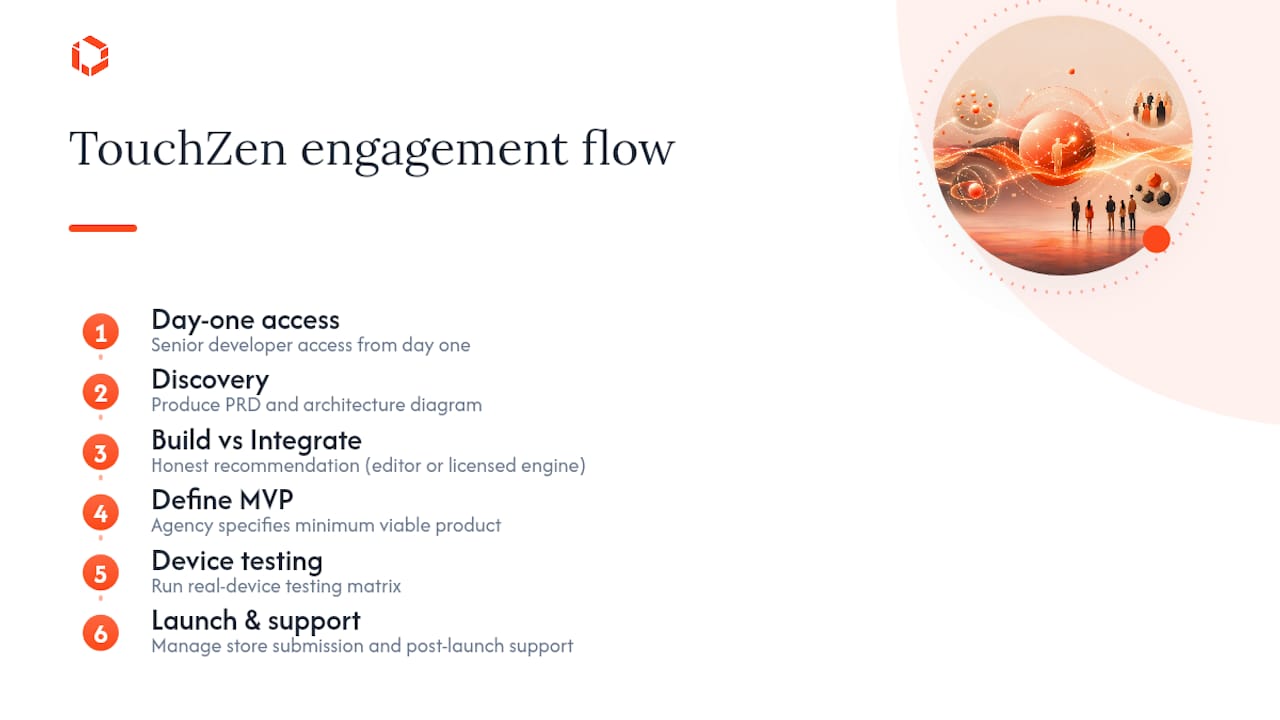
Every engagement starts with senior-developer access from day one, not after a scoping call escalates.
Discovery produces a PRD, an architecture diagram, and an honest recommendation on whether to build the editor or integrate a licensed engine like Banuba, based on whether editing is your product or a feature inside it. From there, we define the MVP, run a real-device testing matrix, and manage store submission and post-launch support as the app evolves.
Founders, Product Leaders: What Actually Predicts Whether a Video App Ships on Time
The industry loves to frame build versus integrate as a philosophical choice about control. It isn't. It's a timeline and staffing decision disguised as one.
Founders who build custom editors when they didn't need to almost always underestimate the six subsystems problem: capture, timeline, realtime effects, audio, rendering, and export each carry their own bugs, their own device quirks, and their own testing burden. Teams can sink four months into rebuilding what a licensed SDK could provide in weeks, purely because "custom" sounds more defensible in a board meeting.
The opposite mistake is just as common. Teams whose video editor is the product license an SDK to move fast, then discover they can't differentiate because every competitor licensed the same engine with the same effects library. If your video features are the reason a customer picks you over a rival, that differentiation has to live somewhere the SDK vendor doesn't control.
The honest test isn't "build or buy." It's asking whether your roadmap two years out depends on features the licensed engine will never expose. If yes, build, and hire a team with senior developers who've shipped video-heavy apps before. If no, integrate, and spend your engineering budget on the parts of the app that actually differentiate you.
Ready to Scope Your Video App? Here's the Next Step
If you're weighing whether to build a custom editor or integrate a licensed engine, the process typically starts with a paid discovery phase, moves into a scoped MVP definition, then delivery, and ongoing support, often with senior developers involved from the first meeting.
You don't need a finished spec to start. Send a one-page brief describing what your video feature needs to do and who it's for, and TouchZen will return a discovery scope covering architecture recommendations, a realistic timeline, and a build-versus-integrate recommendation specific to your product. If your video editor is meant to be a core differentiator rather than a bolted-on feature, that distinction shapes everything else in the proposal. Request a discovery call through TouchZen's mobile app development page and get a scoped answer instead of a guess.
FAQ
How Long Does It Take to Build a Custom Video App?
Simple video apps typically take 2 to 4 months, mid-complexity apps 4 to 8 months, and complex enterprise-grade editors 8 to 18 months, including testing and store review.
Should I Build a Custom Editor or License an SDK Like Banuba?
License an SDK when video editing supports a larger product; build custom when the editor itself is your core differentiator and competitors can't replicate it through the same licensed engine.
What Should I Ask a Video App Development Agency Before Signing?
Ask for named senior developers on your project, a device testing matrix from a prior launch, and a clear QA and CI/CD plan, since these are the strongest predictors of a smooth launch.
Is Flutter or Native Development Better for a Video-Creation App?
Flutter can suit apps that need to ship across iOS and Android efficiently. For video-creation apps, native development is often the better choice when camera, rendering, or platform-specific performance is critical.


