

Joy Foroughi
Executive Assistant


Streaks, Badges or Challenges: Which Gamification Fits Your App
Choose the mechanic that matches the behavior you want. Use streaks when the value of your app comes from frequent, repeated use. Use badges when users work toward milestones over months. Use challenges when you need short bursts of focus, activation or social energy. Most apps do not need all three at launch. They need the one that fits their retention problem, built well enough to test.

Choose the mechanic that matches the behavior you want. Use streaks when the value of your app comes from frequent, repeated use. Use badges when users work toward milestones over months. Use challenges when you need short bursts of focus, activation or social energy. Most apps do not need all three at launch. They need the one that fits their retention problem, built well enough to test.
This guide is for founders and product managers who have to decide what goes into the next sprint. It covers what each mechanic does, the evidence behind it, how to design each one so it feels earned, and how to run a clean test before you scale it.
TL;DR
Streaks build daily or weekly habits, badges recognize milestones and mastery, and challenges create short-term urgency.
Pick the mechanic from your retention data: find the 3 to 5 actions that separate retained users from churned ones, then reward those.
Design for forgiveness: streaks need grace periods, badges need meaning, and challenges need achievable goals.
Gamification is not a guaranteed win. Some randomized trials found added game features did not improve retention, so test against a control group.
Fix onboarding and stability first. Gamification amplifies a good core experience and cannot rescue a weak one.
What streaks, badges and challenges actually are
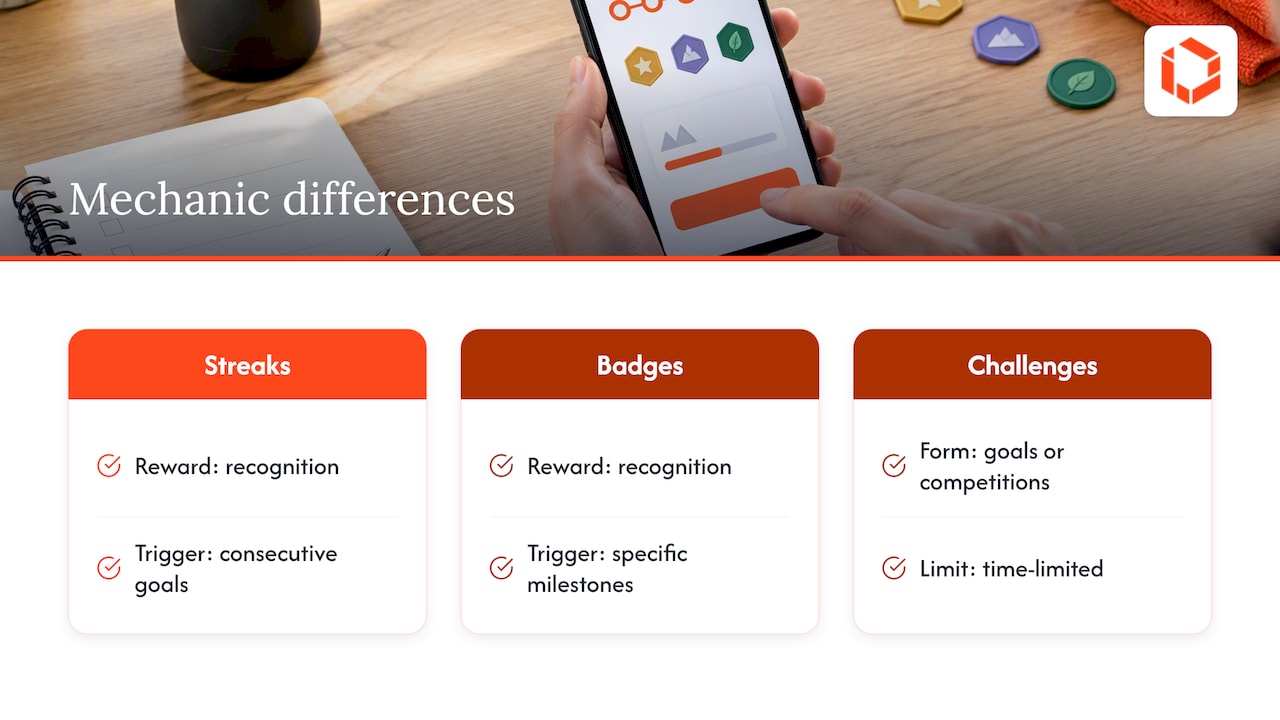
The three terms get mixed together, but they reward different things. A review of popular health and fitness apps describes streaks as recognition for consecutive goal achievement, badges as recognition for completing specific milestones, and challenges as time-limited goals or competitions.
Streaks: reward consistency
A streak counts consecutive days (or weeks) in which the user completes a target action. Miss a day and the counter resets. That reset is the engine: streaks work through loss aversion, because users do not want to lose progress they have built. Research on consumer behavior defines a streak as a behavior performed three or more times in a row.
Badges: reward achievement
Badges are visual markers for specific, often cumulative accomplishments. They reinforce mastery and recognize effort. A design review in mHealth separates absolute badges, based on fixed benchmarks, from relative badges that depend on how a user performs against peers. A badge for finishing your first workout is absolute. A badge for being in the top 10% this week is relative.
Challenges: reward focus
Challenges are time-boxed goals, either solo or against other people. They create a deadline and a finish line, which is why they suit launches, seasonal pushes and re-engagement campaigns. The same mHealth review notes that challenges and quests can motivate continued use, help users understand the app's goals, and feed other mechanics when they are nested inside badges, tied to points or used for leaderboard ranking.
How the three compare at a glance
Streaks | Badges | Challenges | |
|---|---|---|---|
Best for | Daily or weekly habits | Milestones, mastery, long-term products | Short-term focus, activation, competition |
Psychological lever | Loss aversion, consistency | Recognition, collection, progress | Deadlines, social proof, competition |
Main risk | A broken streak can demotivate | Feels patronizing or meaningless | Fatigue if they run constantly |
Build effort | Low to medium (needs time zones, grace logic) | Low to medium (needs art and rule definitions) | Medium to high (needs scheduling, content, rewards) |
Time horizon | Ongoing | Cumulative | Days to weeks |
The guidance lines up across sources. One 2026 guide matches streaks to daily or weekly habits, badges to milestones and challenges to short-term urgency. Another guide on gamification in apps recommends streaks when users should use a product regularly, badges for achievements in long-term products, and challenges for habit-building, activation or competition.
A decision framework: start from behavior, not features
Founders often start with "we should add streaks." Start instead with a question: what do retained users do that churned users do not?
Find the differentiating actions. Identify the 3 to 5 actions that most separate retained users from churned users. These become candidates for your gamification targets. An association with retention does not prove that rewarding an action will improve retention; test that assumption.
Check the natural frequency. Does a healthy user need your app daily, weekly or occasionally? A meditation or language app has a daily rhythm. A tax or travel app does not.
Match the mechanic. Daily or weekly rhythm points to streaks. A long path with distinct stages points to badges. A need for a quick activation spike or a seasonal moment points to challenges.
Decide solo or social. Keep it individual unless community is already part of the product (more on this below).
Define the test before you build. Pick the primary metric and the guardrails.
Pro Tip: If you cannot name the behavior you want to increase in one sentence, you are not ready to pick a mechanic. "Users complete a lesson on 4 of 7 days" is a target. "More engagement" is not.
Quick scenarios
A habit app (fitness, language, journaling): Lead with streaks that fit the activity’s natural rhythm, supported by milestone badges. For fitness, use weekly consistency targets that allow rest days rather than requiring daily workouts.
A marketplace or fintech app with infrequent use: A daily streak will feel forced. Use milestone badges for meaningful firsts and short challenges for activation.
A new app with a thin user base: Start with solo challenges. Competitive features need enough people to feel alive.
A learning or professional tool with a long path: Badges tied to real mastery, with an occasional challenge to pull lapsed users back.
What do the popular apps actually use? In a study of the top 50 free health and fitness apps in Apple's App Store in August 2017, challenges appeared in 20 of 32 gamified apps (62.5%), badges in 6 (18.8%) and streaks in 3 (9.4%). That is a snapshot of one category and one moment, and it says what apps used, not what worked best. Streaks were rare then, so treat that figure as history, not as a benchmark to copy.
Designing streaks that motivate instead of punish
The mechanic is simple. The design is where it succeeds or fails.
Why streaks help. Across seven studies, researchers found that highlighting an intact logged streak increased subsequent engagement compared with highlighting a broken one. They also argue that users treat maintaining a logged streak as a meaningful goal in itself, not just evidence of past activity. Visibility matters: a streak the user cannot see is not a streak.
Why they backfire. The same RevenueCat guide warns that broken streaks can demotivate users. A user who loses a 40-day streak on a sick day may not come back at all.
Design rules we recommend:
Set milestones. One framework suggests marking 3, 7, 14, 30, 60 and 90 days, so early wins arrive fast and long-term goals stay visible.
Build in forgiveness. The same framework allows one grace period per 7-day window so a single miss does not erase everything.
Make the qualifying action meaningful. Opening the app is not a habit. Completing a planned workout, a lesson or a logged entry can be. In fitness apps, count progress toward an appropriate weekly training target and allow planned rest days.
Handle time zones and travel. Nothing erodes trust faster than a streak lost to a server clock.
Show the streak at the right moment. Surface it after the action is complete, and give a gentle reminder before the day ends.
The rule on meaningful action deserves emphasis. Product teams who have tried it report the same lesson: tie rewards to actual completion, not to app opens. If the reward can be earned without delivering value, you are training users to game the system.
Making badges feel earned
Badges are the cheapest mechanic to ship and the easiest to get wrong. A badge nobody cares about is clutter.
The mHealth design review argues that badges should be meaningful, anticipated, non-patronizing and aligned with the application's goals. It also cautions that badges alone may not sustain behavior and should be combined with reinforcing mechanics, such as a streak or a challenge.
In practice:
Tie every badge to a real accomplishment. "Completed your first budget review" beats "Opened the app 5 times."
Show the next badge. Anticipation does the motivating. Let users see what is coming and how far away it is.
Mix absolute and relative badges carefully. Absolute badges feel fair to everyone. Relative badges can motivate competitive users and discourage everyone else.
Keep the count small at first. Eight good badges outperform forty forgettable ones. Add more once you see which ones users chase.
Make them shareable only if sharing is natural. A badge for a marathon distance is worth posting. A badge for changing your password is not.
The peak-end rule gives a useful design lens: research on casual games suggests that players judge an experience by its peak and its final moments. Place your best celebration at the moment a user finishes something hard, and end sessions on a win instead of a blank screen.
Building challenges people finish
Challenges demand the most from your team, because they need a defined start, end, goal and reward. They also have the strongest evidence for strong effects when stakes are clear.
In a naturalistic evaluation of StepBet, a step-count challenge, the challenge success rate was 73%, with average daily step counts increasing by 31.2% overall and by 44% among successful participants. The challenges involved financial deposits, and the study was observational: participation was associated with increased activity, but it does not establish that the challenge caused the increase. Do not assume the same results from free challenges or badges.
When to keep challenges solo
Solo challenges suit personal growth at an individual pace. They work well for new users and for apps where comparison would feel uncomfortable, such as mental health, finance or recovery.
When to add community
Community or team challenges add social accountability and can drive acquisition through social proof. Leaderboards were among the most frequently used features in one physical activity app, which shows people will use them. But leaderboards reward the top of the list and can discourage everyone below it.
If you want social challenges to also bring in new users, the loop between invitation and reward matters. These app referral program ideas show how sharing mechanics can connect to installs.
Pro Tip: Before you launch a competitive challenge, ask whether you have enough active users for it to feel alive. A leaderboard with 12 people looks abandoned. A team challenge with friends invited from the user's own contacts looks personal.
Keep challenges achievable
Set a goal most engaged users can reach. If only 5% can finish, you have built a discouragement machine.
Run them on a rhythm, not constantly. Challenge fatigue is real, and a permanent challenge is just a task list.
Always tell users what happens at the end: a badge, a new level, a streak bonus. This is where mechanics reinforce each other.
Our perspective: gamification is a retention lever, not a rescue plan
We have launched over 75 apps across industries, and the pattern repeats. Founders ask for gamification when retention drops, and often the real problem sits earlier: a confusing first session, a slow screen, an onboarding flow that never gets users to the value of the product. Streaks on top of that just count how many people leave.
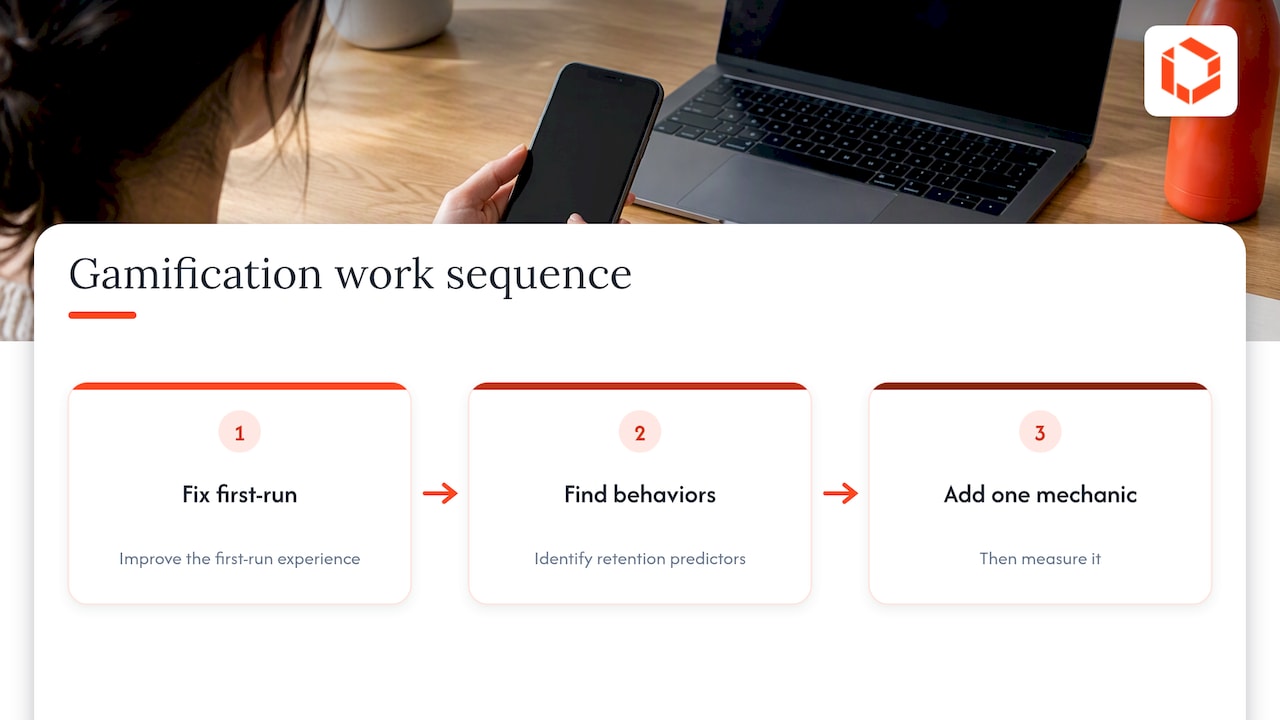
Our advice is to sequence the work. First fix the first-run experience, then identify the behaviors that predict retention, then add one mechanic and measure it. A senior designer and a senior engineer in the same conversation make this faster, because the question "what should we reward?" is a product question and the question "can we track that reliably?" is a technical one. When those two answers come from different people on different weeks, scope creep and decision latency follow. When they come from the same room, you ship a mechanic that works and is measurable.
The research supports caution. In a 2017 systematic review of 15 experimental studies, 12 reported significantly positive engagement effects. That is encouraging, but it also means some did not. Treat gamification as a hypothesis you test, not a feature you assume.
— Cyrus
When gamification does not work
Honest planning includes the failure cases.
Fun without outcomes. In a 2020 randomized trial of a smoking-cessation app, adding a game and virtual currency increased time spent in the app but produced no significant difference in engagement, retention or smoking outcomes. Users enjoyed the extras, but the extras did not change the result.
A weak foundation. A 2021 study on a tailored exergame found engagement with missions remained low, suggesting that app stability and variety have to be in place before gamification can drive behavior.
Too much to process. A 2023 review reported that reduced cognitive load came up in interviews as an important factor for engagement. Stacking points, streaks, badges, levels and leaderboards on one screen works against that.
Rewarding the wrong thing. If the reward can be earned without the underlying behavior, users will take the shortcut.
There is positive evidence too. A 2020 trial of eQuoo, a mental health app combining storytelling and gamification, retained 21% more participants than control groups. Gamification tied to a clear purpose can reduce attrition.
For a broader view of the tactics, see our guide to research backed mobile app gamification tactics. If the bigger issue is early drop-off, start with why users abandon apps during onboarding.
How to test a mechanic before you scale it
A simple experiment design is enough to learn most of what you need:
Write a hypothesis. Example: "Showing a 7-day streak counter after the first completed lesson will increase 7-day retention."
Choose a primary metric and plan the sample size. One experiment guide uses 7-day retention as the primary metric and adds revenue and ad-watch rate as guardrail metrics, so a win in one place does not hide a loss in another. Choose guardrails relevant to your app. Use your baseline retention and the smallest improvement worth acting on to estimate how many users the test needs.
Split users into control and treatment. The control group gets the app without the mechanic. For gamified challenges, one guide recommends measuring feature adoption, trial-to-paid conversion and engagement lift against a non-gamified control group.
Set the stopping rule before launch. Define the required sample size, minimum duration and analysis plan in advance. If your metric is day 7, wait for day 7 to pass for your last enrolled user. Reaching that window alone does not make the result reliable; you also need enough participants. Avoid ending the test early just because an interim result looks positive.
Read the result honestly and follow up. More time in the app is not the same as better retention or better outcomes, as the Quittr trial showed. Check uncertainty around the result and follow users over a longer period, such as day 30 or a full challenge cycle, to see whether any benefit persists after the novelty fades.
You need analytics events in place before any of this works. Our comparison of Firebase Analytics and Mixpanel for retention and our primer on mobile app analytics explain what to instrument. For the wider picture, read how to improve app user retention.
Build it with a senior team
If you are planning gamification for a new product, the cheapest time to design it is during product strategy and UX, not after launch. At TouchZen, senior designers and developers work directly with you from market research and MVP definition through UX/UI design, native and cross-platform engineering, launch and ongoing support and growth. That continuity matters here, because a mechanic is tuned over several releases, not shipped once. If you want to talk through which mechanic fits your app, start at touchzen.ai.

FAQ
Should a new app launch with streaks, badges and challenges together?
Usually not. Launch with the single mechanic that matches your most important retention behavior, measure it, then add a second one that reinforces it. A streak with milestone badges is a natural pairing, and a challenge can follow once you have enough active users.
Are streaks bad for users?
They can be if they are rigid. Broken streaks can demotivate people, so build in a grace period and celebrate milestones. Be especially careful in health, finance and mental wellbeing apps, where missing a day is normal and should not feel like failure.
How many badges should an app have?
Start small, with badges tied to real milestones that match your app's goals. Watch which ones users pursue and add more later. A badge that feels patronizing or arbitrary does more harm than having none.
How do I know if gamification is working?
Run a controlled test with a clear hypothesis, a primary metric such as 7-day retention and guardrail metrics. Compare the group that sees the mechanic with a control group that does not. Look at retention and outcomes, not only time spent in the app.
Sources
Gamification Use and Design in Popular Health and Fitness Applications
A game plan: Gamification design principles in mHealth applications
On or Off Track: How (Broken) Streaks Affect Consumer Engagement
Put your money where your feet are: The real-world effects of StepBet
Effects of a Mobile App Called Quittr, Which Utilizes Gamification
Potential associations between behavior change and cognitive load, Frontiers in Psychology
Gamification as an approach to improve resilience and well-being (eQuoo)
Does gamification increase engagement with online programs? A systematic review


