

Joy Foroughi
Executive Assistant


Bootstrapping an App Startup: When to Self-Fund or Raise
Self-fund your app until you have evidence that people want it, then raise only if growth is limited by cash rather than by product. Before product-market fit, outside money mostly buys you pressure to hire and spend. After it, capital can buy speed in a market you have already proven. The hard part is telling which side of that line you are on, and this guide gives you concrete tests for it.

Self-fund your app until you have evidence that people want it, then raise only if growth is limited by cash rather than by product. Before product-market fit, outside money mostly buys you pressure to hire and spend. After it, capital can buy speed in a market you have already proven. The hard part is telling which side of that line you are on, and this guide gives you concrete tests for it.
TL;DR
Bootstrapping is the norm, not the exception. The SBA reports that roughly 80% of employer businesses and 76% of non-employers start with personal savings.
Running out of money is usually a symptom. CB Insights found poor product-market fit (43%), bad timing (29%) and unsustainable unit economics (19%) behind the dry-up.
Raise when customers are pulling the product out of your hands and cash is the bottleneck. Self-fund while you are still learning what to build.
Whichever path you choose, spend the first dollars on validation and a lean MVP, not on an office, a big team or branding.
What bootstrapping an app actually means
Bootstrapping means funding the company from personal savings, early revenue and sweat equity instead of selling equity to investors. It is still capital. It is just capital that comes with no board seat, no pro rata rights and no deadline except your own bank balance.
For an app startup this has a specific shape. Your largest early costs are not servers or ads. They are product strategy, UX/UI design and engineering time. That is why the funding question and the build question are the same question: how much product do you need to ship to learn something real, and who pays for it?
The numbers behind both paths
Most founders overestimate how common venture funding is and underestimate how common bootstrapping is. A few anchor facts:
Question | What the data says | Source |
|---|---|---|
How do most businesses start? | About 80% of employer businesses and 76% of non-employers use personal savings | |
What size is a typical start? | Most businesses start with under $50,000, while 12% use over $250,000 | |
Do startups mostly fail? | About 80% of new employer businesses survive year one and 51% reach year five. The "90% fail" line is a myth | |
What does a seed round cost? | A priced seed raised a median $4.1M and cost founders about 18% of the company, per Carta data | |
Does money prevent failure? | Failed companies in one analysis raised a median $11M before closing |
Two lessons. First, self-funding is a mainstream, survivable choice. Second, money is not the cure. A funded company with no product-market fit simply fails later and more expensively.
Separate funding gaps from product problems
A cash shortage can reflect weak demand, high costs, slow customer payments or a difficult fundraising environment. It does not, by itself, tell you whether the product is working. Before seeking more capital, identify what is driving the shortfall and which changes could address it.
Ask what the next funding milestone needs to prove: demand, retention, willingness to pay or the ability to serve more customers. A focused MVP or a pre-build test can help answer those questions before you commit to a larger budget. If you want a structured way to do that, our guide to validating your app idea in 30 days walks through it, and the companion piece on validating before writing a single line of code covers the pre-build tests.
When to self-fund
Bootstrapping is usually the right call when most of these are true:
You have not found product-market fit. Y Combinator warns that raising money before this point can be a liability, because it pushes you to scale hiring and overhead before you know what customers want.
Your MVP is cheap to build and test. If a focused first version answers your riskiest question, you do not need a large round to find out.
You can reach revenue early. Subscriptions, paid pilots or a B2B contract can fund the next iteration directly.
You value control. Equity investment is a trade: ownership and control in exchange for the chance to scale fast.
Your market does not require a land grab. If there is no winner-take-all dynamic, slower growth is a cost you can afford.
The discipline here is staying small on purpose. Y Combinator's Michael Seibel advises keeping burn low until usage is explosive, and treating the business as a focused team rather than a growing corporation. The same YC material describes the pre-fit startup as a small special-forces unit, not a battalion.
Pro Tip: Write down the one assumption that would kill your app if it were false. Fund only the work that tests that assumption. Everything else, including polish, extra platforms and secondary features, waits.
What a lean bootstrapped build looks like
A bootstrapped app budget should buy learning per dollar. In practice that means:
A written MVP definition with a hard cut line, so scope creep cannot quietly double the bill.
One platform or one cross-platform codebase first, chosen by where your first users actually are.
Senior people making the early decisions. Rework from a wrong architecture or a confused design is the most expensive line item a bootstrapper can incur.
Analytics from day one, so you can see retention rather than guess at it.
If you are weighing a custom build against off-the-shelf tools at this stage, our breakdown of building an app versus buying SaaS lays out how leaders decide.
When to raise investment
Raising makes sense when capital converts into growth you have already demonstrated. Typical signals:
Pull from the market. Y Combinator describes product-market fit in terms of strong demand from loyal customers. Look for repeat usage, paying customers and demand that stretches your current capacity.
Sustained growth. Track growth over a meaningful period alongside retention and revenue. There is no single weekly growth threshold that proves every app is ready for investment.
Retention that holds. Users continue to find value after their first session or subscription period.
A bottleneck money can fix. Support capacity, a sales channel you have tested, or engineering work tied to demonstrated customer needs.
A time-sensitive opportunity. Faster execution may matter when distribution, partnerships or network effects create an advantage. Explain how investment would help capture that opportunity.
For a growth round, connect the amount you seek to a measurable capacity constraint or opportunity. Earlier funding may instead support validation or an initial build; in that case, define the evidence the investment is intended to produce.
Some founders at this stage also consider buying revenue instead of building it. If that is on your mind, how financing a SaaS acquisition works in real numbers shows what the capital structure looks like on that route.
What investors will want to see
The SBA notes that investors want confidence they will see a return, and that your business plan is the tool for that. The evidence expected depends on the funding stage and business model. For an app, prepare:
Evidence appropriate to your stage: customer research, a prototype or paid pilot for an early raise; live usage and revenue where available.
Retention and engagement cohorts once you have enough usage history to make them meaningful.
Unit economics where measurable, with assumptions clearly separated from observed acquisition costs and customer value.
A plan for using the money, including the milestone it should fund and the runway required to reach it.
Our guide to raising funds for your app goes deeper on the routes and the pitch.
The funding cliff: the risk of raising too early
Y Combinator's advice on spending before product-market fit highlights a risk: increasing headcount and overhead before demand is established can weaken your position in the next round. Michael Seibel recommends getting lean when you have 12 to 15 months of runway without retention and growth, and spending more time understanding customers. Treat that as a prompt to review spending and milestones, rather than a universal deadline for every startup.
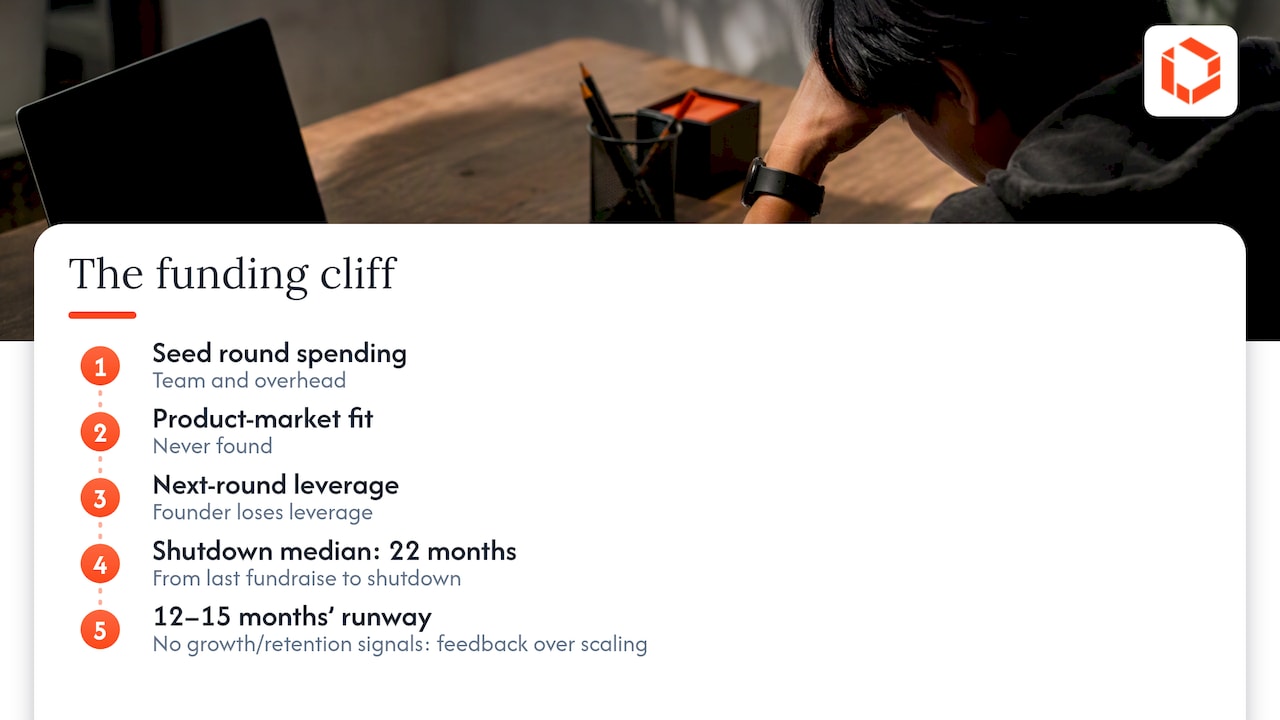
Early investment can fund experiments, but recurring costs reduce how many attempts you can afford. Keep spending tied to the evidence you need before the next funding decision.
A decision framework you can use this week
Score yourself honestly on each line.
Signal | Lean toward self-funding | Lean toward raising |
|---|---|---|
Product-market fit | Still testing | Usage pulling ahead of capacity |
Weekly growth | Flat or erratic | Steady, strong, compounding |
Retention | Unknown or weak | Stable cohorts |
Cost to reach next milestone | Fits in savings plus early revenue | Exceeds what you can fund |
Market dynamics | Room to grow slowly | Time-sensitive, competitive |
Founder goals | Control, profitability | Scale, large outcome |
Use the table to identify the strongest reasons for each path, rather than treating it as a vote. Personal financial limits, the cost of the next milestone and the opportunity itself may outweigh the other signals. If you decide to raise, leave time for fundraising before cash becomes urgent.
Calculate runway and set a personal funding limit
For a business spending more cash than it receives:
Runway in months = available business cash ÷ monthly net cash burn
Monthly net cash burn is cash paid out minus cash received. As a hypothetical example, $60,000 in available business cash and $10,000 in monthly net cash burn gives you six months of runway, assuming spending and receipts stay unchanged. Recalculate when hiring, revenue or one-time expenses change; keep a separate cash forecast for uneven payments.
Before adding personal savings, set a maximum contribution and a review date. Keep essential living costs and your personal emergency reserve outside the app budget. If the next milestone exceeds that limit, reduce scope, seek another funding source or pause before committing more savings.
A hybrid path: bootstrap first, raise later
The choice can change as the business develops. Self-funding an MVP can give you usage and revenue evidence for a later raise, although investment terms will still depend on the company and market.
Here is how to run it:
Define the MVP tightly and build it with a senior team so the first version is built to last, not thrown away.
Launch to a small, real audience and measure activation, retention and willingness to pay.
Set a trigger in advance. For example: "If weekly active users grow steadily for eight weeks and retention holds, we start a raise." Writing it down prevents wishful thinking.
Keep overhead flat until the trigger fires.
Match the raise to your next milestone, whether that is further validation or expanding a product with demonstrated demand.
Where to spend when cash is tight
When you are bootstrapping, the order of spending matters more than the total. A sensible sequence:
Research and competitive analysis: cheap, and it can save months of building the wrong thing.
UX/UI design and prototype: test with users before engineering begins.
MVP engineering: only what the cut line allows.
Launch and go-to-market: targeted, measured, not a broad burn.
Support and iteration: where retention is won.
Marketing deserves a note. Paid ads before retention is proven mostly rent attention that leaves. Fix the product loop first, then amplify it.
Perspective: why the team you hire shapes the funding decision
We have launched more than 75 apps across industries. For founders managing a limited budget, a clear scope and direct communication help keep product decisions tied to the next milestone. Agreeing on priorities, documenting tradeoffs and reviewing working software regularly can reduce avoidable rework.

Founders work directly with our senior developers and designers from kickoff to launch. That gives them a way to discuss scope, technical tradeoffs and changes with the people doing the work. The aim is to put each budget decision in the context of what the first release needs to demonstrate.
Choose a funding path that fits your next milestone, your financial limits and the evidence you have today. Revisit it as those conditions change.
— Cyrus
How we can help you get to the evidence faster
If you are deciding between self-funding and raising, the most useful thing to have in hand is a launched, measurable product. Our MVP development for startups service covers market research, competitive analysis, UX/UI design, prototyping, MVP definition, engineering for iOS, Android, Flutter or React Native, and launch, handled by a senior team you speak with directly. If you are earlier than that, product strategy and consulting helps you decide what to build first. After launch, ongoing support and growth keeps the product evolving as your data comes in.

FAQ
What is the biggest disadvantage of bootstrapping an app?
Speed. With limited cash you hire less, ship fewer features and market more slowly, which hurts in races where the first mover takes the market. You also carry personal financial risk. The tradeoff is that you keep ownership and control.
At what stage should an app startup raise funding?
After you have evidence of product-market fit or strong market adoption, such as steady fast growth and users pulling the product faster than you can supply it. Before that, outside money tends to push premature hiring and overhead. Raise when capital will scale something proven.
Is it true that 90% of startups fail?
No. The figure is a popular myth. Forbes Advisor, citing Bureau of Labor Statistics data, puts first-year survival of new employer businesses near 80% and five-year survival near 51%. Failure is common, but not that common.
Can I bootstrap the MVP and raise afterward?
Yes, and it is a common sequence. Self-funding a lean MVP gives you real usage data, which strengthens your position with investors and can reduce the equity you give up. Decide your raise trigger in advance so you act on data, not impatience.


