

Joy Foroughi
Executive Assistant


How to Hire an App Developer: A Non-Technical Founder's Guide
You can hire a strong app developer without writing or reading a line of code. What you need is a clear definition of the problem, the right type of partner for your stage, a way to check real shipped work, and a contract that clearly defines ownership, scope, payment terms and responsibilities. This guide walks through each step in order, with the questions to ask and the red flags that cost founders the most.

You can hire a strong app developer without writing or reading a line of code. What you need is a clear definition of the problem, the right type of partner for your stage, a way to check real shipped work, and a contract that clearly defines ownership, scope, payment terms and responsibilities. This guide walks through each step in order, with the questions to ask and the red flags that cost founders the most.
TL;DR
Define the user, the problem and the first version before you talk to any developer. Vague briefs produce vague quotes.
Choose your model on purpose: employee, freelancer, dedicated team or agency each carry different responsibilities and risks.
Judge developers by live apps, reference calls and how they explain trade-offs in plain English, not by how technical they sound.
Put code and design ownership, milestones, acceptance criteria and access to your accounts in writing before work starts.
Plan for life after launch. An app that ships without a maintenance plan starts decaying the next week.
Start with the problem, not the tech stack
Most failed hiring conversations begin with a founder describing features. Strong ones begin with a person, a problem and a measurable outcome. Before you contact anyone, write a one-page brief that answers five things:
Who is the user, and where do they currently solve this problem?
What is the one job the first version must do well?
What will you measure in the first 90 days (signups, activation, paid conversions)?
What are the alternatives, and what do customers pay for them today?
What data will the app touch, and how sensitive is it?
The U.S. Small Business Administration says market research should assess demand, market size, customer location, saturation and what customers pay for alternatives. Its startup guidance also recommends defining the problem and target market, then testing a smaller prototype with real customers before committing fully. If you have not done that yet, our guides on validating your mobile app idea before development and on deciding in 30 days are the right first stop.
The SBA also suggests that a plan shared with outsiders describe products and benefits, a roadmap with concrete dates, the relevant technology and any intellectual property. That is almost exactly the brief a developer needs.
Write the first version as a short list of must-haves
Separate what the app must do on day one from what would be nice later. A useful test: if you removed this feature, would your first 100 users still get value? If yes, it goes on the later list. This is how you protect yourself from scope creep, the slow growth of requirements that turns a ten-week build into a six-month one.
Flag sensitive data early
If your app collects health, financial, location or children's data, say so in the first conversation. The FTC's guidance for developers is risk-based: security should reflect the sensitivity and amount of data the app handles. It advises developers to identify what they collect, protect credentials and avoid storing passwords in plain text. A developer who never asks about your data is a developer who has not thought about it.
Choose how you will hire
The model matters as much as the person. Each option solves a different problem.
Option | Best for | Main risk | What you manage |
|---|---|---|---|
Full-time employee | Long-term product building after you have traction | High fixed cost, slow to hire | Everything: priorities, reviews, careers |
Freelancer | A small, bounded task or a prototype | Availability and single point of failure | Scope, quality checks, handoffs |
Dedicated team or staff augmentation | Founders who already have direction and need capacity | Needs a clear product owner on your side | Priorities and acceptance |
Product agency | A first build from concept to launch | Unclear staffing, responsibilities or scope | Decisions and approvals |
A few points are worth knowing before you choose.
Cost of an employee. The U.S. Bureau of Labor Statistics reports a median annual wage of $135,980 for software developers in May 2025. That figure is wages only, before benefits, equipment and recruiting time, and it is a median across all software developers, not a quote for a senior mobile specialist. For founders with limited funding or a short initial build, a full-time hire may be difficult to justify.
Contractor status is not a label you pick. If you hire an individual as a contractor but direct how, when and where they work, the IRS may see an employee. Its Publication 1779 explains that classification rests on behavioral control, financial control and the relationship of the parties, with no single factor deciding. Ask your attorney or accountant before you set up a long-term individual contractor arrangement.
Core product roles. When outsourcing core product development, keep product decisions, account ownership and access to documentation within your company. If you do need ongoing capacity, we compare the trade-offs in full-time employees vs. staff augmentation and explain what to expect from a dedicated app development team. For a first build, our breakdown of an agency vs. freelancers for an MVP covers the decision in detail.
How to evaluate a developer without reading code
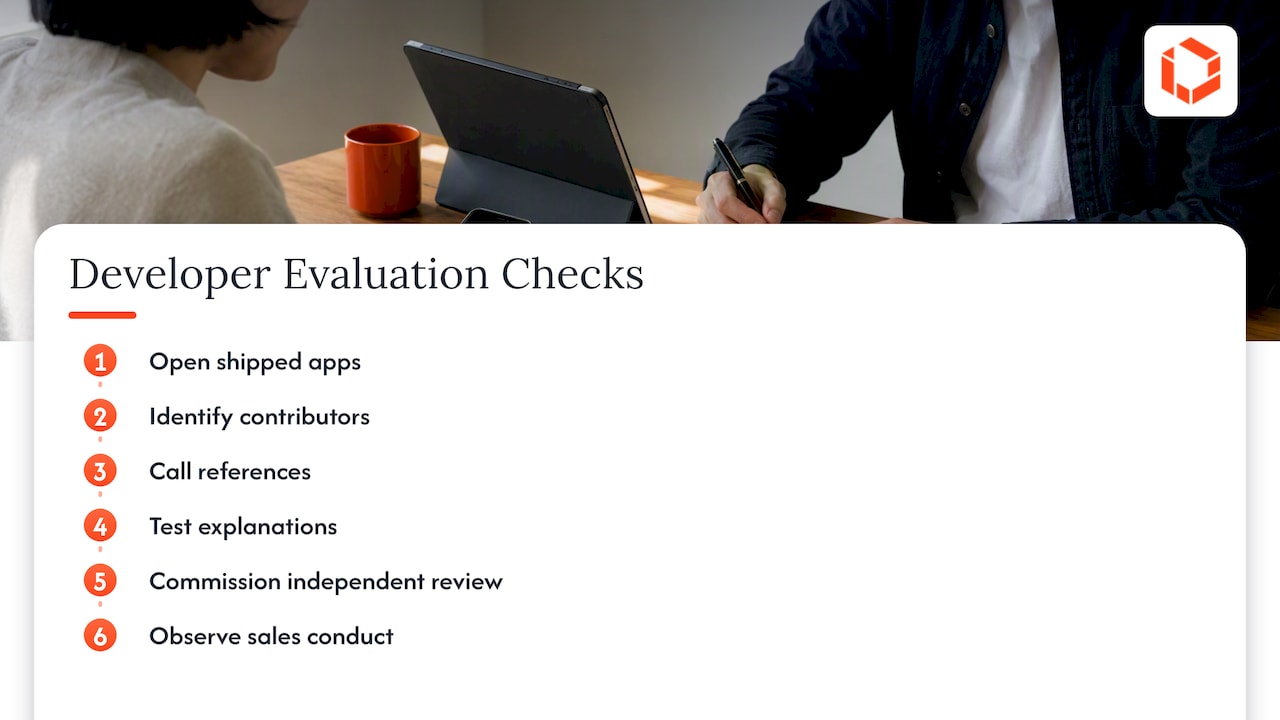
You cannot judge syntax, but you can judge evidence. Use these checks in order.
1. Open the apps, not the case studies
Ask for App Store and Google Play links to apps the team built. Download them. Use them for ten minutes. Check whether they feel fast, whether the onboarding makes sense, how recent the updates are and what the reviews say about crashes or bugs. Mockups and "confidential client" slides prove very little. Industry fit helps too: a team that has shipped in your category already knows its usual traps, such as payment flows, permissions or regulated data.
2. Find out who actually did the work
Ask who designed and who engineered each app in the portfolio, and whether those people will work on yours. Confirm who will work on your project, what their responsibilities are and how any staffing changes will be handled. Ask to meet the exact people who will be on your project before you sign.
3. Call two or three references
Speak with past clients, preferably founders at your stage. Ask what went wrong and how it was handled, whether deadlines held, how change requests were priced and whether they would hire the team again. A team that cannot produce references willing to take a call is telling you something.
4. Test how they explain things
Give them a real decision, such as native iOS and Android versus a cross-platform framework like Flutter or React Native. A good developer explains the trade-offs in your terms (cost, speed, performance, hiring later) and recommends one with reasons. A weak one answers with jargon or says whatever sounds easiest to sell.
5. Ask for an independent review
For larger projects, pay an independent senior engineer or fractional CTO for a few hours to review the proposal, technical plan or a code sample the developer is authorized to share. It is inexpensive compared with a failed build, and it gives you a technical opinion that has no stake in the deal.
6. Watch the sales process itself
How fast do they reply? Do they challenge your assumptions or just agree? Do they ask about users and metrics, or only features? The way a team treats you before you sign is a preview of the way it will treat you in week six.
Questions to ask when you interview app developers
Group your questions so each tells you something specific.
Process and communication
Who will I speak with day to day, and how often do we meet?
How do you handle a decision that is blocked on me?
What do I see at the end of each sprint or milestone?
Scope and estimates
Can you break the estimate into design, engineering, testing and launch?
What would you cut to launch sooner?
How do you price a change request mid-project?
Quality and security
How do you test before release, and on which devices and OS versions?
How do you handle user data and credentials?
What happens when an App Store review rejects the build?
Ownership and exit
Who owns the code, designs and accounts at the end?
Will you document the code so another team could take over?
What are the terms if we part ways mid-project?
We have published longer lists you can use in an interview: questions to ask before hiring an app developer, seven contract-ready outsourcing questions and, if you are hiring for an iOS role specifically, iOS developer interview questions for founders.
What affects app development costs
No honest developer can quote a serious app from a one-line description. Price moves with a handful of variables:
Platforms: iOS only, Android only, or both, and whether you build natively or cross-platform.
Design depth: a polished custom interface and prototype take more time than standard components.
Backend and integrations: accounts, payments, messaging, maps and third-party APIs add work.
Data sensitivity: more protection and compliance work for health or financial data.
Team seniority and location: senior people cost more per hour and often finish faster with fewer rewrites.
Post-launch support: updates for new OS versions, bug fixes and analytics work continue after launch.
Compare proposals on what is included, not only on the total. A lower quote may exclude design, testing, deployment or post-launch support. Compare the deliverables, assumptions and exclusions in each proposal. Our app development cost breakdown lays out how those pieces add up for startups.
Pro Tip: Ask every bidder to price the same must-have list from your brief. If you give each one a different scope, you are comparing stories, not prices.
Protect yourself in the contract
The contract is where non-technical founders are most exposed, so slow down here. At minimum, it should cover:
Ownership and licensing. Define who owns the custom code and designs created for your project. Identify any pre-existing tools, third-party components and licensed assets, and document your company's rights to use them. This matters legally: the U.S. Copyright Office explains that works made for hire cover employees' in-scope work and certain commissioned works, and that ownership can also be transferred by contract, such as an assignment. Do not assume a contractor's work is yours by default. Have an attorney write the assignment clause. We outline the key clauses in 5 protections to lock IP in app development contracts.
Milestones with acceptance criteria. Each payment should be tied to a deliverable you can test, described in plain terms (for example, "a user can sign up, verify an email and reach the home screen on iOS 17 and later").
Accounts in your name. Enroll in the Apple Developer Program as your organization rather than letting a vendor publish under theirs, and do the same for Google Play, your cloud hosting and your analytics.
Access to the repository. You should have admin access to the code repository from day one, not a zip file at the end.
Change and exit terms. Define how scope changes are priced and what handover looks like if the relationship ends.
Warranty and support. A bug-fix period after launch and clear terms for ongoing maintenance.
Red flags that should slow you down
A fixed price quoted within a day, with no questions about users or goals.
Reluctance to show live apps or connect you with references.
Different people appear after the contract is signed.
No written scope, or a scope that says "as discussed."
Pressure to pay a large share upfront.
No mention of testing, security or post-launch support.
Refusal to put code ownership in the contract.
Our perspective: communication is the lever
We have shipped more than 75 apps, and the pattern is consistent. Even skilled teams can struggle when decisions are delayed, requirements are misunderstood or responsibilities are unclear.
That is why we put senior developers and designers directly in front of our clients from kickoff to launch. Fewer handoffs mean faster decisions, fewer misread requirements and faster timelines. As a non-technical founder, your best protection is not technical knowledge. It is direct access to the people doing the work, a short feedback loop and a written scope you can hold everyone to.
If a team will not let you talk to the people who will build your product, ask yourself why.
How TouchZen can help
If you want a senior team that covers the whole path, we handle complete design and development for startups, from research and prototyping to launch. Founders who need a lean first release can start with MVP development, and those still shaping the idea can work with us on product strategy and consulting. We also offer ongoing support and growth so the app keeps improving after launch.
Plan for life after launch
Launch is the start of the real feedback loop. Plan and budget for:
Bug fixes and OS updates: Apple and Google release new operating system versions every year, and your app must keep up.
Analytics and iteration: decide which two or three metrics decide your next sprint.
Security upkeep: the FTC's guidance treats security as an ongoing practice, not a one-time task.
Support capacity: who answers users and who triages bugs?
Knowledge transfer: keep documentation current so you can change teams if you must.
Ask each candidate what their post-launch arrangement looks like, and get it in writing before you sign the build contract.

FAQ
How do I hire an app developer if I am not technical?
Start with a one-page brief covering your user, problem and must-have features. Then pick a hiring model that fits your stage, check live apps and references, and interview with questions about process, ownership and support. Get milestones and code ownership in writing before any work begins.
Should I hire a freelancer or an agency?
A freelancer can suit a small, bounded task or a prototype, but you carry the management and the risk if they become unavailable. An agency suits a first full build when you want design, engineering and launch handled together, provided you can speak directly with the senior people doing the work.
What should I look for in an app developer's portfolio?
Look for live, downloadable apps with recent updates and honest ratings, ideally in your industry. Ask who on the team built each one and whether they will work on your project.
Who owns the code when an agency builds my app?
Do not assume that paying an agency automatically transfers copyright. Your agreement should clearly address ownership of custom deliverables and rights to any third-party components. Have an attorney draft the appropriate assignment and licensing terms.


