
Joy Foroughi
Executive Assistant


Mobile App Maintenance Costs: What to Budget After Launch
Discover mobile app maintenance costs and what businesses should budget after launch. Plan smarter and save on long-term expenses!

TL;DR:
Mobile app maintenance costs are ongoing expenses required to keep an app secure, functional, and competitive after launch. These costs are typically 15 to 20 percent of the original development budget annually, with larger, more complex apps demanding higher maintenance budgets. Proper planning, separate tracking of cost categories, and choosing retainer contracts help manage long-term expenses effectively.
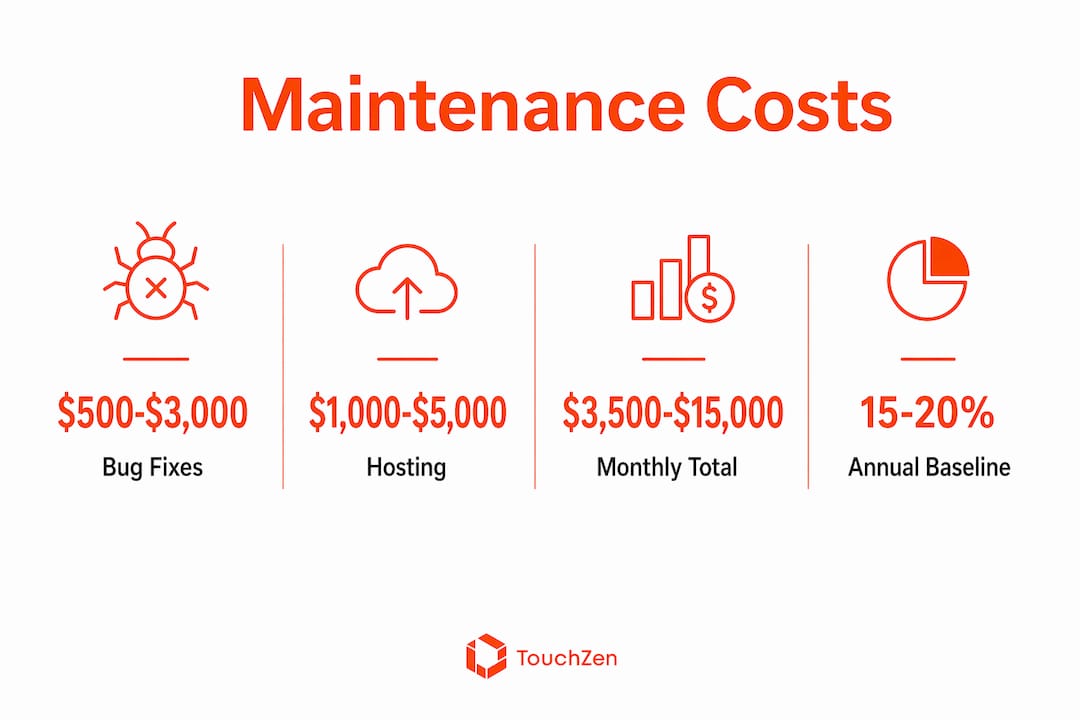
Mobile app maintenance costs are defined as the recurring expenses required to keep a published app functional, secure, and competitive after its initial release. A common planning benchmark is roughly 15–20% of the original development cost per year, depending on app complexity, infrastructure, and support scope. That means a $200,000 app requires $30,000–$40,000 annually just to stay healthy. Most business owners and product managers focus their budgets on the build. The smarter move is to treat post-launch app fees as a permanent line item from day one, not an afterthought.
Understanding mobile app maintenance costs before you launch changes how you plan, staff, and negotiate with development partners. This guide breaks down every cost category, shows how complexity drives spending, and gives you concrete strategies to control long-term app maintenance without sacrificing quality.
What components make up mobile app maintenance costs?
App maintenance expenses fall into six distinct categories. Each one recurs on a different schedule, which is why budgeting for app upkeep requires more than a single annual estimate.
Bug fixes and security patches. Every app ships with imperfections. Security vulnerabilities require immediate patching, and user-reported bugs need triage and resolution. This is the most unpredictable cost category.
OS updates and compatibility adjustments. Apple and Google release major OS updates annually. Each update can break existing functionality, requiring developer time to test and fix compatibility issues.
Hosting and infrastructure. Monthly infrastructure costs range from $50 to $2,000+ depending on app scale and usage. Push notification services, monitoring tools, and analytics platforms each add recurring monthly fees.
Third-party API and SDK licensing fees. Payment processors, mapping services, and authentication providers all charge ongoing fees. These costs grow as your user base grows.
App store developer account fees and compliance. Apple charges $99 per year for its developer program. Google charges a one-time $25 fee but requires ongoing compliance with policy updates that can trigger forced app revisions.
Design iteration and usability improvements. User feedback drives interface changes. Ignoring this category leads to declining retention rates and negative reviews.
As a planning range, monthly maintenance for a standard app can run from roughly $3,500 to $15,000, depending on complexity, infrastructure, and support requirements. That range reflects the difference between a simple utility app and a mid-market product with multiple integrations.
Cost category | Typical monthly range |
|---|---|
Bug fixes and security patches | $500–$3,000 |
Hosting and infrastructure | $50–$2,000+ |
OS compatibility updates | $300–$2,000 |
Third-party API and licensing fees | $200–$1,500 |
Design and UX iteration | $500–$2,500 |
Pro Tip: Track each cost category separately in your accounting system. Bundling all maintenance into one line item hides where your money actually goes and makes it impossible to cut costs intelligently.
How do app complexity and type influence maintenance budgeting?
App complexity is the single biggest driver of ongoing costs of app support. A simple MVP and an enterprise platform can share the same codebase language but require completely different maintenance budgets.

As a planning benchmark, simple apps may require roughly 15–20% of their build cost annually, with total maintenance running $10,000–$30,000 per year. These are typically single-platform apps with minimal backend logic. Mid-range apps covering both iOS and Android with moderate features sit in the $30,000–$50,000 annual range. Complex apps with real-time integrations, heavier backend processing, and multiple third-party APIs may require budgets closer to 20–25% of build cost. Enterprise apps requiring regulatory compliance, multi-module architecture, and dedicated support may require annual maintenance budgets in the $50,000–$125,000+ range.
App type | Annual maintenance range | % of build cost |
|---|---|---|
Simple / MVP | $10,000–$30,000 | 15–20% |
Mid-range (dual platform) | $30,000–$50,000 | 15–20% |
Complex (real-time, API-heavy) | $50,000–$80,000 | 20–25% |
Enterprise (compliance, multi-module) | $50,000–$125,000+ | 20–25% |
Several factors push an app from one tier to the next:
Real-time features like live chat, GPS tracking, or video streaming require constant server-side attention. Apps with heavy server-side infrastructure trend toward 20–25% maintenance costs because scaling and API upkeep compound quickly.
Dual-platform support (iOS and Android) roughly doubles the OS compatibility workload.
Regulatory compliance in industries like healthcare or finance adds mandatory audit and documentation costs.
A large user base increases infrastructure costs even when the feature set stays the same.
Understanding which tier your app falls into gives you a defensible number to present to stakeholders and a realistic baseline for your annual planning cycle.
What strategies can businesses use to control app maintenance expenses?
Controlling long-term app maintenance costs requires deliberate decisions at the contracting, architecture, and planning stages. Reacting to problems after they appear always costs more than preventing them.
Choose retainer contracts over hourly billing. Monthly maintenance retainers provide budget predictability and keep the development team familiar with your codebase. A team that already knows your architecture diagnoses problems faster and fixes them with fewer billable hours. Hourly billing can make month-to-month costs less predictable, while a well-defined retainer can improve budgeting and continuity.
Invest in proactive monitoring. Tools like crash reporting, performance monitoring, and uptime alerts catch issues before users report them. Fixing a bug before it reaches 10,000 users costs a fraction of what a public incident costs in developer time, reputation damage, and lost revenue.
Avoid technical debt from the start. The first year after launch often costs 20–30% of the build cost when technical debt exists. Shortcuts taken during development become expensive refactoring projects post-launch. Read more about managing this risk in TouchZen's guide on mobile app technical debt.
Think in total cost of ownership (TCO) terms.
Over several years, the initial build is only one part of total app ownership costs. Maintenance, infrastructure, security updates, and iterative improvements can become a substantial share of the total investment. Maintenance, infrastructure, and iterative updates consume 65–70% of the 3-year total. Budgeting only for the build leaves you underfunded for the majority of your actual spending.
Balance feature iteration with maintenance capacity. Adding new features without maintaining existing ones creates instability. A practical rule: allocate at least 40% of your development budget to maintenance before approving new feature work.
Evaluate no-code and low-code components for non-core features. For features like push notifications, in-app forms, or basic analytics dashboards, managed services reduce the custom code you need to maintain. Less custom code means lower long-term upkeep costs.
Pro Tip: When negotiating a retainer, ask the development team to include a monthly health report covering open bugs, performance metrics, and upcoming OS changes. This keeps both sides accountable and gives you early warning on budget spikes.
How to forecast and plan your post-launch app maintenance budget?
A realistic maintenance budget starts with your original development cost as the baseline. From there, you adjust for complexity, growth projections, and known recurring fees.
Use this process to build your annual budget:
Set your baseline. Multiply your total development cost by 15–20% for a standard app or 20–25% for a complex or enterprise app. This is your starting point, not your final number.
Add infrastructure costs separately. Do not fold hosting and monitoring into your developer retainer estimate. Recurring infrastructure costs are usage-based and scale with growth. Budget them as a separate line item that you review quarterly.
Account for app store and licensing fees. Apple's $99 annual developer fee is fixed. Third-party API costs are variable. Pull your current API contracts and project usage growth for the next 12 months.
Plan for scalability costs. If you expect significant user growth, your infrastructure costs will increase before your revenue catches up. TouchZen's scalability planning guide covers how to size infrastructure budgets for growth stages.
Review and adjust annually. A budget set at launch becomes inaccurate within 12 months. Schedule a formal budget review each year that accounts for new OS versions, changed API pricing, and updated feature roadmaps.
Budget component | Frequency | Action |
|---|---|---|
Developer retainer | Monthly | Lock in via contract; review annually |
Infrastructure and hosting | Monthly | Monitor usage; adjust quarterly |
App store and licensing fees | Annual | Audit contracts each year |
OS compatibility updates | Twice yearly | Budget a sprint per major OS release |
Feature iteration reserve | Quarterly | Allocate 40% of dev budget minimum |
Communicating this budget to stakeholders requires framing maintenance as risk management, not overhead. An app that goes unmaintained loses users, generates negative reviews, and eventually requires a full rebuild. The cost of a rebuild is always higher than the cost of consistent upkeep. Align your stakeholders on total app investment early, and the annual maintenance conversation becomes much easier.
Key takeaways
Budgeting for app upkeep over a multi-year period gives businesses a more realistic view of total app ownership costs.
Point | Details |
|---|---|
Annual maintenance baseline | Budget 15–20% of your original development cost every year as a starting point. |
Complexity drives cost | Enterprise and complex apps require 20–25% annually, reaching $125,000+ in some cases. |
Retainers beat hourly billing | Monthly retainer contracts reduce diagnosis time and create predictable monthly expenses. |
TCO mindset is non-negotiable | Maintenance, infrastructure, and updates can represent a significant share of total app ownership costs over time. |
Review budgets annually | OS updates, API pricing changes, and user growth all shift your maintenance costs each year. |
The budget mistake I see most often
Most founders I work with treat the launch as the finish line. They spend months agonizing over the build budget, negotiate every line item, and then go quiet on maintenance planning. Six months later, they are paying emergency rates to fix a critical bug that a retainer contract would have caught in a routine check.
The uncomfortable truth about app maintenance is that the build cost is the cheapest part of owning an app. Initial build costs are only one part of long-term app ownership. Ongoing maintenance, infrastructure, security work, and product improvements can become a major part of the total investment over time. Founders who internalize this early make better hiring decisions, negotiate better contracts, and avoid the panic that comes with an unplanned infrastructure bill.
Retainer billing is not just a payment preference. It is an alignment mechanism. When a development team is on a monthly retainer, their incentive is to keep your app healthy because their relationship depends on it. Hourly billing creates the opposite incentive. Every bug is a revenue opportunity for the vendor, not a problem to prevent.
My recommendation for early-stage businesses: start with a lean retainer that covers monitoring, OS updates, and critical bug fixes. Do not try to fund full feature iteration in year one. Get the app stable, learn from real user behavior, and then expand your maintenance scope based on what the data tells you. Chasing features before the foundation is solid is the fastest way to accumulate technical debt that will cost you far more in year two.
— Cyrus
How TouchZen supports your app after launch
Post-launch support is where most development relationships fall apart. TouchZen was built specifically to prevent that outcome.
TouchZen's iOS and Android development services include structured post-launch maintenance programs designed for business owners and product managers who need predictable costs and senior-level accountability. Every client works directly with senior developers, not junior staff, which means faster diagnosis and fewer billable hours wasted on context-building. TouchZen has launched over 75 apps across industries and brings that depth of experience to every maintenance engagement. If you want a clear-eyed budget estimate and a partner who treats your app's health as a long-term commitment, talk to the team about what ongoing support looks like for your specific app.
FAQ
What is the standard annual budget for app maintenance?
The industry standard is 15–20% of the original development cost per year. A $200,000 app requires $30,000–$40,000 annually to maintain.
Why does technical debt increase post-launch maintenance costs?
Technical debt forces developers to fix structural code problems before addressing new issues. The first year post-launch can cost 20–30% of the build cost when significant technical debt exists.
Is a retainer or hourly billing better for app maintenance?
Retainer contracts are better for most businesses. They keep the development team familiar with your codebase, reduce diagnosis time, and produce predictable monthly expenses compared to variable hourly billing.
What percentage of total app investment goes to maintenance over 3 years?
Maintenance, infrastructure, and updates consume 65–70% of total 3-year investment. The initial build accounts for only 28–35% of what you will spend over that period.
What recurring fees do most businesses overlook in their app budget?
App store developer fees, third-party API licensing, push notification services, and monitoring subscriptions are the most commonly missed items. These recurring infrastructure costs range from $50 to $2,000+ per month depending on app scale.