
Joy Foroughi
Executive Assistant


Mobile App Product Roadmap Essentials for Startup Founders
Discover the Mobile App Product Roadmap Essentials for Startup Founders. Learn to align vision, prioritize, and ship your app faster.

Your mobile app roadmap has one job: align your vision, prioritize validated learning, and cut decision latency so your team ships the right thing fast. Three elements make that possible from day one.
North Star metric — a single number that tells you whether the product is working (activation rate, retention, or willingness-to-pay, not downloads or signups alone)
Next validation experiment — one testable hypothesis your team will prove or disprove in the next 4–6 weeks
Update cadence with a named owner — a weekly or biweekly rhythm with one person accountable for keeping the roadmap current
Start this week by writing a one-page MVP brief that names your target user, your riskiest assumption, and the single metric you will move. Everything else follows from that.
What should your roadmap's North Star and goals look like?
The North Star metric is the one number that best captures the value your app delivers to users. It differs from vanity metrics like total downloads or registered accounts because it measures behavior, not presence. A consumer utility app might track daily active users completing a core task. A SaaS mobile product might track weekly active paying seats. A marketplace might track completed transactions per buyer per month.
Before you write a single feature, translate your vision into one to three product goals tied to outcomes founders actually care about. Pre-PMF (pre-product/market fit), those goals center on learning: can you activate a user, retain them through a second session, and get a signal of willingness-to-pay? Post-PMF, goals shift toward growth rate, payback period, and expansion revenue.
A short KPI list to track from the start:
Activation rate — percentage of new users who reach the first value moment within 24–48 hours
Day-7 and Day-30 retention — the clearest early signal of product-market fit
Conversion to paid — even a waitlist or pre-order counts as a signal
Core engagement action — the one in-app action that correlates with retention (send a message, complete a task, make a booking)
Understanding why mobile apps matter for startups helps you frame the right North Star from the beginning, before scope creep pulls you toward features that feel important but don't move the number.
How do you align your team and stakeholders around the roadmap?
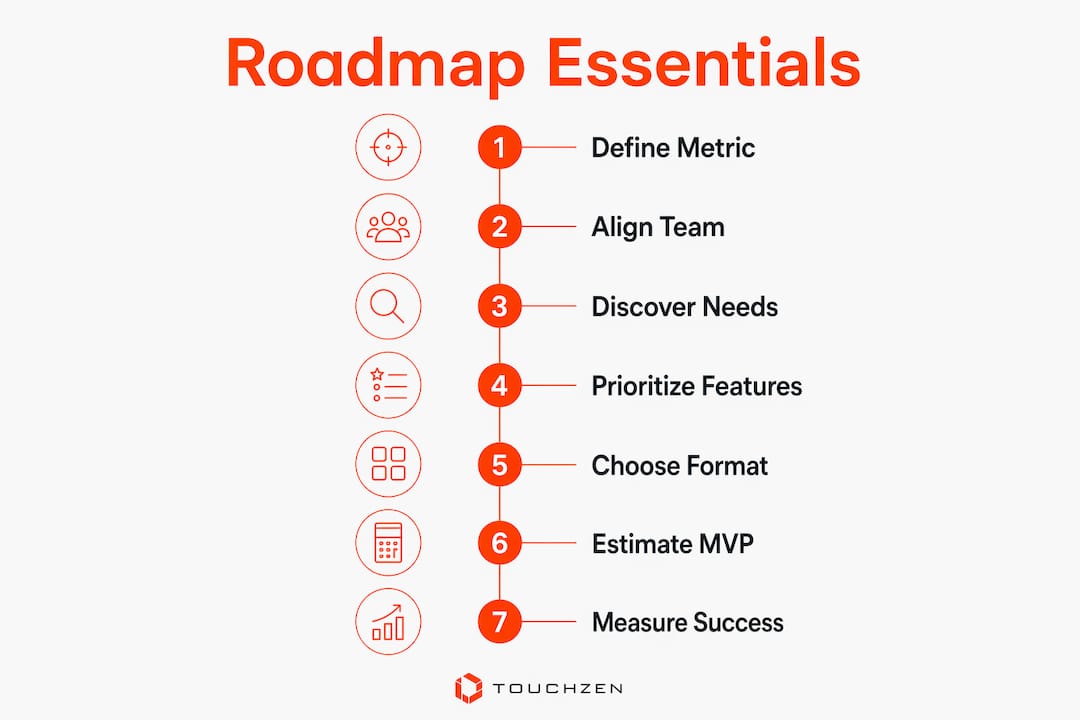
Governance sounds heavy for a five-person startup. It doesn't have to be. The goal is clarity on who decides what, so the roadmap doesn't drift every time an investor suggests a feature or a developer hits a blocker.
Core roles every early-stage team needs:
Founder/product owner — sets priorities, owns the roadmap document, makes final scope calls
Tech lead — flags technical dependencies, estimates effort, and raises blockers early
Designer — owns the user experience flow and prototype artifacts
Growth/marketing owner — connects roadmap items to acquisition and activation experiments
QA — defines acceptance criteria and catches regressions before they reach users
A lightweight RACI for roadmap decisions looks like this: the founder is Responsible and Accountable for priority changes; the tech lead is Consulted on feasibility; the designer and growth owner are Consulted on user impact; investors and advisors are Informed via a monthly one-pager. That's it.
For meeting cadence, a weekly sprint sync (30 minutes, focused on blockers and the current experiment) plus a biweekly roadmap check (60 minutes, reviewing what the last experiment taught you and what moves to "now") covers most early-stage teams. Investors and advisors get a clean one-page snapshot monthly, not the full execution board. Early users get a brief "what's coming" summary only when you have something concrete to show.

How do you discover and validate market needs before locking in features?
The most expensive mistake founders make is treating a feature list as a roadmap. Hypothesis-driven roadmaps replace feature items with testable bets: "We believe [user] has [problem]. If we build [solution], we expect [metric] to change by [amount] within [timeframe]." That framing forces you to define success before you build anything.
Validation experiments range from zero-code to lightweight builds:
Landing page test — describe the product, drive paid traffic, measure signup conversion
Concierge/manual MVP — deliver the service manually before automating it (Zapier workflows, spreadsheets, direct messages)
Prototype test — share a Figma clickthrough with 5–10 target users and watch where they get stuck
Paid ads to a signup funnel — test messaging and audience before writing a line of code
User interviews — 15-minute structured calls with 8–12 target users to surface jobs-to-be-done
Pre-order or waitlist — real money or email commitment as a demand signal
Convert experiment signals into roadmap inputs by asking two questions: Did users take the action we predicted? If not, what did they do instead? Qualitative feedback tells you why; conversion metrics tell you how many. Both belong in the roadmap as evidence, not opinion.
Run one experiment per two-week cycle pre-PMF. After each cycle, hold a 30-minute debrief and update the roadmap's "now" card before the next sprint starts.
Pro Tip: Keep your first validation experiment as manual as possible. If you struggle to get 10 target users to pay or commit, test the value proposition further before investing in a polished interface. Dropbox famously used a demo video to validate interest before building the full product.
Which prioritization frameworks actually work for resource-constrained startups?
Pre-PMF, the best prioritization rule is the simplest one: does this item validate your core hypothesis? If yes, it's high priority. If it's a nice-to-have that doesn't move your North Star, it's parked in "later." That learning-first rule beats heavyweight scoring when your team is small and your assumptions are still unproven.
Framework | Best for | Inputs needed | Startup fit |
|---|---|---|---|
Learning-first rule | Pre-PMF, weeks 1–12 | Core hypothesis, one metric | Highest — zero overhead |
MoSCoW | MVP scoping, sprint planning | Must/Should/Could/Won't labels | High — fast and collaborative |
RICE | Post-PMF feature prioritization | Reach, Impact, Confidence, Effort | Medium — needs some data |
Opportunity Scoring | Identifying underserved needs | User importance + satisfaction ratings | Medium — requires user research |
A worked RICE example for a single MVP experiment: you're deciding whether to build in-app push notifications. Reach = 500 users in 90 days (estimated). Impact = 3 (massive, using the standard RICE scale). Confidence = 60% (some evidence from interviews). Effort = 2 weeks. RICE score = (500 × 3 × 0.6) / 2 = 450. Compare that score against other candidates and build the highest-scoring item first.
Technical dependencies belong in your prioritization pass, not as an afterthought. Early-stage teams should explicitly ask: does this item reduce critical technical uncertainty, or does it depend on infrastructure that doesn't exist yet? An experiment that de-risks your core tech stack ranks higher than a feature that assumes that stack is already stable.
Which roadmap format fits your startup's current stage?
Three formats cover most early-stage needs, and the right choice depends on where you are relative to PMF.

Now/Next/Later is the default for pre-PMF teams. "Now" holds the single experiment your team is running this week or two. "Next" holds the experiment you'll run after this one closes. "Later" is a parking lot for hypotheses you haven't validated yet. This format avoids the false precision of date-based timelines and keeps the team focused on learning, not shipping to a calendar.
Outcome-based roadmaps work well once you have some user data. Each card states a goal (increase Day-7 retention from 20% to 35%), the experiment or feature set attached to it, the owner, and the success metric. The format keeps conversations on outcomes rather than outputs.
Timeline boards are appropriate post-PMF, when you have enough predictability to commit to quarters. Pre-PMF, a timeline board creates the illusion of certainty and leads to scope creep when experiments don't go as planned.
A "now" card should contain: the hypothesis, the owner, the success metric, the experiment type, and a decision rule (if metric X is reached by date Y, we proceed; if not, we pivot). An "outcome" card adds the goal state and the current baseline.
For tools, a shared Notion board, a Trello board with three columns, or a lightweight Linear project covers most pre-PMF teams. Post-PMF, a dedicated product management tool adds value for cross-team coordination. When selecting a stack, match your technology approach to your team's skills: React Native or Flutter for cross-platform speed, Swift or Kotlin for native performance requirements.
For investor snapshots, export a clean one-page view showing your current North Star metric, the three most recent experiment results, and what's in "now." Never share the full execution board with investors — it invites feature requests that distort your priorities.
How long does an MVP actually take, and how should you estimate it?
Avoid fixed feature timelines pre-PMF. A well-structured MVP roadmap focuses on the next 4–6 weeks and expects rapid change. Long timelines create false commitments and make pivots feel like failures when they're actually learning.
A practical 6-week MVP plan compresses validation, build, beta, and launch into iterative weekly objectives that produce measurable evidence for continuation or pivot decisions. Week 1 is for validating scope and writing an MVP brief; week 2 covers product requirements and core flow; week 3 is dedicated to building core functionality; week 4 launches a private beta with 3–20 qualified users and gathers qualitative feedback; week 5 focuses on improving activation and first-value-moment optimization; and week 6 culminates in a focused launch with a review of the success metric.
Estimation tips that save founders weeks of wasted work:
Use T-shirt sizing (S/M/L/XL) for speed in early planning; save hour-level estimates for sprint planning
Buy before you build — use Stripe for payments, Twilio for SMS, Firebase for auth rather than building from scratch
No-code shortcuts for validation: Webflow for landing pages, Airtable for data, Zapier for workflows
Scope tradeoffs — cutting one “should-have” feature can significantly reduce development and testing time
For a realistic sense of how long different build phases take, the mobile app development timeline guide from TouchZen breaks down effort by app type and complexity. Planning for scale from the start also matters; mobile app scalability considerations should appear in your roadmap as technical milestones, not afterthoughts.
How should you present and govern the roadmap as it evolves?
The roadmap is a communication tool first and a planning document second. Roadmaps that live only in the founder's head, or that get updated once a quarter, stop being useful within weeks.
Audience-specific views:
Investor one-pager — North Star metric trend, last three experiment results, current "now" item, and next milestone
Team weekly view — full now/next/later board with owners, blockers, and acceptance criteria visible
Customer roadmap summary — a brief "what we're working on" note with no dates, focused on the problems you're solving
Change-control checklist:
Who approves scope changes? The founder/product owner, with tech lead consulted on feasibility
How do you log decisions? A brief decision log (date, change, rationale, who approved) in the roadmap doc itself
What evidence triggers a re-prioritization? A failed experiment, a new user interview finding, a critical technical blocker, or a shift in competitive context
When do you revise "now"? At the end of each experiment cycle, not mid-sprint
For fundraising conversations, show your roadmap as evidence of disciplined thinking, not a feature promise. Investors want to see that you know what you're testing, why, and what you'll do with the result. Avoid sharing specific delivery dates for features that haven't been validated yet — it creates expectations you can't reliably meet.
How do you measure success and build repeatable learning loops?
Every roadmap item should have a hypothesis attached to it before it enters "now." A practical template:
"If we [build/change/test X], then [metric Y] will [increase/decrease] by [Z%] within [timeframe], because [assumption about user behavior]."
That structure forces three things: a measurable outcome, a timeframe, and an explicit assumption you can prove wrong. When the experiment closes, you compare actual results to the prediction and update the roadmap accordingly.
Pre-PMF metrics to track first:
Activation rate (users reaching first value moment)
Day-7 retention
Willingness-to-pay signal (pre-orders, paid conversions, upgrade rate)
Core engagement action frequency
Instrument experiments with the minimum viable analytics setup: event tracking for your core action, a funnel view from install to activation, and a simple cohort table for retention. Tools like Mixpanel, Amplitude, or even a well-structured Google Analytics 4 property cover most early-stage needs without over-engineering.
OKRs work well as a lightweight alignment layer once you have two or more roadmap items running in parallel. One objective (e.g., "Prove retention is solvable before Series A") with two or three key results (Day-7 retention above 30%, three qualitative interviews confirming the value moment, one cohort with zero churn in week two) keeps the team aligned without turning the roadmap into a spreadsheet exercise.
TouchZen's copyable MVP roadmap template and founder checklist
The 6-week structure above maps directly to how TouchZen approaches early-stage product builds. Across 75+ apps launched, the teams that move fastest share one habit: they write the MVP brief before they open a design tool.
Copyable MVP brief checklist:
Target user (one specific persona, not "everyone who...")
Riskiest assumption (the one thing that, if wrong, kills the idea)
Core metric (the single number that proves the assumption)
Must-have features (three or fewer — a focused MVP includes only what's needed to test the core hypothesis)
Manual shortcuts (what you'll do by hand instead of building)
Beta plan (3–20 qualified users, how you'll recruit them, what you'll ask)
Decision rule (if metric X is reached by week 6, we proceed to scale; if not, we pivot or stop)
TouchZen has supported early-stage product teams across 75+ app launches. Clear MVP briefs and measurable success criteria help teams stay focused as they move from validation to design and development.
For founders who want to go deeper on the end-to-end build process, the end-to-end app development guide and the MVP to market in 90 days resource both extend the roadmap framework into full execution planning.
Key Takeaways
A mobile app product roadmap works when it ties every decision to a testable hypothesis, a named owner, and a single North Star metric that the whole team can see.
Point | Details |
|---|---|
North Star first | Define one behavioral metric before writing any feature; it anchors every prioritization decision. |
Hypothesis-driven items | Replace feature requests with "if/then/because" bets so every roadmap item has a measurable success criterion. |
6-week MVP cycles | Use the next 4–6 weeks to validate scope, build core functionality, launch a small beta, improve activation, and review the success criteria. |
Audience-specific views | Maintain separate investor, team, and customer snapshots to prevent scope creep from stakeholder feedback. |
TouchZen as your build partner | TouchZen has shipped 75+ apps, reaching 20M+ collective downloads, with 12+ apps featured by Apple and Google. |
The roadmap is not the plan — it's the question
Most founders treat their roadmap as a commitment. The best ones treat it as a hypothesis log. There's a meaningful difference. A commitment creates pressure to ship what you said you'd ship. A hypothesis log creates pressure to learn what you said you'd learn. When you frame it that way, a pivot isn't a failure — it's the roadmap working exactly as intended.
What gets founders into trouble isn't building the wrong feature once. It's building the wrong feature, then defending it in the next sprint because it's already on the roadmap. Change control exists to prevent that. The decision log, the named owner, the explicit success criteria — those aren't bureaucracy. They're the mechanism that lets you change direction without losing the team's trust.
One thing TouchZen sees consistently across early-stage projects: the founders who ship fastest are the ones who write the decision rule before the experiment starts. Not after the data comes in, when confirmation bias is already at work. Write it first. Then let the data speak.
Start small. Run one experiment. Update the roadmap. Repeat.
TouchZen builds the roadmap with you, not after you
TouchZen helps founders reduce the risk of spending months building features that have not been validated. TouchZen's senior developers and designers work directly with you from the first strategy session, so the gap between your roadmap and your shipped product stays narrow.
The outcomes speak plainly: 75+ apps launched, a 10x subscription increase and 100k downloads for select projects in year one, and ongoing post-launch support that keeps the product evolving as your user data grows. Whether you need full mobile app development from MVP brief to App Store, or a focused product strategy session to sharpen your roadmap before you build, TouchZen's team is ready to move fast with you. Talk to an app expert at TouchZen and get your first roadmap session on the calendar this week.
Useful sources and further reading
MVP roadmap templates and structure: Product Roadmap for Startup MVPs — hypothesis-driven structure with problem, solution, and business-model validation phases
Now/next/later format and 6-week MVP plan: MVP Roadmap Template for a New App — concise template with week-by-week outputs and beta sizing guidance
App development stages and technical tradeoffs: App Dev Roadmap Guide — covers planning, design, development, and deployment stages with technology selection notes
Why roadmaps matter for founders: Why Product Roadmaps Are Essential for Startup Founders — strategic rationale and common founder pitfalls
AI-assisted roadmap planning: How to Build an AI-Driven Product Roadmap for Startups — practical guide to using AI tools in the roadmap process
Early-stage SaaS roadmapping: The Art of Product Roadmapping for Early-Stage SaaS Founders — nuanced guidance on roadmap governance and stakeholder management
TouchZen resources: End-to-End App Development Guide · MVP to Market in 90 Days · Competitor Analysis Before You Build
FAQ
What is the most important element of a startup app roadmap?
The single most important element is a defined North Star metric tied to user behavior, not vanity counts. Every roadmap item should connect back to moving that number.
How long should an MVP roadmap cover?
Focus on 4–6 weeks at a time pre-PMF. A practical 6-week cycle covers scope validation, build, private beta, activation improvement, and a focused launch, with a clear decision rule at the end.
Should a startup use RICE or MoSCoW for prioritization?
Pre-PMF, a simple learning-first rule (does this validate the core hypothesis?) outperforms both. MoSCoW works well for MVP scoping; RICE adds value post-PMF when you have enough user data to estimate reach and impact reliably.
How often should a startup update its product roadmap?
Update the "now" column at the end of every experiment cycle, typically every one to two weeks. Review the full roadmap at a biweekly roadmap check and share an investor snapshot monthly.
How can TouchZen help founders build a mobile app roadmap?
TouchZen offers product strategy support and full mobile app development, working directly with experienced team members from the first session. The team has launched 75+ apps and helps founders move from MVP planning through launch and post-launch iteration.