
Joy Foroughi
Executive Assistant


Mobile App Technical Debt: When to Refactor, When to Rewrite, and When to Leave It Alone
When to refactor, rewrite, or leave a mobile app alone. A founder's guide to spotting technical debt and choosing the smartest next step. Not all technical debt is bad. The trick is knowing when to clean it up, when to start over, and when to leave the codebase alone. Here's a practical guide for founders running a growing app that's getting harder to maintain.
Introduction
Every successful mobile app accumulates technical debt. Some of it is the price of moving fast, launching an MVP, or pivoting toward what the market actually wants. None of that is a failure. The team made the right call at the time, and the app is in the App Store because of it.
The harder question shows up later. A year or two in, releases start taking longer. Features that used to ship in a sprint now take three. New developers spend their first month just understanding the codebase. Crashes creep up. Each small change risks breaking something else. At that point, technical debt has stopped being a tradeoff and started being a tax on the business.
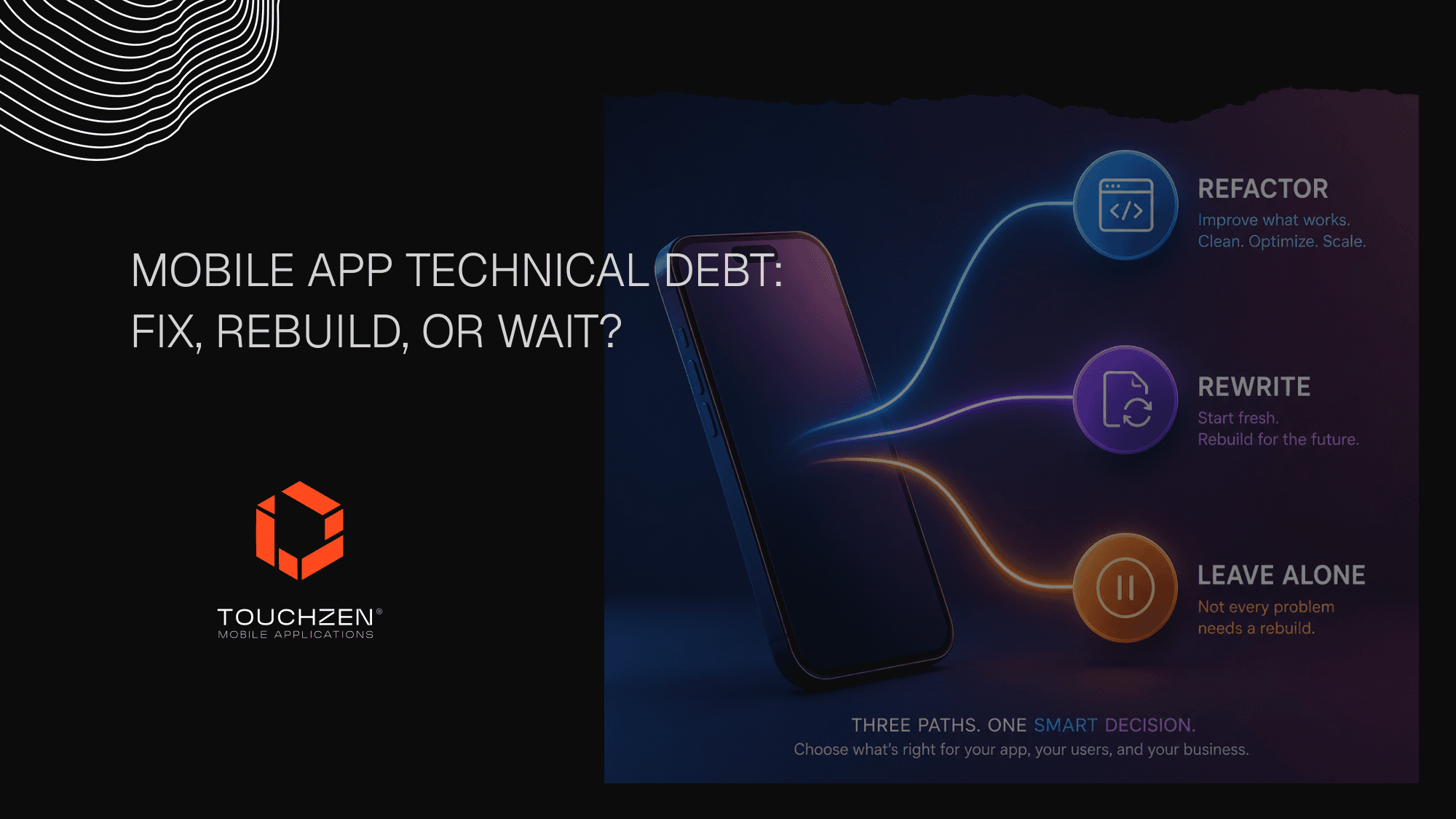
This guide is for founders and product owners at that exact moment. It walks through what mobile app technical debt actually is, the signs that the debt has gone from manageable to costly, and the three real choices in front of you: refactor, rewrite, or leave it alone. Each of those is the right answer some of the time. The trick is knowing which one your app needs.
At TouchZen Media, we help founders evaluate whether an app needs cleanup, modernization, or a full rebuild.
What Mobile App Technical Debt Actually Means
Technical debt is the gap between how an app is built today and how it should be built to serve the business going forward.
Some debt is intentional. A founder skips analytics during a rushed launch because they need the App Store submission to go through this week. Six months later, that decision needs to be revisited. That is healthy debt, taken on for a good reason.
Other debt is accidental. A junior developer hard-codes API endpoints. A feature gets bolted onto a flow that was never designed to support it. The design system gets ignored for one release, then two, then ten. Nobody planned for this debt, and nobody is tracking it.
A useful frame: technical debt is fine until it becomes a tax. The tax shows up as slower releases, higher costs, fragile features, and frustrated engineers. The goal is not zero debt. The goal is debt that the business can still afford to carry.
Common Signs Your App Has Technical Debt
A few patterns show up consistently in apps that have crossed from healthy to costly:
App performance has gotten visibly slower over time
Features that used to be stable now break after OS updates
The dependency list is years out of date and nobody wants to upgrade it
Adding a small new feature requires touching code in five unrelated places
The same bug keeps coming back in a slightly different form
Crash reports are trending up release over release
Two or three different design patterns coexist in the same app
The onboarding or checkout flow has been patched so many times it no longer makes sense
New engineers need months, not weeks, to ship their first meaningful change
Analytics are unreliable, so nobody actually knows how users behave
Any one of these on its own is normal. Three or more is a pattern. Five or more is usually a signal that the cost of doing nothing has quietly become higher than the cost of fixing it.
Why Technical Debt Happens in Mobile Apps
Mobile adds its own pressure on top of the usual reasons. Apps live across two platforms with different lifecycles, depend on third-party SDKs that update on their own schedules, and ship through App Store and Google Play review processes that punish sloppy work. Every year, Apple and Google retire APIs that older apps still rely on.
The most common origin stories we see:
An MVP shipped fast to validate a market and then never had a cleanup phase
A pivot that bent the original architecture in ways it was never designed for
Multiple agencies or freelancers, each with a different style, each leaving fingerprints behind
A cross-platform setup that made sense early but no longer fits where the product is going
Heavy reliance on a single senior engineer who has since left
None of these are unusual. All of them are fixable. The right fix depends on which one applies and how far it has gone.
If your current setup involves a mix of native and cross-platform decisions, our guide to cross-platform app development is a useful companion piece on when each approach makes sense.
When It Is Better to Refactor
Refactoring is the right move when the product is still solid but parts of the code need cleanup.
Good candidates for refactoring usually look like this:
The core architecture is sound, but specific modules have gotten messy
The app works well for users but is painful to extend
A specific area (onboarding, payments, sync) is clearly weaker than the rest
The team can describe the cleanup in concrete, bounded steps
The dependency list and tooling are mostly current
The team building the refactor is the same one that built the original code, or has full access to documentation
Refactoring is incremental. It happens alongside normal feature work. It lowers risk because nothing about the product changes from the user's perspective. The downside is that it requires discipline. Refactoring projects that drift into "while we're in here, let's also..." are how teams burn quarters with nothing to show for it.
A practical refactoring example: cleaning up an onboarding flow that has had four sets of A/B tests bolted onto it. The flow still works for users. The code behind it is a mess. A focused refactor brings it back to something a new engineer can read in an afternoon.
When a Full Rewrite Makes Sense
A rewrite is the right call when the architecture itself is blocking the business.
Signs that point toward a rewrite:
The app is built on a stack that no longer has good community support
The architecture cannot support features the business now needs (real-time, AI, video, offline-first, etc.)
Crash rates are high and the root cause sits deep in the foundation
The original framework or language is being deprecated by Apple or Google
The team cannot recruit engineers willing to work on the existing codebase
The cost of maintaining the current app exceeds the cost of rebuilding it within 12 to 18 months
Rewrites are expensive, slow, and risky. They also offer the only path forward for some apps. Done well, a rewrite resets the cost structure of the product for years to come. Done poorly, it stalls the business while a new codebase tries to reach feature parity with the old one.
A practical rewrite example: an early-stage fintech app built on an outdated cross-platform stack that cannot integrate the AI features the team now needs to compete. Rebuilding on a modern foundation, possibly with native iOS and Android or a current Flutter or React Native setup, opens the roadmap back up. For founders weighing where AI fits into the next version, our AI-native mobile app development guide is a useful read.
When It Is Smarter to Leave the Codebase Alone
This is the option founders most often forget exists. Not every app needs to be fixed right now.
Leaving the codebase alone is the right call when:
The app is stable and users are happy
The business model is still being validated, and a major engineering investment would be premature
The product is generating revenue and a rewrite would distract from growth
The pain is real but limited to a single area that can be patched cheaply
The team has bigger near-term priorities (fundraising, expansion, a key partnership)
The right question is not "is there debt in this app?" The answer to that is always yes. The right question is "is the debt costing us more than fixing it would cost?"
If revenue is climbing and engineering is shipping at a reasonable pace, the smart move is often to keep going, log the debt for later, and revisit when the picture changes.
How Founders Should Make the Decision Without Wasting Budget
Most refactor-vs-rewrite decisions get made in two ways. The wrong way is in a vacuum, usually by an engineer frustrated with the current code who pitches a rewrite to a non-technical founder. The right way starts with a short, honest audit.

A practical decision framework:
List the top three pains the team and the users are actually experiencing
For each, identify whether the root cause is in a specific module or in the foundation
Estimate the cost of fixing each pain through refactoring
Estimate the cost of fixing each pain through a rewrite
Estimate the cost of doing nothing for another six months
Compare all three against the business priorities for the next year
If the pain is real and the cause is in a few modules, refactor. If the cause is in the foundation and the pain is growing, plan a rewrite. If the pain is real but bounded and the business has bigger priorities, document the debt and move on.
A short, paid technical audit from a senior team is almost always cheaper than committing to the wrong path. Our services page covers what a focused audit looks like in practice.
A Simple Founder Checklist
Before making any decision, work through these:
Have you documented the top three pains, in plain language, with examples?
Do you know whether those pains live in modules or in the foundation?
Have you had a senior engineer outside the original team review the code?
Have you compared refactor, rewrite, and "do nothing" against the same set of pains?
Do you have a realistic cost and timeline for each path?
Is the decision aligned with where the business is going, not where it has been?
If two or more of these are blank, the decision is being made on instinct. That is the most expensive way to do it.
How TouchZen Media Can Help
At TouchZen Media, we have spent over a decade building and maintaining mobile apps for startups and growing companies. Across 75+ shipped apps, 20M+ combined downloads, and 12+ features from Apple and Google, we have seen the full range of technical debt situations: rushed MVPs that need a cleanup, well-built apps that just need a focused refactor, and aging codebases that genuinely need a full rebuild. We’ve also seen situations where the smartest move was to leave the codebase alone and focus engineering effort somewhere else.
Our work covers the entire path: short technical audits, modernization plans, UX redesigns, refactoring engagements, full rewrites on native iOS and Android or Flutter and React Native, AI integration, and long-term product support. We bring the same senior team that has shipped featured apps to your existing code, look at it honestly, and tell you what we would do if it were our own product.
If your app is becoming harder to maintain, update, or scale, we can review the product, identify the highest-risk technical debt, and help you decide whether to refactor, rebuild, or leave things alone for now. You can get in touch to start that conversation, or browse the TouchZen Media portfolio for a sense of the kinds of products we have helped take from messy to maintainable.

Frequently Asked Questions
1. What is technical debt in mobile app development?
Technical debt is the long-term cost of decisions made to ship quickly or under constraints. Every app has some. It becomes a problem when it starts slowing down releases, raising crash rates, or making new features expensive to build.
2. How do I know if my mobile app needs refactoring?
Common signs include slow releases, fragile features that keep breaking, outdated dependencies, rising crash reports, and a codebase that new engineers struggle to understand. If three or more of those apply, a focused refactor is usually worth scoping.
3. Is it better to refactor or rebuild a mobile app?
Refactor when the core product and architecture are still solid and the pain lives in specific modules. Rebuild when the architecture itself is blocking growth, the original stack is outdated, or the cost of maintaining the current app has crossed the cost of starting over. A short audit by a senior team is the cleanest way to decide.
4. How much does it cost to fix mobile app technical debt?
Costs vary widely based on scope. A targeted refactor of a single module can be a few weeks of senior engineering. A full rewrite can run anywhere from $80,000 into the six figures, depending on app complexity. A paid audit, usually a fraction of either, is the best first step.
5. Can TouchZen help review an existing app before deciding what to do?
Yes. We offer short, honest technical audits for founders trying to decide between refactoring, rewriting, or holding off. The audit covers code health, architecture, dependency risk, and the highest-leverage areas to improve. You can reach the team through the TouchZen contact page.
Conclusion
Technical debt is not a sign that something went wrong. It is a sign that something shipped. The real question is not whether your app has debt. It is whether the debt is still affordable.
Some apps need a careful refactor. Some need a full rebuild. Some need to be left alone for another two quarters while the business chases revenue. The wrong answer is not picking one of those. The wrong answer is making the decision in the dark.
If your team is wrestling with that decision now, TouchZen Media can help. A focused audit, an honest recommendation, and a clear path forward are usually a one-week investment that saves months of misdirected work. Reach out when you are ready to talk it through.