
Joy Foroughi
Executive Assistant


What Is a Product Requirements Document? A Clear Guide
Discover what a product requirements document is and why it's essential for successful product development. Learn how to create one effectively!

TL;DR:
A product requirements document (PRD) is a clear, concise guide that defines a product's purpose, features, and expected behavior to align development teams. It serves as a single source of truth, preventing miscommunication and costly rework during product development. Writing a short, measurable, and collaboratively developed PRD and maintaining it as a living document facilitates effective teamwork and successful product outcomes.
A product requirements document (PRD) is a concise, authoritative guide that defines a product's purpose, features, and expected behavior for development teams. Also known in formal engineering contexts as a software requirements specification (SRS) under IEEE 29148, the PRD serves as the single source of truth that bridges business strategy and technical implementation. Without one, product teams operate on assumptions, and assumptions are where projects go off the rails. Whether you are a product manager at a startup or a senior developer at a growing tech company, understanding what belongs in a PRD and how to write one well is one of the highest-leverage skills you can develop.
What is a product requirements document and why does it matter?
A PRD is a structured document that defines product purpose, key user personas, functional and non-functional requirements, and explicit out-of-scope items. It is not a technical specification, a project plan, or a feature wishlist. The PRD answers three core questions: what problem are we solving, who has that problem, and what does the solution need to do to address it?

The importance of product requirements becomes clear the moment a team skips this step. Engineers build the wrong feature. Designers create flows that conflict with business rules. Stakeholders approve a product they did not actually want. A well-written PRD prevents all of this by giving every team member a shared reference point before a single line of code is written.
For regulated industries, the stakes are even higher. Frameworks like FDA 21 CFR Part 820, IEC 62304, DO-178C, and ISO 26262 mandate formal requirements traceability as part of compliance. That means your PRD is not just a planning tool. In those contexts, it is a legal document.
What are the essential components of a product requirements document?
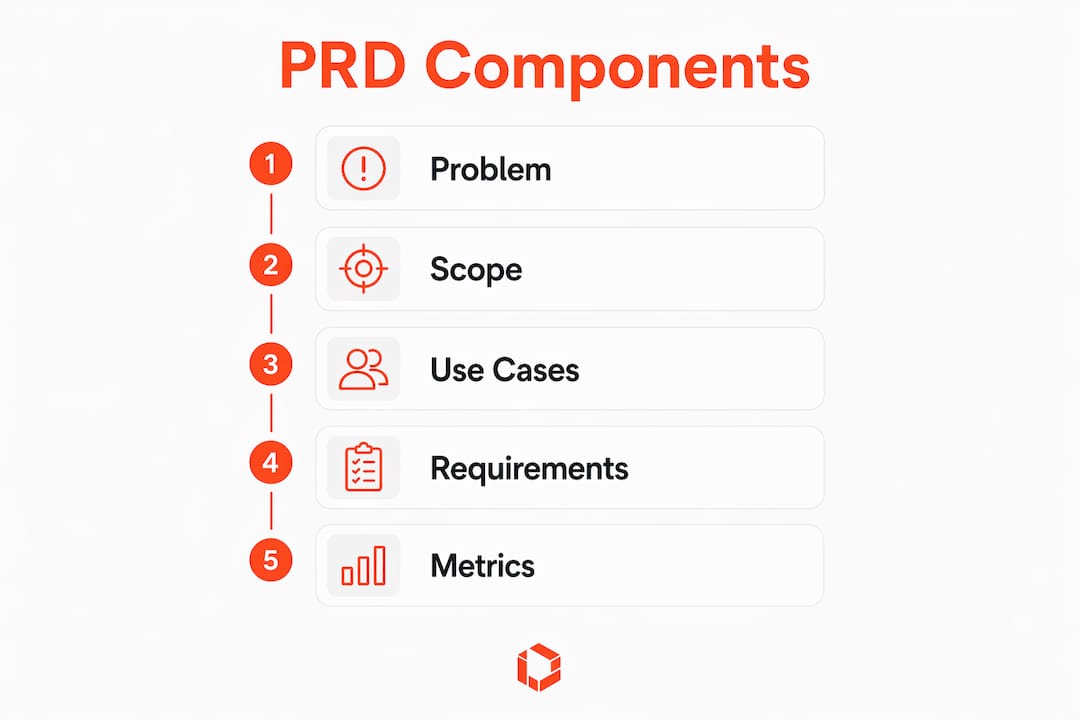
A high-quality PRD contains specific, ordered sections that each serve a distinct purpose. Skipping any one of them creates gaps that surface later as miscommunication or rework. Here are the core elements of a product requirements document:
Problem statement. Defines the core issue, who is affected, and why the current situation is negative. This is the foundation. Every feature decision should trace back to it.
Scope and non-scope definitions. Scope tells the team what the product will do. Non-scope is equally critical. It explicitly states what the product will not do, which is the primary defense against scope creep.
User personas and user stories. Personas describe the real people using the product. User stories follow the format "As a [user], I want [action] so that [outcome]," grounding requirements in actual behavior rather than abstract functionality.
Acceptance criteria. Each user story needs a testable condition that confirms when the requirement is met. Without acceptance criteria, "done" means something different to every team member.
Functional requirements. These describe what the system must do. Log in, send a notification, process a payment. Each requirement should be specific and verifiable.
Non-functional requirements. These describe how the system performs. Response time under 200 milliseconds, 99.9% uptime, support for 10,000 concurrent users. Measurable specs here prevent vague performance debates later.
Out-of-scope items. A dedicated list of features explicitly excluded from the current version. This protects the team from well-intentioned additions that derail timelines.
Success metrics. Quantifiable outcomes that define whether the product achieved its goal. Monthly active users, conversion rate, error rate. If you cannot measure it, you cannot validate it.
A practical PRD structure allocates roughly 0.5 pages to the problem statement, 0.5 pages to scope, and 1.5 pages to user stories, with short sections for success metrics and open questions. That structure keeps the total document under three pages, which is the threshold where PRDs remain usable rather than becoming shelf documents.
How should you write an effective product requirements document?
Writing a PRD that teams actually read and use requires discipline. Most first-time PRD authors make the same mistake: they start with features instead of problems. The right starting point is always a specific, well-defined problem statement that answers what is happening, why it is negative, and who is affected. Features are the answer to the problem, not the problem itself. Starting with a specific problem statement forces clarity before any solution is proposed.
Once the problem is defined, use measurable language throughout. Vague terms like "fast," "user-friendly," or "alert the user" are the most common source of misinterpretation in product development. Every requirement should be tied to a verifiable spec. "The app shall load the home screen in under 1.5 seconds on a 4G connection" is a requirement. "The app should be fast" is not.
One framework worth adopting is EARS (Easy Approach to Requirements Syntax), which structures requirements as "When trigger], the [system] shall [action]." This [EARS syntax eliminates ambiguity by forcing every requirement to have a clear trigger and expected outcome. It also makes requirements directly testable, which your QA team will thank you for.
Pro Tip: Involve engineering and design in the PRD writing process before the document is finalized. Early involvement of these teams surfaces feasibility issues while changes are still cheap. Late involvement is one of the most reliable predictors of costly rework.
Format matters as much as content. Short paragraphs, informative headers, and bullet lists improve readability and adoption across diverse stakeholders who skim rather than read. Place the most critical information at the top of each section. A PRD that nobody reads is worse than no PRD at all, because it creates false confidence that alignment exists.
Keep the document under three pages. If your PRD runs longer, it is a sign that scope is too broad or that you are writing a technical specification rather than a requirements document. Brevity is a feature, not a shortcut.
How does a product requirements document facilitate collaboration?
A PRD is the primary communication tool between product, design, engineering, and business stakeholders. Without it, each team operates from its own mental model of the product, and those models diverge quickly. Here is how a well-structured PRD drives alignment across the full development cycle:
Shared reference point. Every team member, from the CEO to the junior developer, works from the same document. Disagreements about scope or priority get resolved by returning to the PRD, not by whoever speaks loudest in a meeting.
Cross-functional review process. For complex products, the PRD review should include systems engineering, test, and quality assurance teams. Cross-functional reviews catch broken traceability and conflicting requirements before they reach development.
Design alignment. Designers use the PRD to understand user personas and acceptance criteria before creating wireframes. This prevents the common scenario where a beautiful design fails to meet a core functional requirement.
Engineering feasibility check. Engineers use the PRD to flag requirements that are technically impossible or disproportionately expensive within the current architecture. This feedback loop, when it happens early, saves weeks of rework.
Stakeholder accountability. When a stakeholder requests a change mid-project, the PRD makes the impact visible. Adding a feature means updating scope, adjusting timelines, and re-prioritizing. The document makes those trade-offs concrete and discussable.
Treating the PRD as a living document is what sustains this alignment over time. Requirements change. Markets shift. User research surfaces new insights. A PRD that is updated immediately when requirements change keeps the team aligned. A PRD that is written once and filed away creates a false map that leads the team in the wrong direction.
You can also connect your PRD process to your agile development workflow to maintain alignment across sprints and reduce decision latency between planning and execution.
Common pitfalls when creating product requirements documents
Even experienced product managers make predictable mistakes with PRDs. Knowing these pitfalls in advance lets you sidestep them before they cost you time and credibility.
Subjective language. Words like "intuitive," "fast," and "easy to use" mean different things to different people. Replace every subjective term with a measurable threshold. "Users shall complete onboarding in under 3 minutes" is objective. "Onboarding shall be simple" is not.
Documents that are too long. A PRD that exceeds three pages signals that scope is unclear or that the author is writing for themselves rather than for the team. Length is not thoroughness. It is often a sign of unresolved decisions.
Writing the PRD in isolation. Product managers who write the PRD alone and then hand it to engineering are setting up a conflict. The document reflects one perspective, and the team that has to build it had no input. Collaboration during writing, not after, is what produces a document the team trusts.
Treating the PRD as a contract. A PRD is a communication tool, not a legal agreement. Treating it as static means the team keeps building toward an outdated target while the real requirements have already shifted.
Missing success criteria. A PRD without measurable success criteria leaves the team with no way to know when the product is done or whether it worked. Every PRD should define what success looks like in numbers.
Pro Tip: When you catch yourself writing a requirement that cannot be tested, stop and rewrite it. If your QA team cannot write a test case for it, the requirement is not specific enough. Use this as your real-time quality check throughout the writing process.
For early-stage products, connecting your PRD to invention development stages can help you understand how requirements evolve from concept to prototype, which shapes how you structure the document from day one.
Key takeaways
A product requirements document is only as useful as its clarity, brevity, and how consistently it is updated throughout the product lifecycle.
Point | Details |
|---|---|
Start with the problem | Define the core issue and affected users before listing any features. |
Keep it under 3 pages | Concise PRDs get read and used; long ones get filed and ignored. |
Use measurable language | Every requirement needs a verifiable threshold, not a vague descriptor. |
Involve teams early | Engineering and design input during writing prevents costly late-stage rework. |
Treat it as a living document | Update the PRD immediately when requirements change to maintain team alignment. |
Why I think most PRDs fail before development even starts
Most PRDs fail not because of bad writing but because of bad timing. Teams write the document after decisions have already been made informally. By the time the PRD is circulated, engineering has already started scoping, design has already sketched flows, and the document becomes a retroactive justification rather than a genuine guide.
The PRDs I have seen work best share one trait: they were written before anyone had strong opinions about the solution. That window, between "we have a problem" and "here is how we will solve it," is where a PRD has the most leverage. Once the team is attached to a solution, the PRD becomes a political document rather than a technical one.
Brevity is also underrated. I have reviewed PRDs that ran 40 pages and contained less useful information than a well-structured 2-page document. Length signals that the author has not yet decided what matters. The discipline of keeping a PRD under three pages forces the prioritization that the team needs to do anyway. Do it in the document, not in a meeting three weeks into development.
The other thing I would push back on is the idea that a PRD is a product manager's document. The best ones are co-authored. When engineers flag a requirement as technically risky during the writing phase, that is not a problem. That is the PRD doing its job. Bring in your fractional product dev team or your design leads early, and the document that comes out the other side will be one that the whole team owns.
— Cyrus
How TouchZen helps you execute from PRD to launch
Turning a well-written PRD into a shipped product requires a team that reads the document, respects the requirements, and communicates when something needs to change. TouchZen works directly with product, design, and engineering stakeholders from kickoff through launch, so your PRD does not get lost in translation between planning and execution.

TouchZen has launched over 75 apps across industries, with results including 100,000 downloads in the first year and a 10x increase in user subscriptions for clients. Whether you need mobile app development that aligns with your PRD specifications or an MVP built fast without sacrificing quality, TouchZen's senior developers and designers work directly with your team. No junior handoffs. No communication gaps. Just execution that matches what you planned.

FAQ
What is the difference between a PRD and a technical spec?
A PRD defines what the product must do and why, while a technical specification defines how engineers will build it. The PRD comes first and informs the technical spec.
How long should a product requirements document be?
The optimal PRD length is under three pages. Longer documents lose readability and are less likely to be used by the full team during development.
Who writes the product requirements document?
The product manager typically leads PRD creation, but engineering, design, and QA teams should contribute during the writing phase to confirm feasibility and completeness.
How often should a PRD be updated?
A PRD should be updated immediately whenever a requirement changes. Treating it as a living document prevents the team from building toward an outdated target.
What is the EARS framework for writing requirements?
EARS (Easy Approach to Requirements Syntax) structures requirements as "When [trigger], the [system] shall [action]," producing unambiguous, testable statements that reduce misinterpretation across teams.