

Joy Foroughi
Executive Assistant


Questions to Ask Before Hiring an App Developer
Discover what questions you should ask before hiring an app developer. Ensure you choose the right expert for your project’s success.
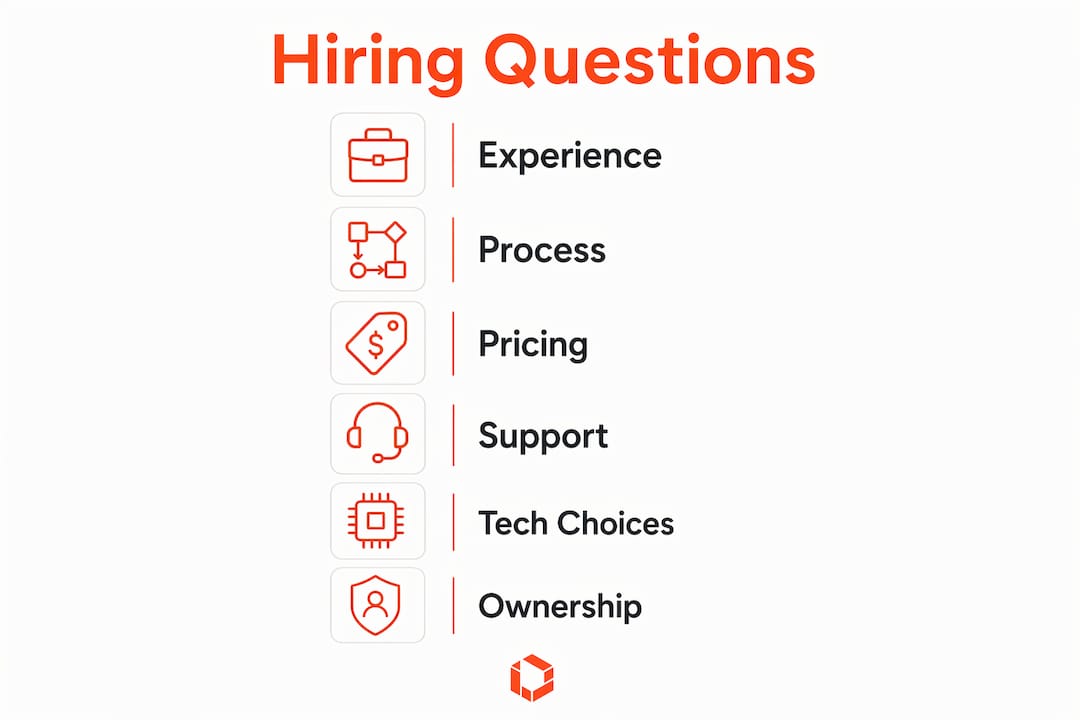
The most important questions to ask before hiring an app developer cover six core areas: their experience and portfolio, development process, pricing and timeline, post-launch support, security practices, and who owns the code when the project ends. Get clear, specific answers to all of them. Vague or evasive responses at this stage predict exactly the kind of project you want to avoid.
The mobile app market continues to grow, but opportunity alone does not guarantee a successful product. Choosing the wrong development partner can lead to missed deadlines, budget overruns, and long-term maintenance problems. That scale means the opportunity is real, but so is the cost of hiring the wrong developer.
What questions should you ask before hiring an app developer?
Use this list as your baseline. Every question here targets a specific risk area, and every answer tells you something concrete about whether this developer can actually deliver.
Experience and portfolio:
Can you show me apps you've built that are similar to what I need?
What industries have you worked in, and how many apps have you launched?
Can you provide references from past clients with similar projects?
Development process:
What methodology do you use: Agile, Waterfall, or something else?
How do you handle scope changes or new feature requests mid-project?
Walk me through how you'd release a feature that affects both the frontend and backend.
Timeline and pricing:
What is a realistic timeline for my project, and what could delay it?
Do you charge fixed rates, hourly, or milestone-based fees?
Can you provide a detailed cost breakdown before we sign anything?
Post-launch support:
What does your maintenance plan look like after launch?
How do you handle app store rejections from Apple or Google?
Who manages bug fixes, updates, and compatibility patches?
Security and technology:
What security practices do you follow for data protection and compliance?
What technology stack do you recommend for my project, and why?
How do you approach scalability as my user base grows?
Legal and ownership:
Who owns the source code and all intellectual property when the project ends?
Will I have full access to the repository from day one?
Are there any proprietary frameworks in your stack that could limit my control?
How do you evaluate a developer's experience and portfolio?
A portfolio tells you what a developer has actually shipped, not just what they claim to know. Look for apps that are live in the App Store or Google Play, not just mockups or internal tools. Relevance matters more than volume: a developer who has built three apps in your industry is more valuable than one with twenty apps in unrelated categories.
When reviewing their work, pay attention to design quality, user flow, and whether the apps still function well. An app that crashes on the current iOS version is a red flag about ongoing maintenance habits. Check the ratings and recent reviews in the app stores.
Ask for the names of specific apps they built so you can download and test them yourself.
Confirm their actual role: did they build the whole app, or just one feature?
Look for portfolio diversity across native iOS, Android, and cross-platform projects.
Ask whether any of their apps scaled to a large user base, and how they handled that growth.
Soliciting client references from similar projects is one of the most reliable ways to validate competence before you commit. When you speak to references, ask specifically about communication during the project, not just the final result. A developer who delivered a great product but went silent for weeks at a time is a pattern you need to know about upfront.
Pro Tip: Ask references one specific question: "Was the final cost within 20% of the original estimate?" Budget overruns are the single most common complaint in app development, and a reference's answer here tells you more than any portfolio screenshot.
For founders evaluating iOS-specific developers, the iOS developer evaluation guide from TouchZen covers the technical questions that separate strong candidates from average ones.
How does a developer's process affect your project?
The development methodology a team uses shapes everything: how often you see progress, how changes get handled, and how quickly problems surface. Agile development breaks work into short sprints, typically one to two weeks, with regular check-ins and deliverables. Waterfall follows a linear sequence where each phase must complete before the next begins. Most experienced developers work in some form of Agile, but what matters more than the label is how they actually run their projects.
Ask how they handle scope changes. Every app project encounters them. A developer who charges a flat fee and refuses any changes mid-project will create friction the moment your requirements evolve. One who has no change-control process at all will let scope creep quietly inflate your budget.
Ask how they communicate progress: weekly calls, project management tools like Jira or Asana, or something else?
Find out how often you'll see working builds during development, not just status updates.
Ask who your primary contact is and whether that person is a senior developer or a project coordinator.
Testing a developer's release planning approach reveals a lot. Ask them to walk you through how they'd release a feature that touches both the frontend and backend. A strong answer covers API coordination, test coverage, deployment strategy, and rollback planning. An answer that only addresses the code itself, with no mention of testing or user impact, signals limited real-world experience.
Client involvement is another dimension worth probing. Some developers prefer to disappear and resurface with a finished product. That approach works for some clients and fails badly for others. Know what you're signing up for before the project starts.

What should you know about timeline and pricing?
Pricing structures in app development fall into three main models: fixed price, hourly rate, and milestone-based payment. Each carries different risk profiles. Fixed-price contracts give you budget certainty but often include conservative estimates that pad for unknowns. Hourly billing gives you flexibility but makes final costs harder to predict. Milestone-based agreements tie payments to deliverables, which creates accountability on both sides.
Transparent communication about realistic timelines and clear budgeting is a baseline expectation, not a bonus feature. Any developer who gives you a firm timeline without asking detailed questions about your requirements is guessing.
Ask what specific factors could delay the project: third-party API dependencies, app store review times, or design revisions.
Request a written cost breakdown that separates design, development, testing, and deployment.
Confirm what happens if the project runs over the estimated timeline: is there a cap, or does the meter keep running?
Ask whether the estimate includes app store submission fees and any third-party service costs.
Deciding between a US-based team and an offshore team also affects both cost and communication. The US-based vs. offshore comparison from TouchZen breaks down the real trade-offs in timezone alignment, quality control, and total project cost. Understanding those trade-offs before you negotiate pricing puts you in a much stronger position.
What post-launch support should you expect from a developer?
Post-launch maintenance covering bug fixes, updates, and compatibility adjustments is critical for long-term app success and user retention. Most developers offer some form of post-launch support, but the terms vary widely. Some include a 30-day warranty period. Others charge hourly for any work after delivery. A few offer retainer-style agreements with defined monthly hours.
App store compliance requirements change regularly. iOS and Android both push operating system updates that can break existing functionality. A developer with no post-launch plan leaves you exposed every time Apple or Google releases a major update.
A reliable developer should have a clear strategy for handling app store rejections from Apple or Google Play, including how they diagnose the rejection reason and how quickly they resubmit. Rejections are common, especially on first submission, and a developer who treats them as your problem rather than theirs is one to avoid.
Ask what their standard warranty period covers and what it excludes.
Find out how they handle emergency bugs that affect core functionality after launch.
Ask whether they monitor app performance and crash reports post-launch, or whether that's your responsibility.
Confirm their process for submitting updates and managing app store compliance over time.
For a detailed breakdown of what post-launch budgeting actually looks like, the app store rejection guide from TouchZen covers the most common rejection reasons and how experienced developers resolve each one.
How should you assess security, scalability, and technology choices?
Security and scalability are not features you add later. They are architectural decisions made at the start of a project, and changing them after the fact is expensive. Ask every developer candidate how they approach both before a single line of code is written.

On the security side, the OWASP Mobile Top 10 is the industry standard reference for mobile app vulnerabilities. A developer who can speak to these risks, including insecure data storage, improper authentication, and insufficient cryptography, understands what they're building against. Ask specifically about data encryption at rest and in transit, consent management, and their approach to penetration testing.
The technical stack discussion should cover API integration, third-party service management, scalability planning, and performance. These factors directly affect how your app behaves under real user load.
Ask whether they recommend native development (Swift for iOS, Kotlin for Android), cross-platform frameworks like Flutter or React Native, or a hybrid approach, and why.
Find out how they handle API versioning and what happens when a third-party service your app depends on changes its API.
Ask how they plan for database scaling and what cloud infrastructure they use. Microsoft Azure, for example, offers managed services that simplify scaling for apps with variable traffic.
Ask about their testing and quality assurance process: unit tests, integration tests, and user acceptance testing before any release.
For founders deciding between development frameworks, the Flutter developer guide from TouchZen explains what to look for when evaluating cross-platform specialists specifically.
If you're still deciding between building an app and using an existing web solution, the DIY vs. hiring a developer breakdown is worth reading before you commit to a development budget.
What TouchZen's experience reveals about hiring the right developer
TouchZen has shipped more than 75 mobile apps across industries, reaching over 20 million collective downloads, with more than 12 apps featured by Apple and Google. That experience has shown us that successful outcomes depend on clear communication, senior-level involvement, and accountability throughout the development process.
One of the most overlooked risks in app development is intellectual property ownership. Some agencies retain rights to proprietary frameworks they use in your build, which means you don't fully own what you paid for. Contracts must guarantee unrestricted repository access and full IP rights from day one, including source code, API credentials, and all design assets.
Pro Tip: Before signing any contract, ask the developer to confirm in writing that you will have full access to the code repository from day one and that all IP transfers to you upon final payment. If they hesitate or propose a clause that retains any rights to their frameworks, treat that as a deal-breaker.
Here is what the TouchZen model looks like in practice, and what you should expect from any serious development partner:
Clear communication with the senior team responsible for building your app.
Weekly progress builds you can actually test, not status reports describing what was done.
A post-launch support plan defined in the contract before work begins, not negotiated after delivery.
Full IP transfer and repository access confirmed in writing before the project kicks off.
A clear escalation path for scope changes, with written approval required before any additional work begins.
The difference between a successful app launch and a stalled project often comes down to these structural agreements, not the technology choices. If you're ready to work with a team that builds accountability into the process from the start, TouchZen's app development services cover iOS, Android, and AI-powered builds with senior developers on every project.
For business owners who want to see how TouchZen ranks among US development teams, TouchZen’s top app developers in the USA overview shows verified client reviews and project outcomes across industries.
Key Takeaways
Hiring the right app developer requires asking specific, structured questions across six areas: experience, process, pricing, post-launch support, security, and IP ownership.
Point | Details |
|---|---|
Portfolio verification | Download and test live apps the developer built; check current ratings and recent user reviews. |
IP ownership in writing | Contracts must guarantee full source code and repository access from day one to prevent vendor lock-in. |
Post-launch plan upfront | Define bug fix coverage, update schedules, and app store compliance support before signing. |
Security from the start | Ask about OWASP Mobile Top 10 practices, data encryption, and penetration testing before development begins. |
Pricing model clarity | Request a written cost breakdown separating design, development, testing, and deployment before work starts. |
Frequently Asked Questions
What should I ask first when hiring an app developer?
Start by asking about similar apps they have launched, their role in those projects, their development process, estimated timeline and budget, post-launch support, and code ownership.
How can I verify an app developer's portfolio?
Download and test their live apps, check recent app-store reviews, confirm exactly what they contributed to each project, and speak with references from similar projects.
Is fixed-price or hourly pricing better for app development?
Fixed pricing works best when the scope is clearly defined. Hourly pricing provides more flexibility when requirements may change. Milestone-based payments can offer a balance by connecting payments to specific deliverables.
Who should own the source code after the project?
Your contract should clearly grant you ownership of the source code, intellectual property, design assets, repository, and essential credentials upon completion and final payment.
What post-launch support should an app developer provide?
Post-launch support should address warranty coverage, bug fixes, operating-system compatibility, app-store resubmissions, performance monitoring, security updates, and ongoing maintenance costs.


