
Joy Foroughi
Executive Assistant


App Monetization Strategy Planning: 2026 Guide
Learn how to choose the right app monetization model in 2026, from subscriptions and freemium to hybrid revenue streams, paywall testing, and long-term growth strategy.

App monetization strategy planning is the process of selecting and implementing revenue streams that align with your app's value and user behavior to maximize profitability. The industry term for this discipline is revenue model architecture, and getting it right early is the single most consequential decision a startup founder makes. Subscriptions now form 65% of all non-game app store revenue, with weekly subscriptions alone accounting for 55.5% of that share. Yet 8 out of 10 new subscription apps fail to generate over $10,000 in lifetime revenue. The gap between those two realities is strategy. Tools like RevenueCat, Adapty, and the App Store's native subscription infrastructure give you the infrastructure. What you do with it determines whether you land in the top 10% or the bottom 80%.
What are the primary mobile app revenue models?
The five core mobile app revenue models are subscriptions, freemium, in-app purchases, in-app advertising, and one-time purchases. Each carries a different risk profile, revenue ceiling, and user experience cost. Understanding the trade-offs before you build saves you from costly architectural pivots later.
Subscriptions generate predictable recurring revenue and dominate non-game apps in 2026. They work best when your app delivers ongoing value, think fitness coaching, productivity tools, or content platforms. Weekly, monthly, and annual tiers each attract different user segments, and annual plans typically deliver the highest lifetime value (LTV).

Freemium with free trials lets users experience core value before committing. This model works well when your product has a clear "aha moment" that converts skeptics into paying users. The free trial variant, where full access is gated behind a trial period, consistently outperforms hard paywalls in consumer apps.
In-app purchases (IAP) split into consumables (coins, credits, boosts) and non-consumables (permanent unlocks, one-time features). Consumables suit games and social apps with repeat engagement loops. Non-consumables fit utility apps where users pay once for a permanent upgrade.
In-app advertising works when your user base is large and engagement is high but willingness to pay is low. Ad revenue scales with volume, not conversion, so it favors apps with millions of daily active users rather than niche tools.
One-time purchase is the simplest model but carries the lowest revenue ceiling. It suits professional tools with a defined feature set and a user base that resists subscriptions on principle.
Model | Revenue Potential | UX Impact | Complexity | Best For |
|---|---|---|---|---|
Subscription | High | Medium | Medium | Content, fitness, productivity |
Freemium + Trial | High | Low | Medium | SaaS, utilities, B2B |
In-app purchases | Very High | Medium | High | Games, social, marketplaces |
In-app advertising | Medium | High | Low | News, entertainment, utilities |
One-time purchase | Low | Very Low | Low | Professional tools, niche apps |
How to plan hybrid monetization for multiple revenue streams
Hybrid monetization is the practice of combining two or more revenue models to capture value from different user segments simultaneously. Top apps now run 2–3 revenue streams tailored by user segment, and the data confirms that hybrid models increase ARPU without sacrificing retention when managed carefully. The key phrase is "when managed carefully." Stacking models without a clear framework creates complexity creep that confuses users and fragments your analytics.
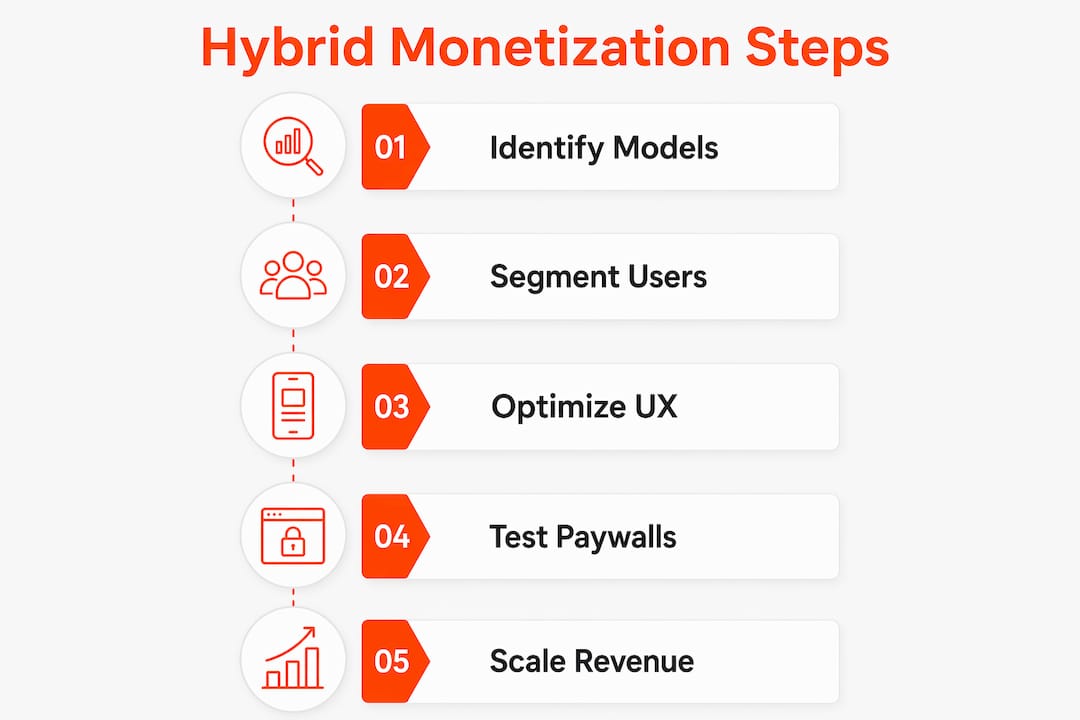
The most common hybrid stack for consumer apps combines a subscription base with consumable in-app purchases for power users and light advertising for free-tier users. Each layer serves a distinct segment. Free users see ads and experience limited features. Paid subscribers get an ad-free experience. Power users within the paid tier can purchase consumables for accelerated outcomes.
Here is a practical framework for building and testing a hybrid model:
Establish your primary model first. Pick the revenue model that best fits your core value proposition and build it to a stable conversion baseline before adding complexity.
Identify underserved segments. Use cohort analysis to find users who engage heavily but do not convert to your primary model. These are your candidates for a secondary revenue stream.
Design the secondary stream to complement, not compete. If your primary model is a subscription, consumable IAPs should accelerate outcomes for subscribers, not replace the subscription for non-subscribers.
Set clear guardrails before launch. Define the metrics that would signal cannibalization: a drop in subscription conversion rate, a rise in churn among users who purchase consumables, or a decline in ad revenue per user.
Run a controlled experiment. Release the hybrid model to 20% of new users, measure all guardrail metrics for 30 days, and compare LTV against your control group before full rollout.
Align your team on the data. Hybrid models require product, engineering, and growth to interpret the same metrics. Misaligned reads on what "success" looks like are the most common reason hybrid experiments fail.
Pro Tip: Start with the simplest possible hybrid stack. Adding a third revenue stream before the first two are optimized is the fastest way to create organizational confusion and dilute your conversion data.
What metrics and experiments drive effective app monetization strategy planning?
Data is the operating system of effective app revenue optimization. Apps running 50 or more experiments earn 18.7 times more revenue than those running only one experiment. The median revenue for high-experiment apps is $914,734 compared to $48,848 for single-experiment apps. That is not a marginal difference. It is the difference between a fundable business and a failed product.
The metrics that matter most for monetization decisions are:
Trial-to-paid conversion rate: Consumer apps average 2–5%, while B2B apps with strong onboarding can reach 50%. Knowing your baseline tells you whether your problem is acquisition, onboarding, or paywall design.
Average Revenue Per User (ARPU): This tells you how much each user is worth across all revenue streams. Low ARPU with high engagement signals a monetization gap, not a product problem.
Lifetime Value (LTV): LTV is the total revenue a user generates before churning. It is the number that determines how much you can spend on user acquisition.
Churn rate: Monthly churn above 5% in a subscription app signals that your value delivery is not matching your value promise.
One of the most counter-intuitive findings in 2026 monetization data concerns paywall design. The paywall with the lowest initial conversion often produces the highest long-term LTV. A paywall that filters for high-intent users may convert fewer people on Day 0 but retain them far longer. This means optimizing purely for Day 0 conversion rate is a trap that inflates short-term numbers while destroying long-term unit economics.
Localization is the highest-leverage paywall optimization available. Localization delivers a 62.3% revenue uplift compared to 28.3% from price changes alone. Translating your paywall copy, adjusting pricing to local purchasing power parity, and adapting trial lengths to regional norms outperforms any single price test you will run. Tools like Adapty and RevenueCat make localized paywall experiments accessible without custom engineering.
Optimization Lever | Revenue Uplift | Complexity | Priority |
|---|---|---|---|
Paywall localization | 62.3% | Medium | High |
Trial length testing | Variable | Low | High |
Price tier restructuring | 28.3% | Low | Medium |
Paywall timing (trigger point) | Variable | Medium | High |
Pro Tip: Track paywall design performance by cohort LTV at 30, 60, and 90 days, not just Day 0 conversion. The variant that wins on Day 0 often loses at Day 90.
How does your monetization model shape app growth and user experience?
Monetization model selection is an architectural choice that influences acquisition cost, retention loops, and platform integrations from day one. Choosing the wrong model does not just limit revenue. It creates long-term strategic drag on growth by misaligning your unit economics, user acquisition strategy, and product roadmap simultaneously.
Consider a fitness app that launches with a one-time purchase model. The team quickly discovers that user acquisition cost (UAC) exceeds the one-time price in paid channels, making paid growth mathematically impossible. Switching to subscriptions mid-product requires rebuilding the billing architecture, retraining the support team, and re-educating existing users. The cost of that pivot often exceeds the cost of getting the model right at launch.
The relationship between monetization and app store optimization (ASO) is also direct. Subscription apps benefit from App Store and Google Play featuring algorithms that favor apps with strong retention signals. A freemium app with high daily active users but low conversion sends mixed signals to platform algorithms, which can suppress organic discovery.
Platform commissions add another layer of complexity. Apple and Google both take a 15–30% commission on in-app transactions. For apps approaching $1 million in annual revenue, app-to-web checkout becomes a viable strategy for high-intent, organic, and re-engagement users. The engineering overhead is significant, and app-to-web billing only becomes advantageous over in-app billing after reaching $1 million in annual revenue. Below that threshold, the operational complexity outweighs the commission savings.
Aligning your UX design with your monetization model from the start prevents the most common growth bottleneck: a product experience that works against conversion. If you want to explore how user experience choices affect monetization outcomes directly, the connection runs deeper than most founders expect.
Key takeaways
Effective app monetization strategy planning requires choosing the right revenue model architecture early, running continuous experiments, and aligning UX design with monetization goals to build sustainable growth.
Point | Details |
|---|---|
Subscriptions dominate revenue | Subscriptions form 65% of non-game app store revenue; build your primary model around recurring value. |
Hybrid models require guardrails | Stack revenue streams only after your primary model is stable and with clear cannibalization metrics defined. |
Experimentation drives revenue | Apps running 50+ experiments earn 18.7x more revenue; treat your paywall as a product, not a one-time decision. |
Localization beats price changes | Paywall localization delivers 62.3% revenue uplift versus 28.3% from price adjustments alone. |
Model choice is architectural | Picking the wrong monetization model creates strategic drag that compounds across UA, retention, and platform tooling. |
The monetization mistake i see founders make most often
Most founders treat monetization as a feature they will "figure out later." I have watched this play out across dozens of app launches, and the pattern is consistent. The team spends six months building a product, ships it with a basic paywall, and then discovers that the monetization model they chose does not fit the user behavior they actually see in production.
The founders who avoid this are the ones who treat monetization as a hypothesis to test before they finish building, not after. They run pricing surveys during beta, test paywall copy with landing pages before the app is live, and instrument their analytics to capture conversion signals from day one. That discipline is what separates the top 10% of apps from the majority that never reach $1,000 in revenue.
The second mistake I see is founders confusing activity with progress when it comes to experimentation. Running 50 experiments is not the goal. Running 50 well-designed experiments with clear hypotheses, clean control groups, and LTV-based success metrics is the goal. Sloppy experiments produce misleading data that leads to confident wrong decisions.
My honest advice: pick one monetization model, get it to a stable conversion baseline, and then layer complexity. Localize your paywall before you test a new pricing tier. Test trial length before you add a consumable IAP layer. The 2025 mobile app market data confirms that consumer spending is rising even as download volumes fall. Users are willing to pay. Your job is to build a monetization structure that makes paying feel like the obvious choice.
— Cyrus
Build your monetization strategy with the right development partner
Implementing a sophisticated monetization model requires more than a good plan. It requires a development team that understands how paywall architecture, billing integrations, and UX design interact at the code level.
Touchzen has launched over 75 apps across industries, delivering results like a 10x increase in user subscriptions and 100,000 downloads within the first year. The team works directly with senior developers and designers, so your monetization architecture gets built right the first time. From mobile app development that supports complex hybrid billing systems to UX/UI design that converts at the paywall, Touchzen builds the infrastructure your revenue strategy depends on. If you are ready to move from planning to execution, the team is ready to build with you.
FAQ
What is app monetization strategy planning?
App monetization strategy planning is the process of selecting, structuring, and testing revenue models that align with your app's value proposition and user behavior. It covers model selection, paywall design, pricing tiers, and ongoing experimentation to maximize LTV.
Which monetization model generates the most revenue?
Subscriptions generate the most revenue for non-game apps, forming 65% of all non-game app store revenue as of 2026. Hybrid models that combine subscriptions with in-app purchases or advertising can increase ARPU further when managed carefully.
How many experiments should i run on my paywall?
Apps running 50 or more experiments earn 18.7 times more revenue than those running only one. Start with trial length and paywall copy tests, then move to localization and pricing tier experiments as your user base grows.
When does app-to-web checkout make sense?
App-to-web checkout becomes financially advantageous only after your app reaches $1 million in annual revenue. Below that threshold, the engineering overhead and operational complexity outweigh the savings from avoiding platform commissions.
What is the biggest risk in hybrid monetization?
The biggest risk is complexity creep, where adding multiple revenue streams fragments your analytics and confuses users before your primary model is stable. Define cannibalization guardrails and test each new stream in a controlled experiment before full rollout.