Joy Foroughi
Executive Assistant


Modernize Legacy Apps Without Starting From Scratch
Unlock Legacy Application Modernization Without Starting From Scratch. Discover practical strategies to incrementally modernize with minimal disruption.

TL;DR:
Most organizations prefer incremental modernization methods like the strangler pattern and API facades rather than rewriting entire systems. A 2–4 week assessment maps dependencies, identifies bounded contexts, and selects a pilot to build momentum. Technical controls such as feature flags, canary deployments, and observability are essential for safe, reversible rollouts.
You don't need to rewrite your entire system to modernize it. Legacy application modernization without starting from scratch is the practical default for most organizations: use incremental techniques like the strangler fig pattern, API facades, anti-corruption layers, and targeted refactoring to replace aging components one bounded context at a time. The single highest-impact first step is a focused 2–4 week assessment phase that maps runtime dependencies, identifies bounded contexts, and selects an early-win pilot to build organizational momentum.
Before you commit to any path, orient around these highest-leverage levers:
Dependency mapping and architectural observability: replace tribal knowledge with live runtime data before touching a single line of code
Strangler fig pattern: route traffic through a facade, build new services in parallel, retire legacy components after cutover
API facades and anti-corruption layers: expose clean interfaces to the outside world while the legacy core is still running
Feature flags and canary deployments: control rollout risk and preserve rollback capability at every stage
The 7 R's framework: a structured decision model (rehost, replatform, refactor, rearchitect, replace, retire, retain) that prevents over-engineering
TouchZen works with technology leaders at exactly this stage: scoping the assessment, selecting the right R for each bounded context, and delivering early-win pilots that build the internal confidence to fund the next wave.
What is legacy application modernization and why does incremental matter?
Legacy application modernization is the process of updating outdated software so it runs efficiently on current platforms, meets current security and compliance standards, and supports the business capabilities your teams need now. The goal is not aesthetic. It's about maintainability, agility, and cost control.
The business drivers are well-documented. Security and regulatory exposure grows every year a system runs on an unsupported framework. Operational costs compound as the talent pool for older languages shrinks. Feature velocity slows when every change requires navigating years of undocumented coupling. And increasingly, legacy security and data flow limitations create blind spots that block real-time decisioning and agentic AI workflows, which are becoming table stakes for competitive operations in 2026.
Incremental modernization wins on three dimensions that a full rewrite cannot match. First, continuity: the business keeps running while modernization happens in the background. Second, risk: each bounded context is a contained experiment with a defined rollback path. Third, value: you can deliver measurable improvements in deployment frequency or mean time to recovery (MTTR) within weeks, not years, which is what secures the next round of funding.
Pro Tip: Frame your modernization program around two or three measurable early wins, such as a 20% reduction in deployment lead time or a specific MTTR target, rather than a multi-year transformation roadmap. Concrete, near-term outcomes are what move budget committees and keep engineering teams engaged.
What are the 7 R's and which ones avoid a full rewrite?
R-based frameworks are commonly used to compare modernization and migration options, although the number and labels vary by provider. In this article, we use seven modernization-focused options: rehost, replatform, refactor, rearchitect, replace, retire, and retain. Each has a different risk profile, cost structure, and level of engineering effort.
The 7 R's at a glance
Rehost (lift-and-shift): Move the application to a new environment, typically cloud infrastructure, with minimal code changes. Fast, low-risk, and a good first step when the priority is datacenter exit or cost reduction.
Replatform: Migrate to a new platform while making targeted optimizations, such as swapping a self-managed database for a managed cloud service. Moderate effort, meaningful operational gains.
Refactor: Restructure and optimize existing code to improve performance and maintainability without changing core functionality. The right choice for a payments module or authentication service that works but carries significant technical debt.
Rearchitect: Redesign the underlying architecture, typically moving from a monolith toward microservices or a modular monolith as an intermediate step. Higher effort, but the path to long-term scalability and AI-readiness.
Replace: Retire the legacy application and adopt a modern SaaS or off-the-shelf solution. Best when maintaining the existing system costs more than switching.
Retire: Decommission the system entirely. No migration, no modernization, just a clean shutdown.
Retain: Leave the system as-is, deliberately. Not every system needs to change, and forcing modernization on a stable, low-traffic system wastes engineering hours.
The table below maps each R to its rewrite risk and a practical use case.
R | Avoids full rewrite? | Practical use case |
|---|---|---|
Rehost | Yes | Datacenter exit, fast cloud migration |
Replatform | Yes | Swap self-managed DB for managed cloud service |
Refactor | Yes | Reduce technical debt in a payments or auth module |
Rearchitect (strangler) | Yes, incrementally | Break a monolith into services over multiple waves |
Replace | Yes, by adopting another product | Legacy ERP too costly to maintain |
Retire | N/A | Decommission unused internal tools |
Retain | Yes | Stable, low-risk system with no business case to change |
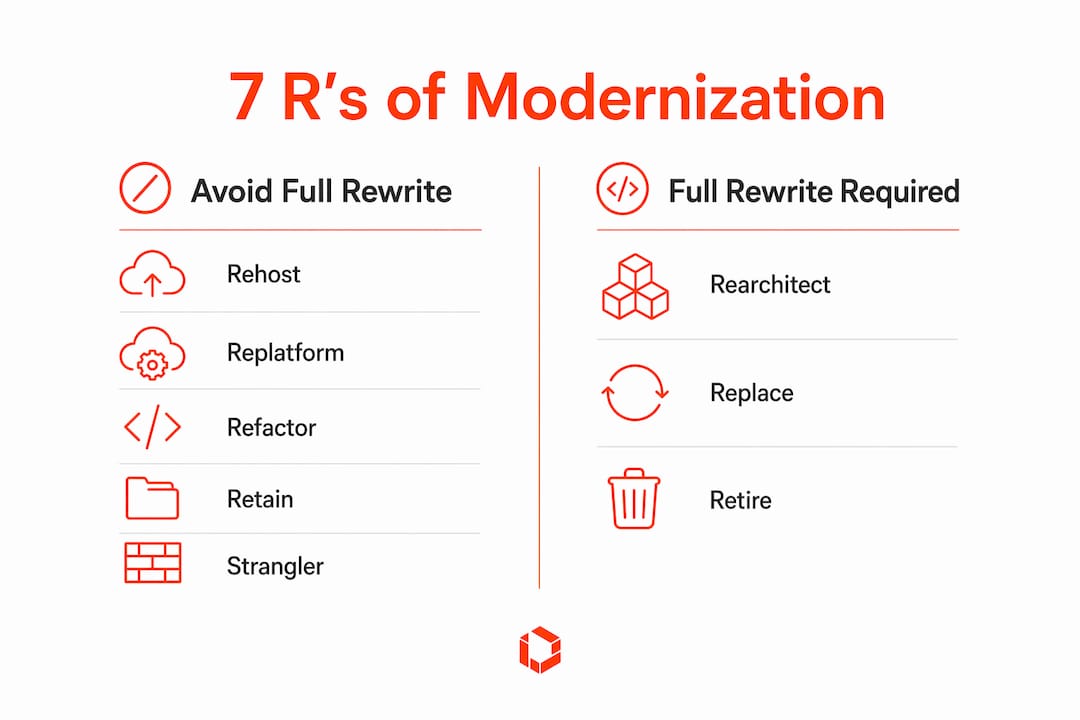
Some legacy applications do not justify modernization investment and belong in the retain or retire bucket. Use a three-bucket triage—stay, modernize, or replace—to prioritize applications by business value and technical health before committing engineering resources.
When rebuild or replace is the right call, document the decision explicitly: record the business value score, the technical health score, and the cost comparison. That paper trail protects the team when stakeholders revisit the decision six months later.
Which technical patterns let you modernize without a full rewrite?
The patterns below are the practical toolkit for incremental modernization. Each one lets you change a bounded context without stopping the rest of the system.

Strangler fig pattern
Build new functionality as independent services, route traffic through a facade, and retire the legacy component after cutover. The facade is the control plane: it handles traffic splitting, rollback routing, and the eventual decommission. Start with a bounded context that has clear inputs and outputs and low shared-state coupling. A reporting module or a notification service is a better first candidate than a core transaction engine.
Pro Tip: Define your routing rules and rollback triggers before you write a single line of new service code. A facade without a documented rollback path is a deployment risk, not a safety net.
API facade
Expose a clean, versioned API surface in front of the legacy system. External consumers call the facade; the legacy core handles the request. Over time, you replace the legacy implementation behind the facade without changing the contract. This pattern is particularly effective for improving outdated applications that need to integrate with modern platforms, analytics pipelines, or AI services.
Anti-corruption layer (ACL)
When two systems with incompatible domain models need to communicate, an ACL translates between them without letting the legacy model's concepts leak into the new service. This is the pattern that prevents the new codebase from inheriting the old system's worst design decisions.
Adapter and wrapper
Wrap a legacy component with a modern interface so it can participate in a new architecture without being rewritten. Lower effort than a full refactor, and reversible. The trade-off is that the legacy code's performance and reliability characteristics remain unchanged.
Dual-write and change data capture (CDC)
During data migration, write to both the legacy and new data stores simultaneously, then validate consistency before cutting over. CDC tools like Debezium stream changes from the legacy database in near real time, reducing the synchronization window. Use row-count and checksum validation on financial or transactional data before you flip the switch.
Containerization
Package the legacy application in a Docker container to improve portability and reduce environment-specific failures. Kubernetes then manages deployment, scaling, and health checks. Containerization is not modernization by itself, but it can create a more consistent deployment foundation for incremental refactoring by reducing environment drift.

The shared-database anti-pattern is the single most common source of hidden coupling. If two services share a database schema, you have not actually decoupled them. Resolve schema ownership before you claim a bounded context is independent.
How to run a focused assessment and pick your early-win pilot
A 2–4 week assessment is the evidence-based foundation for every modernization decision that follows. Skip it, and you are planning from stale documentation and tribal knowledge. Run it well, and you produce a defensible roadmap and a pilot selection the whole organization can get behind.
Here is the assessment checklist in sequence:
Application inventory: catalog every system, its business function, its owner, and its rough traffic and transaction volume.
Runtime dependency mapping: use architectural observability tools to map live call graphs, data flows, and failure domains. This replaces guesswork with evidence.
Code quality scan: run static analysis (SonarQube, Checkmarx, or equivalent) to surface technical debt hotspots, security vulnerabilities, and test coverage gaps.
Data schema mapping: document every data store, its ownership, and its consumers. Flag shared schemas immediately.
Stakeholder interviews: capture undocumented business rules, integration constraints, and political dependencies that no tool will surface.
Three-bucket triage: score each application on business value and technical health, then assign it to stay, modernize, or replace.
Early-win selection: choose one bounded context with high business visibility, low coupling, and a clear success metric. This is your pilot.
The typical timeline from assessment to first production rollout looks like this: discovery and assessment (2–4 weeks), pilot build and validation (6–12 weeks), then wave rollouts of additional bounded contexts in 8–12 week increments. Each wave funds the next by demonstrating measurable outcomes.
For the pilot itself, define kill criteria before you start: what technical or business signal triggers a rollback? Set a rollback window based on the system’s data, compliance, and operational constraints, and establish clear testing and release criteria before any pilot component goes to production. These governance controls are what separate a well-run pilot from an expensive experiment.
What technical controls belong in an incremental modernization roadmap?
The technical checklist below is the backbone of a safe, repeatable modernization program. Each control reduces the blast radius of a failed deployment and preserves your ability to roll back.
Control | Purpose | Key consideration |
|---|---|---|
CI/CD pipelines | Automate build, test, and deploy for every bounded context | Separate pipelines per service reduce blast radius |
Automated regression and integration tests | Catch regressions before production | Set a minimum coverage threshold before pilot go-live |
Feature flags | Control rollout and enable instant rollback | Avoid flag sprawl; retire flags after cutover |
Canary deployments | Progressive rollout to a subset of traffic | Define success metrics and auto-rollback triggers |
Observability (metrics, logs, traces) | Detect anomalies in real time | Instrument new services before legacy decommission |
Secrets and config management | Prevent credential exposure during migration | Use Vault, AWS Secrets Manager, or equivalent |
Data validation (row-count, checksum) | Verify migration fidelity for financial data | Run validation before and after every cutover |
Data migration is often one of the longest and riskiest parts of modernization. Appropriate controls may include CDC or carefully designed dual-write patterns, reconciliation checks, backups, schema changes behind feature flags, and a rollback plan tailored to the system. For financial or transactional data, validate migration integrity with methods such as record counts and checksums before cutover.
Feature flags, canary deployments, and automated regression suites are the operational guards that make incremental rollouts safe. Without them, every deployment is a binary bet. With them, you can roll forward or back in minutes, not hours.
Pro Tip: Moving toward cloud-native architecture can reduce infrastructure and operating costs by 15%–35% annually for some migrations. Use that range as a conservative anchor in your business case, not a guarantee, and tie it to the specific bounded contexts you are targeting.
For timeline and cost planning, budget roughly two to four weeks for assessment, six to twelve weeks per pilot, and eight to twelve weeks per subsequent bounded-context rollout. Costs scale with coupling complexity, test coverage debt, and data migration scope. The app development acceleration practices that reduce pilot cycle time most reliably are automated testing, trunk-based development, and pre-built infrastructure templates.
What organizational structures sustain incremental modernization?
Technical patterns alone do not deliver a modernization program. The organizational structures around them determine whether the program survives contact with the first production incident.
Readiness checklist:
Executive sponsor: a named leader with budget authority who can unblock cross-functional decisions and protect the program from competing priorities
Product owner: someone who owns the business outcome for each bounded context, not just the technical delivery
Cross-functional squad: engineers, a security representative, a data owner, and a platform lead assigned to the pilot from day one
Runbooks and support agreements: documented escalation paths and on-call responsibilities before the pilot goes live, not after
KPI set for incremental modernization programs:
Deployment frequency (DORA metric): how often you ship to production
Change failure rate (DORA): percentage of deployments that cause a production incident
Lead time for changes (DORA): time from code commit to production
MTTR: how quickly you recover from incidents
Cost per transaction: tracks operational efficiency gains over time
Feature lead time and adoption: measures whether modernized components actually accelerate business delivery
The roles matrix matters most at three decision points. During assessment, the security lead and data owner must sign off on the dependency map and data schema inventory. During the pilot, the product owner owns the success metrics and the kill criteria decision. During wave rollouts, the platform lead owns the infrastructure template and the CI/CD pipeline standards.
Securing incremental budget is a communication challenge as much as a financial one. Present the pilot's ROI in terms the finance committee understands: reduced MTTR, lower infrastructure cost, faster feature delivery. Tie each metric to a dollar figure where possible. The technical debt decision framework that resonates most with budget committees is a simple comparison: the cost of the next 12 months of maintenance versus the cost of the pilot plus the projected savings.
Key Takeaways
Incremental modernization, anchored by a 2–4 week evidence-based assessment and an early-win pilot, is the lowest-risk path to upgrading legacy systems without a full rewrite.
Point | Details |
|---|---|
Start with a 2–4 week assessment | Map runtime dependencies and select one early-win bounded context before committing to any modernization path. |
Use the 7 R's to triage, not just plan | Some legacy apps belong in retain or retire; modernizing without a clear business case wastes budget and resources. |
Strangler fig and API facades reduce rewrite risk | These patterns let you replace components incrementally while the legacy system keeps running. |
Technical controls are non-negotiable | Feature flags, canary deployments, automated tests, and a 30-day rollback window protect every pilot deployment. |
TouchZen delivers assessment-to-pilot engagements | TouchZen's senior-developer model and record of 75+ successful app launches supports low-risk modernization pilots from scoping through production. |
The case for evidence-based modernization over instinct
Modernization programs often struggle when planning is based on assumptions rather than verified dependencies. A team may commit to a long rewrite and discover late in the project that critical integrations were never documented, turning the rewrite into a costly rescue effort.
The incremental approach described here is not a compromise. It is the more disciplined path. Running a live dependency map before choosing a strategy, selecting a bounded context with clear boundaries and a measurable success metric, and defining kill criteria before the pilot starts: these are the practices that separate programs that deliver from programs that stall.
There is a tendency among technology leaders to treat the assessment phase as overhead, something to compress or skip when the pressure to "start modernizing" is high. That instinct is exactly backward. The assessment is where you earn the right to move fast. Without it, speed is just risk in disguise.
One more thing worth saying plainly: not every legacy system needs to be modernized. The retain decision, made deliberately and documented, is a legitimate outcome of a good assessment. Spending engineering hours on a stable system with no growth trajectory is a cost, not a virtue.
TouchZen can run your modernization assessment and pilot
If you are ready to move from planning to execution, TouchZen offers a structured path from assessment through pilot delivery and beyond. The engagement starts with a focused discovery phase where senior developers map your runtime dependencies, identify bounded contexts, and produce a prioritized modernization roadmap with a clear early-win selection.
From there, TouchZen builds and validates the pilot, managing the technical controls (CI/CD, feature flags, automated testing, observability) that keep the rollout safe and reversible. From there, TouchZen can help scope and implement incremental improvements with clear testing, rollout, and measurement plans. Our model provides direct access to senior specialists alongside clear project leadership. With more than 75 apps shipped and recognition in IT consulting, TouchZen brings practical experience delivering complex digital products.
Post-pilot, the team stays engaged through wave rollouts and ongoing support, so the program does not stall after the first win. Whether your priority is cloud migration, AI-readiness, or reducing maintenance cost, the path starts with a conversation.
Discuss your modernization goals with TouchZen and identify the right next step for your product.
Useful sources for incremental modernization
These resources are worth reading in the order listed, from foundational frameworks to specific tooling.
Microsoft Azure: What Is Application Modernization — the clearest overview of modernization strategies, including rehost through rearchitect, with cloud-native context. Start here if you need to brief a non-technical executive.
IBM: What Is Legacy Application Modernization — strong coverage of technical debt, DevOps integration, security considerations, and containerization with Docker and Kubernetes.
vFunction: The Ultimate Guide to Application Modernization — the best single source on architectural observability and the 7 R's framework. Read this before your assessment phase.
CC Conceptualise: Modernizing Legacy Applications — A Pragmatic 4-Phase Approach — detailed guidance on the assessment-to-pilot timeline, strangler fig implementation, and data migration controls.
Catio: How to Modernize Legacy Applications — practical coverage of three-bucket prioritization and operational risk controls (feature flags, canary deployments, regression suites).
CGI US: Modernizing Legacy Applications Is No Longer Optional — business case framing, including the 15%–35% infrastructure savings estimate for cloud-native migrations.
GAO: IT Modernization Report — authoritative US government perspective on legacy system risk and modernization investment priorities.
NetFusion Designs: Our Migration Approach — a companion read on migration methodology and planning for teams that want a structured partner-level framework alongside their internal assessment.
TouchZen: Mobile App Development Services — TouchZen's primary engagement page for modernization pilots, MVP builds, and platform migrations.
FAQ
What are the 7 R's of application modernization?
The 7 R's are rehost, replatform, refactor, rearchitect, replace, retire, and retain. They form the modernization-focused framework used in this article, although terminology and categories vary across providers.
Which modernization strategies avoid a full rewrite?
Rehost, replatform, refactor, retain, and strangler-based rearchitecting all avoid a full rewrite. They let you replace or improve components incrementally while the existing system continues to run.
How long does a legacy modernization assessment take?
A focused assessment typically takes 2–4 weeks and produces a runtime dependency map, a three-bucket application triage, and an early-win pilot selection. That foundation is what makes the subsequent pilot defensible and fundable.
Why do legacy systems block AI and real-time use cases?
Legacy security and data flow limitations create observability blind spots and throughput constraints that prevent real-time decisioning and agentic AI workflows. Modernizing for observability and throughput is the prerequisite for integrating AI-driven operations.
What is the strangler fig pattern in practice?
The strangler fig pattern involves building new functionality as an independent service, routing traffic through a facade that splits requests between the legacy and new implementations, and retiring the legacy component once the new service is validated. It is the most widely used incremental modernization pattern because it preserves rollback capability at every stage.