
Joy Foroughi
Executive Assistant


Product Owners: 30 60 90 Day Stabilization to Vet Maintenance Vendors
The moment your original team hands off the keys, stop and run three checks before signing anything: confirm you actually own every account tied to the app, get proof of working monitoring and a successful backup restore, and demand a written SLA with a tested incident process. If those three checks fail, don't hire a maintenance partner yet. Instead, spend one focused stabilization window fixing them, whether that's an internal sprint or a vendor's paid audit.

The moment your original team hands off the keys, stop and run three checks before signing anything: confirm you actually own every account tied to the app, get proof of working monitoring and a successful backup restore, and demand a written SLA with a tested incident process. If those three checks fail, don't hire a maintenance partner yet. Instead, spend one focused stabilization window fixing them, whether that's an internal sprint or a vendor's paid audit.
TL;DR:
Confirm ownership and test backups, builds, and rollback procedures during the handover to avoid costly surprises later.
Focus stabilization efforts in the first 30 days by closing access gaps, centralizing monitoring, and validating backups with actual restores.
Use a 30–60–90-day plan to prioritize access, monitoring, and operational improvements; actual stabilization time depends on the app's condition.
Evaluate vendors based on proven incident response capabilities, secure development practices, and documented experience managing handovers, not just promises.
Match maintenance pricing models to your app's criticality, with retainers suited for steady growth, while low-traffic apps may only need break-fix agreements.
How to Choose Mobile App Maintenance Services After a Team Handover
Every credible vendor decision starts with matching your app's actual needs to a service model, not the other way around. Product owners who skip this step end up buying a retainer sized for an enterprise app when they have a scrappy MVP, or a cheap break-fix deal when their revenue depends on uptime.
Mobile app maintenance breaks into four categories, and mixing them up is where budgets go sideways:
Corrective maintenance fixes what's broken: crash reports, memory leaks, a payment flow that silently fails on certain Android builds.
Adaptive maintenance keeps the app working as the outside world changes: a new iOS release, a Google Play API level bump, a deprecated third-party SDK.
Perfective maintenance improves what already works: shaving load times, refining a clunky onboarding screen, tuning push notification timing.
Preventive maintenance heads off future failures: dependency audits, security patching, refactoring code that's becoming unmanageable.
Engagement models map loosely to these categories. Break-fix arrangements suit a low-traffic MVP where you just need someone on call. A retainer works for apps in steady growth because it bundles a predictable block of hours across all four maintenance types. A dedicated resource (one or two engineers embedded with your product) fits apps complex enough to need continuity of institutional knowledge. Hybrid models blend a baseline retainer with hourly overflow for spikes.
The trade-off is always the same triangle: control, cost, and readiness. A junior-heavy team costs less per hour but takes longer to diagnose inherited code, which erases the savings fast.
What Should You Verify Before Hiring Anyone?
Before you evaluate a single vendor proposal, verify the handover itself was real. A surprising number of "completed" handovers turn out to be a code repository and a goodbye email, nothing more.
Run through this sequence:
Confirm account ownership. Check who controls the App Store Connect and Google Play Console listings, the cloud provider project, billing contacts, third-party service accounts (payment processors, push notification providers, analytics), and whether credentials have moved into a password manager your team controls. Google Play's own transfer documentation notes that transfers require both accounts to stay active during the process, and can involve temporary unpublishing or payment-profile checks, so this step needs to happen early, not on deadline day.
Test reproducibility. Pull the repository onto a clean machine and build it from scratch. If it doesn't compile without someone's personal environment quirks, you've found your first real risk.
Run a backup restore drill. Don't take "we have backups" on faith. Actually restore one and confirm the data comes back intact.
Rehearse a low-risk deploy and rollback. Push a trivial change to a test environment, then roll it back. This surfaces broken CI/CD pipelines before they surface in production.
Inventory documentation. Look for an architecture diagram, runbooks for common incidents, a known-issues list, and current monitoring/alerting configuration.
Pro Tip: Ask the departing team to sit on a 30-minute call while you attempt the clean build. Watching where they hesitate tells you more about hidden fragility than any document they hand over.
If you find unbuildable code, missing store ownership, secrets committed directly into the repository, or no evidence backups have ever been tested, pause. Hiring a maintenance vendor on top of an unverified handover just moves the fire to someone else's desk, at your expense.
What Should the First 90 Days Look Like?
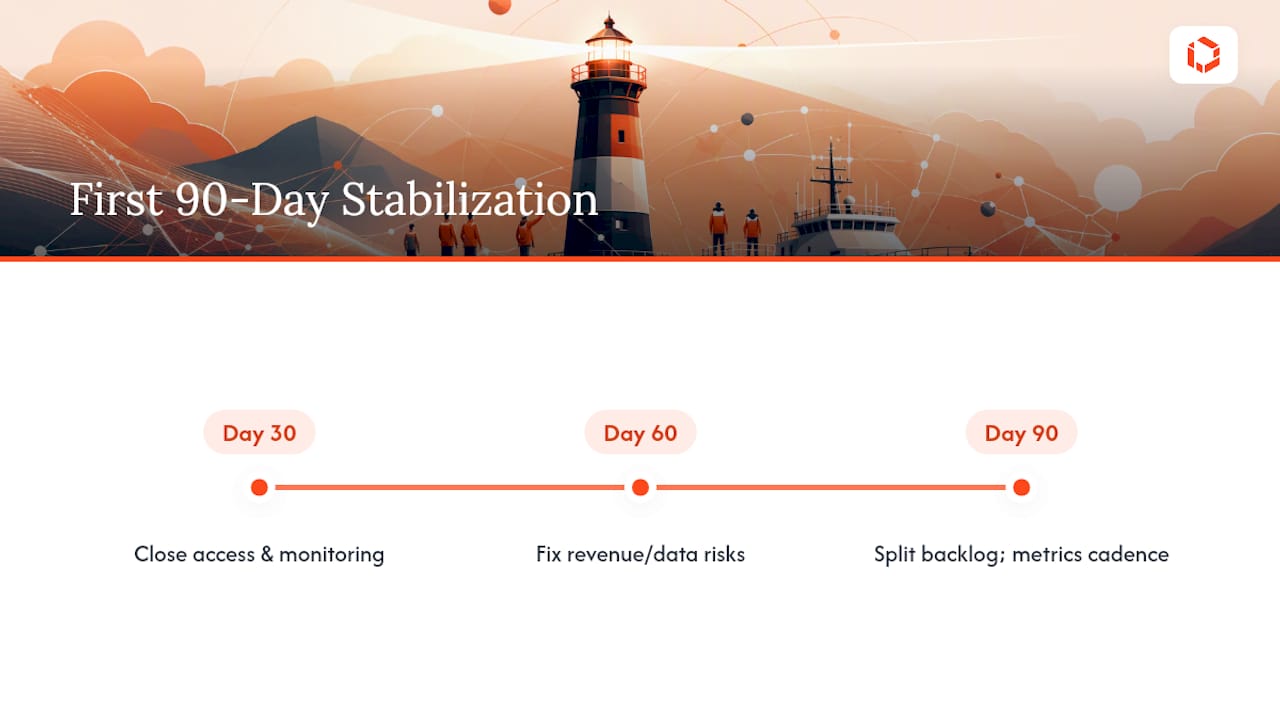
Stabilization takes a deliberate sequence of checks and fixes. The 30/60/90-day milestones below are a planning framework, not a guaranteed timeline: the app's condition, access gaps, and outstanding risks determine how long the work takes.
In the first 30 days, close every access gap you found in the handover checklist. Centralize error tracking and monitoring into one dashboard rather than three disconnected tools. Set alerts on the flows that actually matter: authentication, checkout, billing. Validate backups with an actual restore, not a checkbox. Run one low-risk production deploy with a rehearsed rollback path.
By day 60, resolve the risks serious enough to threaten revenue or data integrity. Improve CI/CD reliability so deploys stop feeling like gambling. Add basic service-level objectives for uptime and response time. Remove any shared or generic credentials still floating around from the previous team. Patch the vulnerabilities flagged as critical.
By day 90, split your backlog into three honest lanes: stabilization work still outstanding, technical debt reduction, and new feature delivery. Start chipping at the debt lane deliberately rather than letting it pile up behind feature requests. Instrument performance metrics with a reporting cadence stakeholders can actually follow week to week.
A useful discipline here comes from operational quick wins documented in app takeover practice: one-command local setup, mandatory tests on every pull request, a protected main branch, and written runbooks for your top three recurring incidents. None of these are glamorous. All of them are the difference between a team that firefights forever and one that stabilizes and moves on.
How Do You Evaluate and Contract a Maintenance Vendor?
Once your app is stable enough to hand off, evaluate vendors on evidence, not sales pitches. Anyone can promise a four-hour response time. Far fewer can show you a tested playbook that proves it.
Start with capabilities:
Cross-platform experience across iOS, Android, and whichever cross-platform framework your app uses (Flutter, React Native).
Seniority of the engineers actually assigned to your account, not the ones featured in the sales deck.
Documented experience managing past handovers, ideally with specifics on what went wrong and how they fixed it.
Real observability tooling already in place, not something they'll "set up later."
SLA language deserves scrutiny most buyers skip. A response-time SLA (someone acknowledges the ticket) is not a resolution-time SLA (the problem is actually fixed). Both should be defined by severity, with a clear escalation ladder and a required post-incident report. NIST SP 800-61 Revision 3 sets the standard here: incident response needs documented playbooks, defined roles, and periodic testing, not just a promised turnaround time printed on a proposal.
Security demands the same evidentiary standard. NIST's software supply-chain guidance recommends asking suppliers to demonstrate secure development practices, active vulnerability management, and signed change control, backed by actual documentation rather than a checkbox on a questionnaire.
Pro Tip: Ask every finalist vendor for a redacted example of a real incident report they filed for another client. If they can't produce one, their "incident process" probably exists only in the sales deck.
Contracts need to nail down account-transfer terms, IP and repository ownership, exit obligations if you leave, defined scope of work, termination notice, and the fee and scope for that initial stabilization audit. Score proposals on a simple rubric: technical fit, SLA clarity, security posture, and pricing transparency, weighted however matters most to your app.
How Much Should Post-Handover Maintenance Cost?
Pricing shapes vary more than most first-time buyers expect, and matching the model to your app's criticality matters more than chasing the lowest hourly rate.
Monthly retainer, priced either by hours or by SLA tier, suits apps in steady growth that need predictable coverage across all maintenance types.
Hourly or time-and-materials billing fits apps with light, unpredictable maintenance needs, typically early-stage MVPs.
Break-fix pricing works only for low-traffic apps where downtime carries minimal cost.
Dedicated team or full-time-equivalent arrangements suit enterprise-scale apps where continuity and institutional knowledge outweigh flexibility.
Budget in proportion to what failure would cost you. A revenue-critical checkout flow justifies a bigger monthly retainer than a low-traffic internal tool ever would. Whatever model you choose, build in a separate line item for the initial audit and stabilization work. That phase can cost more than steady-state maintenance because it involves discovery, not routine upkeep. For a fuller breakdown of typical maintenance cost ranges and what drives them, it helps to see real numbers before you negotiate.
Contracts should also define scaling clauses (what happens when usage doubles), how overage hours get billed, and what counts as out-of-scope work requiring a separate quote. Vague scope language is where "maintenance retainers" quietly turn into never-ending change requests.
What Does TouchZen Bring to a Post-Handover Engagement?
When comparing providers, ask who will actually work on the inherited codebase and speak with your team. If you're considering TouchZen, confirm the assigned engineers, communication plan, and scope of the initial audit in the proposal.
The following steps illustrate a possible stabilization engagement; the actual sequence and deliverables should be agreed upon after assessing the app.
A proposed stabilization sequence could mirror the 30/60/90 approach outlined earlier:
Full access and account inventory before any code changes begin.
A monitoring baseline established early in the engagement.
A backup restore drill planned, run, and documented where access allows.
Prioritized remediation of the highest-severity risks found.
A written handover record so the next transition, whenever it happens, isn't starting from zero.
Readers who want more depth on outsourcing without losing operational control or on tightening a mobile development workflow will find both useful before any vendor conversation.
Common Mistakes Product Owners Make After a Handover
The pattern repeats across nearly every inherited app: the product owner accepts an undocumented handover because pushing back feels adversarial, skips the backup restore check because it seems like busywork, and greenlights new feature work before anyone confirms the app is stable. Each shortcut feels reasonable in isolation. Together, they guarantee a crisis within months.
The fix is unglamorous but effective. Insist on proof, not promises: a clean build, a restore drill, a rollback rehearsal. Require an initial stabilization window before any vendor touches the roadmap. Score every vendor proposal against the same rubric instead of trusting whoever pitches the most confidently.
None of this requires deep technical expertise from the product owner. It requires refusing to skip steps that feel inconvenient under deadline pressure, which is exactly when they matter most.
Get a Managed Maintenance Partner for the Stabilization Work
One option is to scope a stabilization audit with a maintenance provider, then agree on ongoing support and incident response based on the risks the audit uncovers.
Ask for a proposal that specifies the 30/60/90 priorities, the assigned point of contact, reporting cadence, restore testing, and handover obligations. TouchZen's Ongoing Support & Growth and Staff Augmentation pages describe two possible service models. Confirm the exact deliverables, timelines, and exit terms in writing before committing. For a scoped stabilization audit, share your current access inventory and next release date.
Sources
Before signing anything, check these directly: NIST's incident handling guide for what a real incident process requires, NIST's supply-chain security guidance for vendor security expectations, and the official Apple and Google Play transfer pages for exact account-ownership rules.
NIST SP 800-61 Revision 3: Computer Security Incident Handling Guide
NIST: Software Supply Chain Security Guidance (Executive Order 14028)
Transfer apps to a different Google Play developer account - Google Play Console Help
FAQ
What Is Mobile App Maintenance?
Mobile app maintenance is the ongoing work that keeps a live app functional, secure, and current after launch. It spans four types: corrective (fixing bugs), adaptive (keeping pace with OS and API changes), perfective (improving performance and usability), and preventive (heading off future failures through patching and refactoring).
How Much Does It Cost to Maintain a Mobile App?
Cost depends heavily on your pricing model and app criticality: monthly retainers, hourly time-and-materials billing, break-fix arrangements, and dedicated team pricing all carry different economics. A revenue-critical app justifies a larger retainer than a low-traffic MVP, and a full breakdown of typical cost ranges is worth reviewing before you budget.
What Are Some Good Maintenance Service Options?
The strongest options are vendors who can prove tested incident response, verified account ownership, and monitoring evidence rather than just quoting a response time. TouchZen structures its Ongoing Support & Growth engagements around exactly that evidence, with a senior team handling stabilization directly instead of delegating to junior staff.
What Should I Check During an App Store Account Handover?
Confirm who controls the app in App Store Connect or Google Play Console, who has access to signing keys and payment settings, and whether the receiving account meets the platform's transfer requirements. Follow the relevant platform's instructions and verify the listing after the transfer; do not assume a transfer requires taking the app offline.
How Long Does Stabilization Take After a Handover?
There is no fixed timeline. Use the first 30 days to verify access, monitoring, and recoverability, then plan the next 60 days around the risks you uncover. Missing credentials, broken builds, and unresolved incidents can extend the work beyond this framework.