
Cyrus Kiani
Founder / CEO



Firebase vs Supabase: Startup Backend Guide for 2026
Most startup founders assume Firebase is the default backend choice. That assumption can cost you months of engineering time and thousands in migration costs. The reality? Performance benchmarks show Supabase PostgreSQL with 15-25ms latency for complex JOINs on 1M rows, versus Firebase Firestore's 30-50ms. Your backend decision directly impacts scalability, cost structure, and technical flexibility. This guide walks you through architecture differences, real-world performance data, security considerations, AI integration capabilities, and a practical decision framework to help you choose confidently.
Key Takeaways
Point | Details |
|---|---|
Database impacts app complexity | Supabase's relational PostgreSQL supports complex queries, while Firebase’s NoSQL is better for rapid prototyping. |
Performance benchmarks matter | Supabase outperforms in relational operations and throughput; Firebase excels in mobile and real-time scenarios. |
Security and flexibility are critical | Supabase offers self-hosting and robust security; Firebase is proprietary with stricter migration challenges. |
AI and real-time feature support | Supabase integrates vector search natively; Firebase relies on external Google AI services. |
Decision framework for startups | Match platform strengths to app requirements and plan for scalability and vendor independence. |
Core architecture: databases, schemas, and data queries
With the landscape set, let's examine how core database architectures shape your app's capabilities.
The fundamental difference between these platforms lies in their database engines. Supabase uses PostgreSQL (relational SQL database), while Firebase uses Firestore (NoSQL document database). This architectural choice cascades into every aspect of your application development.
Supabase's relational model enables complex JOINs, aggregations, and strict data integrity through foreign keys and constraints. You can query across multiple tables efficiently, enforce referential integrity at the database level, and leverage decades of SQL optimization. This matters when you're building startup app types that require sophisticated data relationships, like marketplaces, SaaS platforms, or analytics dashboards.
Firebase's NoSQL approach offers schema flexibility and horizontal scaling advantages. You can iterate quickly without migrations, nest data structures naturally, and scale reads almost infinitely. However, relational operations become challenging. Joining data requires multiple queries or denormalization, which increases complexity and storage costs.
Architecture comparison:
Feature | Supabase (PostgreSQL) | Firebase (Firestore) |
|---|---|---|
Data model | Relational tables | Document collections |
Query language | SQL | NoSQL queries |
JOINs | Native support | Manual client-side |
Schema | Strict, enforced | Flexible, dynamic |
Data integrity | Foreign keys, constraints | Application-level |
Migration complexity | Standard SQL migrations | Schema-less updates |
The impact on your mobile backend basics extends beyond initial development. Consider future scenarios: adding user roles, implementing multi-tenancy, or integrating third-party analytics. Relational databases handle these through normalized schemas and JOINs. NoSQL requires denormalization strategies that can bloat your data and complicate updates.
"Supabase excels in complex queries and data integrity, while Firebase shines in quick prototyping and flexible schemas. Choose based on your app's data complexity, not just familiarity."
Your choice affects how you model data from day one. If your app resembles a traditional business application with clear entity relationships, SQL's structure provides clarity and maintainability. If you're building a chat app or gaming platform where document-based data flows naturally, NoSQL reduces friction.
Key considerations for startups:
Data relationships: Multiple interconnected entities favor SQL
Query complexity: Aggregations and analytics need relational power
Schema evolution: Frequent structural changes suit NoSQL flexibility
Team expertise: SQL knowledge is more common among developers
Future migration: Relational databases have clearer export/import paths
Understanding these architectural foundations helps you align your backend with your product roadmap. The CMS choices for startups you make today determine your technical flexibility tomorrow. For deeper technical analysis, review this Supabase vs Firebase guide from experienced developers.
Performance, latency, scalability: Real-world benchmarks for startups
Now that you know the underlying database structure, let's look at how they actually perform in real startup scenarios.
Performance benchmarks reveal significant differences that directly affect user experience. Supabase PostgreSQL delivers 15-25ms latency for complex JOINs on 1M rows, while Firebase Firestore requires 30-50ms. For simple document reads, Firebase performs exceptionally well, often under 10ms. The gap widens as query complexity increases.
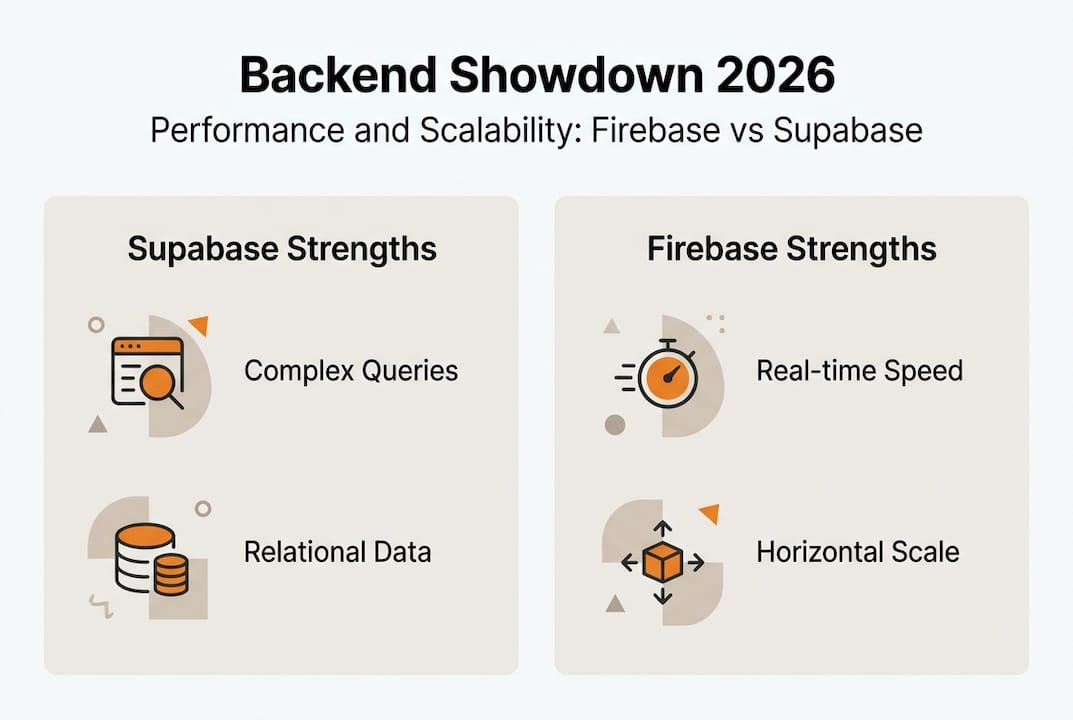
Supabase outperforms Firebase in database-driven scenarios requiring aggregations, filtering across relationships, or analytical queries. PostgreSQL's query planner optimizes execution paths efficiently. Firebase requires multiple round trips for equivalent operations, increasing latency and client-side processing.
Real-world performance scenarios:
Use Case | Supabase Advantage | Firebase Advantage |
|---|---|---|
Complex reporting queries | 40-60% faster | Not recommended |
Simple document reads | Comparable | 10-20% faster |
Real-time database updates | Strong for structured data | Excellent for high concurrency |
Bulk data operations | Native SQL efficiency | Requires batching |
Cold start latency | Edge Functions: 50-100ms | Cloud Functions: 200-400ms |
Firebase excels in high-concurrency real-time scenarios like chat applications or multiplayer games. Its real-time database handles thousands of simultaneous connections efficiently. Supabase's real-time capabilities shine when you need database-driven updates with complex filtering, leveraging PostgreSQL's pub/sub system.
Cold start performance matters for serverless functions. Supabase Edge Functions demonstrate faster initialization than Firebase Cloud Functions, reducing perceived latency for users. This impacts framework latency and overall app responsiveness.
Throughput differences become critical as you scale. PostgreSQL handles concurrent writes to the same table more efficiently through MVCC (Multi-Version Concurrency Control). Firestore's document-level locking can create bottlenecks in write-heavy applications.
Pro Tip: Benchmark both platforms using your actual data model and query patterns before committing. Create a prototype with realistic data volumes and measure latency under load. This 2-week investment prevents costly migrations later.
Scalability considerations extend beyond raw performance. Firebase scales horizontally almost automatically but costs increase linearly with usage. Supabase offers more predictable pricing through database sizing, though you manage scaling decisions. For scalability tips, consider your growth trajectory and budget constraints.
Performance optimization strategies:
Supabase: Index optimization, query tuning, connection pooling
Firebase: Denormalization, composite indexes, strategic data duplication
Both: Caching layers, CDN for static assets, edge computing
The performance winner depends on your specific use case. E-commerce platforms with complex product catalogs benefit from Supabase's relational queries. Social apps with simple user profiles and high real-time activity favor Firebase's strengths.
Security, vendor lock-in, and long-term flexibility
Performance isn't the only concern. Security and flexibility are equally crucial for long-term success.
Supabase's row-level security (RLS) provides granular permission control at the database level. You define policies using SQL that determine which rows users can access, modify, or delete. This approach excels for multi-tenant applications where data isolation is critical. RLS policies execute before queries reach your application, ensuring security even if client code has vulnerabilities.
Firebase security rules operate at the document and collection level. While powerful for simple scenarios, they become brittle as permission logic grows complex. Nested rules and cascading permissions require careful management. Testing security rules thoroughly is more challenging than validating SQL policies.
Security model comparison:
Supabase RLS advantages: Database-enforced security, SQL-based policies, easier testing and auditing
Firebase rules advantages: Integrated with authentication, real-time validation, simpler for basic scenarios
Multi-tenancy: Supabase handles complex tenant isolation naturally through RLS
Compliance: Both support SOC 2, but PostgreSQL's maturity aids enterprise compliance
Vendor lock-in represents a strategic risk many startups underestimate. Supabase is open-source and self-hostable, reducing vendor lock-in, while Firebase is proprietary. If Google changes pricing or deprecates features, migration becomes your only option. Supabase lets you export your PostgreSQL database and host it anywhere.
Firebase's proprietary NoSQL structure complicates migration. Converting Firestore documents to relational schemas requires significant engineering effort. Security rules don't translate to other platforms. Cloud Functions use Firebase-specific APIs that need rewriting.
"Open-source backends provide an exit strategy. Even if you never self-host, knowing you can gives you negotiating power and protects against platform risk."
Self-hosting considerations matter as you scale. Supabase's open-source nature means you can migrate to your own infrastructure when costs justify it. This flexibility becomes valuable at scale, where managed service margins add up. Firebase offers no equivalent path.
Pro Tip: Document your security model and create a migration plan from day one. Map your data structures, authentication flows, and business logic to platform-agnostic patterns. This 10-hour investment protects months of future work.
Long-term flexibility extends to startup app security and compliance requirements. As you grow, enterprise customers demand security certifications, data residency options, and audit logs. PostgreSQL's maturity and Supabase's transparency make these requirements easier to meet.
Cost predictability differs significantly. Firebase's pay-per-operation model can spike unexpectedly with usage patterns. Supabase's database-sizing approach provides more predictable monthly costs. For end-to-end development budgeting, this predictability matters.
For honest insights from developers who've used both in production environments, read this production comparison covering real-world challenges and solutions.
AI integration, real-time features, and edge cases
Beyond core features and security, startups must think about real-time and AI-driven requirements emerging in 2026.
AI integration capabilities differ substantially. Supabase supports AI via pgvector for vector search natively, enabling semantic search, recommendation engines, and RAG (Retrieval-Augmented Generation) applications directly in your database. You can store embeddings alongside your data and query them efficiently using SQL.
Firebase requires additional Google services for AI features. You'll integrate Vertex AI or other Google Cloud AI products separately, adding complexity and cost. Vector search requires external solutions like Pinecone or building custom infrastructure.
AI and modern feature comparison:
Vector search: Supabase native via pgvector; Firebase needs external services
Embeddings storage: Supabase in PostgreSQL; Firebase requires separate database
Semantic queries: Supabase SQL-based; Firebase client-side processing
ML model integration: Both support via cloud functions
Real-time AI updates: Supabase database triggers; Firebase Cloud Functions
📊 Statistic: Applications using native vector search see 40-60% faster semantic query performance compared to external vector database integrations, reducing infrastructure complexity and latency.
Real-time capabilities serve different use cases optimally. Firebase's real-time database excels in high-concurrency scenarios like chat applications, collaborative editing, or multiplayer games. It handles thousands of simultaneous connections with minimal configuration.
Supabase's real-time features leverage PostgreSQL's pub/sub system, providing database-driven updates with complex filtering. You can subscribe to specific rows, tables, or query results. This approach works exceptionally well for dashboard applications, inventory systems, or any scenario where real-time updates need sophisticated business logic.
Edge cases and specialized scenarios:
Multi-tenancy: Supabase RLS provides superior tenant isolation
Complex access control: SQL policies handle intricate permission logic
Offline-first mobile: Firebase offers better offline sync capabilities
Geographic distribution: Firebase's global infrastructure excels
Custom business logic: PostgreSQL functions enable server-side processing
For industry app trends in healthcare, fintech, or enterprise SaaS, compliance and data control requirements often favor Supabase's transparency and self-hosting options. Consumer apps prioritizing rapid iteration and global scale may prefer Firebase's infrastructure.
The cross-platform strategy you choose interacts with your backend decision. React Native and Flutter work well with both platforms, but SDK maturity and community support differ. Firebase has longer-established mobile SDKs, while Supabase's JavaScript-first approach integrates smoothly with modern web frameworks.
AI-driven features are becoming table stakes for competitive apps. Native vector search in Supabase eliminates architectural complexity and reduces costs compared to managing separate vector databases. If your roadmap includes semantic search, personalization, or AI-powered recommendations, this capability provides significant advantages.
Decision framework: How to choose your backend in 2026
With all factors considered, here's how to navigate your decision in a step-by-step framework.
Your backend choice should align with your application type, growth trajectory, and technical requirements. For startups building web apps with relational data, complex queries, or needing cost predictability and avoiding lock-in, choose Supabase. Firebase fits mobile-heavy, offline-first prototypes or Google-integrated apps.
Step-by-step decision framework:
Identify your app's data model: Map entities and relationships. Complex interconnections favor SQL.
Evaluate query requirements: Aggregations, JOINs, and analytics point to Supabase.
Assess real-time needs: High-concurrency chat/gaming suits Firebase; database-driven updates favor Supabase.
Consider AI roadmap: Native vector search requirements indicate Supabase.
Analyze security complexity: Multi-tenancy and granular permissions work better with RLS.
Project scaling costs: Model usage at 10x, 100x current volume for both platforms.
Evaluate vendor lock-in risk: Open-source and self-hosting options provide flexibility.
Test performance: Benchmark with realistic data and query patterns.
Startup scenario recommendations:
Startup Type | Recommended Backend | Key Reasons |
|---|---|---|
SaaS platform | Supabase | Complex queries, multi-tenancy, cost predictability |
Social network | Firebase | Real-time updates, offline sync, global scale |
E-commerce | Supabase | Relational product data, inventory, analytics |
Chat application | Firebase | High-concurrency real-time, mobile-first |
Analytics dashboard | Supabase | Complex aggregations, reporting, SQL queries |
Gaming platform | Firebase | Real-time multiplayer, offline capabilities |
Healthcare app | Supabase | Compliance, data control, security requirements |
Content platform | Either | Depends on content relationships and scale |
Budget considerations extend beyond initial development. Firebase's operational costs can surprise you as usage grows. Document reads, writes, and bandwidth charges accumulate quickly. Supabase's database-sizing model provides more predictable monthly expenses, though you manage capacity planning.
Team expertise matters practically. If your developers know SQL, Supabase reduces the learning curve. Firebase's NoSQL paradigm requires different thinking about data modeling and queries. Consider training time and ongoing maintenance complexity.
Critical evaluation questions:
Will you need to migrate or self-host within 2-3 years?
Does your app require complex reporting or analytics?
Are you building for web-first or mobile-first users?
How important is cost predictability versus pay-per-use?
Do you need native AI and vector search capabilities?
For comprehensive guidance on mobile app benefits and platform selection, consider your target users' devices and usage patterns. Mobile-heavy applications with offline requirements lean toward Firebase. Web applications with complex data favor Supabase.
The decision isn't permanent, but migration costs are real. Choose based on your 12-24 month roadmap, not just immediate needs. Both platforms evolve rapidly, so revisit your decision as your startup scales. For additional perspectives, explore this startup comparison guide with detailed use cases.
Work with experts for scalable startup apps
Once you've mapped your backend decision, getting experienced help can save time and money.
Choosing between Firebase and Supabase represents just one piece of your technical architecture. The real challenge lies in implementing your choice correctly, optimizing for performance, and building scalable systems that support your growth. Working with seasoned app development professionals who understand both platforms eliminates costly mistakes and accelerates your time to market.
Our team has architected and deployed applications on both Firebase and Supabase across industries from healthcare to fintech. We help startups benchmark platforms against their specific requirements, design optimal data models, and implement security patterns that scale. Whether you're migrating between platforms or starting fresh, expert guidance ensures you avoid common pitfalls.
We offer comprehensive services from initial architecture consulting to full-stack development and ongoing optimization. Our approach combines technical expertise with business understanding, ensuring your backend choice aligns with your product roadmap and growth objectives. Schedule a consultation to discuss your specific requirements and get actionable recommendations tailored to your startup's needs.
Explore our portfolio of successful app launches and connect with our team of mobile app development companies recognized for delivering scalable solutions. Ready to build your app with confidence? Reach out to our app expert services for a project assessment and strategic guidance.
Frequently asked questions
Is Supabase better than Firebase for web startups in 2026?
Supabase is typically better for web startups needing relational data and cost predictability, while Firebase suits mobile-heavy, real-time prototypes. Your specific data model and query requirements determine the optimal choice.
How does vendor lock-in affect startups with Firebase?
Firebase's proprietary setup and NoSQL database make migration challenging, creating vendor lock-in. Supabase's open-source nature and standard PostgreSQL provide clear exit strategies and self-hosting options.
Does Supabase offer better performance for complex queries?
Supabase outperforms Firebase in complex JOINs and aggregation queries due to its PostgreSQL engine with 15-25ms latency versus Firebase's 30-50ms. Simple document reads favor Firebase's optimized NoSQL structure.
How do both platforms handle AI search and integration?
Supabase natively supports vector search via pgvector for AI applications, while Firebase requires additional Google AI services. This architectural difference significantly impacts implementation complexity and cost for AI-powered features.