Joy Foroughi
Executive Assistant


Full-Time Employees vs. Staff Augmentation: 2026 Guide
Discover whether you should hire full-time employees or use staff augmentation. Our 2026 guide gives you the insights to make the best choice.
TL;DR:
Startups should adopt a hybrid workforce model combining full-time employees for long-term roles and staff augmentation for specialized, time-bound projects. Effective management requires active oversight of augmented staff, treating them like internal team members rather than outsourcing. This approach balances speed, cost, and flexibility, enabling startups to scale efficiently with deliberate role mapping and strategic planning.
Staff augmentation is defined as a flexible hiring model where you bring in external specialists to work under your direct management for a defined project or time period. The decision of whether to hire full-time employees or use staff augmentation is the most consequential workforce choice a startup founder makes in 2026. Get it wrong and you either burn cash on permanent overhead for temporary needs, or you lose institutional knowledge by relying on contractors for roles that demand deep company ownership. This guide cuts through the noise using 2026 benchmarks from Second Talent, NRI Staffing, and CorrectContext to give you a clear framework for making the right call.
Should I hire full-time employees or use staff augmentation?
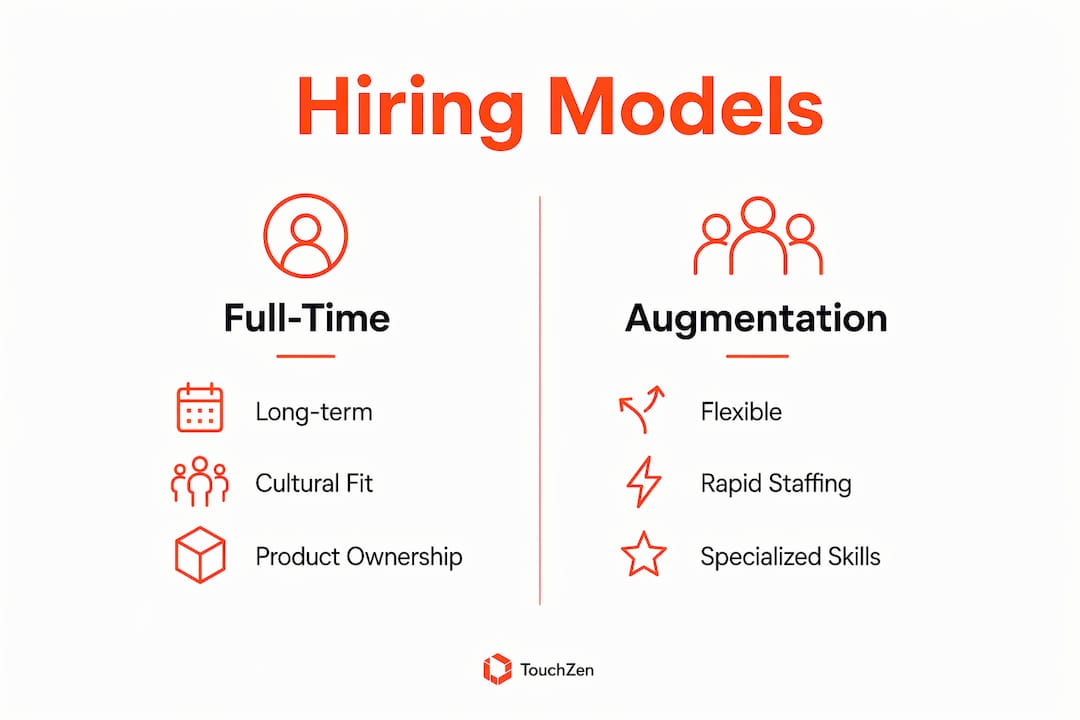
The answer depends on three variables: the role's strategic importance, the time horizon, and your urgency. Full-time employment is the right model when a role requires long-term institutional knowledge, cultural ownership, and continuous contribution to your core product. Staff augmentation is the right model when you need specialized skills for a defined project, need to move fast, or want to test a capability before committing to a permanent hire.

Speed alone tells a compelling story. Staff augmentation providers deliver vetted candidates within 24–72 hours, compared to roughly 22 weeks for a senior full-time engineering hire. That gap represents months of lost product velocity for a startup racing to hit a launch date. On the cost side, full-time hires carry salary, benefits, and overhead, while contract rates run 30–50% higher per hour to compensate for the lack of long-term benefits. The math only favors augmentation for shorter engagements.
Factor | Full-Time Employee | Staff Augmentation |
|---|---|---|
Time to productivity | 22+ weeks to hire | 24–72 hours to place |
Cost structure | Salary + benefits + overhead | Higher hourly rate, no long-term commitment |
Flexibility | Low: difficult to scale down | High: scale up or down by project |
Cultural integration | Deep: owns roadmap and values | Shallow: project-focused contributor |
Best use case | Core competency, long-term role | Specialized, time-bound project |
Pro Tip: Before posting any job, ask yourself one question: "Would this role still exist in 18 months?" If the answer is no, augmentation is almost always the better path.
When should you hire full-time vs. use contractors?
The core vs. commodity skills framework is the most reliable decision tool available. Core competencies are the capabilities that define your product and competitive advantage. Commodity skills are specialized but repeatable tasks that any qualified professional can execute without deep context.
Here is a practical decision process for startup founders:
Map the role to your roadmap. A VP of Engineering who will own your technical architecture for the next three years is a core hire. A cloud migration specialist who will move your infrastructure to AWS over six months is a commodity engagement.
Apply the 12-month threshold. The 12-month mark is the breakeven point for strategic utility. Roles expected to last under 12 months almost always cost less and perform better under an augmentation model.
Assess your urgency. Full-time IT hiring averages 44+ days even for standard roles. If your product sprint starts in two weeks, augmentation is your only realistic option.
Evaluate pipeline risk. If losing this person would derail your entire product roadmap, that is a full-time hire. If losing them would require a replacement with similar skills, augmentation is appropriate.
Consider the knowledge transfer cost. Roles that require months of onboarding to become effective, such as a founding product manager or a lead architect, should almost always be full-time.
Concrete examples clarify the framework quickly. A founding CTO who will shape your technical culture for years is a full-time hire. A React Native developer brought in to build a specific feature set for your MVP is an augmentation candidate. A head of growth who will own your acquisition strategy long-term is a full-time hire. A data engineer contracted to build your analytics pipeline is an augmentation engagement.
Pro Tip: When to hire contractors becomes obvious once you separate "what we build" from "how we build it." Full-time staff own the what. Augmented talent executes the how.
How does management differ for augmented vs. full-time staff?
The single most dangerous misconception in staff augmentation is treating it like outsourcing. These are fundamentally different models. Outsourcing means a vendor owns the outcome and delivers a finished product. Augmentation means you direct the daily work, set priorities, and manage performance exactly as you would with a full-time employee.
Staff augmentation requires the same internal management discipline as full-time hiring. That means daily standups, code reviews, sprint planning, and performance feedback. Founders who assume augmented developers will self-manage consistently report poor outcomes, missed deadlines, and scope creep. The model only works when you have the internal leadership bandwidth to manage it actively.
Key differences in day-to-day management include:
Onboarding speed: Augmented staff need a condensed onboarding process focused on tools, codebase access, and communication norms. Full-time hires need deeper cultural and strategic onboarding.
Performance feedback: Augmented staff respond to project-specific KPIs and sprint velocity. Full-time employees require broader performance reviews tied to career growth.
Cultural integration: Full-time employees absorb your company values, communication style, and long-term vision over time. Augmented staff contribute within a defined scope and rarely develop that depth.
Decision authority: Full-time employees can and should make autonomous decisions within their domain. Augmented staff typically need clearer boundaries and more explicit direction.
"Augmented staff require active internal management and should not be viewed as a set-it-and-forget-it solution." — NRI Staffing, 2026
The practical implication for founders is direct. Before you bring on augmented talent, confirm that a senior internal leader has the capacity to manage them daily. If that bandwidth does not exist, you will not get the output you are paying for.
What hybrid workforce strategies work best for startups?
The most effective approach for growth-stage startups is a hybrid workforce model that combines a stable core team with flexible augmented capacity. This is not a compromise. It is a deliberate portfolio strategy used by high-growth technology companies to balance stability and speed.
The allocation logic is straightforward. Full-time employees own your product roadmap, your technical architecture, and your company culture. Augmented talent provides specialized skills and scaling capacity for specific initiatives. A startup building a mobile app might employ a full-time product manager, a full-time lead engineer, and a full-time designer, then augment with a backend specialist, a QA engineer, and a DevOps contractor for the launch sprint.
Role Type | Recommended Model | Rationale |
|---|---|---|
VP of Engineering | Full-time | Owns architecture and technical culture long-term |
Lead Product Manager | Full-time | Drives roadmap continuity and stakeholder alignment |
Cloud Migration Specialist | Augmented | Time-bound, specialized, replaceable skill set |
QA Engineer (launch sprint) | Augmented | Project-specific need with defined end date |
React Native Developer (MVP) | Augmented or temp-to-hire | Evaluate fit before committing to full-time |
Budgeting by capacity rather than headcount is the operational shift that makes hybrid models work. Instead of planning for "five engineers," plan for a specific number of engineer-months of capacity. That framing lets you substitute full-time or augmented talent based on speed, cost, and permanence without disrupting your financial model.
The temp-to-hire strategy deserves special attention as a risk mitigation tool. A trial period of 60–180 days through an augmentation engagement lets you evaluate a developer's technical quality, communication style, and cultural fit before making a full-time offer. This approach eliminates the single biggest risk in full-time hiring: the bad hire that costs months of salary and productivity to unwind.
Pro Tip: Structure your hybrid model with a simple rule: full-time staff own decisions, augmented staff execute tasks. When those roles blur, you get accountability gaps that slow everything down.
Key takeaways
The right workforce model for a startup is almost always a hybrid: full-time employees for core, long-term roles and staff augmentation for specialized, time-bound projects.
Point | Details |
|---|---|
Speed favors augmentation | Staff augmentation places talent in 24–72 hours versus 22+ weeks for full-time senior hires. |
Use the 12-month threshold | Roles lasting under 12 months almost always cost less and perform better under augmentation. |
Augmentation is not outsourcing | You must manage augmented staff daily with the same discipline as full-time employees. |
Hybrid models outperform pure strategies | Combining a stable core team with flexible augmented capacity optimizes both quality and speed. |
Temp-to-hire reduces full-time risk | A 60–180 day trial period lets you evaluate fit before committing to a permanent hire. |
My take on this decision after watching founders get it wrong
The founders who struggle most with this choice are the ones who treat it as binary. They either hire everyone full-time because it "feels more committed," or they augment everything because it "feels more flexible." Both extremes create problems that compound over time.
The most common mistake I see is confusing augmentation with outsourcing. A founder brings in three augmented developers, assumes they will self-organize, and then wonders six weeks later why the codebase is a mess and the sprint is three weeks behind. Augmentation is a lever, not a delegation. You pull it harder when you need speed or specialized skills. You still hold the handle.
The second mistake is skipping role mapping before making any hire. I have watched startups burn through six months of runway hiring a full-time data scientist for a project that needed eight weeks of augmented work. The core vs. commodity framework is not complicated, but founders rarely apply it with discipline before they start interviewing.
My honest recommendation: build your core team small and tight, then use augmentation aggressively for everything else. Treat your distributed team strategy as a living document that you revisit every quarter. The right model at Series A is not the right model at Series B. Stay flexible, stay deliberate, and never stop managing the people doing the work.
— Cyrus
How TouchZen helps startups scale their development teams
Startups face a real tension between moving fast and building right. TouchZen resolves that tension by giving you direct access to senior developers and designers who work as an extension of your team, not as a black-box vendor. Whether you need a full mobile app development team to take your product from concept to launch, or augmented specialists to accelerate a specific sprint, TouchZen structures engagements around your roadmap and timeline.
TouchZen has launched over 75 apps across industries, delivering results like 100,000 downloads in the first year and a 10x increase in user subscriptions. If you are weighing your staffing options for an upcoming build, the TouchZen team can help you map the right model before you make a costly commitment. Explore your options with top-ranked app developers who understand how startups actually scale.
FAQ
What is staff augmentation in simple terms?
Staff augmentation is a model where you hire external specialists who work under your direct management on a project or time-limited basis. Unlike outsourcing, you control the daily work and priorities.
How do I know when to hire full-time vs. use contractors?
Apply the 12-month threshold: if a role is expected to last under 12 months or requires a specialized skill set for a defined project, augmentation is the stronger choice. Roles requiring long-term institutional knowledge and cultural ownership warrant full-time hiring.
Is staff augmentation cheaper than hiring full-time employees?
Not always on a per-hour basis. Contract rates run 30–50% higher than equivalent full-time hourly rates. However, augmentation eliminates benefits, overhead, and long-term commitment costs, making it more cost-effective for shorter engagements.
What is a temp-to-hire strategy and why does it matter?
A temp-to-hire engagement gives you a 60–180 day trial period to evaluate a contractor's technical quality and cultural fit before making a full-time offer. It is one of the most effective ways to reduce the risk of a costly bad hire.
Can startups use both full-time employees and augmented staff at the same time?
Yes. A hybrid workforce model is the approach most high-growth startups use. Full-time employees own the roadmap and culture while augmented talent provides specialized skills and scaling capacity for specific initiatives.