

Joy Foroughi
Executive Assistant


How to Find Beta Testers for Your App Before Launch
Learn how to find beta testers for your app before launch. Discover key strategies to gather valuable feedback and ensure a successful release.

TL;DR:
Beta testing involves releasing an app to real users to identify bugs and improve user flow before launch. Recruiting 50 to 200 targeted testers, with clear profiles and structured feedback tasks, ensures meaningful insights and avoids feedback fatigue. Building a community early and maintaining engagement maximizes the value of beta programs and prepares the app for a successful launch.
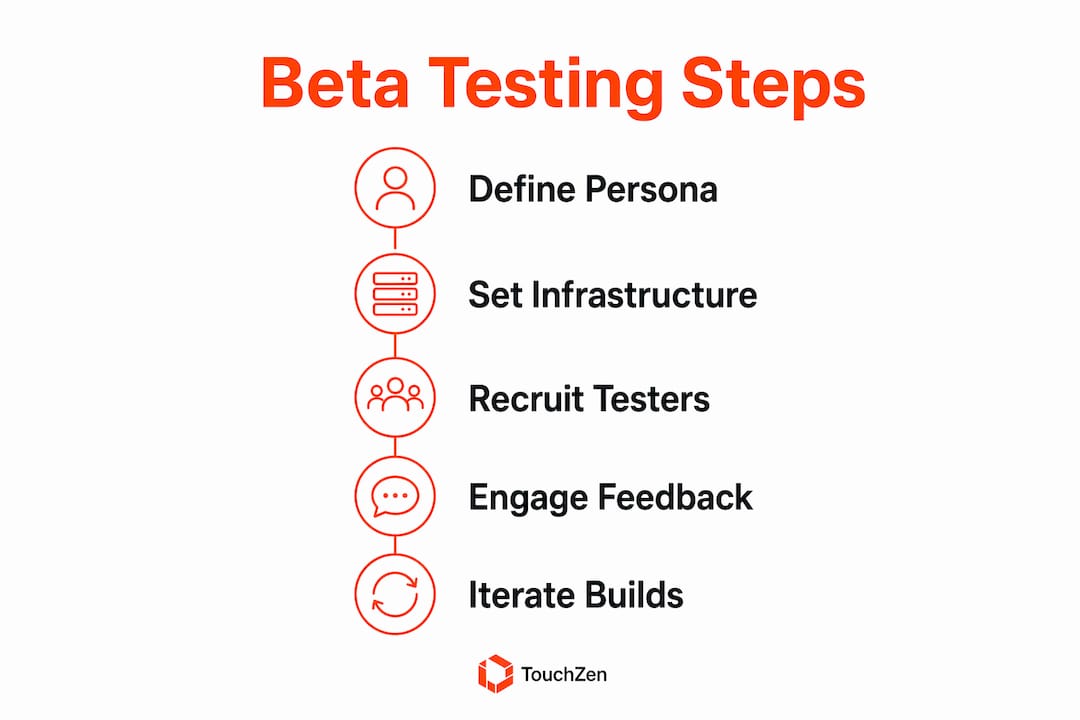
Beta testing is defined as the structured process of releasing a pre-launch app build to real users who identify bugs, validate user flows, and surface friction points before a public release. Knowing how to find beta testers for your app before launch is the single most important step between a polished prototype and a product that actually works for real people. Industry guidance recommends 50–200 engaged testers for most consumer apps, with at least 25 completing core tasks and submitting quality feedback. That number is not arbitrary. It reflects the minimum threshold needed to catch the bugs and UX failures that internal teams consistently miss.
How to find beta testers for your app: start with the right profile
Recruiting the wrong testers is worse than recruiting too few. A tester pool skewed toward power users will miss the friction points that average users hit immediately. Developers should segment user personas using app analytics and market research to recruit testers who reflect actual user demographics and behaviors.
Write a one-paragraph tester description before you recruit a single person. Include their job title or daily context, the core problem your app solves for them, and the outcome they want. This description becomes your filter. Anyone who does not match it gets excluded, regardless of how enthusiastic they are.
Mixing "neophiles" with average users is critical to ensure beta testing covers realistic usage patterns. Neophiles, the early adopters who love new technology, will find edge-case bugs. Average users will tell you whether your onboarding makes sense to someone who has never heard of your app.
Define 2–3 distinct tester personas based on your app's primary use cases
Prioritize testers who experience the problem your app solves in their daily life
Exclude friends and colleagues who will be too polite to give honest feedback
Avoid recruiting only from tech communities if your app targets a general audience
Pro Tip: Write your tester description as if you are writing a job posting. Specificity filters out low-quality applicants before you spend time onboarding them.
What infrastructure do you need before recruiting testers?
Getting your distribution infrastructure right before recruiting saves you from scrambling when testers try to install your build. For iOS, Apple's TestFlight supports up to 10,000 external testers per app. Setup requires submitting a build through App Store Connect, adding a beta review note, and generating a public link or individual invites. TestFlight builds expire every 90 days, so you must push updated builds before that deadline or lose active testers mid-cycle.
For Android, Google Play offers two relevant tracks: Internal Testing (up to 100 testers, instant publishing) and Open Testing (unlimited testers, visible in the Play Store). Internal Testing works best for early, rough builds. Open Testing suits a more polished beta where you want broader reach and organic discovery.
Platform | Track | Tester Limit | Publishing Speed |
|---|---|---|---|
iOS | TestFlight External | 10,000 | First external build requires review |
Android | Internal Testing | 100 | Usually available within minutes |
Android | Open Testing | Unlimited | Timing varies |
Plan your beta testing window to run 7–14 days per cycle. Shorter windows create urgency. Longer windows cause testers to procrastinate and disengage. Set a hard end date in every communication you send.
Pro Tip: Set a calendar reminder 10 days before your TestFlight build expires. Uploading a new build resets the 90-day clock and keeps your tester pool active without interruption.
Where to recruit beta testers effectively
Recruitment channel selection determines the quality of your tester pool more than any other variable. The best testers come from communities where your target problem is actively discussed, not from generic "beta tester wanted" posts. Recruit in waves of 20–50 testers to keep feedback manageable. Reaching out to 120 potential testers typically yields 30–40 active participants. Plan your outreach volume accordingly.
Your existing waitlist. If you have been building a waitlist, these people already want your app. Send a personalized email, not a mass blast. Name the specific task you need them to complete and how long it will take.
Reddit and niche forums. Find subreddits where your target user hangs out and post a clear, respectful recruitment message. A fitness app belongs in fitness subreddits, not in r/betatesting. Relevance beats reach every time.
Discord servers. Many niche communities run active Discord servers. Joining and contributing before posting a recruitment message dramatically increases response rates. Cold posts in Discord channels get ignored.
Indie Hackers and Product Hunt communities. These platforms attract builders and early adopters who understand pre-launch products. They can be useful for connecting with relevant communities and potential beta testers.
Beta testing platforms. Dedicated platforms connect developers with testers who have opted in to test new apps. These range from free community boards to paid services with screened tester pools. Paid options typically deliver higher completion rates.
Your personal and professional network. Warm outreach converts at a higher rate than cold outreach. Ask contacts who match your tester profile, not everyone you know. Personalized outreach outperforms mass emails in tester engagement by a significant margin.
Referral-based waitlists. Give existing testers a unique invite link and reward them for bringing in qualified testers. This multiplies your pool while maintaining persona alignment.
Recruit from communities where your target problem is discussed and use referral-based waitlists to multiply signups. Tools like Agent Cohort can help you manage community building and tester group coordination when your pool grows beyond a handful of participants.
Pro Tip: Your recruitment message should state three things clearly: the specific task, the time required (under 30 minutes is ideal), and what the tester gets in return. Vague messages attract vague testers.

How to keep beta testers engaged and collect real feedback
Not every beta signup will provide substantive feedback. Plan for some participants to drop off and actively manage engagement throughout the testing cycle. It means you must over-recruit significantly and then actively manage engagement to extract value from the testers you have.
The single most effective tactic is task specificity. Assigning structured, measurable missions under 30 minutes significantly increases completion rates over open-ended testing. Instead of asking testers to "explore the app," ask them to "complete a purchase from the home screen and tell us where you got confused." One task. One session. One clear deliverable.
Set a hard deadline for each feedback cycle, typically 5–7 days
Create a dedicated Slack or Discord channel for testers to report issues in real time
Use Google Forms or a structured feedback template to standardize responses
Send a mid-cycle check-in message on day 3 to re-engage silent testers
Acknowledge feedback publicly in your tester channel so contributors see their input matters
Engagement thrives when testers see their feedback acknowledged and incorporated. Ignoring feedback causes testers to disengage quickly. Post a weekly update that lists what you fixed, what you are investigating, and what you decided not to change and why. That transparency builds the kind of tester loyalty that carries into your public launch.
Incentives work best when tied to completion, not signup. A tester who signs up and never opens the app costs you nothing to reward. A tester who completes three feedback cycles and submits detailed reports deserves recognition, whether that is early access, a discount, or a public shoutout.
Pro Tip: Run feedback sprints. Pick one feature per sprint, assign one task, and close the loop within a week. This keeps your app user experience improvements focused and your testers from feeling overwhelmed.
Common pitfalls that kill beta programs before they deliver
Most beta programs fail not from lack of testers but from predictable, avoidable mistakes. Recognizing these patterns early saves weeks of wasted effort.
Vanity recruitment. Chasing signup numbers instead of qualified testers produces a large, inactive pool. Set gated access with a short screener question to filter out low-intent signups.
Wrong persona recruitment. Recruiting tech-savvy friends when your app targets small business owners produces feedback that does not reflect your real users' experience.
Scope creep in testing. Asking testers to evaluate every feature at once produces shallow, unfocused feedback. One feature per cycle produces depth.
Ignoring the TestFlight 90-day expiry. Builds expire without warning to testers. A tester who tries to open an expired build and gets an error message rarely comes back.
Starting recruitment too late. Waiting until your build feels "polished" means you miss the feedback that shapes core architecture. Building a beta community during the prototype stage leads to better early feedback and higher retention than waiting.
Failing to prune inactive testers. A tester who has not opened the app in two weeks is not coming back. Remove them, free up a slot, and invite someone from your waitlist.
"The most common mistake I see is treating beta testing as a final quality check rather than an ongoing feedback loop. By the time a team recruits testers, they often have already made decisions that testers would have challenged. Start earlier than feels comfortable."
For a deeper look at structuring your pre-launch testing process, the mechanics of build distribution and feedback collection deserve their own dedicated attention.
Key takeaways
Recruiting quality beta testers requires a defined persona, the right distribution infrastructure, multi-channel outreach in controlled waves, and active engagement loops that reward completion over signup.
Point | Details |
|---|---|
Define your tester profile first | Write a one-paragraph persona before recruiting to filter out mismatched testers. |
Over-recruit to hit feedback targets | Expect some signups not to participate, so recruit beyond your minimum feedback target. |
Use waves of 20–50 testers | Cohort-based recruitment keeps feedback manageable and engagement high. |
Assign one task per cycle | Structured missions under 30 minutes produce far higher completion rates than open-ended testing. |
Acknowledge feedback publicly | Testers who see their input acted on stay engaged through multiple cycles. |
What we have learned from running beta programs early and often
The conventional wisdom says to recruit beta testers when your app is ready. That advice is wrong, and we have seen it cost teams months of rework.
The teams that get the most out of beta testing start building their tester community at the prototype stage, sometimes before a single line of production code exists. They share mockups in Discord servers, post early concepts on Indie Hackers, and collect emails from people who say "yes, we have that problem." By the time the first testable build ships, they already have a warm, invested group of people who care about the outcome.
The other thing most articles skip is the emotional side of tester management. Testers are volunteers. They are giving you their time and attention in exchange for early access and the feeling that they matter to your product. The moment they sense their feedback is going into a void, they stop. When development teams go silent after a major feedback session, tester engagement can drop quickly.
Mix your tester profiles deliberately. Power users will find the edge cases. Average users will tell you whether your core flow makes sense. You need both. A pool of only enthusiasts produces feedback that makes your app better for enthusiasts, not for the broader market you are actually trying to reach.
Start early, communicate constantly, and treat your testers like the product partners they are. That mindset shift produces better feedback, higher completion rates, and a group of advocates who will promote your app on launch day without being asked.
TouchZen builds apps designed for real-world testing from day one
TouchZen has launched over 75 apps across iOS and Android, and every project includes beta testing strategy as part of the development process, not as an afterthought. The team works directly with senior developers and designers, so the feedback loop between testers and builders stays short and productive. If you are building an app and want a development partner who integrates user-validated testing into the build cycle from kickoff, TouchZen is built for exactly that. Startups working with TouchZen have achieved results including 100,000 downloads in the first year and a 10x increase in user subscriptions. See how TouchZen's award-winning development team approaches launch-ready app builds.
FAQ
How many beta testers does an app need before launch?
Most consumer apps need 50–200 engaged testers, with at least 25 completing core tasks and submitting quality feedback. The exact number depends on app complexity and the number of distinct user flows you need to validate.
Where is the best place to find app beta testers?
The best sources are communities where your target problem is actively discussed, including relevant Reddit subreddits, Discord servers, Indie Hackers, and Product Hunt communities. Your existing waitlist and personal network also convert at higher rates than cold outreach to strangers.
How long should a beta testing window last?
Beta testing windows of 7–14 days per cycle produce the best results. Shorter windows create urgency, while longer windows cause testers to delay and disengage before submitting feedback.
Why do so few beta testers actually give feedback?
Many testers sign up but never complete the assigned tasks or submit detailed feedback. The gap between signup and completion closes when you assign one specific task, set a clear deadline, and follow up mid-cycle with a direct message.
What is the TestFlight 90-day rule and why does it matter?
TestFlight builds expire after 90 days, at which point testers can no longer open the app. Developers must push a new build before expiration to maintain tester access and avoid losing momentum mid-cycle.


