

Joy Foroughi
Executive Assistant


Mobile App Competitor Analysis: What to Look for Before You Build
Master mobile app competitor analysis. Learn what to look for before you build to ensure your app meets market needs and beats the competition.

TL;DR:
Conducting thorough competitor analysis helps identify market gaps and guides product development decisions. It involves mapping all competitor types, analyzing recent user feedback, and uncovering unmet needs to inform differentiation. Regular updates ensure strategies remain aligned with evolving market conditions and user expectations.
Mobile app competitor analysis is the practice of systematically examining rival products, features, user feedback, pricing, and marketing strategies to inform your own development decisions. 42% of failed apps failed because they addressed no real market need. That single statistic explains why studying the competitive field before writing a single line of code is not optional. The mobile app market holds over 8.93 million apps across major platforms, which means your idea almost certainly has existing competition. Knowing what those competitors do well, where they fall short, and what users still want gives you a real product roadmap before development begins.
How to identify and categorize mobile app competitors effectively
The first step in any competitor analysis is mapping who you are actually competing against. Most product managers think only about direct competitors, but that framing is too narrow.
Three competitor types matter in mobile app market research:
Direct competitors solve the same problem for the same audience. A budgeting app competes directly with other budgeting apps.
Indirect competitors solve the same problem through a different method. A spreadsheet template competes indirectly with a budgeting app.
Substitute competitors address the same underlying need in a completely different category. A financial advisor service is a substitute for a budgeting app.
Mapping all three types forces you to understand the full range of choices your future users already have. Market leaders set user expectations, so including aspirational competitors in your analysis informs long-term positioning, even if you cannot match their resources on day one.
The most practical method for identifying competitors is app store keyword research. Search the terms your target users would type, then document every app that appears in the top 20 results. Supplement that with user behavior research: read forum threads on Reddit, check product review sites, and look at what apps appear in "people also downloaded" sections. This combination surfaces competitors that paid advertising might hide from you.

Pro Tip: Search app store keywords from the perspective of a frustrated user, not a product manager. Users search for problems, not solutions. "Track spending without a bank login" surfaces different competitors than "personal finance app."
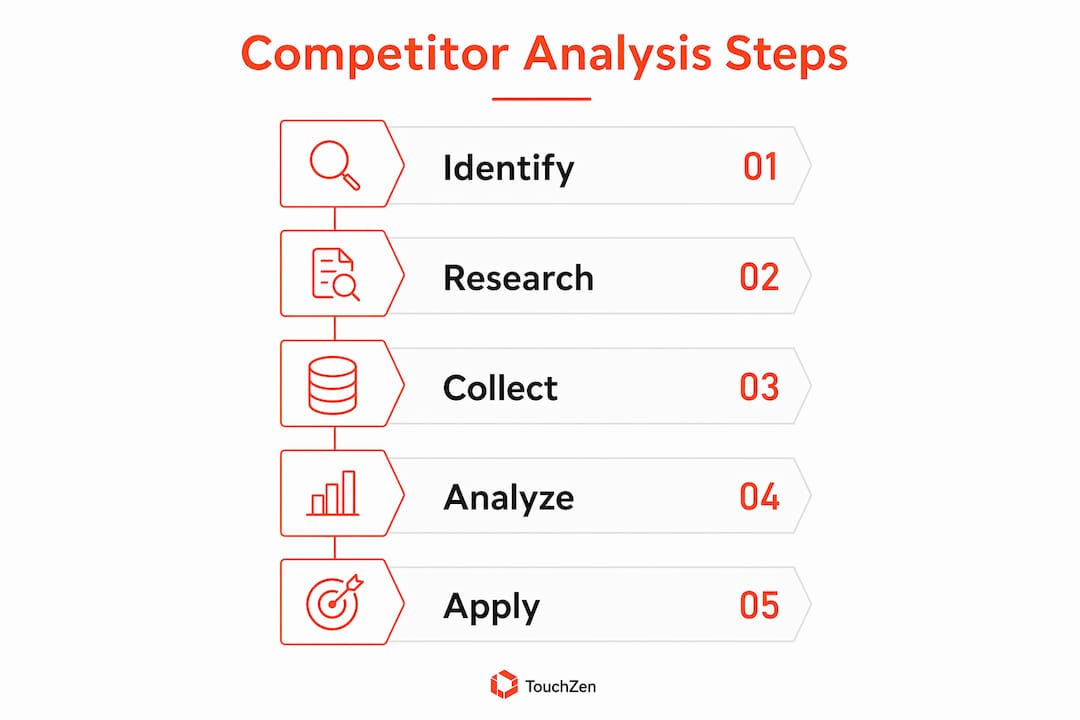
What data to collect from competitor apps before building your own
Once you have your competitor list, the next step is structured data collection. Collecting data without a framework produces noise. Collecting data across consistent categories produces a product strategy.
The core data categories to gather from each competitor include:
Feature inventory: List every feature the app offers, then mark which features appear in all competitors (table stakes) versus which appear in only one or two (potential differentiators).
User reviews: Focus on reviews from the past 90 days. Apps that respond to negative feedback see 12% higher user retention. Recent reviews reflect the current product, not the version from two years ago.
Pricing and monetization models: Note whether competitors use freemium, subscription, one-time purchase, or in-app purchases. Record price points and what each tier unlocks.
Update frequency: Apps with frequent updates and quick bug fixes often signal active product development. An app that has not been updated in six months may indicate slower development, shifting priorities, or a mature product with fewer planned releases.
Marketing and acquisition tactics: Check their app store screenshots, description copy, and keyword rankings. Look at their social media presence and any paid ad creative you can find.
For marketing data specifically, keyword gap analysis reveals where competitors lack search coverage, which points directly to acquisition opportunities you can capture. Pair that with a review of their onboarding flow by downloading and using the app yourself. You will notice friction points that users complain about in reviews but that screenshots never reveal.
Pro Tip: Create a shared spreadsheet with one row per competitor and one column per data category. Fill it in over one week before drawing any conclusions. Patterns become obvious when data sits side by side.
How to interpret competitor data to find market gaps and opportunities
Raw data does not produce strategy. Interpretation does. The goal of this phase is to move from "here is what competitors do" to "here is what we should build and why."
Use this four-step process to extract strategic direction from your data:
Separate table stakes from differentiators. Table stakes are features every app in your category must have to be considered credible. Differentiators are features that drive growth and loyalty. Honest competitor evaluation requires distinguishing between the two, because building only table stakes produces a forgettable app.
Build a complaints matrix from negative reviews. Collect the most common complaints across all competitors and group them by theme. Using competitor negative reviews as a structured complaints matrix forces you to prioritize real user pain points over feature copying. If three competitors all have users complaining about slow sync speeds, that is a gap you can own.
Identify messaging whitespace. Read each competitor's app store description and website copy. Note what emotional or functional benefits no one is claiming. If every competitor talks about "saving money" but no one talks about "reducing financial anxiety," you have found a positioning angle that is both true and unclaimed.
Run a SWOT analysis for each top competitor. Document their strengths, weaknesses, opportunities they are ignoring, and threats they face. This structured view reveals where the market is moving and where you can position ahead of the curve.
The table below shows how to categorize findings from this process:
Analysis type | What you find | How you use it |
|---|---|---|
Feature gap analysis | Missing features users want | Add to product roadmap as priority items |
Complaints matrix | Recurring user frustrations | Build solutions into core UX from day one |
Messaging whitespace | Unclaimed positioning angles | Craft differentiated marketing copy |
SWOT per competitor | Structural weaknesses | Target their weak segments with your launch |
Pro Tip: Do not build every gap you find. Align feature gaps with your core value proposition first. Evidence-based competitor analysis requires matching gaps to your strengths, or you end up with a bloated app that does nothing exceptionally well.
How to apply competitor insights to your development and marketing strategy
Competitor analysis produces value only when it changes what you build and how you position it. The most common mistake product managers make is completing the analysis and then filing it away. The insights must feed directly into your product roadmap, pricing decisions, and go-to-market plan.
Here is how to apply what you have learned:
Product roadmap: Use your feature gap and complaints matrix findings to prioritize your MVP features. Build what users are actively asking for in competitor reviews, not what you assume they want.
Pricing strategy: If all competitors charge $9.99 per month for a mid-tier plan, you have three options: undercut to capture price-sensitive users, match and compete on quality, or charge more and position as the premium option. Each choice requires a different product and marketing approach. Make the decision deliberately.
Differentiated messaging: Your messaging whitespace findings translate directly into ad copy, app store descriptions, and pitch decks. Claim the benefit no competitor is claiming, then build the product that actually delivers it.
User acquisition: Users are more likely to switch when a new app clearly solves a problem their current solution does not. Your acquisition strategy must name the trigger that causes users to leave a competitor and choose you. This is not a tagline. It is a specific, provable claim.
Continuous monitoring: Competitor analysis must be ongoing to avoid stale insights. Set a monthly review cadence. Competitors update their apps, change their pricing, and shift their messaging. Your strategy should update in response.
Connecting competitor insights to app marketing strategies is where the real leverage sits. A well-researched positioning angle can improve acquisition efficiency because your message resonates with users who are already dissatisfied with existing options.
Competitive analysis strengthens product positioning, pricing decisions, and marketing strategy when integrated into everyday workflows. The same principle applies to app launches: teams that understand their competitive position can attract users more effectively and give them stronger reasons to stay.
Key takeaways
Thorough mobile app competitor analysis before you build reduces failure risk, sharpens your product roadmap, and gives you a positioning advantage that is grounded in real user behavior rather than assumptions.
Point | Details |
|---|---|
Map all competitor types | Analyze direct, indirect, and substitute competitors to see the full range of user choices. |
Focus on recent user reviews | Reviews from the past 90 days reflect the current product and reveal active pain points. |
Separate table stakes from differentiators | Build features that drive growth, not just features that make you credible. |
Use complaints as a product roadmap | Recurring negative reviews across competitors show you exactly what to build better. |
Keep analysis current | Update your competitive intelligence monthly so your strategy reflects the market as it is, not as it was. |
What I have learned from watching founders skip this step
Most founders I have worked with treat competitor analysis as a box to check, not a tool to use. They spend two hours browsing app stores, write down five competitor names, and call it done. Then they build for six months and launch into a market they do not actually understand.
The founders who build apps that gain traction do something different. They spend real time inside competitor apps, not just reading about them. They download the top five competitors and use each one for a week. They read every one-star review with genuine curiosity, not defensiveness. They ask: "What is this user actually trying to do, and why did this app fail them?"
The other mistake I see constantly is copying competitor features without understanding why those features exist. A feature that works for a market leader works because of their brand, their user base, and their distribution. Copying the feature without those advantages produces a worse version of something users already have. The complaints matrix approach fixes this. It forces you to build from user pain, not from product envy.
The hardest part of honest competitor analysis is acknowledging when a competitor is genuinely better than what you are planning to build. That discomfort is productive. It either forces you to find a real differentiator or saves you from launching a product that cannot win. Both outcomes are valuable. The goal is not to build an app. The goal is to build an app that earns and keeps users. Competitor analysis is how you figure out whether your current plan achieves that.
— Cyrus
How TouchZen builds apps grounded in real market intelligence
TouchZen integrates competitor research directly into the development process, starting at kickoff rather than treating it as a pre-sales formality. Every project begins with a structured analysis of the competitive field, covering features, user feedback patterns, pricing models, and acquisition gaps. That research feeds directly into UX decisions, feature prioritization, and app store positioning. The team has launched over 75 apps across industries, including results like 100k downloads in the first year, and competitor research is one of the key inputs the team uses to make informed product, UX, and positioning decisions. If you are ready to build with a team that treats competitor analysis as a core input rather than an afterthought, explore TouchZen's mobile app development services or connect directly with the app experts team.
FAQ
What is mobile app competitor analysis?
Mobile app competitor analysis is the process of examining rival apps' features, pricing, user reviews, and marketing strategies to inform your own product decisions. It reduces the risk of building something the market does not need.
How many competitors should I analyze?
Analyze 5–10 competitors across direct, indirect, and substitute categories. A broader set surfaces more gaps and gives you a clearer picture of user expectations across the market.
Why do recent user reviews matter more than older ones?
Reviews from the past 90 days reflect the current version of a competitor's app. Older reviews describe a product that may have changed significantly, making them less useful for identifying active pain points.
How do I find gaps in a competitor's app?
Build a complaints matrix from one-star and two-star reviews across all competitors. Group recurring themes by category. The themes that appear most frequently across multiple apps represent the gaps your product can address.
How often should I update my competitor analysis?
Update your competitive intelligence at least once a month. Competitor analysis must be ongoing because competitors change their pricing, features, and messaging regularly, and stale data produces outdated strategy.


