Joy Foroughi
Executive Assistant


iOS Developer Interview Questions: A Founder's Guide
Discover what questions you should ask before hiring an iOS developer. This guide helps you find the right fit with tailored interview insights.
Hiring the right iOS developer starts with knowing exactly what questions to ask before a single line of code gets written. The standard technical interview process, called a developer screening, is your first real filter between a candidate who talks well and one who ships. Questions about Swift 6, SwiftUI, UIKit, App Store navigation, and real-world problem-solving reveal far more than a polished resume ever will. This guide gives you the precise questions to ask, the answers to listen for, and the red flags to catch before you make a costly commitment.
What questions should you ask before hiring an iOS developer
The most revealing technical questions target platform-specific knowledge, not general programming theory. A 45-minute focused screen that prioritizes architectural judgment over algorithm puzzles tells you far more about a candidate's real capability. Algorithms are teachable. Architectural instincts come from shipping real products.
Start with Swift 6. Swift 6 concurrency features like Actors, Sendable protocols, and structured concurrency are now critical knowledge for crash-free, multi-threaded app development. A senior candidate must explain the trade-offs between TaskGroup, async let, and serial actors, including how cancellation and error propagation work in each model. If a candidate cannot walk you through those distinctions clearly, they are not operating at a senior level.
Ask these technical questions in your first screen:
"Walk me through how you would convert a callback-based networking layer to async/await in Swift 6." This reveals whether they understand structured concurrency or just know the syntax.
"When would you choose UIKit over SwiftUI, and vice versa?" Evaluating SwiftUI vs. UIKit trade-offs shows strategic thinking, not just tool familiarity.
"Describe a real Instruments capture session where you tracked down a retain cycle." Absence of a specific, detailed answer suggests mid-level skills at best.
"How do you profile memory usage in a production app?" Strong candidates name Instruments, describe specific workflows, and reference real examples.
"Show me an app you shipped. Pull up the App Store listing." App Store credits on a developer's page confirm actual shipping experience over vague "worked on" claims.
Pro Tip: Ask candidates to share their App Store developer page link before the interview. If they cannot produce one, treat that as a significant signal about their shipping history.
Mastering Apple's Human Interface Guidelines is another marker of a truly native-feeling app. Ask candidates how they stay current with HIG updates and whether they can cite a recent guideline change that affected a project decision. Candidates who reference Apple's Human Interface Guidelines by name and apply them to real decisions are the ones who build apps users actually enjoy.

How do you assess real-world problem-solving skills?
Technical knowledge is table stakes. What separates a senior iOS developer from a mid-level one is how they behave when things go wrong. Your interview questions need to surface that behavior directly.
Use this numbered sequence to structure your problem-solving assessment:
"Walk me through your last App Store rejection. What happened, and what did you do?" Candidates who discuss App Store rejections reveal their resilience, their understanding of Apple's review process, and their ability to communicate setbacks clearly. A candidate who has never been rejected likely has not shipped much.
"Describe the most complex bug you have ever debugged. How did you find it?" Listen for specific tools, specific symptoms, and a clear logical process. Vague answers signal shallow experience.
"You are three days from launch and the API your app depends on starts returning malformed data. What do you do?" This scenario question tests architectural foresight, communication instincts, and composure under deadline pressure.
"How do you decide when to refactor versus when to ship with technical debt?" This question separates developers who understand business context from those who only think in code.
"Describe a time you pushed back on a product decision for technical reasons. How did it go?" Strong senior developers advocate for technical quality while staying collaborative. Weak ones either never push back or push back poorly.
"Developers who interview well but lack shipping experience are a common pitfall. Always ask about App Store rejection experiences to separate candidates who have truly shipped from those who have only contributed." — Cadence blog
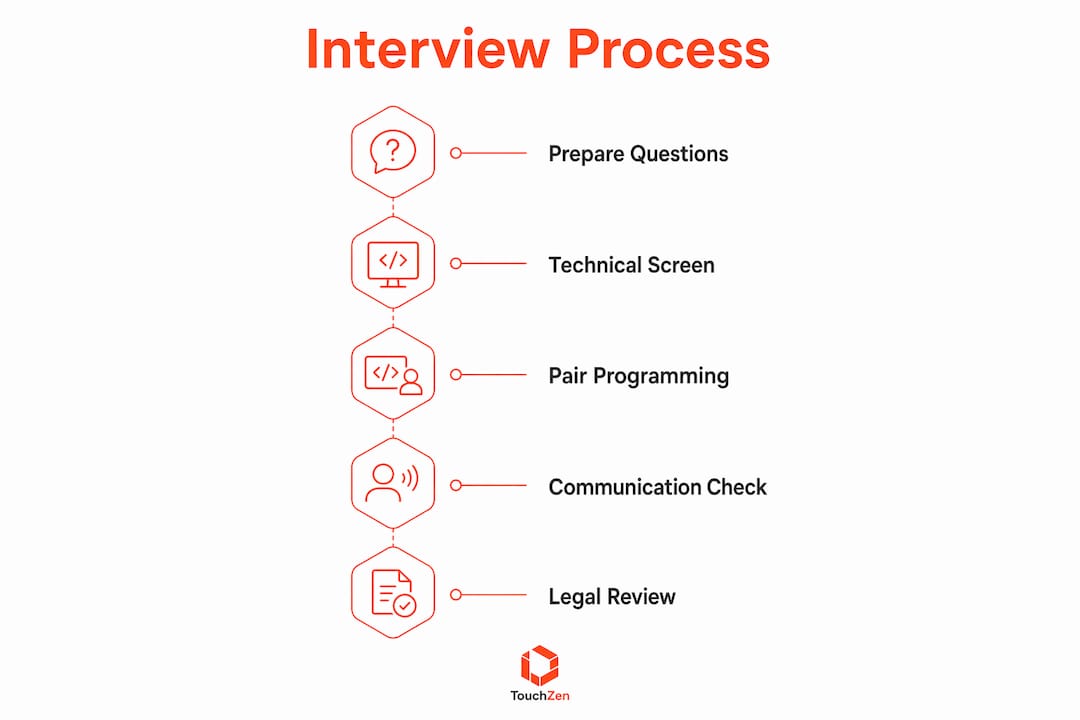
The most effective deep assessment is a 90-minute paid pair-programming session using real codebase bugs. This format reveals how a candidate thinks out loud, handles unfamiliar code, asks questions, and communicates under mild pressure. It is worth paying for. A bad hire costs far more than a 90-minute session.
Pro Tip: Give candidates a real bug from your existing codebase or a sanitized version of one. Generic coding exercises test preparation, not problem-solving. Real bugs test judgment.
How do communication and workflow skills affect remote hiring?
Communication is not a soft skill in iOS development. It is a hard requirement, especially in remote or hybrid teams. Effective remote developer management depends on clear expectations, asynchronous discipline, and daily check-ins, not micromanagement. Your interview questions need to surface how a candidate actually works, not just how they describe working.
Ask these questions to evaluate communication and workflow fit:
"How do you prefer to handle code reviews? Walk me through your process as both reviewer and reviewee." This reveals whether they treat code review as a learning tool or a gatekeeping ritual.
"How do you communicate a technical blocker to a non-technical stakeholder?" The best developers translate complexity without condescension. Listen for clarity and empathy in their answer.
"What does your daily async communication rhythm look like when working remotely?" Strong candidates describe specific tools, specific check-in cadences, and proactive status updates.
"Do you use AI-assisted development tools like Cursor or Claude in your workflow?" Proficiency with AI tools is now an expected productivity baseline for Swift engineers in 2026. A 30% productivity gain is the cited benchmark. Candidates unfamiliar with these tools are already behind.
"How do you handle a situation where you disagree with a technical direction set by the team lead?" This reveals whether they can advocate professionally without creating friction.
If you are weighing US-based vs. offshore teams, communication style and time zone overlap become even more critical filters. Add questions about overlap hours, preferred communication tools, and experience with distributed teams to your screen.
What legal and IP questions must you ask before signing?
Every founder must treat IP protection as a non-negotiable condition of hire, not an afterthought. The legal framework for hiring a developer is as important as the technical one.
Ask every candidate these questions before any contract is signed:
"Are you willing to sign a work-for-hire agreement that assigns all created IP to our company?" All work produced by a developer must be explicitly stated as the exclusive property of the hiring company. This is a standard legal requirement as of 2026. Any hesitation here is a red flag.
"Have you signed NDAs with previous clients? Are you currently bound by any non-compete agreements?" This protects you from inheriting legal conflicts and confirms the candidate understands professional confidentiality.
"Do you have any existing code libraries or frameworks you plan to incorporate into our project?" Pre-existing code can create ownership disputes. You need to know upfront.
"Are you comfortable with a clause that prohibits you from working on competing apps during our engagement?" This is standard for full-time and exclusive contract roles.
Skipping these questions is one of the most expensive mistakes a founder can make. A developer who builds your core product without a proper work-for-hire agreement can legally claim ownership of that code. Protect yourself before the first commit.
Key takeaways
Hiring the right iOS developer requires structured technical screening, real-world problem-solving assessment, communication evaluation, and airtight legal agreements before any work begins.
Point | Details |
|---|---|
Screen for Swift 6 mastery | Ask about Actors, Sendable protocols, and concurrency trade-offs to confirm senior-level platform knowledge. |
Verify shipping history | Require App Store listing links with developer credits, not just claims of prior experience. |
Use paid pair-programming | A 90-minute session on real bugs reveals problem-solving and communication far better than standard interviews. |
Assess AI tool fluency | Candidates should actively use tools like Cursor or Claude as a standard part of their 2026 workflow. |
Lock down IP before day one | Require work-for-hire contracts and NDAs that assign all created code exclusively to your company. |
What I have learned about hiring iOS developers the hard way
The single biggest mistake I see founders make is hiring based on interview confidence rather than demonstrated shipping history. A developer who speaks fluently about Swift concurrency but cannot produce a single App Store link with their name credited is not a senior developer. They are a well-prepared interviewee.
The App Store rejection question is my personal litmus test. Every developer who has shipped real apps has been rejected by Apple at least once. How they describe that experience tells you everything: Did they understand the rejection reason? Did they fix it cleanly? Did they communicate the delay to their client proactively? Developers who have never been rejected have never shipped anything meaningful.
I also think the industry undervalues the paid pair-programming session. Founders resist it because it feels awkward to pay someone for an interview. But a 90-minute session on a real bug is the closest thing to a working relationship preview you will ever get before signing a contract. You see how they think, how they communicate under mild pressure, and whether they ask smart questions or just start typing. That session has saved more bad hires than any resume screen I have ever run.
One more thing: ask about mobile development workflow discipline early. Developers who cannot describe their own process clearly will not follow yours. Process discipline is not bureaucracy. It is how apps get shipped on time.
— Cyrus
How TouchZen helps founders hire and build with confidence
Finding a senior iOS developer who can ship, communicate, and protect your IP is genuinely hard. TouchZen removes that friction by giving founders direct access to vetted senior developers and designers from day one, with no delegation to junior staff.
TouchZen has launched over 75 apps across industries, with results including 100,000 downloads in the first year and a 10x increase in user subscriptions for clients. The team brings full accountability from kickoff to launch, plus ongoing post-launch support so your app keeps growing. If you are ready to build with a team that has already solved the hiring problem for you, explore TouchZen's iOS and Android development services or see why founders rank TouchZen among the top app developers in the USA.
FAQ
What is the most important question to ask an iOS developer?
Ask candidates to show you their App Store listing with their name credited as a developer. This single question separates candidates with real shipping experience from those who only claim it.
How long should an iOS developer technical interview take?
A focused initial technical screen runs about 45 minutes and prioritizes architectural judgment over algorithm-heavy tests. Follow up strong candidates with a 90-minute paid pair-programming session for deeper assessment.
Should I ask about swift 6 specifically?
Yes. Swift 6 features like Actors, Sendable protocols, and structured concurrency are now baseline knowledge for senior iOS developers in 2026. Candidates who cannot explain these concepts clearly are not operating at a senior level.
What legal documents must an iOS developer sign before starting?
Every iOS developer must sign a work-for-hire agreement that assigns all created IP exclusively to your company, plus a Non-Disclosure Agreement. These are non-negotiable legal protections, not optional formalities.
How do I evaluate communication skills in a remote iOS developer?
Ask candidates to describe their daily async communication rhythm, their code review process, and how they communicate technical blockers to non-technical stakeholders. Strong remote developers describe specific tools, cadences, and proactive habits, not vague intentions.