
Cyrus Kiani
Founder / CEO



Master Client-Agency Communication for App Success
Most startup founders obsess over finding the right agency, the sharpest designers, and the most experienced developers. But here's what rarely gets discussed: even the best technical team can't save a project derailed by poor communication. Effective communication builds trust, aligns expectations, and reduces project risk at every stage of app development. This guide breaks down actionable strategies, practical frameworks, and real-world tips tailored specifically for tech founders working with digital agencies. We'll show you what actually works, where most collaborations break down, and how you can lead your project to a successful outcome.
Key Takeaways
Point | Details |
|---|---|
Communication is non-negotiable | Clear, frequent exchanges are essential for trust and success in startup-agency work. |
Right tools boost results | Collaborative platforms like Slack and Teams outpace email for real-time project coordination. |
Agility prevents issues | Quick feedback and defined roles keep projects on track and minimize costly mistakes. |
Immersion beats outsourcing | Active founder participation ensures alignment and avoids misunderstandings in agency collaboration. |
Why communication is the foundation of successful agency partnerships
Let's get one thing straight: communication isn't a soft skill you can delegate or skip. For startup founders working with agencies, it's the single most powerful lever you have over project outcomes. Without it, even the most talented development team will build the wrong thing, on the wrong timeline, with the wrong priorities.
Trust between a founder and an agency doesn't appear automatically. It's built through consistent, transparent dialogue. When you communicate clearly from day one, you reduce ambiguity, prevent misaligned expectations, and create a shared language around goals, timelines, and trade-offs. This is especially critical in app development, where a single misunderstood requirement can cost weeks of rework.
"The top success factors in IT projects are people-related: the right team, the right sponsor, and the right environment. Communication underpins all of them, and decision latency is a key risk." CHAOS Report on IT project outcomes
This is not just theory. The data is clear: projects with structured communication routines succeed far more often than those relying on informal updates and assumptions. Decision latency, meaning the delay between a question being raised and an answer being given, is one of the most damaging dynamics in any agency engagement.
Here's what poor communication actually costs you:
📉 Scope creep from features that were never properly defined
📉 Missed deadlines caused by delayed approvals or unclear priorities
📉 Budget overruns from rework driven by misunderstood requirements
📉 Team frustration when developers build something founders didn't actually want
📉 Eroded trust that makes future collaboration harder and slower
Founders must actively participate in shaping communication norms, not just respond when the agency reaches out. Building effective collaboration requires you to align all internal stakeholders before the agency even starts. Who approves designs? Who signs off on feature changes? Who handles technical questions? These answers need to exist before kickoff.
When you invest in improving app user experience, the underlying decisions are only as good as the communication that informs them. Clear dialogue is what turns good intentions into great products.
Key communication strategies for client collaboration in app development
Understanding the 'why' sets the foundation. Now let's get into the 'how.' These are the practical methods that make collaboration smooth, predictable, and productive.
1. Define communication expectations before work begins. Agree on which tools you'll use, how often you'll meet, and who speaks for each side. This sounds basic, but skipping it is one of the most common mistakes founders make. Key methodologies include regular check-ins, active listening, clear channels, documentation, and collaborative tools over email.
2. Choose the right tools for each type of communication. Not every message belongs in the same channel. Here's a quick comparison:
Tool | Best use case | Pros | Cons |
|---|---|---|---|
Slack | Daily async updates, quick questions | Fast, searchable, integrates with dev tools | Can get noisy without channel discipline |
Microsoft Teams | Larger orgs, file sharing, structured threads | Deep Microsoft 365 integration | Heavier interface, steeper learning curve |
Zoom | Weekly syncs, design reviews, demos | Real-time clarity, screen sharing | Scheduling friction, meeting fatigue risk |
Notion / Confluence | Documentation, decision logs | Persistent, organized, shareable | Requires upfront setup and maintenance |
3. Implement a weekly rhythm. Weekly check-ins keep both sides aligned without overwhelming anyone. Short, focused, and structured works better than long, rambling calls.
4. Assign a documentation owner. Every key decision made in a meeting should be written down and shared within 24 hours. Use project management software tools like Linear, Jira, or Notion to track decisions and action items.
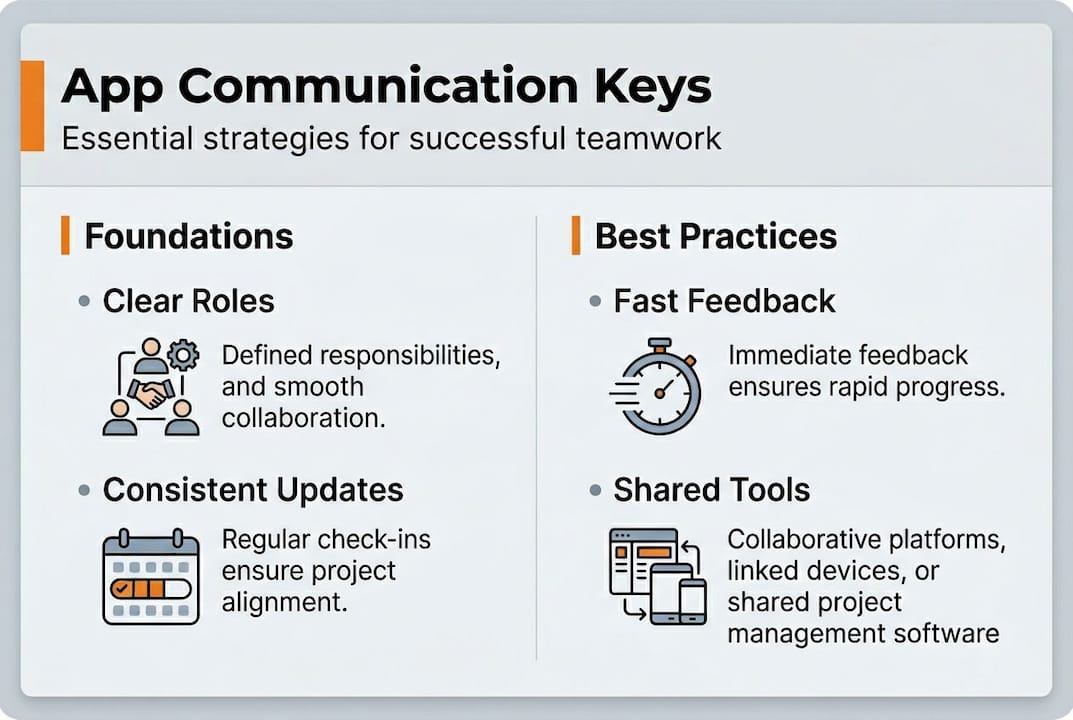
5. Create fast feedback loops. When the agency shares a design or prototype, respond within 48 hours. Delays compound quickly in sprint-based development.
Pro Tip: Treat your agency as a strategic partner, not a vendor. Vendors execute orders. Partners solve problems. When you bring your agency into the 'why' behind product decisions, they make better technical and design choices on your behalf.
Tackling common pitfalls and edge cases in client-agency communication
Even with great strategies, pitfalls lurk. Let's examine the real-world traps that affect startups most and how to sidestep them.
The most damaging issues in client-agency projects often trace back to structural communication failures, not technical ones. Misaligned stakeholders, wrong decision-makers, scope creep from unclear briefs, and late feedback causing redesigns are the most common culprits.
Here are the pitfalls founders encounter most often:
🚨 Multiple decision-makers with conflicting opinions confuse the agency and slow everything down
🚨 Vague briefs that leave too much open to interpretation
🚨 Feedback delivered too late in the sprint cycle, requiring expensive rework
🚨 Stakeholders who aren't looped in until the final review, then derail the project
🚨 Assuming the agency understands your business context without explicitly sharing it
The fix for most of these is structural. Designate one primary decision-maker on the founder side. This person has final say and is available to respond within a defined timeframe. When the agency knows exactly who to go to, decisions happen faster and with less friction.
Weekly demos are another powerful tool. Rather than waiting for a milestone delivery, ask the agency to show working software every week. This keeps feedback cycles tight and surfaces misalignments early, when they're cheap to fix. The CHAOS Report project success data reinforces that early and frequent feedback loops are directly tied to better outcomes.
Shared trackers, whether in Jira, Linear, or a simple Notion board, give both sides visibility into what's in progress, what's blocked, and what's coming next. This prevents the classic "we thought you were working on X" conversations.
For scalability planning, early communication about technical architecture is just as important as design feedback. Founders who engage on these decisions early avoid costly rebuilds later.
Pro Tip: When you give feedback, be specific. "I don't like the color" is not actionable. "The blue feels too corporate for our target audience of Gen Z users" gives the designer something to work with. Specific feedback saves time and money.
Tailoring communication strategies for technology startups
Knowing the pitfalls, let's zoom in on how founders can customize communication playbooks for startup-agency success.
Startups operate differently from enterprises. You move faster, your team is smaller, and your priorities can shift week to week. The communication structures that work for a Fortune 500 company will slow you down. You need something leaner and more responsive.
Here's how startup communication needs differ from traditional enterprise models:
Priority | Startups | Traditional enterprises |
|---|---|---|
Decision speed | Hours to 1 day | Days to weeks |
Feedback cycles | Weekly or biweekly sprints | Monthly milestones |
Stakeholder count | 1 to 3 key decision-makers | 5 to 15 approvers |
Tool preference | Slack, Notion, Loom | Email, SharePoint, formal reports |
Flexibility | High, pivots are expected | Low, change management required |
For startups, the goal is to use the right tools for real-time collaboration and confirm steps clearly at each stage. Here's a step-by-step routine that works:
Kickoff call: Define goals, timelines, tools, and decision-makers. Document everything.
Weekly sync: 30-minute check-in covering what was built, what's next, and any blockers.
Async updates: Daily Slack or Loom updates from the agency on progress and questions.
Sprint review: Every two weeks, review working software and reprioritize the backlog.
Decision log: A shared doc where every key decision is recorded with context and date.
When choosing a right CMS for startups or defining your custom app development scope, these communication routines ensure your agency stays aligned with your evolving product vision. Smaller teams can move faster, but only if the communication infrastructure supports it.
What most guides miss about startup-agency communication
Here's a candid perspective that most communication frameworks skip entirely: communication is active, not passive. Most guides hand you a checklist and call it a day. But the founders who get the best results from agency partnerships don't just follow a process. They immerse themselves in it.
When a founder goes quiet, assuming the agency will figure it out, the project drifts. This is what we call magical thinking about development: the belief that a good brief and a talented team are enough. They're not. Real collaboration requires your ongoing presence, your timely decisions, and your transparency about business context.
The best agency relationships we've seen share one trait: the founder shows up. They review demos. They give fast, specific feedback. They share business updates that affect product priorities. They treat the agency as an extension of their own team, not a black box that delivers software.
This is especially relevant when you're working on a UI design guide for startups or navigating complex feature trade-offs. Your active participation shapes outcomes that no framework alone can guarantee. 📌
Partner with expert app development agencies for world-class collaboration
Ready to apply these strategies with a team that actually lives by them? The communication frameworks in this guide work best when your agency partner is already built around transparency, fast feedback, and direct access to senior developers.
At TouchZen Media, we work with startup founders who want a real partner, not just a vendor. We're recognized among the top app developers in California and listed among the leading mobile app development companies for a reason: we prioritize clear communication from day one. Whether you're scoping your first app or scaling an existing product, the TouchZen Media team is ready to help you build something great. 🚀
Frequently asked questions
What is the role of communication in successful client-agency collaboration?
Communication builds trust, aligns expectations, and reduces project risks throughout the app development process. Without it, even technically strong teams produce misaligned outcomes.
Which tools are best for collaborating with digital agencies in 2026?
Slack, Microsoft Teams, and Zoom are top choices for real-time project communication and collaboration. Collaborative tools like Slack consistently outperform email for fast-moving startup projects.
How can startups avoid miscommunication when working with agencies?
Set clear roles, use shared tools, schedule regular check-ins, and give feedback promptly to minimize misunderstandings. Misaligned stakeholders and late feedback are the two most preventable causes of project failure.
Why do so many app development projects fail despite technical expertise?
Most failures stem from people and communication issues, not technical flaws. Top success factors are people-related, and decision latency alone can derail an otherwise well-resourced project.