
Joy Foroughi
Executive Assistant


Mobile App Deep Linking and SEO: How to Send Google Search Traffic Straight to an App Screen
How deep linking connects mobile app growth with SEO. Send Google search traffic directly to app screens for better conversion and retention. Most apps treat web SEO and app growth as separate channels. The teams that connect them win. Here is how mobile app deep linking and SEO work together to send Google search traffic straight to the right app screen.
Introduction
Most founders we work with treat web traffic and app traffic as two different worlds. The marketing team optimizes the website for Google. The product team optimizes the app for retention. The two channels run in parallel and rarely cross paths.
That separation is one of the most expensive habits in mobile growth. When a user searches for something specific on Google, lands on your website, and then has to manually find the same thing inside your app, you have already lost most of them. The friction is invisible to the marketing dashboard, but the cost shows up downstream as low conversion, weak retention, and attribution gaps that make every channel look worse than it actually is.
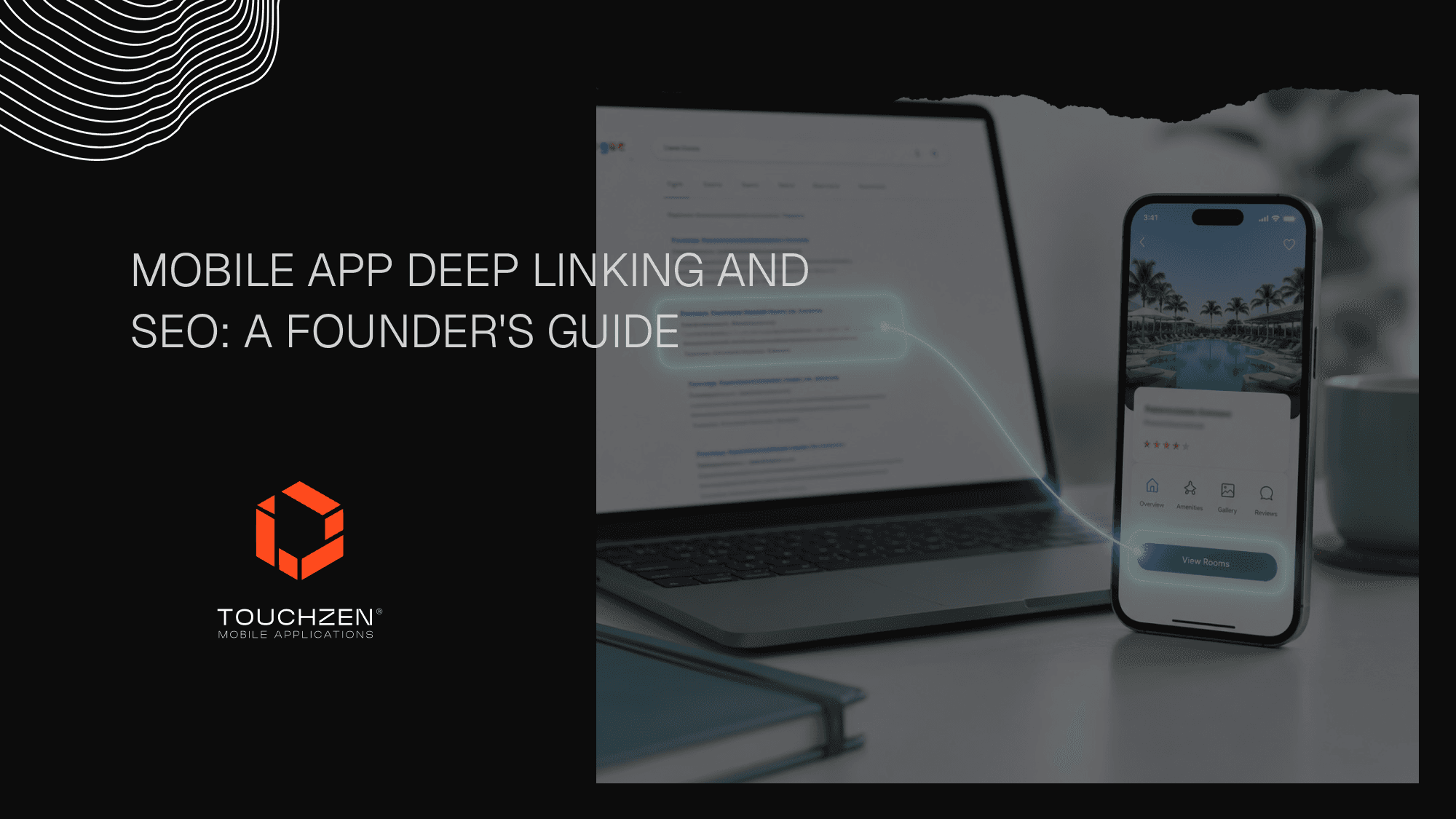
Mobile app deep linking and SEO solve this problem. Done right, a user searches on Google, taps a result, and lands on the exact app screen they were looking for. No homepage detour. No browsing. No friction. The visit converts because it never breaks momentum.
This guide walks through how mobile app deep linking and SEO work together, the link types every founder should understand, how to map app screens to search intent, and what to think about before adding deep linking to your roadmap.
TouchZen Media mobile app development services
What Is Mobile App Deep Linking?
In simple terms, deep linking is the ability to open a specific screen inside a mobile app from a URL, rather than just launching the app to its home screen.
When a user taps a link in Google search, an email, a social post, or an SMS, a properly configured deep link takes them directly to the relevant content inside the app: a product page, an article, a class, a profile, a property listing. If the app is not installed, the same link can be configured to send the user to the App Store or Google Play and remember where they were going so the app opens to the right screen after install.
Think of it as the mobile equivalent of clicking a URL on the web. The web has always worked this way. Mobile apps did not, at first. Deep linking is what closes that gap.
Why Deep Linking Matters for SEO and App Growth
The marketing case for mobile app deep linking SEO is straightforward. Every search engine result, every social share, every email link can become a direct path into the product. The benefits show up in four places.
Higher conversion. Users who land on the exact screen they searched for convert at much higher rates than users who have to navigate to it.
Better retention. First sessions that begin with relevance are stickier. The user immediately sees that the app understands what they came for.
Cleaner attribution. Deep links carry parameters that show which channel, campaign, or content drove the install or visit. Without them, organic web traffic looks like a black box.
Compounding SEO value. Each piece of indexable web content becomes a doorway into the app. The blog post, the landing page, the product page all do double duty.
For mobile app marketing strategies
How Google Search Traffic Can Lead to App Screens
Search engines and mobile platforms have supported different forms of app indexing and app-to-web linking for years, and the modern path looks roughly like this.
A user searches on a mobile device. Google returns results that include both web pages and, where supported, links that open directly inside installed apps. If the user has your app installed, tapping the result can launch the app to the specific screen the URL maps to. If they don't, the link opens the web page, which is itself optimized to convert the visit into an install with the screen waiting on the other side.
The mechanics depend on how your team has set up universal links (iOS) and app links (Android), how the web and app URL structures mirror each other, and how the app handles incoming URLs. None of this is exotic engineering, but each piece has to be done correctly. Skipping a step usually means the deep link silently breaks and nobody notices for months.
Types of Deep Links Founders Should Know
Most founders do not need to know every technical detail, but understanding the categories helps the team make the right call.
Standard Deep Links
A URL that opens a specific screen if the app is installed. If the app is not installed, the link does nothing useful. Fine for internal use, but a poor fit for SEO and acquisition.
Universal Links (iOS) and App Links (Android)
The modern standard. A single URL that works whether the app is installed or not. If installed, the URL opens the app to the right screen. If not installed, it opens the web page. Apple and Google both verify the link through a small file hosted on your domain, which prevents other apps from hijacking your URLs. These are what most founders should be implementing.
Deferred Deep Links
A link that remembers where the user was going even if the app has to be installed first. The user taps a link, gets sent to the App Store, installs the app, opens it for the first time, and lands directly on the screen the original link pointed to. Critical for paid acquisition and content marketing, where most of the audience will not have the app yet.
Branded Short Links and Smart Links
Tools like Branch and Adjust provide one-tap links that handle device detection, deferred deep linking, fallback behavior, and attribution in a single layer. Most apps that take growth seriously use one of these platforms rather than building the entire pipeline in house.
Practical Use Cases by App Category
Deep linking pays off in different ways depending on the app.
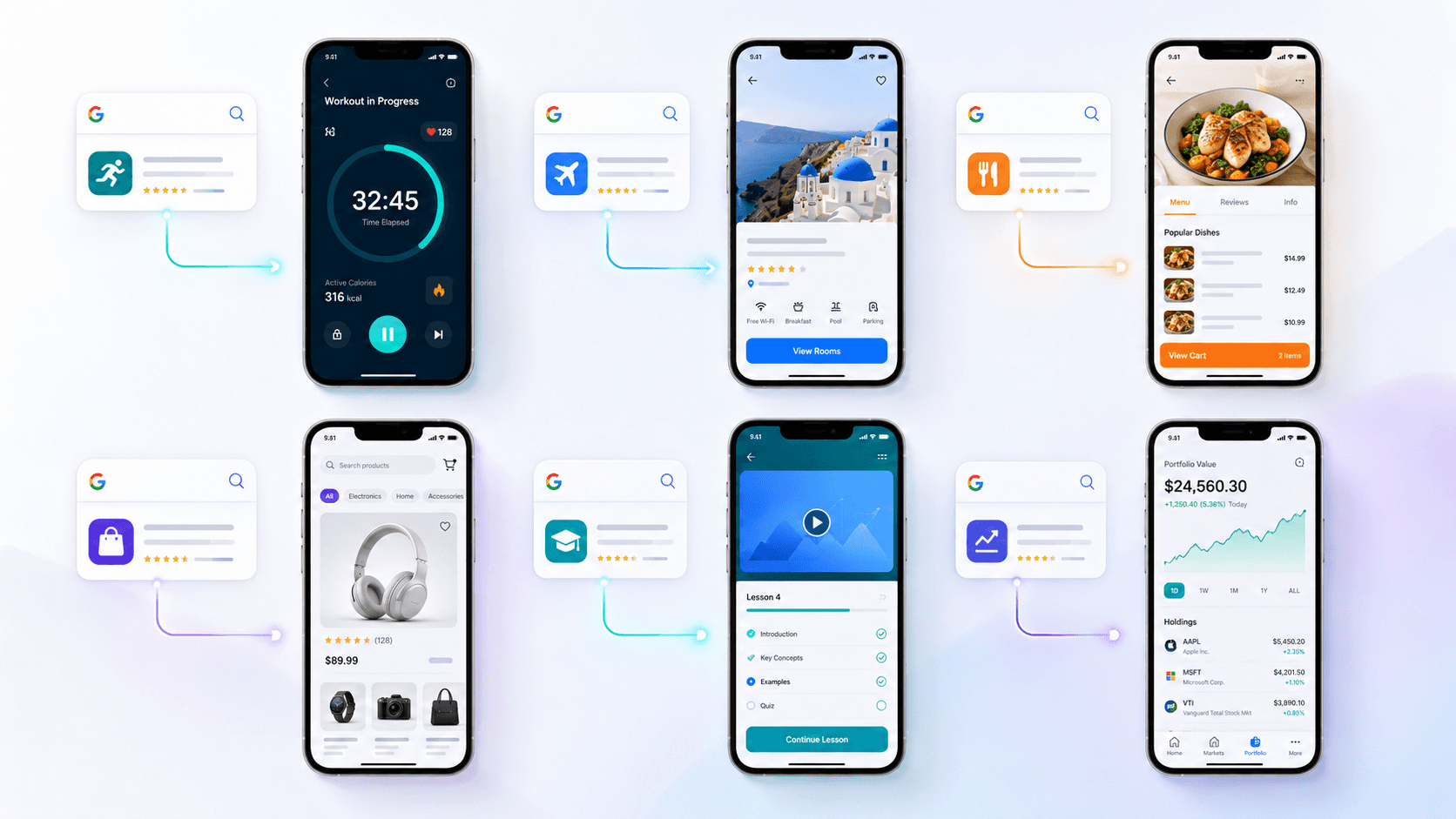
Fitness apps. A search like "best 20-minute HIIT workout" can land users on the exact workout screen in your app, ready to start. Each workout becomes its own indexable web page and its own direct app entry point.
Travel apps. Search results for a specific destination ("hotels in Lisbon under $200") map directly to the search results inside the app, with filters applied. The user never has to re-enter their query.
Food and delivery apps. A user searching for "Thai food near me" can be sent into the app with their location detected and Thai cuisine pre-filtered. Each restaurant page on your website maps to its corresponding restaurant screen in the app.
Marketplace apps. A long-tail product search on Google can deep link to the specific listing in the app. SEO content built around buying intent ("best vintage leather jackets") becomes a high-converting acquisition funnel.
Education apps. Searches for specific topics ("learn Python in 30 days") open directly to the relevant course in the app, with the user's progress preserved if they are already enrolled.
Finance apps. A search like "how to start investing with $100" links straight to the onboarding flow for beginner portfolios, skipping the marketing pages entirely.
Implementation Checklist for Founders
Before adding deep linking to the roadmap, the team should agree on a few foundational decisions.
URL structure. Web URLs and app screens should mirror each other where possible. A consistent structure makes implementation simpler and SEO stronger.
Screen mapping. Decide which app screens are worth deep linking to. Not every screen needs a public URL. The high-leverage ones are typically content pages, product pages, and search results.
Fallback experience. What does the user see if the app is not installed, or if the link is opened on desktop? Each link should have a meaningful fallback web page.
Analytics and attribution. Decide which tool (Branch, Adjust, AppsFlyer, or in-house) will track which channel sent the user.
App indexing. Submit your app to Google's indexing tools and verify that links resolve correctly.
QA and testing. Test universal links, app links, and deferred deep links across iOS and Android, with the app installed, uninstalled, and freshly installed. Many deep linking bugs only show up in one of those states.
A common pattern: launch deep linking with twenty high-leverage URLs first, prove the lift, then expand across the rest of the app.
Common Mistakes Founders Make With Deep Linking and SEO
A handful of mistakes show up again and again.
Treating it as a marketing project alone. Deep linking needs engineering, design, and marketing aligned. A solo marketing initiative usually stalls.
No fallback pages. Users who tap a link on desktop or without the app installed hit a dead end. Every deep link needs a web page behind it.
Inconsistent URL structure. Web and app URLs drift apart over time, and links start breaking silently. A clear naming convention prevents this.
No attribution tagging. Deep links are launched, but no one can tell which channel they came from. The lift becomes invisible and the project loses internal support.
Skipping deferred deep linking. Without it, every new user from search has to re-find what they were looking for after install. Most of them won't.
No ongoing QA. OS updates, app releases, and SDK changes can break deep linking quietly. Apps that don't test regularly often have broken links for months before anyone notices.
When Should a Startup Invest in Deep Linking?
Deep linking is rarely the first thing a startup needs, but it becomes critical earlier than most teams expect. Reasonable signals that it is time to invest:
The app has live web traffic from SEO, content, or paid channels
Content on the web could meaningfully drive users into specific app screens
The team is starting to run paid acquisition and needs accurate attribution
The app has more than a handful of meaningful screens worth landing on
Conversion or retention numbers from web-to-app handoffs are obviously weak
For a brand-new MVP with no audience yet, deep linking can wait. For any app with growing organic traffic, it should already be planned.
How TouchZen Media Helps With Deep Linking and App Growth
Deep linking sits at the intersection of mobile app development, web architecture, and marketing strategy. Done well, it requires all three working together. At TouchZen Media, we have shipped 75+ mobile apps, with 20M+ combined downloads and 12+ apps featured by Apple and Google. Our work spans strategy, UX/UI design, native iOS and Android, Flutter and React Native, launch, and post-launch growth support, which means we tend to see deep linking as part of a broader acquisition and retention picture rather than an isolated engineering task.
If you have a mobile app and want to connect your web SEO directly to your in-app experience, or if you are planning a new app and want deep linking and indexing built in from day one, we'd be glad to talk through what that could look like for your product.
Conclusion
The single biggest unlock in many mobile app growth strategies is connecting web traffic to the right app screens. Mobile app deep linking SEO is what makes that possible. When a user searches on Google and lands inside the app at exactly the right place, conversion and retention numbers move together, and every dollar spent on content and SEO starts pulling double duty.
The technical pieces are well understood. Universal links, app links, deferred deep links, and indexing are mature, stable tools. What separates the apps that benefit from them and the ones that don't is whether the team treats deep linking as a strategic project, with engineering, design, and growth aligned around the same goal.
If you are ready to make your app and your website work as one connected acquisition channel, the TouchZen Media team can help you scope, build, and ship the deep linking strategy that fits where your product is going.
Frequently Asked Questions
1. What is mobile app deep linking?
Mobile app deep linking is the ability to open a specific screen inside an app from a URL, instead of just launching the app to its home screen. A deep link sends a user directly to the content they were looking for, whether that is a product, an article, a class, or a search result.
2. How does deep linking help mobile app SEO?
Deep linking lets Google search results lead users straight into the relevant screen of an installed app, while still serving a real web page for users without the app. The same content earns both web rankings and app installs, which lifts conversion and improves attribution. For more on connecting product and growth decisions, see our TouchZen Media mobile app development services page.
3. What is the difference between deep links and deferred deep links?
A standard deep link opens an app screen only if the app is already installed. A deferred deep link remembers where the user was going, sends them through the App Store or Google Play if needed, and then routes them to the original destination after first launch. Deferred deep links are essential for any growth channel that targets users who do not yet have the app.
4. Can Google search traffic open a specific screen inside my app?
Yes. With universal links on iOS, app links on Android, and proper indexing, a Google search result can open directly to the matching screen inside the app for users who have it installed. Users without the app see the web page, which can convert them into installs.
5. When should a startup add deep linking to its mobile app?
As soon as the app has live web traffic worth converting, paid campaigns running, or content that could drive users into specific app screens. For very early MVPs without an audience, deep linking can wait, but for any app focused on growth, it should be planned in the first six months. If you are weighing the timing, the TouchZen team can help you decide.
6. Do I need a developer to set up mobile app deep linking?
Yes. Deep linking touches both the mobile codebase and the web infrastructure. Tools like Branch and Adjust reduce the work, but real implementation still requires an engineer who understands how universal links, app links, and deferred deep linking interact with your app's architecture.