

Joy Foroughi
Executive Assistant


Vision Pro, Meta Glasses, and Spatial Apps: Should Your Startup Build for Spatial Computing in 2026?
Should your startup build for Vision Pro, Meta glasses, or spatial computing in 2026? A founder's guide to when spatial apps make sense and when they don't. Spatial computing is moving from demo to roadmap conversation in 2026. Here is a balanced, founder-friendly look at when a startup should build for Vision Pro, Meta glasses, or AR/VR, and when waiting is the smarter call.
Introduction
Spatial computing keeps showing up in founder conversations in 2026, and not in the speculative way it did two years ago. Apple Vision Pro has moved beyond its initial launch conversation, with visionOS and hardware discussions continuing to evolve. Meta has shipped real consumer smart glasses with a steady upgrade roadmap. Meta, Apple, Samsung, Google, and several hardware startups continue to explore smart glasses, AR, VR, and mixed-reality devices. The question for founders is no longer whether spatial computing will exist. It is whether their company should build for it now, plan to build later, or stay on the sidelines.
The honest answer for most startups is "not yet, but soon." The honest answer for a meaningful minority is "yes, and the window matters." This guide is for founders trying to figure out which group they are in. It walks through what spatial computing actually means in 2026, where it is useful, where it is still too early, and how to make a decision that does not bet the company on a platform shift.
TouchZen Media mobile app development services
What Spatial Computing Means for Startups
Spatial computing refers to apps and experiences that operate in three-dimensional space, anchored to the user's environment rather than confined to a 2D screen. Instead of tapping a flat phone interface, users interact with content that appears in the room, on their hands, or in their field of view.
For founders, the practical implication is that spatial apps require a different design language, a different development stack, and a different kind of product thinking than mobile apps. A spatial app is not a phone screen pasted in the air. The interfaces, input methods, and user expectations are genuinely different.
Vision Pro, Meta Glasses, AR, VR, and Mixed Reality: A Quick Map
The vocabulary is messy, so it helps to lay it out plainly.
Virtual reality (VR) fully immerses the user in a digital environment. The real world is replaced. Devices like Meta's Quest line are the dominant consumer examples.
Augmented reality (AR) overlays digital content onto the real world, usually viewed through a phone camera, a tablet, or smart glasses. Meta Ray-Ban glasses and the smart glasses category in general live here, along with phone-based AR features through ARKit and ARCore.
Mixed reality (MR) blends the two. Digital objects coexist with the physical world, recognizing surfaces, lighting, and the user's hands. Apple Vision Pro is the most prominent mixed reality device, with full passthrough, hand and eye tracking, and a developer ecosystem built on visionOS.
The "spatial computing" umbrella covers all three categories, though in 2026 it most often refers to mixed reality experiences on devices like Vision Pro and the more capable smart glasses that have begun to ship.
TouchZen Media Ongoing Support & Growth service page
When a Startup Should Seriously Consider Building a Spatial App
A few signals point toward spatial computing being the right bet now, not later.
The first is when the product genuinely depends on three-dimensional context. A surgical training tool that needs to show a procedure in space, a real estate platform that wants to walk a buyer through a property, a CAD or industrial design tool where designers manipulate 3D objects directly. In these cases, the spatial device is not a nicer way to do something. It is the only way to do something the user actually wants.
The second is when the customer base already owns or will soon own the hardware. Enterprise teams adopting Vision Pro for training, design, or field work tend to move quickly. A startup selling into that buyer is not waiting for consumers to adopt.
The third is when the market itself is forming. Some early apps on the App Store and Google Play earned outsized traction by being among the first credible offerings in their category. Vision Pro and Meta glasses platforms are at a similar moment for the right kind of product.
The fourth is when the founder has a real conviction about the long-term shift. Some startups exist to bet on a platform change. That is legitimate, but the team should know they are doing it.
When a Startup Should Not Build for Spatial Computing Yet
For most consumer startups, spatial computing is still too early as a primary platform. The reasons are practical.
Device penetration is small. Vision Pro is selling, but it is not in tens of millions of pockets. Meta glasses are growing, but the addressable market is still a fraction of the smartphone install base. A consumer product that depends on volume to work usually cannot find it on spatial devices yet.
The hardware roadmap is still in motion. Devices in 2026 are meaningfully better than 2024, and 2028 devices will be meaningfully better than 2026. Building heavily for the current generation can mean rebuilding when the next one ships.
Development cost is real. Spatial app development is genuinely more expensive than mobile. The team needs different skills, the design language is unfamiliar, and QA is more complex because the test environment is the physical world.
User behavior is unsettled. Founders building for the phone in 2026 know roughly how a user will hold the device, how long sessions will last, and what kinds of interactions feel natural. Spatial computing is still figuring those defaults out.
For most consumer apps, a smart phone-first strategy with spatial features added later is the realistic path. The exceptions are above.
Where Spatial Apps Make Sense Today
A few categories already justify spatial development in 2026.
In healthcare, spatial apps support surgical training, clinical visualization, physical therapy, and patient education. The ability to render anatomy at scale and walk through procedures spatially is genuinely different from any 2D experience.
In professional training and education, spatial apps deliver hands-on simulation that flat video cannot match. Aviation, manufacturing, emergency response, and skilled trades have all seen real adoption.
In real estate, spatial walkthroughs of homes, commercial buildings, and unbuilt developments are increasingly expected by buyers, especially at the high end of the market.
In fitness, spatial apps can coach posture, form, and movement in ways a flat screen cannot. Vision Pro and similar devices give a trainer the ability to mark up the user's body in real time.
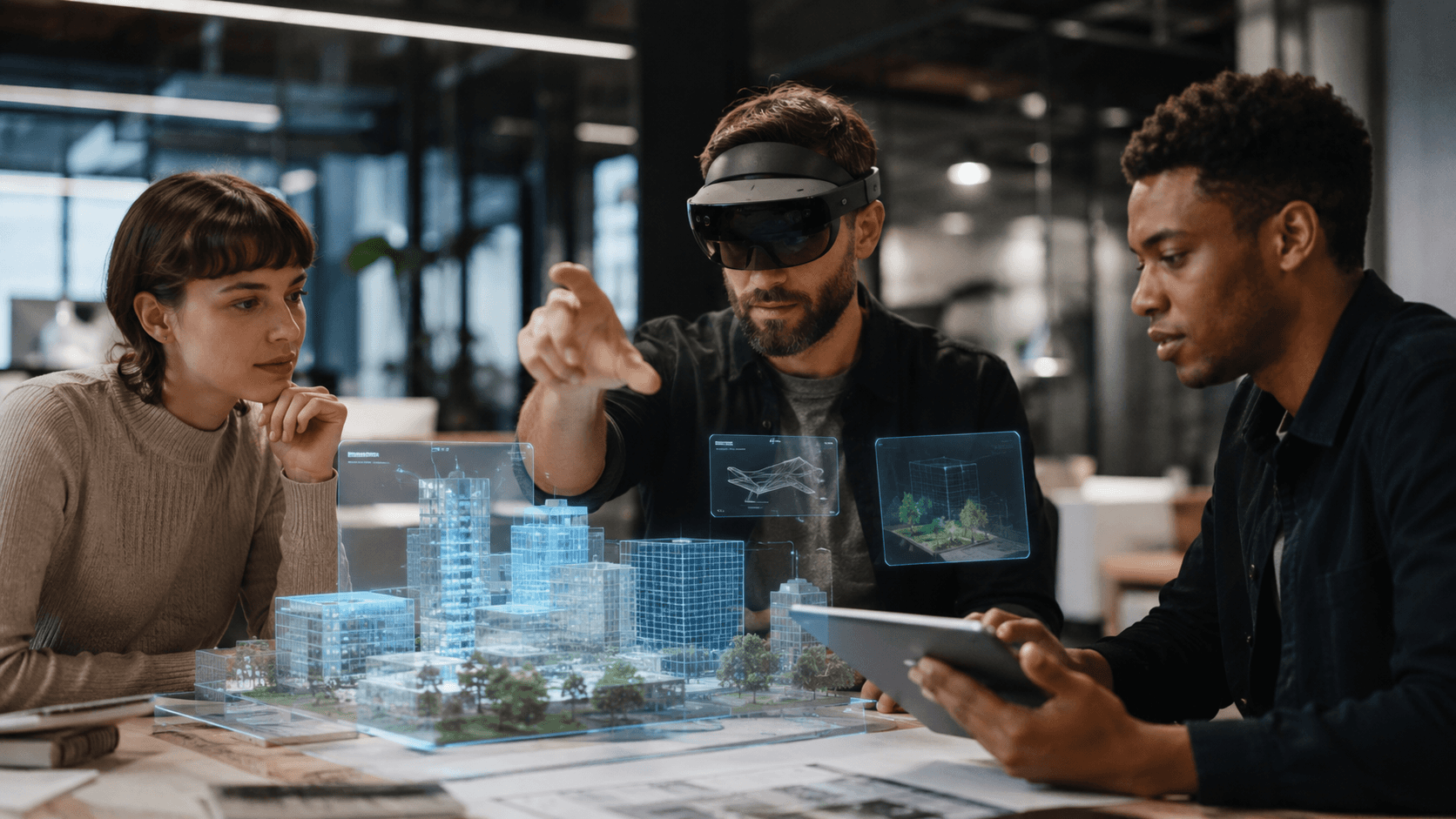
In design, CAD, and creative work, spatial apps let designers manipulate 3D models, architectural renderings, and product mockups directly. Some of the strongest enterprise spatial apps live in this category.
In productivity, spatial computing is exploring large virtual displays, multi-window setups, and immersive focus environments. This is more experimental, but the workflow gains are real.
In immersive commerce, brands are using spatial apps to let users place products in their actual rooms, try on apparel at scale, or experience cars and furniture before buying.
The common thread across these categories is that the spatial experience does something a phone cannot. That is the test.
Product, UX, and Development Challenges
Building a spatial app introduces challenges most mobile teams have not encountered before.
UX moves from screen design to environment design. Where does content sit in the room? How does it respond to the user moving, turning, or walking away? How big should an object feel? How close is too close? These are real design questions with no settled answers.
Input shifts from touch to hands, eyes, and voice. A button cannot be a button in the same way. A scroll cannot be a scroll. The team needs designers who understand spatial input and developers who understand the platform's specific gesture and accessibility models.
Development uses different stacks. visionOS, Unity, Unreal, and platform-specific SDKs are all in play depending on the device and the experience. Teams used to React Native or Flutter need to factor in either a new stack or a hybrid approach.
QA happens in the physical world. Testing requires real devices, real spaces, and a real understanding of how lighting, room size, and movement affect the app.
TouchZen Media UX services page
Budget, Timeline, and Maintenance Considerations
For founders weighing a spatial project, the rough orders of magnitude in 2026 look like this. A focused spatial MVP typically lands in a higher cost range than a comparable mobile MVP, often 1.5x to 2.5x, depending on complexity. Timelines are longer, because the design and engineering loops take more iterations. Maintenance is heavier, because the platforms are still evolving quickly. New OS releases on visionOS or Meta's platforms can break existing apps or open up significant new capabilities, and teams need to keep up.
These are not reasons to avoid spatial. They are reasons to plan for it.
How to Validate a Spatial App Idea Before Building
The validation pattern that works for mobile apps applies here too, with a few adjustments.
Start with the user problem and confirm that a spatial experience genuinely solves it better than a phone. Talk to ten to fifteen target users. Watch them try existing spatial apps in the category. Look at what they get excited about and what they ignore.
Build a small spatial prototype before committing to a full product. A focused Unity or visionOS prototype, scoped to a single experience, costs a fraction of a full build and answers the most important question: does this feel right in space?
Test on the real hardware. Founders sometimes evaluate spatial ideas on a desktop or in a simulator. The honest signal is the experience on the device, in the user's actual environment.
How TouchZen Media Helps Founders Evaluate and Build for Spatial Computing
At TouchZen Media, we work with founders to evaluate emerging platforms the same way we evaluate any product decision. The question is not whether spatial computing is exciting. It is whether spatial computing is the right answer to the specific problem the product is trying to solve. Our team has shipped 75+ mobile apps across iOS, Android, Flutter, and React Native, with 20M+ combined downloads and 12+ apps featured by Apple and Google, and we apply the same rigor to spatial and emerging-tech work that we apply to mobile.
For founders exploring Vision Pro, Meta glasses, or AR/VR, we help with product strategy, UX design, prototyping, and full development across mobile and emerging platforms. If the right answer is a spatial app, we can build it. If the right answer is a mobile-first product with a future spatial roadmap, we can help shape that too.
Frequently Asked Questions
1. Is it worth building a Vision Pro app in 2026?
For a small set of products with genuine spatial use cases or enterprise customers already adopting Vision Pro, yes. For most consumer startups, a phone-first strategy with a spatial roadmap is the more practical call. The right answer depends on whether the product needs three-dimensional context to deliver value.
2. What is the difference between AR, VR, and spatial computing?
AR overlays digital content on the real world. VR replaces the real world with a digital one. Mixed reality blends the two. Spatial computing is the broader category covering all three, most often used in 2026 to describe mixed reality experiences on devices like Vision Pro and capable smart glasses.
3. How much does it cost to build a spatial app?
Cost varies widely, but a focused spatial MVP typically runs 1.5x to 2.5x the cost of a comparable mobile MVP. Timelines are longer, design iteration is heavier, and maintenance is more involved. The investment is real, which is why product fit matters before committing.
4. Should I use Unity, Unreal, or native visionOS for spatial apps?
The right stack depends on the product. Native visionOS is strong for apps that lean into Apple's design language and want to integrate deeply with the platform. Unity and Unreal are useful for cross-device experiences, complex 3D content, and existing teams with game engine expertise. The choice should be made after the product is scoped, not before.
5. When will spatial computing be mainstream enough for a consumer app to launch on it primarily?
Best guess in 2026 is a few years out for true consumer scale, possibly faster in specific markets. Enterprise adoption is happening now. Founders who want to build for spatial computing as a primary platform should plan around a long ramp, build in flexibility, and probably keep a mobile or web touchpoint alongside.


