
Joy Foroughi
Executive Assistant


Website Redesign Services: A 2026 Business Guide
Boost your online presence with expert website redesign services. Improve user experience, SEO, and visibility in 2026's AI-driven market.

TL;DR:
Website redesign services focus on rebuilding websites to enhance user experience, performance, and search visibility in 2026. They involve strategizing for mobile responsiveness, speed, SEO, and AI platform compatibility to maintain and grow organic traffic. Choosing between a redesign or a refresh depends on website functionality, architecture, and growth potential.
Website redesign services are specialized solutions that rebuild or restructure your website to improve user experience, performance, and conversion rates. Whether you're running a WordPress blog, a Shopify store, or a custom Webflow site, a professional redesign goes far beyond swapping colors or fonts. It addresses site architecture, mobile responsiveness, page speed, and SEO integrity simultaneously. In 2026, the stakes are higher because AI-driven search platforms like ChatGPT, Gemini, and Perplexity now influence how customers discover businesses online. Getting your redesign right means staying visible in both traditional and AI-powered search results.
What are the key benefits of website redesign services?

Professional website redesign services deliver measurable improvements across every layer of your digital presence. The most direct benefit is better user experience. When visitors can find information quickly, navigate without friction, and complete purchases or form submissions without confusion, your business wins.
Here are the core benefits you should expect from a quality redesign:
Improved mobile usability: A modern, responsive design adapts to every screen size. Mobile traffic now represents the majority of web visits for most industries, so a site that breaks on a phone is a revenue leak.
Faster page load times: Core Web Vitals optimization during a redesign directly improves Google rankings and user engagement metrics. Speed is not a luxury; it is a ranking factor.
Stronger brand clarity: A redesign forces you to audit your messaging. Agencies that specialize in UI design best practices help you align visuals with your brand voice so visitors understand your value proposition within seconds.
Higher conversion rates: Businesses see up to 2× more contact form submissions within 90 days after redesigns that focus on conversion architecture and performance. That is a direct revenue impact, not a vanity metric.
SEO preservation and growth: A properly executed redesign protects your existing organic rankings while creating new opportunities for visibility on AI search platforms.
Scalable architecture: A ground-up rebuild on a modern CMS like WordPress, Shopify, or Webflow gives your team the tools to publish content, run campaigns, and add features without calling a developer every time.
Pro Tip: Before signing any redesign contract, ask the agency to show you a post-launch performance report from a previous client. Conversion rate changes, bounce rate shifts, and organic traffic trends tell you far more than a portfolio screenshot.
Redesign vs. refresh: which one does your site actually need?
The terms "redesign" and "refresh" are often used interchangeably, but they describe very different scopes of work. Choosing the wrong one wastes budget and can create new problems.
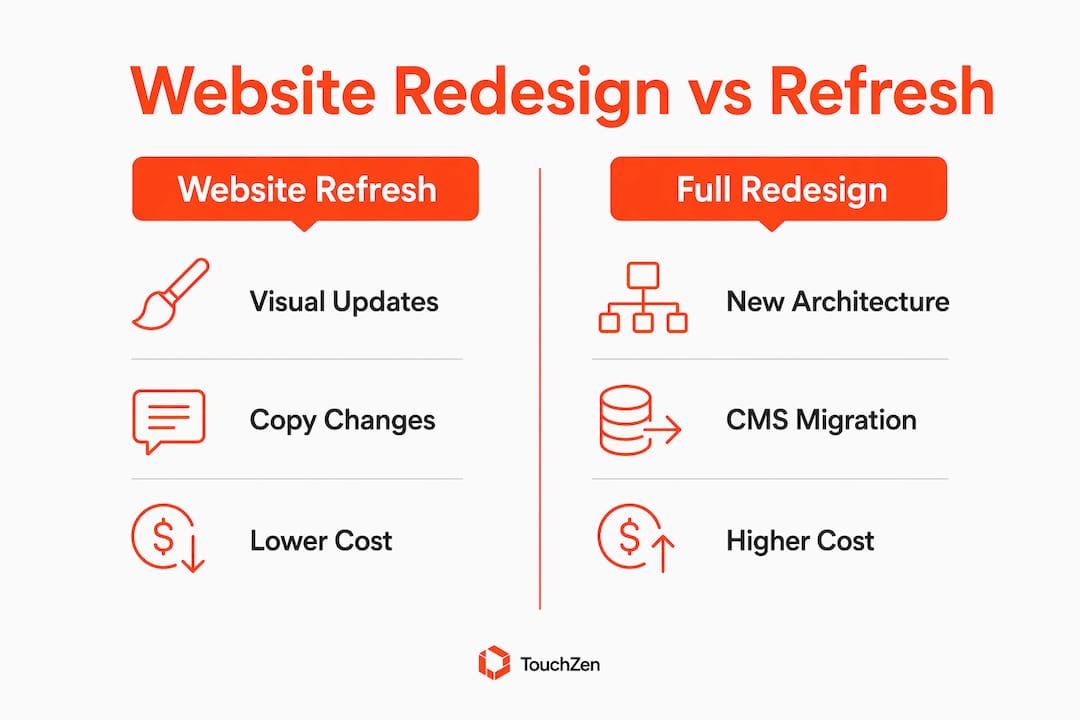
A full redesign is a ground-up rebuild involving a new CMS, new site architecture, and new content hierarchy. A refresh is a surface-level update that changes visuals and copy without touching the underlying structure. The distinction matters because a refresh applied to a broken foundation only masks the problem temporarily.
Factor | Website Refresh | Full Redesign |
|---|---|---|
Scope | Visual updates, copy changes | New architecture, CMS, and structure |
Cost | Lower ($500–$3,000) | Higher ($2,500–$30,000+) |
Timeline | 1–2 weeks | 3–6 weeks or more |
SEO Impact | Minimal risk | Requires careful migration planning |
Best For | Sites with solid structure but dated look | Sites with poor UX, slow speed, or CMS limitations |
Technical Changes | None or minimal | Full rebuild, redirects, schema migration |
A refresh works when your site loads fast, converts reasonably well, and simply looks outdated. A full redesign is necessary when your CMS or architecture is limiting growth or user experience. For example, if your site takes more than four seconds to load, has no mobile layout, or runs on a platform your team cannot update without developer help, a refresh will not fix those problems.
Pro Tip: Run a Google PageSpeed Insights test and a Google Search Console crawl before deciding between a refresh and a redesign. If you see Core Web Vitals failures or hundreds of crawl errors, you need a redesign, not a paint job.
How to choose the right website redesign agency
Selecting the right provider for your website revamp is one of the highest-leverage decisions in the entire project. The wrong agency can cost you rankings, time, and budget simultaneously.
Focus your evaluation on these criteria:
UX and SEO expertise together: Many agencies are strong in design but weak in technical SEO. You need both. A redesign must improve site architecture, content hierarchy, and SEO-safe migration to protect rankings and conversions. Ask specifically how they handle URL mapping and 301 redirects.
CMS platform experience: Confirm the agency has proven experience on your platform of choice. WordPress, Shopify, and Webflow each have distinct technical requirements. Choosing the right CMS for your business affects your long-term ability to manage content and scale features.
Custom vs. template approach: Template-driven builds are faster and cheaper. Custom-coded solutions give you full control over performance and functionality. Know which one your business actually needs before comparing quotes.
Pricing transparency: A transparent pricing approach focused on scope and measurable outcomes produces better business alignment than vague packages. If an agency cannot tell you exactly what is included in a price, that is a red flag.
Communication structure: Ask who will be your primary contact throughout the project. Agencies that route all communication through account managers and delegate execution to junior staff create decision latency and scope creep. Direct access to senior designers and developers accelerates timelines and improves quality.
Post-launch support: A redesign is not a one-time event. Ask about maintenance plans, performance monitoring, and how the agency handles bugs or ranking drops after launch.
How much do website redesign services cost?
Pricing for professional website redesign services varies widely based on scope, complexity, and the agency's positioning. Setting a realistic budget before you start conversations with agencies prevents wasted time on both sides.
Redesign investments typically start at approximately $2,500 for smaller, template-driven projects and scale to $30,000 or more for complex, custom-coded platforms. That range reflects real differences in deliverables, not just agency markup.
Project Type | Typical Cost Range | Timeline | Best For |
|---|---|---|---|
Template Refresh | $500–$2,500 | 1–2 weeks | Small businesses, basic branding updates |
Standard Redesign | $2,500–$8,000 | 3–5 weeks | SMBs needing new UX and CMS migration |
Custom Web Design | $8,000–$20,000 | 5–10 weeks | Growing companies with complex needs |
Enterprise / B2B Platform | $20,000–$30,000+ | 10–16 weeks | Large catalogs, integrations, high traffic |
The factors that push costs higher include page count, e-commerce functionality, third-party integrations, custom animations, and multilingual support. Most redesign projects take 3–6 weeks depending on page count, content readiness, and integration complexity. Delays almost always trace back to slow content delivery from the client side, not the agency.
Ongoing maintenance plans typically run $200–$1,500 per month depending on the level of support. Budget for this from the start. A site that goes unmonitored after launch will degrade in performance and rankings over time.
How do redesigns integrate SEO and AI search readiness in 2026?
SEO integration is not an add-on to a redesign. It is a core deliverable. Skipping it means trading short-term aesthetics for long-term traffic loss.
Here is the process a competent agency follows for SEO-safe migration and AI search readiness:
Audit existing rankings and URLs. Before any development begins, map every indexed URL and its current ranking position. This becomes the baseline for your redirect strategy.
Build a complete 301 redirect map. Proper redesign requires preserving URL structure, setting up 301 redirects, and migrating metadata and schema markup to prevent organic traffic loss. Every changed URL needs a redirect to its new equivalent.
Migrate and expand schema markup. Transfer all existing structured data and add new schema types relevant to your business. This step directly affects how Google and AI platforms interpret your content.
Implement FAQ and entity markup. Schema markup, FAQ, and entity markup keep redesigned sites discoverable on AI-driven search engines like ChatGPT, Gemini, and Perplexity. This is no longer optional for businesses that want AI search visibility.
Optimize Core Web Vitals. Page speed, layout stability, and interactivity scores all affect rankings. Build performance targets into the design brief, not as an afterthought.
Monitor Search Console for 30 days post-launch. SEO-safe site migration requires a 30-day post-launch Search Console monitoring period to catch crawl errors, ranking drops, or redirect failures before they compound.
Pro Tip: Use the 2026 SEO content checklist to audit your content structure before the redesign begins. Fixing content gaps before development starts saves significant revision time and protects your post-launch rankings.
Staying visible on AI search platforms requires more than good content. It requires structured data that machines can parse. Maintaining visibility on AI-driven search platforms like Google AI Overviews means your redesign must treat entity markup as a first-class deliverable, not an afterthought.
Key takeaways
A successful website redesign requires equal investment in technical SEO, user experience, and AI search readiness to protect rankings and drive measurable conversion growth.
Point | Details |
|---|---|
Redesign vs. refresh distinction | Choose a full redesign when your CMS or architecture limits growth; use a refresh only for surface-level visual updates. |
SEO migration is non-negotiable | Map all URLs, set up 301 redirects, and migrate schema markup before launch to prevent organic traffic loss. |
AI search readiness in 2026 | Implement FAQ schema and entity markup so your site stays visible on ChatGPT, Gemini, and Perplexity. |
Budget realistically | Costs range from $2,500 for template projects to $30,000+ for custom platforms; include ongoing maintenance in your budget. |
Vet agencies on communication | Direct access to senior designers and developers reduces scope creep and accelerates project timelines. |
What I've learned after watching dozens of redesigns succeed and fail
Most business owners treat a website redesign as a cosmetic project. They focus on colors, fonts, and hero images. The sites that fail after launch almost always failed for the same reason: nobody protected the SEO during the build.
I have seen companies lose 40% of their organic traffic within 60 days of launching a beautiful new site because the agency never set up 301 redirects or migrated the schema markup. The site looked great. It just became invisible to search engines overnight.
The second pattern I see repeatedly is scope creep driven by poor communication. A client approves a wireframe, the agency hands it to a junior developer, and three weeks later the delivered product looks nothing like what was discussed. This is why direct access to the people actually building your site matters more than the agency's portfolio.
My honest recommendation: treat your redesign like a product launch, not a home renovation. Define success metrics before the project starts. Set conversion rate targets, page speed benchmarks, and organic traffic baselines. Hold your agency accountable to those numbers at the 30-day and 90-day marks post-launch.
The businesses that get the most from their redesign investment are the ones that stay engaged throughout the process. You do not need to know how to code. You do need to show up to weekly check-ins, review content drafts promptly, and ask hard questions about SEO migration. That level of involvement is the difference between a site that performs and one that just looks good in a screenshot.
— Cyrus
How TouchZen approaches your website redesign
If you are ready to move from a site that exists to one that performs, TouchZen builds custom web design solutions with senior designers and developers on every project. No delegation to junior staff. No vague packages.
TouchZen covers the full scope: UX architecture, SEO-safe migration, AI search readiness, and post-launch performance monitoring. The team has delivered over 75 successful digital products, with results like 10x growth in user subscriptions and 100,000 downloads in the first year. Whether you need a modern website makeover or a ground-up rebuild, TouchZen tailors the scope and pricing to your actual business goals. Explore TouchZen's award-winning design work or connect with the team directly to discuss your project at TouchZen.

FAQ
What is included in website redesign services?
Website redesign services typically include UX redesign, CMS migration, mobile-responsive development, SEO migration with 301 redirects, schema markup implementation, and post-launch performance monitoring. The exact scope varies by project size and agency.
How long does a website redesign take?
Most redesign projects take 3–6 weeks depending on page count, content readiness, and integration complexity. Enterprise or e-commerce platforms with custom features can take 10–16 weeks.
How much should I budget for a professional website makeover?
Budgets start at approximately $2,500 for template-driven projects and scale to $30,000 or more for complex, custom-coded platforms. Factor in ongoing maintenance costs of $200–$1,500 per month after launch.
Will a redesign hurt my SEO rankings?
A redesign will not hurt your rankings if the agency properly maps all URLs, sets up 301 redirects, and migrates metadata and schema markup before launch. Skipping these steps is the primary cause of post-redesign traffic loss.
What is the difference between a website redesign and a website refresh?
A redesign is a ground-up rebuild involving new CMS, architecture, and content structure. A refresh is a surface-level update to visuals and copy that leaves the underlying structure intact.