

Joy Foroughi
Executive Assistant


What Founders Should Receive From Product Strategy Consulting
Before development starts, product strategy consulting should leave you with written, reviewable documents: a clearly defined problem and target user, supported by research and documented assumptions, a competitive read, a scoped MVP with priorities, designs or wireframes, a short roadmap, a technical and risk assessment, a budget and timeline expressed as ranges, and success metrics with targets. A slide deck alone is not enough if it leaves the key decisions, evidence and next steps undocumented.

Before development starts, product strategy consulting should leave you with written, reviewable documents: a clearly defined problem and target user, supported by research and documented assumptions, a competitive read, a scoped MVP with priorities, designs or wireframes, a short roadmap, a technical and risk assessment, a budget and timeline expressed as ranges, and success metrics with targets. A slide deck alone is not enough if it leaves the key decisions, evidence and next steps undocumented.
This guide lists each deliverable, what "good" looks like, and how to tell whether the package is ready to hand to engineers. Use it as a scorecard for any consultant or agency, including us.
TL;DR
Strategy work should end in documents you own: research findings, a product requirements document (PRD), a prioritized scope, wireframes, a roadmap, a risk log and a measurement plan.
Every requirement needs a priority and a testable acceptance criterion. Every estimate needs a range and written assumptions.
Open risks and unanswered questions need an owner and a next step, not a footnote.
The sign-off should state plainly whether the next step is to build, pilot, or stop.
Ask who leads the engagement, who approves recommendations, and how directly you can speak with the people responsible for key decisions.
Why strategy comes before code
Early-stage software startups often build from the founders' own assumptions. A study of early-stage software startups found that product decisions often relied on founders’ assumptions and explored a structured approach to identifying hypotheses for testing. That is the real job of pre-development strategy: turning beliefs into evidence, and evidence into a plan engineers can execute without guessing.
AWS's guidance on developing product strategies says the strategy should establish the product vision, measurable success criteria, a business case, feature priorities and a delivery plan before development begins. Those five items are a good spine for what you should receive. The rest of this article turns them into concrete deliverables.
The nine deliverables to expect
Different firms name them differently. What matters is that each exists as a document you can open, question and hand to another team if you ever need to.
# | Deliverable | What it answers | Completion test |
|---|---|---|---|
1 | Problem statement and goals | Who hurts, how much, and what outcome you want | One page a stranger can understand |
2 | User research and personas | Who the users are and how they behave today | Based on real conversations, not guesses |
3 | Market and competitive analysis | What alternatives exist and where the gap is | Names the gap and the evidence for it |
4 | MVP definition and priorities | What ships first and what waits | Every feature has a priority and a reason |
5 | PRD with acceptance criteria | What exactly gets built | Each requirement is testable |
6 | Wireframes or prototype | What the core flows look like | Tested with at least a few target users |
7 | Technical feasibility and architecture notes | What is hard, what is risky, what to build on | Decisions recorded with rationale |
8 | Roadmap, budget and timeline ranges | When and at what cost, with assumptions | Ranges, not single numbers |
9 | Success metrics and measurement plan | How you will know it worked | Each metric has a formula and a target |
A problem statement and goals you can repeat
The first document should say who has the problem, why existing options fail them, and what business outcome the product must produce. If your consultant cannot compress this into a paragraph, the rest of the work will drift.
Ask for goals in plain business terms: subscriptions, activation, retention, revenue per user, cost saved. Features are a means. If the goals document lists features, send it back.
User and market research that changes decisions
Research is useful only if it changes what you build. Frameworks for early market research, such as the Market Research Playbook, center on a few practical questions: who has the problem, how many potential customers exist, which alternatives they use today, how they buy, and what they may pay.
You should receive:
Personas or user segments tied to specific behaviors and contexts, such as a field technician using the app one-handed on site, rather than "millennials who like convenience."
Journey maps showing where the problem occurs and what users do instead.
A competitive analysis covering what rival apps do well, where reviews show frustration, how they price and how they acquire users.
A list of assumptions you are still carrying, ranked by how much damage it would do if they were wrong.
💡 Pro Tip: Ask which findings changed the scope and which strengthened existing assumptions. Either outcome should be supported by evidence.
If you want to run a lightweight version yourself first, our guide on how to validate your app idea and decide in 30 days walks through the process.
An MVP definition with priorities and a reason for each cut
The MVP definition is where strategy becomes expensive or cheap. Productboard's MVP framework says a PRD should cover user personas, the outcome the MVP must achieve, first-release scope, designs or wireframes, risks, constraints and dependencies. That is a useful template for what lands on your desk.
What you should see in the scope document:
The single outcome the first release must prove, for example that users will complete a booking and come back within a week.
A ranked feature list with a clear in, later or never decision for each item.
The reasoning behind each cut, so you can defend the scope to investors and your own team.
Dependencies and sequencing, because some features cannot ship before others.
AWS notes that feature prioritization should account for technical dependencies, sequencing, trade-offs and their effect on value delivery. A pure "most requested first" ranking ignores this, and it is how a team ends up building a notification system before there is anything worth notifying about.
For a deeper look at how scope translates to budget, see our breakdown of three MVP budget tiers and the cost levers.
Requirements an engineer can test
A requirement such as "users can pay easily" is too vague to test. A good one names its type (functional, non-functional or constraint), its priority, the goal it supports, an owner, and an acceptance criterion someone can check pass or fail: "Given a signed-in user with a saved card, when the payment provider approves the payment, the app displays an order confirmation and records the transaction. A declined payment displays an error and allows the user to retry without creating a duplicate order."
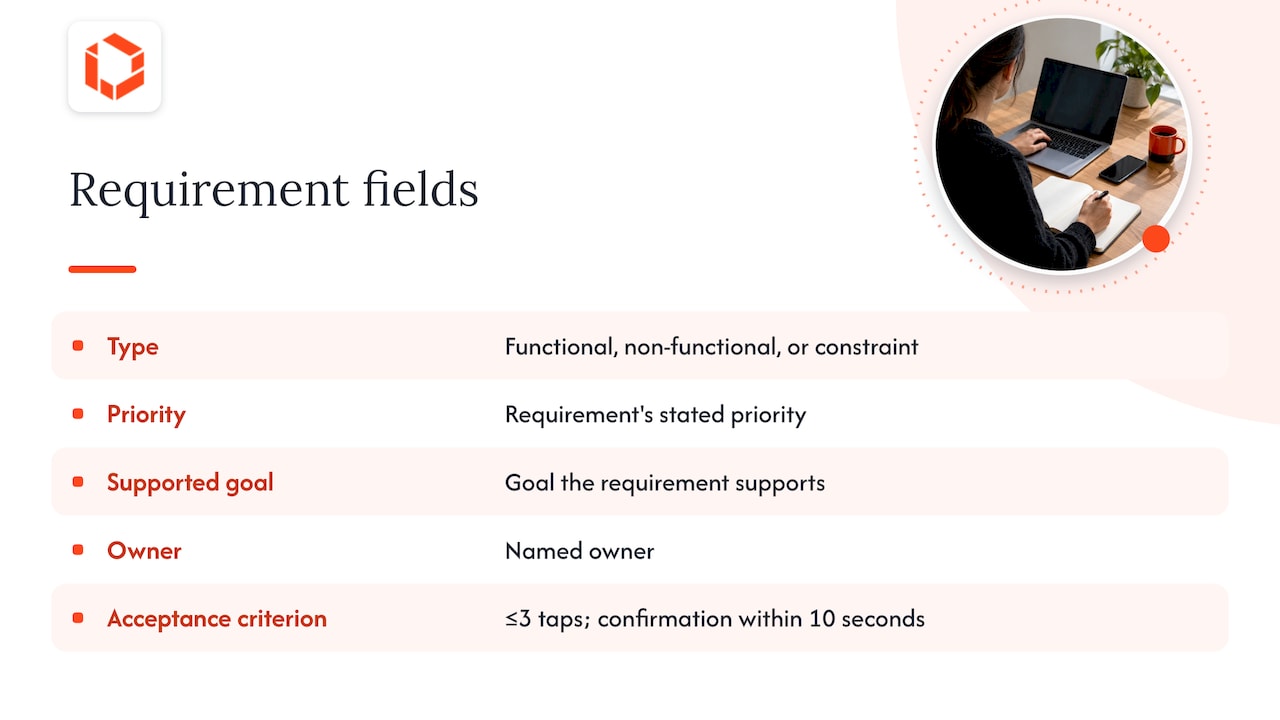
This is the line between a document that protects you and one that invites scope creep. When criteria are vague, every disagreement during development becomes a change request. When they are testable, you and the team can point at the same sentence.
Wireframes or a clickable prototype
You should see the core flows before anyone writes production code. For most apps that means onboarding, the primary action, payment or conversion if relevant, and the empty and error states people forget.
A prototype is cheap to change and code is not. Put it in front of real target users, and ask the consultant to show you what changed because of their reactions. If you are preparing for this stage, our checklist of six things to prepare before hiring a prototyping team helps you arrive with decisions made.
Technical feasibility, risks, budget and timeline
This is the part founders most often receive in thin form, so be specific about what to ask for.
Feasibility and architecture
The recommended approach (native iOS and Android, or a cross-platform framework such as Flutter or React Native) with the reasons tied to your product, not the vendor's preference.
Third-party services and APIs you will depend on, with their limits and costs.
Data, security and compliance considerations that apply to your category, such as health or payments data.
The one or two technically hardest features, with a plan to prove them early.
Risks and open questions
A risk log lists what could go wrong, how likely it is, how bad it would be, who owns it and what happens next. "Needs further investigation" with no owner is a postponed problem. Each item should have a name beside it and a date or milestone by which it gets resolved.
Budget and timeline
Honest estimates are ranges with written assumptions: which features are in, which platforms, which integrations, how many rounds of design revision. A single confident number at this stage usually means assumptions are hidden somewhere. Ask what would push the estimate to the top of the range and what would pull it to the bottom.
Also ask for the estimate to be tied to the phased scope, so that if funds run short you know which release you can still afford to ship.
A short roadmap tied to goals
A roadmap is not a wish list with dates. Aha! describes a usable roadmap as one that links features to strategy, defines user stories and requirements, estimates effort, makes launch trade-offs, and organizes work into goals, initiatives, releases, features and timelines.
For a startup, keep it short. AWS recommends a dynamic backlog and a relatively short roadmap aligned with the MVP release, with priorities revised as customer and market feedback arrives. A twelve-month feature calendar written before your first user logs in is fiction. A roadmap covering the MVP and the next one or two learning cycles is a plan.
Our article on mobile app product roadmap essentials shows what this looks like for apps specifically.
Success metrics you can calculate
AWS advises that success measures should align with business outcomes, define how each metric is calculated, and set an initial target for an expected time frame, and that they be revised as better measures emerge. Turn that into a table you receive before development:
Metric | Formula | Initial target | Review date |
|---|---|---|---|
Activation rate | New users completing the defined activation event within seven days of signup ÷ all users in that signup cohort × 100 | Provisional target; validate during beta | End of first month |
Week-4 retention | Users in a signup cohort completing the defined activity on days 22–28 ÷ all users in that cohort × 100 | Provisional target; validate during beta | Once the cohort has completed 28 days |
Trial-to-paid conversion | Users starting a paid subscription within the defined conversion window ÷ trial users whose conversion window has ended × 100 | Provisional target; validate during beta | Quarterly |
The targets should come from your research and market comparisons, not from optimism.
How to tell the package is ready for development
Before signing a build contract, run this check:
Each section meets its completion test. Not "drafted," but finished and reviewed by you.
Requirements have priorities and acceptance criteria. Spot-check five at random.
Estimates are ranges with assumptions on paper.
Every risk and open question has an owner and a next step.
Another qualified team could understand the scope, prepare an estimate and identify remaining questions without reconstructing the original decisions.
The sign-off names the decision: build, pilot, or stop.
The third option matters. Strategy that can only conclude "build" is a sales process. Sometimes the right answer is a smaller pilot, a no-code test, or buying an existing tool instead of building one.
Our discovery phase guide for founders goes further into how this stage is run.
Red flags in a strategy engagement
⚠️ You never speak to the person doing the analysis. Findings arrive through an account manager.
⚠️ Deliverables are slides with no requirements, criteria or estimates.
⚠️ The recommendation is always the biggest build the firm sells.
⚠️ Competitive analysis is a feature checklist with no evidence about why users switch.
⚠️ Risks are described but nobody owns them.
⚠️ Assumptions are hidden inside a single price.
Our perspective
Across our app projects, we have found that strategy works best when product, design and engineering decisions stay connected. Clear ownership and direct access to the people making recommendations help resolve questions before they delay development.

That is why our strategy work is done directly by senior developers and designers who talk with you from kickoff to launch. You get the reasoning, not a summary of it. When a feature is cut, you hear why from the person who made the call. When a technical risk appears, the engineer who would build around it is in the room.
We also believe strategy should end with a real decision, including a decision not to build the whole thing yet. A smaller first release that proves demand is better for you than a larger one that proves we can ship.
How TouchZen can help
Our Product Strategy & Consulting service is built around the deliverables above: research, competitive analysis, MVP definition, prioritized scope, roadmap and a go-to-market plan, delivered by a senior team you can reach directly. If your scope is already clear, we also take projects through MVP development for startups, design, engineering, launch and ongoing support.

Tell us where you are, whether it is an idea, a rough spec or a stalled build, and we will tell you what you should have in hand before spending on development. You can start at touchzen.ai.

FAQ
How long should product strategy consulting take before development?
It depends on how much is already known about your users and market. A product with clear demand evidence may need a short engagement, while a new category with many unknowns needs more time for research and prototype testing. Ask for a timeline tied to specific deliverables rather than a flat number of weeks.
Can I use the strategy documents with another development team?
Confirm this in the agreement before work starts. Specify which final documents, editable design files and prototypes you will receive, along with your rights to use and share them with another development team. Ask the consultant to identify any third-party materials or licensing restrictions.
What is the difference between discovery and product strategy?
The terms overlap heavily. Discovery usually focuses on understanding the problem, users and requirements, while product strategy adds market positioning, business case, roadmap and success metrics. Either way, judge the work by the deliverables, not the label.
Do I need all nine deliverables for a small app?
The depth scales with risk, but the questions stay the same. A simple internal tool may need a one-page problem statement and a short requirements list, while a consumer app with payments needs full research, prototypes and a risk log. Skipping a deliverable should be a deliberate decision you can explain.
What if the strategy says my idea should not be built?
That is the process working. Finding out before development that demand is weak, or that a cheaper route exists, saves far more than the consulting cost. The useful output is what to test next, or which smaller version is worth building.


